
Animal Collection
Animals: Wildlife & Candid Animal Photography
The Animals collection brings together photographs of wildlife and creatures observed across a wide range of settings—from the quiet marshes and winter branches of Colorado to the dust and motion of rodeo arenas, and beyond into the wilder registers of instinct and scale.
Birds hold still at the edge of wetlands, insects reveal their own hidden architecture up close, horses move with controlled power through rodeo grounds, and larger animals—giraffes, apes, lions—carry a stillness and presence that feels almost portrait-like. These images explore the full spectrum of animal life, from the smallest and most overlooked to the most commanding.
Rather than pursuing spectacle alone, this collection moves fluidly between intimacy and grandeur—the patient study of a single bird's watchful posture, the raw energy of a horse in motion, the quiet gravity of a lion's gaze. Influenced by the color sensibilities of Ernst Haas and the observational stillness of Wim Wenders, these photographs celebrate instinct, restraint, and the unhurried rhythm found across the animal world—wild, working, and domestic alike.
A Closer Look
Explore the finer details of each photograph by hovering over an image to reveal subtle focus and texture, or click to expand the work into a distraction-free viewing environment. This immersive view allows each study of Animals to be experienced at its full scale and proportion.
Search for a specific photograph, series, or browse the curated collections. Looking for a particular format? Search by Square or 1:1, Landscape or 3:2, or Panorama or 16:9.
“The greatness of a nation and its moral progress can be judged by the way its animals are treated.”
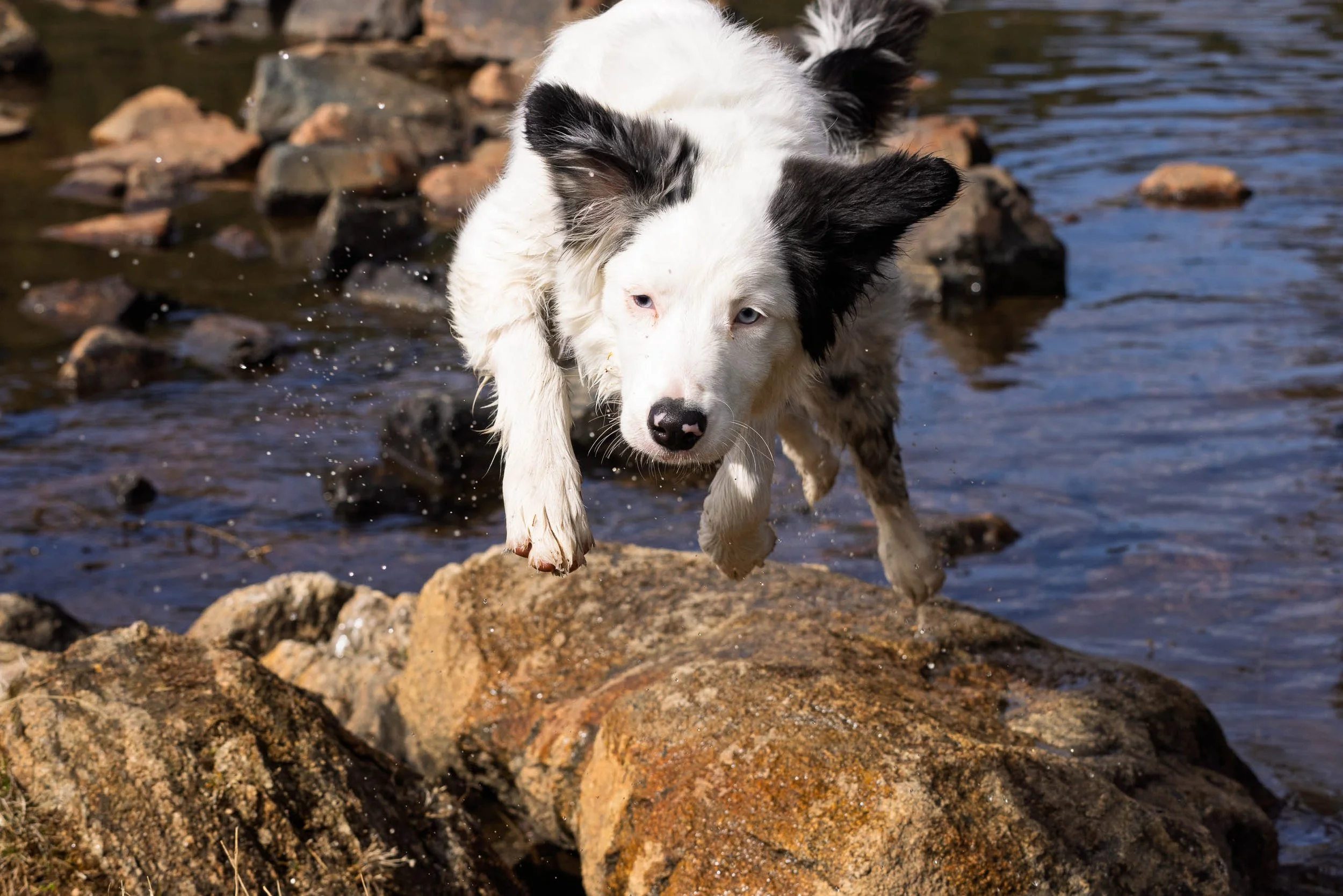
Committed catches a border collie at the exact instant physical motion meets direct address — mid-stride onto a wet boulder on Little Bear Creek, near Evergreen Lake, water still hanging in the air, eyes locked squarely on the camera. Rather than the arc of a full leap, this is the moment of landing itself: weight committed, paw already finding the rock, nothing left ambiguous about where the motion is headed. The low, near-eye-level angle puts the viewer directly in the dog's path.
The composition builds entirely around that gaze. A diagonal line runs from the airborne water droplets through the raised ear into the eyes — sharp, unflinching, and the clear anchor of the frame — before trailing down through the muzzle to the planted paw. Cool blue creek water behind sets up a quiet color contrast against warm, lichen-streaked granite in the foreground, giving the black and white coat real separation without competing for attention.
Where Full Tilt captures a dog in full aerial extension, Committed is its counterpart — the instant after the leap resolves, confrontation replacing flight. That pairing of decisive-moment timing with direct, almost portrait-like eye contact draws as much from Cartier-Bresson's sense of the single unrepeatable instant as it does from William Wegman's character-driven approach to photographing dogs — the motion is real, but the picture is really about the look.
Design & Styling
Committed suits the same spaces as Full Tilt — mudrooms, family rooms, veterinary and pet-service offices, dog-friendly retail and hospitality settings — but its direct eye contact makes it a stronger choice where you want a piece that engages the viewer immediately rather than one that reads quietly from across a room.
Curated Pairings
For shared concept: Pair with Out of the Chute, which shares the same interest in a single instant of physical force caught before it fully resolves.
For formal treatment: Complement with Her Run, which uses the same device of full physical commitment and motion-thrown hair/fur to convey speed at the frame's peak instant.
Fine Art Presentation
Available as an open edition print in canvas, metal, and archival paper presentation formats, unsigned and unnumbered. The clean contrast between the cool water and warm rock tones suits Metal particularly well, giving the water droplets real sparkle and the black-and-white coat sharp definition; canvas offers a softer, more residential alternative.
Note: Custom and oversized photographic prints are available. Please contact the studio directly to discuss custom framing, matting, or specialized museum glass options.
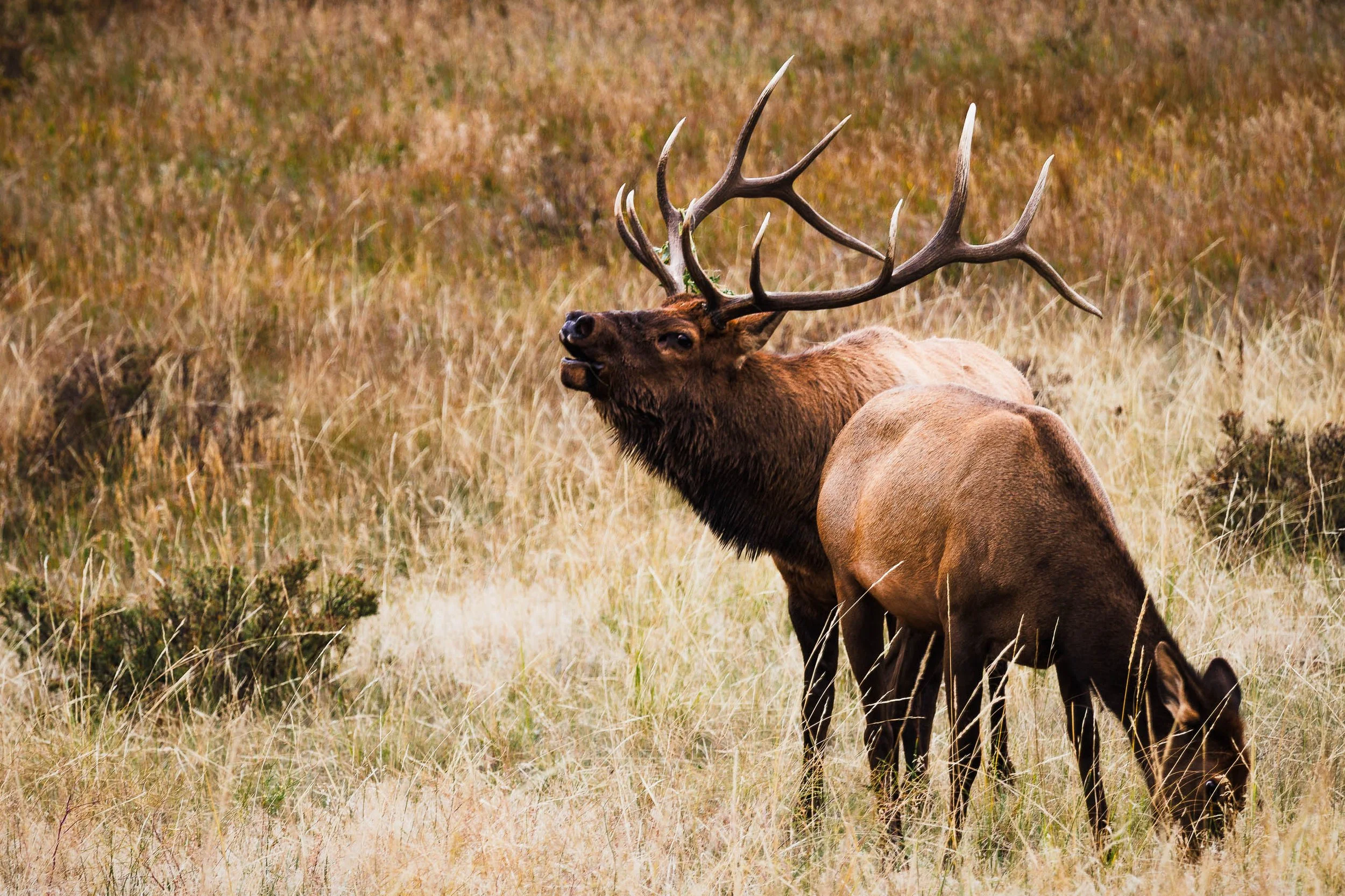
Falling on Deaf Ears captures the comic imbalance at the heart of the fall elk rut in Rocky Mountain National Park — a mature bull throws his head back in a full bugle, antlers lifted skyward, while just beside him a cow continues grazing without so much as a glance in his direction. The moment holds two entirely different registers of attention in a single frame: urgent display on one side, complete indifference on the other.
The composition leans on that opposition directly. The bull's raised head and antlers carry the eye up and to the left into open space, while the cow's lowered head pulls it back down and to the right — a visual push-pull that gives the frame real tension rather than settling into a static double-portrait. A rich, warm color treatment deepens the golden autumn grass and the elks' tan coats, with real shadow modeling in the fur and antlers giving the frame a considered, atmospheric weight rather than a documentary snapshot.
Bugling elk are among the most photographed subjects in Western wildlife work, and Rocky Mountain National Park draws photographers every fall specifically for this display — but the specific hook here isn't the call itself, it's the cow's total lack of response to it. That small behavioral detail, more than the bugle, is what separates this from a straightforward wildlife portrait, continuing the same interest in quiet, specific narrative found across Robert Niemeier's animal work — the same instinct for a genuine moment over a generic pose that runs through pieces like Standing Ground and Black Thunder.
Design & Styling: Works well as a statement piece in mountain lodge and ranch great rooms, ski resort lobbies, and hunting-lodge interiors looking for an authentic, high-impact Colorado presence.
Curated Pairings:
Held at Rest (deliberate contrast — same species/park, rest vs. display)
Standing Ground (shared concept — distinguished individual against a companion, held in open grassland)
Black Thunder (same concept, different domain — silent vs. vocal male assertion).
Fine Art Presentation: Signed, numbered limited edition (edition of 15) in Gallery Metal, ChromaLuxe® Metal, TruLife Acrylic, archival paper, canvas, and wood. The richer contrast and warm saturation of the final edit suit ChromaLuxe® Metal particularly well; Canvas is a strong alternative for a softer, more painterly presentation.
Note: Custom and oversized photographic prints are available. Please contact the studio directly to discuss custom framing, matting, or specialized museum glass options.
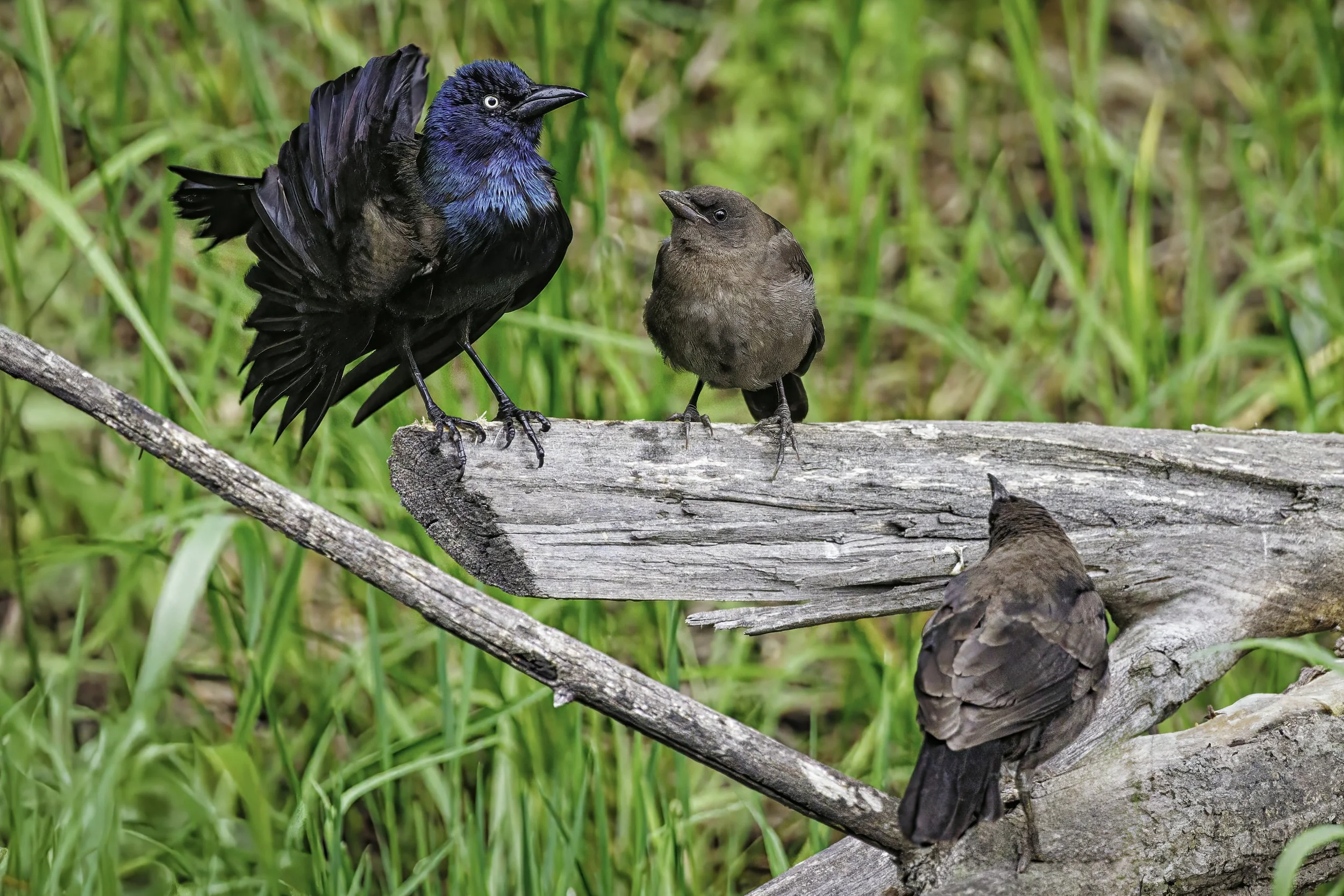
The Argument catches a common grackle mid-exchange with two brown-headed cowbirds on a weathered driftwood perch — the grackle fully fanned, tail spread, head turned in what reads unmistakably as mid-scold, while the two cowbirds react in kind, one meeting his gaze directly, the other turning away. Nothing about the moment is staged; it's a genuine slice of mixed-species social behavior, caught at the precise instant it read as a story rather than a portrait.
The soft green grass behind the birds keeps the frame calm and uncluttered, letting the real subject — the interaction itself — carry the whole photograph. It's a small, candid piece of narrative built entirely from body language: a fanned tail, a tilted head, a turned back.
Design & Styling:
The Argument works well in casual, character-forward spaces — sunrooms, breakfast nooks, offices with a sense of humor, or alongside other candid wildlife and narrative work. Its calm green palette also suits healthcare and wellness settings looking for approachable, nature-forward pieces with a bit of personality.
Curated Pairings:
For direct narrative harmony, pair with The Discussion, continuing the same grackle-and-cowbird exchange in a different, calmer register.
For narrative harmony, complement with The Conversation, extending the theme of candid animal social interaction.
For setting harmony, pair with /animals/p/no-parking-barn-swallows-photography another unposed moment of bird behavior captured mid-motion.
Fine Art Presentation:
Available as a signed fine art print in ChromaLuxe® Metal (gloss, semi-gloss, or matte), acrylic, framed paper, canvas, and wood presentation formats. Metal or acrylic is recommended to hold the iridescent blue-black detail on the grackle's head.
Available as a signed fine art print in metal, acrylic, framed paper, canvas, and wood presentation formats. Metal or acrylic is recommended to hold the iridescent blue-black detail on the grackle's head.
Note: Custom and oversized photographic prints are available. Please contact the studio directly to discuss custom framing, matting, or specialized museum glass options.

Kindred Drift is a close, warm-toned study of two golden batfish moving together against a dark, textured reef. The nearer fish fills much of the frame, its tall sail-like dorsal and anal fins catching the light in soft gold, while a second batfish drifts just behind and to the left — close enough to feel like a companion rather than incidental company.
The dark, richly textured reef behind them recedes into shadow, letting the warm tones of the fish carry the frame. Smaller striped fish move through the background, giving the piece a genuine sense of a living reef environment without competing with the two batfish at the center of the composition.
This is a quieter, more classically composed wildlife piece than a documentary reef shot — the pairing of the two fish, and the way the light settles on their pale gold bodies, gives the image a gentle, companionable feeling.
Design & Styling
With its warm palette and gentle, companionable subject, Kindred Drift suits family rooms, casual living spaces, coastal and lake-house interiors, and any setting looking for approachable, nature-forward wall art. It also works well in aquariums, marine-themed retail, or hospitality spaces with an ocean or reef motif.
Curated Pairings
To create a cohesive gallery wall, consider these companion pieces:
For the underwater pairing: Pair with Drifting Silence, extending the underwater subject matter in a quieter, more atmospheric register.
For warm color continuity: Complement with Crimson Bloom, another close aquarium study built around warm tones against a dark background.
For wildlife companionship: Pair with The Discussion, extending the theme of paired animals in quiet company.
Fine Art Presentation
Available as a signed fine art print in ChromaLuxe® Metal (gloss, semi-gloss, or matte), framed paper, framed canvas, and acrylic presentation formats. The warm gold tones and dark reef background both hold up well on ChromaLuxe® Metal, which gives the highlights on the fins real clarity while keeping the shadow areas rich rather than muddy.
Note: Custom and oversized photographic prints are available. Please contact the studio directly to discuss custom framing, matting, or specialized museum glass options.
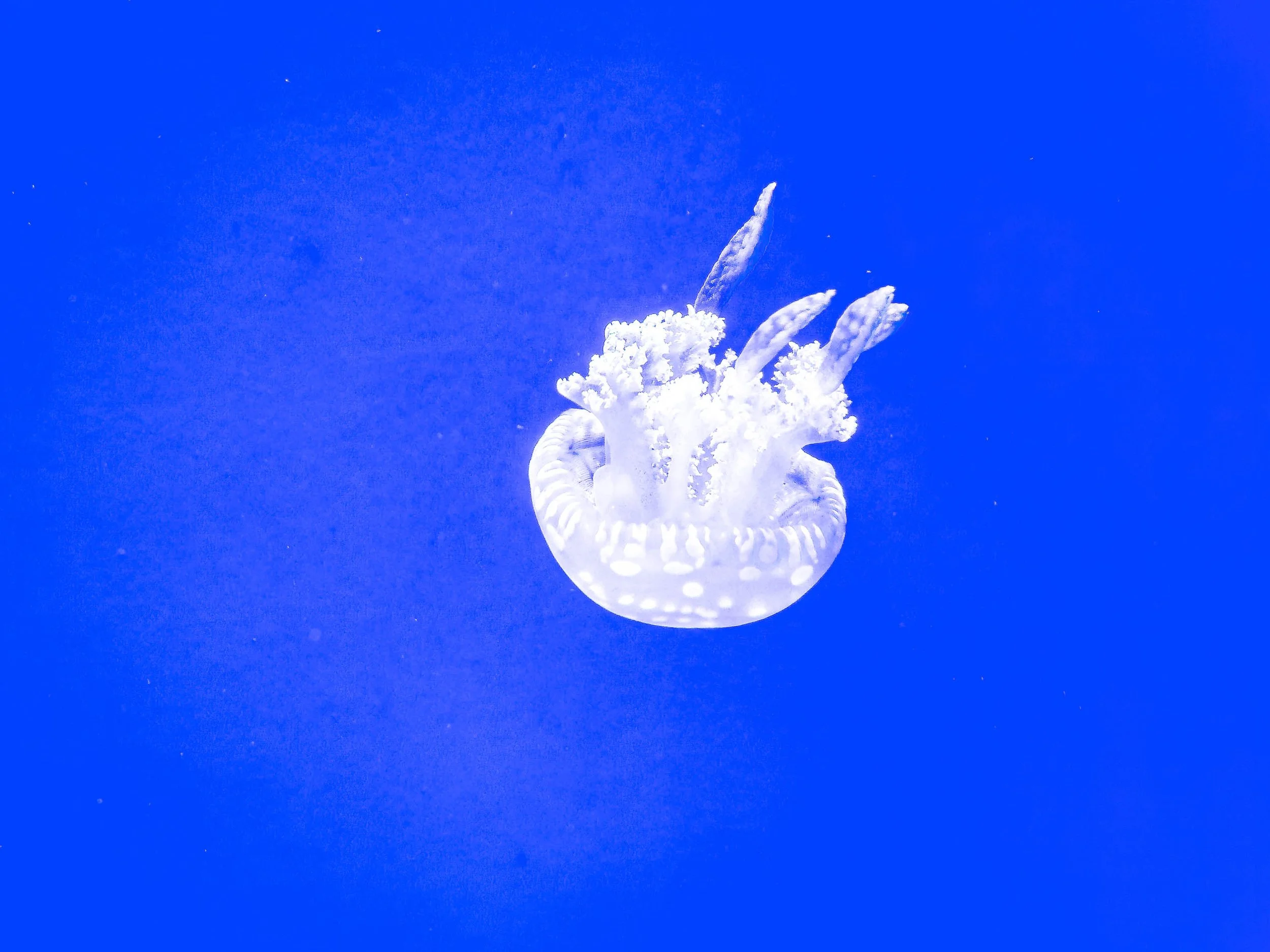
Some blues feel like a dream. Deep Drift captures a spotted jellyfish suspended in rich, saturated blue at Ripley's Aquarium of Canada in Toronto, its fringed, coral-like arms rendered in bold color against a backdrop that feels equal parts ocean and dream. Weightless and unhurried, it drifts through the frame with quiet confidence.
This is the color companion to Drifting Silence, the same image and captured moment in a somewhat different crop. Where the monochrome version is quiet and restrained, Deep Drift is bold and immersive, letting the vivid blue carry the mood.
A jellyfish is roughly ninety-five percent water, with no brain, heart, or bones, so it reads almost as pure light and gesture. In an aquarium's blue-lit water, the fringed arms trail like a slow signature, and the stillness of the frame makes that quiet motion feel deliberate.
Design & Styling
With its bold color and playful subject, Deep Drift is a natural fit for a child's bedroom, nursery, playroom, or ocean-themed space. It also works well in pediatric healthcare settings or family-oriented waiting areas looking for something bright and engaging rather than purely contemplative.
Curated Pairings
To build out a playful, ocean-inspired wall, consider these companion pieces:
For its monochrome counterpart: Pair with Drifting Silence, the same image in quiet sepia tones and a somewhat different crop — a striking color and monochrome set.
For playful company: Complement with Kali - Grace in Profile, a black-and-white giraffe portrait that adds graphic contrast to this piece's color and movement.
For a warm counterpart: Pair with Kindred Drift, a close, warm-toned study of two golden batfish against a dark reef — the same underwater world in gold instead of blue.
Fine Art Presentation
Available as a signed fine art print on ChromaLuxe® Metal (gloss, semi-gloss, or matte), Glossy Anti-Glare Acrylic (TruLife), canvas, and archival paper (framed or unframed). Acrylic is the recommended presentation: its depth suits a subject suspended in saturated blue and keeps the fringed arms luminous. ChromaLuxe® Metal is the alternative when you want the blue at full, crisp intensity, and canvas is the softer, lighter choice for a child's room or nursery.
Note: Custom and oversized photographic prints are available. Please contact the studio directly to discuss custom framing, matting, or specialized museum glass options.
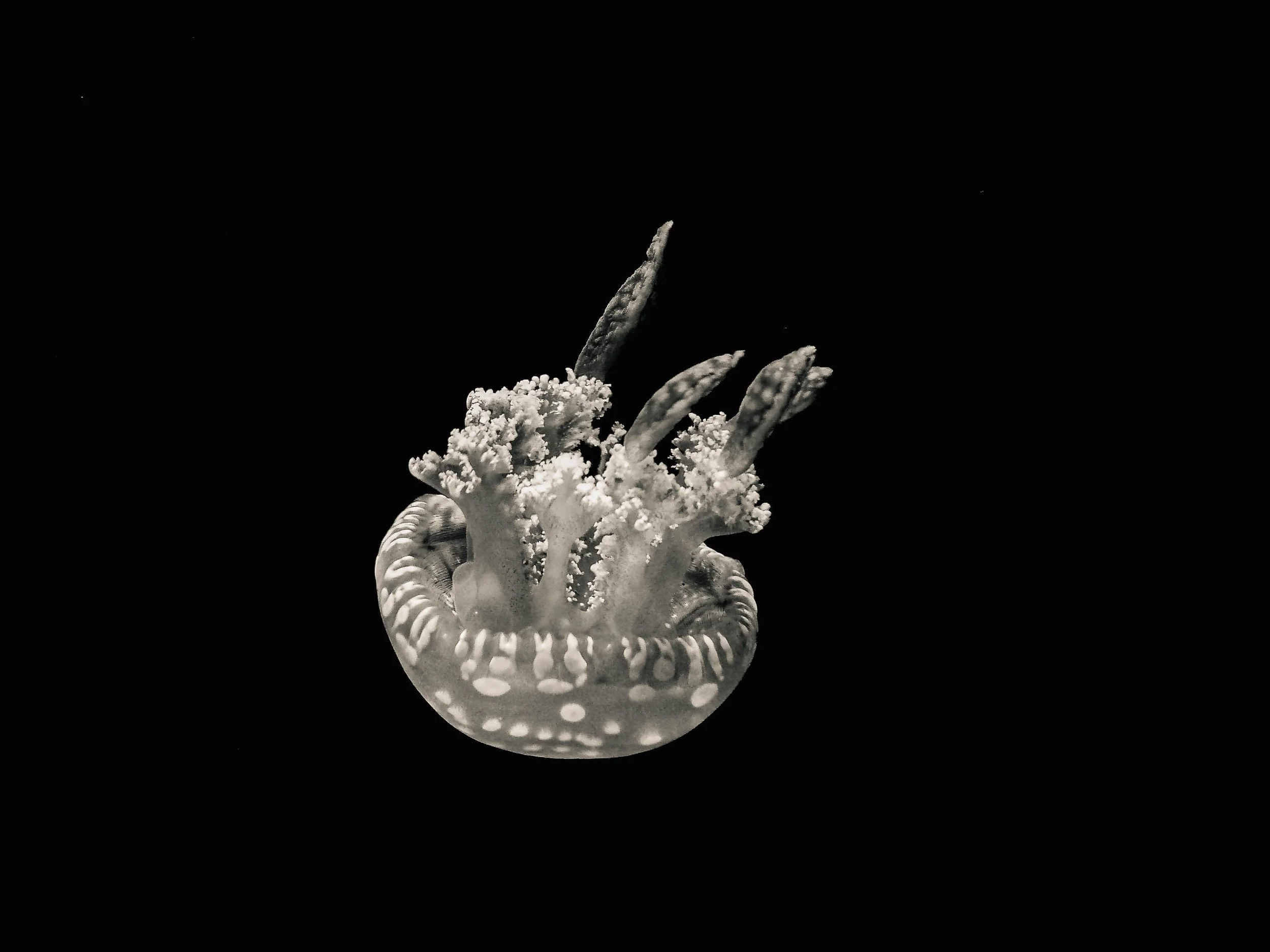
Some subjects seem to hover between animal and sculpture. Drifting Silence is a quiet study in form, suspended in near-total darkness: a spotted jellyfish, photographed at Ripley's Aquarium of Canada in Toronto, drifting alone with its frilled, coral-like arms catching just enough light to emerge from the black.
The bell sits low in the frame, its rows of pale spots glowing like a string of pearls against the dark. From it the arms rise like a branching coral, crowned with clusters of tiny frills, while long, paddle-shaped appendages reach upward, one lifting well above the rest. The eye starts on the brightest spots along the bell, climbs the frilled arms, and follows the tallest appendage up into the black, where the space around the animal gives it room to breathe.
Rendered in warm, sepia-toned monochrome rather than the vivid color typically associated with its subject, the jellyfish stops reading as a literal sea creature and becomes something closer to sculpture, isolated the way a single object might be lit in a gallery case: a study in light, texture, and stillness.
Design & Styling
With its restrained palette and sculptural quality, Drifting Silence works well in wellness environments, meditation spaces, residences, and quiet professional settings where a calming, contemplative presence is welcome. Its monochrome treatment allows it to sit comfortably alongside both color and black-and-white work in a gallery wall.
Curated Pairings
To build out a quiet, nature-focused wall, consider these companion pieces:
For its color counterpart: Pair with Deep Drift, the same image in vivid blue and a somewhat different crop — a striking monochrome and color companion set.
For tonal harmony: Complement with Kali - Grace in Profile, another restrained black-and-white animal portrait that shares the same quiet, sculptural sensibility.
For the same sculptural stillness: Pair with The Silent Assembly (Monochrome), weathered trunks reduced to elemental forms and their reflections — another subject that monochrome turns into sculpture.
Fine Art Presentation
Available as a signed fine art print on ChromaLuxe® Metal (gloss, semi-gloss, or matte), Glossy Anti-Glare Acrylic (TruLife), canvas, and archival paper (framed or unframed). Framed archival paper is the recommended presentation for this sepia-toned monochrome: its matte, tactile surface gives the jellyfish the quiet, gallery-case calm the image is built on. Acrylic is the alternative for depth, letting the arms emerge from the near-black background as if lit from within.
Note: Custom and oversized photographic prints are available. Please contact the studio directly to discuss custom framing, matting, or specialized museum glass options.
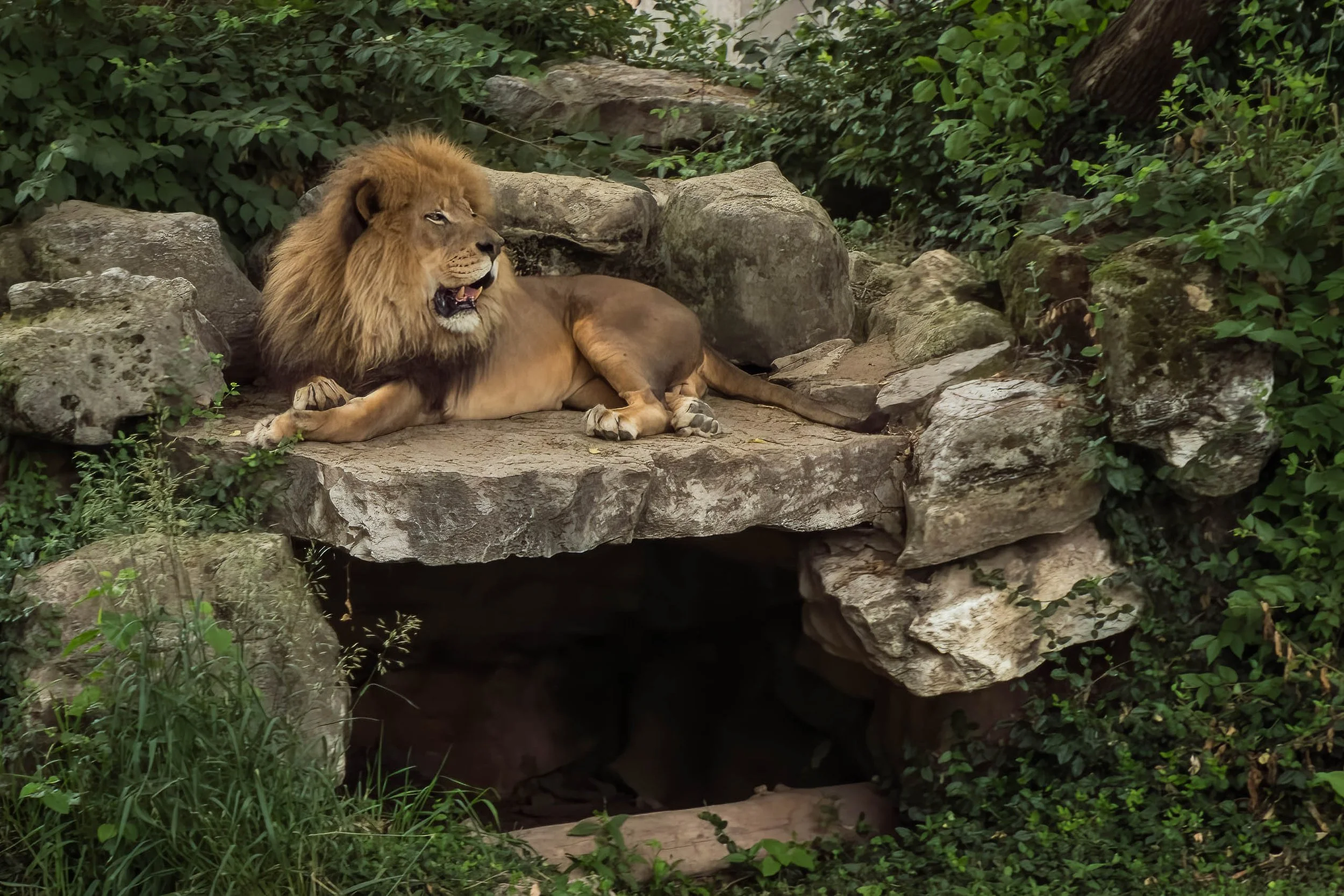
Some subjects hold court simply by lying down. Held Court finds a male lion sprawled across a rock ledge above his den at the Saint Louis Zoo, his head turned to look back over his shoulder, mouth open in the unguarded space between a yawn and a roar.
The composition is built in layers. The mane and tawny body fill the upper left, where the eye lands first on the profile: half-closed eyes, a mane caught in loose, individually defined strands, and the open mouth. From there it travels along the forelegs and heavy paws resting on the flat edge of the ledge. Below, the den opens as a true void, deep shadow beneath the overhanging slab, which anchors the frame and gives the bright fur something to push against. Rounded boulders and dense green foliage crowd in from the sides and above, so the animal's warm gold is the single warm note in a picture of gray stone and green.
This is wildlife photography built around presence and voice rather than stillness, proof that the most compelling moment with a big cat is not always the calm one. He is not performing for the camera. He is a king comfortable enough in his own territory to make some noise about it.
Design & Styling
Held Court suits spaces that want confidence, presence, and a bit of drama: executive offices, media rooms, sports bars and breweries, game rooms, and any interior looking for a bold wildlife statement piece. Given the open-mouthed expression, it is less suited to calming-focused environments such as healthcare or senior living.
Curated Pairings
To build a wall around wildlife behavior and presence, consider these companion pieces:
For the same zoo: Pair with Dust and Sky, an elephant caught mid-ritual in a cloud of dust, building a wall around a range of wildlife behavior at the same institution.
For animal power and mid-behavior moments: Complement with Edge of Stillness, a bald eagle motionless at the line between ice and water, another animal caught in the middle of being itself.
For another portrait from the zoo: Pair with Kali - Grace in Profile, a giraffe in calm profile at the Saint Louis Zoo, the quiet counterpart to this one's voice.
Fine Art Presentation
Available as a signed fine art print on ChromaLuxe® Metal (gloss, semi-gloss, or matte), Glossy Anti-Glare Acrylic (TruLife), canvas, wood, and archival paper (framed or unframed). ChromaLuxe® Metal is the recommended presentation: the warm gold of the mane and the deep shadow of the den both benefit from metal's contrast and brightness. Acrylic adds depth for a bold, contemporary presentation, and framed archival paper or framed canvas give a softer, more traditional read where the space calls for it.
Note: Custom and oversized photographic prints are available. Please contact the studio directly to discuss custom framing, matting, or specialized museum glass options.
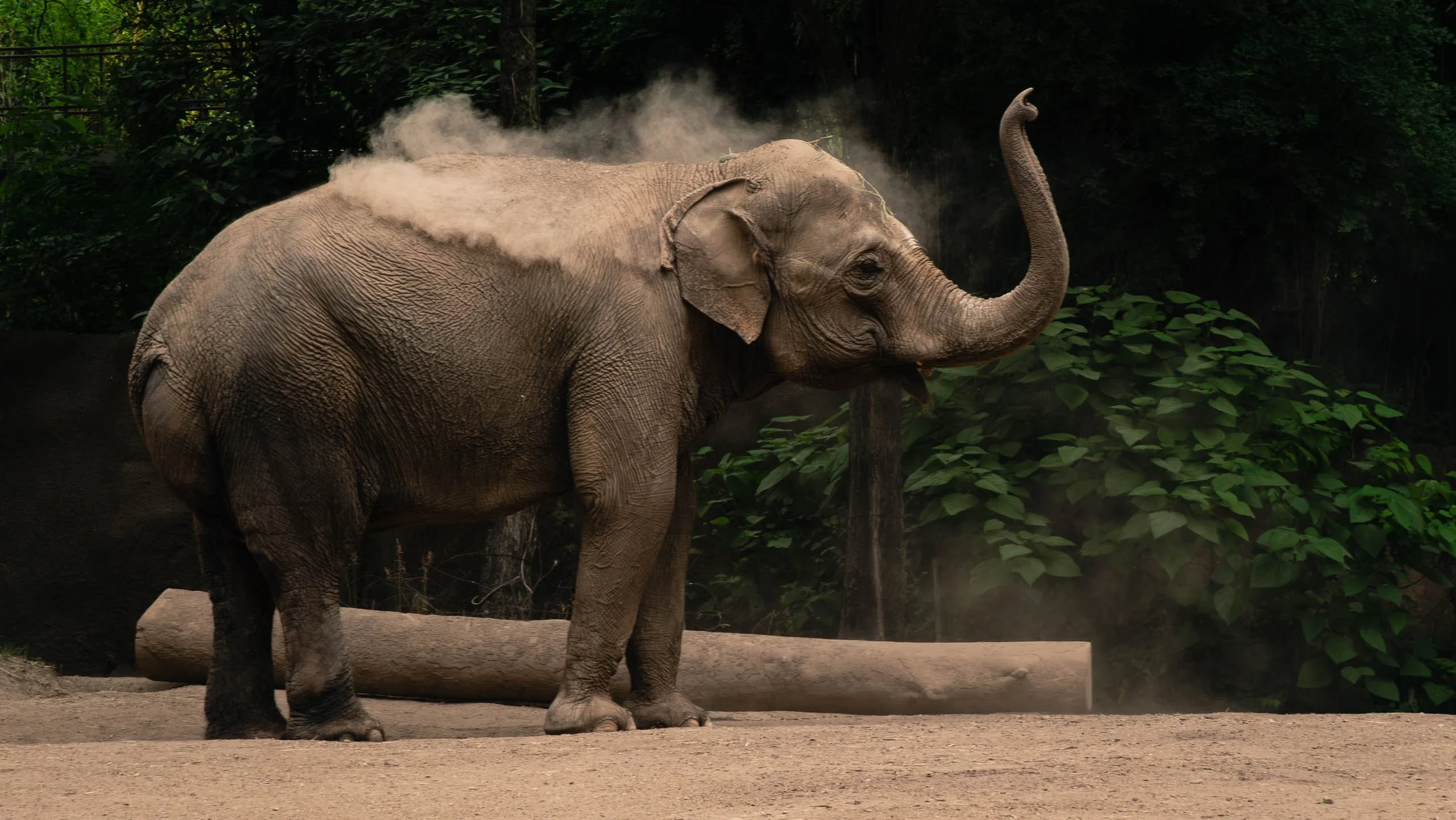
Dust and Sky catches an elephant mid-ritual, trunk curled high overhead as a fresh cloud of dust settles across its back. Dust-bathing is practical behavior — a coat of dry earth to guard against sun and insects — but photographed at this exact moment, backlit and drifting against a wall of dark forest, it reads as something closer to ceremony. The dust hangs in the air with real weight and texture, each particle catching just enough light to separate it from the black canopy behind.
The elephant's skin carries its own landscape of texture — every crease and fold rendered in sharp, tactile detail, a record of decades in a single hide. The raised trunk, curled at the tip like a question mark, gives the whole gesture a sense of triumph rather than routine, as if the dust bath were a performance rather than a habit.
Photographed at the Saint Louis Zoo, Dust and Sky sits alongside Robert Niemeier's other zoo wildlife portraits as a study in behavior rather than pose — an animal caught doing something entirely its own, unposed and unbothered by the camera.
DESIGN & STYLING
Dust and Sky works well in spaces that want warmth, texture, and a genuine sense of animal presence without literal safari cliché — nature centers, children's spaces, veterinary and animal-care offices, hospitality environments, and residential walls looking for an earthy, textural anchor piece. The warm tan-and-brown palette against deep green-black shadow gives it real versatility as a grounding piece in a larger gallery wall.
CURATED PAIRINGS
For the same location: Pair with Kali — Grace in Profile — two very different registers of the same Saint Louis Zoo, one contemplative, one full of motion.
For texture and earth tones: Complement with Standing Ground — dust, hide, and grounded animal presence in a very different setting.
For wild animal power and motion: Add The Edge of Stillness to build a wall around wildlife caught mid-behavior rather than posed.
FINE ART PRESENTATION
Dust and Sky is available as a signed fine art photographic print in multiple presentation styles. ChromaLuxe® Metal (gloss, semi-gloss, or matte) suits this piece well — the warm highlights on the elephant's back and the fine texture of the dust cloud both benefit from metal's brightness and clarity. Acrylic adds further depth to the dark background for a more contemporary presentation. Framed archival paper and Canvas Framed both offer a softer, more traditional read if the space calls for it.
Note: Custom and oversized photographic prints are available. Please contact the studio directly to discuss custom framing, matting, or specialized museum glass options.
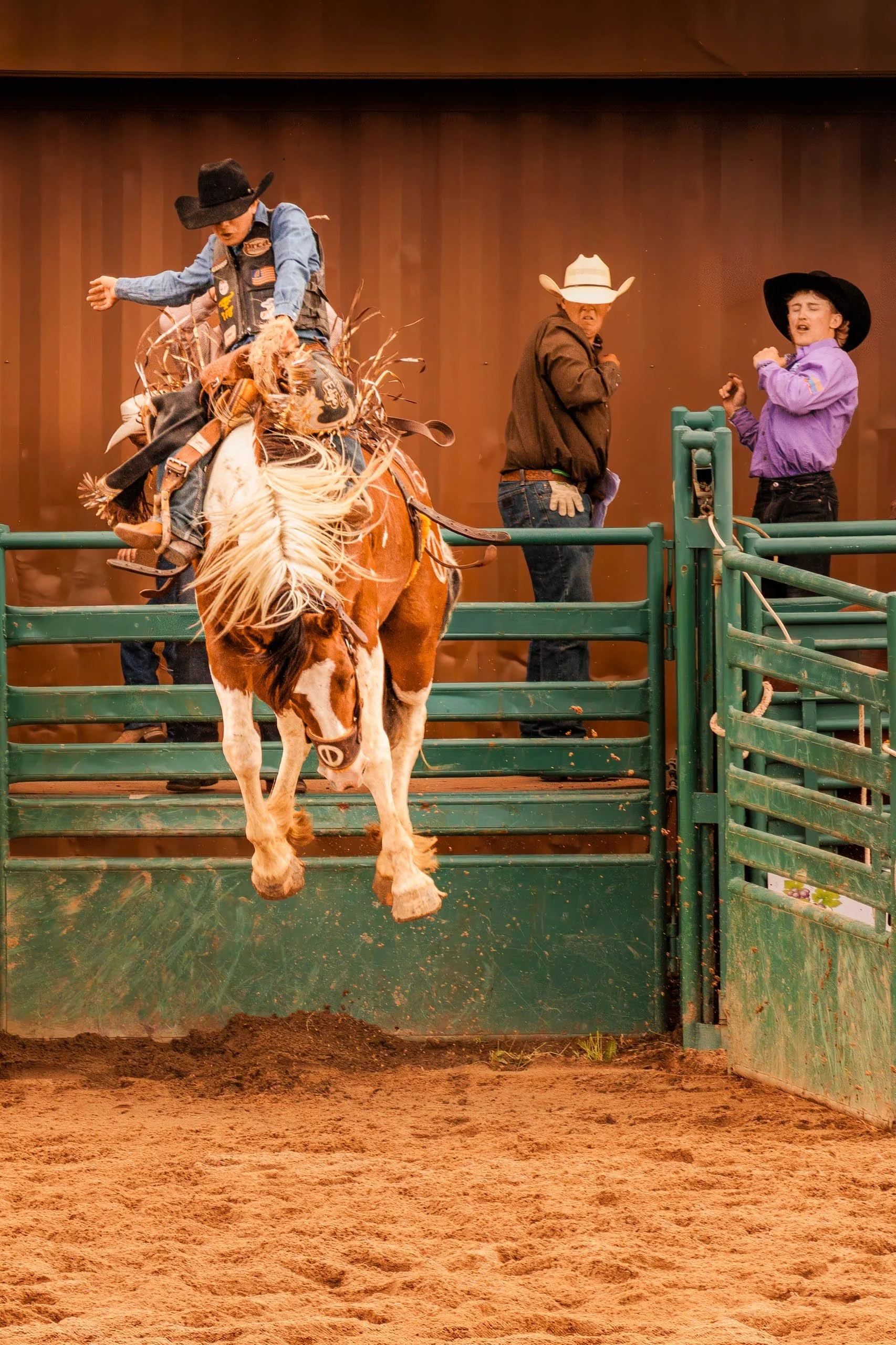
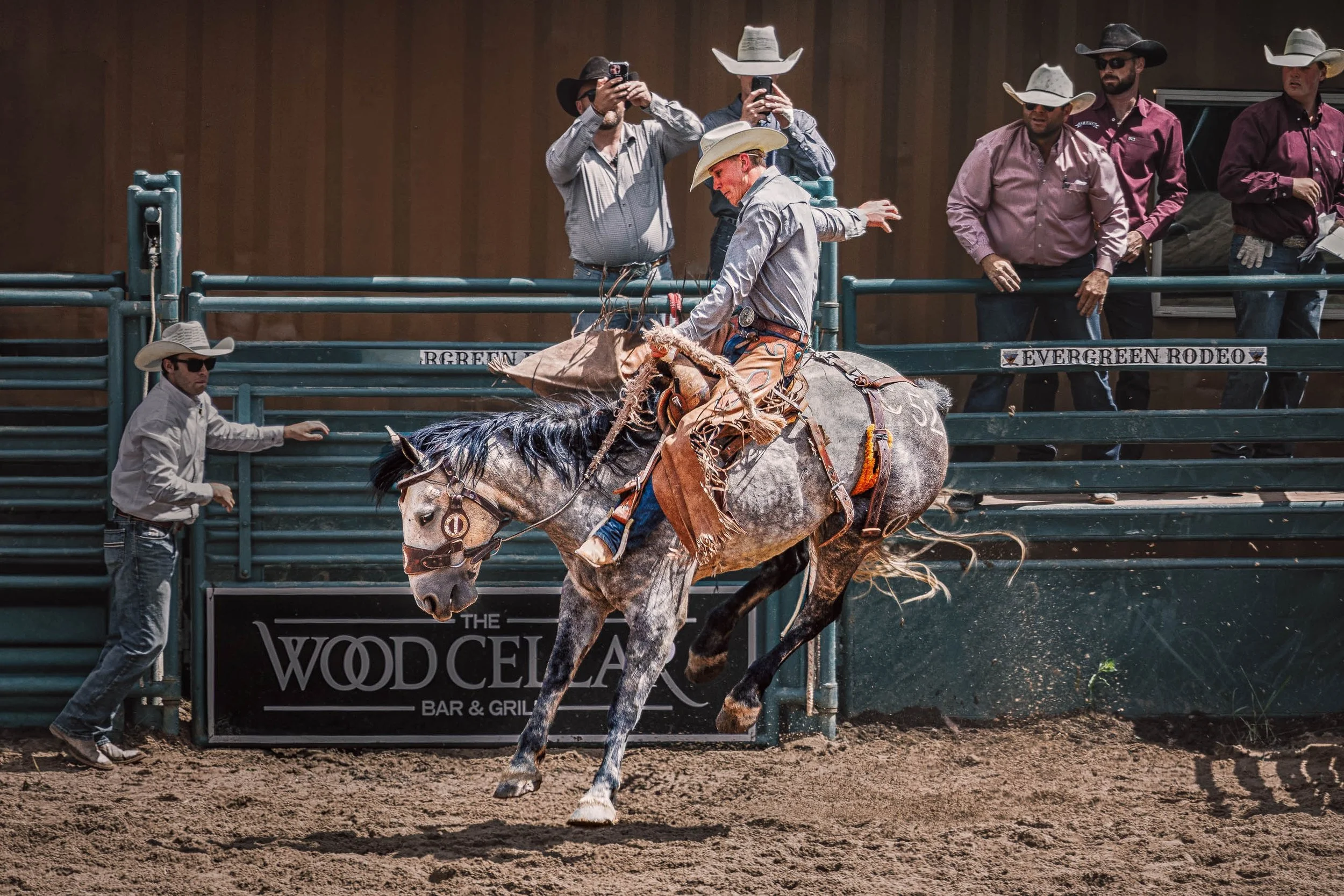
Flying Colors captures the exact instant a paint horse clears the top rail of the chute, straw and mane torn loose in its wake, the bareback rider still finding his balance against the animal's full upward force. Photographed at the Evergreen Rodeo in the Colorado foothills, the frame holds a moment that lasts a fraction of a second in real time: hind legs already tucked from the launch, front legs kicked forward and back, the rider's free arm thrown wide for counterbalance. Behind the gate, two hands work the rope and react to the burst of motion — proof that even the crew braced for it is caught off guard by the release.
The vertical composition is what sets this piece apart from its Evergreen Rodeo companions. Rather than the wide, panoramic sweep of the arena, the frame is built around a single rising line — horse and rider driving straight up out of the chute, straw scattering outward like sparks. The teal-green gate panels ground the moment in place and give the warm hide, denim, and dirt tones somewhere to push against. The eye starts at the horse's white blaze, follows the explosion of straw upward to the rider's black hat, then drops back down through the gate to the reacting crew — a loop that keeps returning to the instant of release.
Drawing on the kinetic color sensibilities of Ernst Haas and the documentary presence of Wim Wenders, Flying Colors treats the bareback event as lived experience rather than staged spectacle. This is the working west at full intensity — the Evergreen Rodeo, a Colorado foothills summer tradition running for over a century, held in the light of one unrepeatable afternoon.
Design & Styling
The vertical burst of straw, hide, and teal gate panels in Flying Colors gives a hallway, den, or lodge stairwell real energy. It suits western homes, sports bars, restaurants, and offices that want motion and color.
Curated Pairings
To build a wall around the Evergreen Rodeo, consider these companion pieces:
For arena continuity: Pair with Out of the Chute, both capture the same explosive break from the gate, one in panoramic width, one in vertical rise.
For color harmony: Complement with The Painted Storm, two paint horses, two moments, the same warm-and-cool palette carried across both frames.
For visual contrast: Add Hold On, the held tension of bull riding set against the sudden release of a bareback bronc, a study in two different kinds of nerve.
Fine Art Presentation
Available as a signed fine art print on ChromaLuxe® Metal (gloss, semi-gloss, or matte), Glossy Anti-Glare Acrylic (TruLife), canvas, wood, and archival paper (framed or unframed). ChromaLuxe® Metal is the recommended presentation: it holds the sharpness of the airborne moment and the contrast between warm hide tones and the cool teal gate panels. Acrylic is the alternative for extra depth in the scattering straw.
Note: Custom and oversized photographic prints are available. Please contact the studio directly to discuss custom framing, matting, or specialized museum glass options.

The Discussion is a study in unposed theater — the moment two very different birds, a Common Grackle and a Brown-headed Cowbird, find themselves angled toward one another in what reads, to any human eye, as an argument already well underway. Photographed on a weathered log against a soft wash of green, the image catches both subjects mid-gesture: the grackle's iridescent blue-black plumage catching cool light, the cowbird mid-call with its beak wide open, seemingly not backing down.
There's a quiet irony worth knowing if you look closer: cowbirds are brood parasites, laying their eggs in other species' nests — grackles included — and letting the host raise their young. Whatever this "discussion" actually is, it may not be a friendly one. The photograph doesn't explain that history; it simply catches the body language that looks, uncannily, like an argument between neighbors.
The soft, creamy green background isolates both birds without competing for attention, while the diagonal line of the log grounds the composition and gives the exchange a stage to play out on.
Design & Styling
With its charm, narrative quality, and calm green palette, The Discussion works well in nature centers, veterinary offices, children's spaces, and as a playful accent piece in otherwise serious interiors. Its gentle, non-threatening emotional register also makes it a strong candidate for healthcare and wellness environments seeking approachable, mood-lifting nature imagery.
Curated Pairings
To build a cohesive bird-portrait collection, consider these companion pieces:
For continued perched-bird intimacy: pair with Kingfisher on Watch.
For a shared sense of quiet vigilance: complement with The Sentry.
For continued branch-top character studies: consider The High Perch.
Fine Art Presentation
Available as a signed fine art print in ChromaLuxe® Metal (gloss, semi-gloss, or matte), framed paper, and acrylic presentation formats. Archival paper is especially recommended to bring out the fine detail in feather texture and the grackle's iridescent sheen.
Note: Custom and oversized photographic prints are available. Please contact the studio directly to discuss custom framing, matting, or specialized museum glass options.
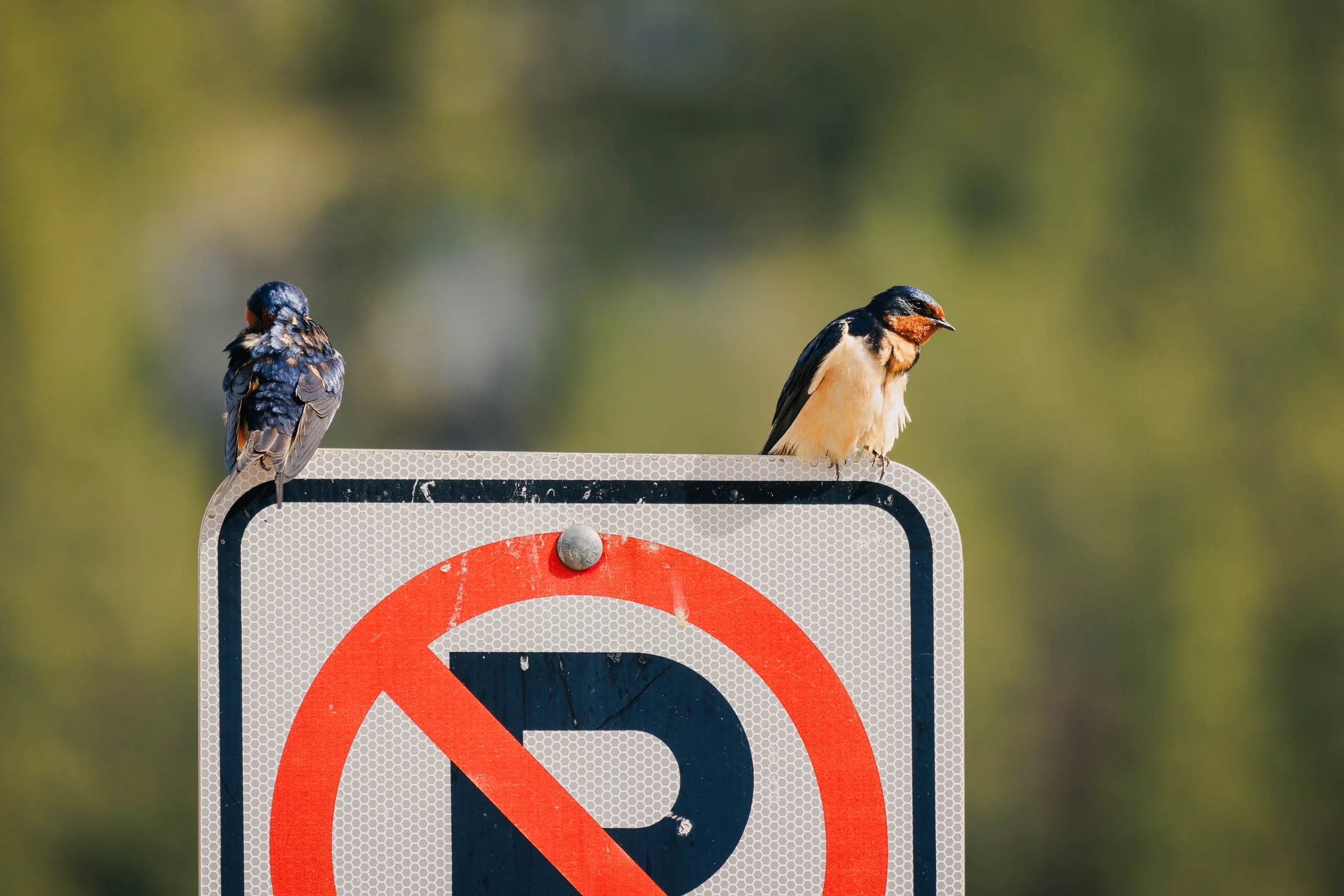
Two barn swallows have claimed the top of a No Parking sign, entirely unbothered by the irony. Golden late-day light catches their rust-colored throats and the sign's reflective red circle in equal measure, while a soft green field dissolves into bokeh behind them. One bird faces away, feathers still slightly ruffled from preening; the other looks down and out of frame with sharp, alert posture — the eye landing almost exactly on the sign's corner hashmark, anchoring the whole composition.
It's a quieter kind of humor than a punchline — the kind that rewards a second look. The sign's bold geometry (the red slash, the navy "P") does real compositional work here, giving the birds a graphic, almost architectural perch rather than a branch or wire. A small, well-observed moment of wildlife ignoring the rules humans set for themselves.
Design & Styling
This piece's wit and bold color palette make it a natural conversation piece for:
Offices and creative workspaces — a bit of humor and personality for spaces that want to feel less corporate
Restaurants, cafes, and hospitality spaces — an easy, approachable piece that draws a smile from guests
Residential entryways and mudrooms — playful without being juvenile, works well in high-traffic, casual spaces
Curated Pairings
For bird photography continuity: Winter's Watch — another close, warm-toned bird portrait, quieter in mood but sharing the same patient observation
For color harmony: The Moment Red Remembers — matching bold red tones against a softer, muted background
For visual contrast: Kali - Grace in Profile — a quiet, black-and-white wildlife portrait that plays against this piece's color and humor
Fine Art Presentation
Available in framed archival paper, ChromaLuxe® Metal (gloss, semi-gloss, or matte), canvas, and gallery-grade acrylic. The sign's bold red and navy graphics hold up especially well on metal or acrylic, where the color saturation and reflective quality of the print echo the sign's own reflective surface. A mid-to-large format (20x30 or larger) lets the composition's negative space breathe.
Note: Custom and oversized photographic prints are available. Please contact the studio directly to discuss custom framing, matting, or specialized museum glass options.

A male red-winged blackbird holds his ground at the top of a bare, weathered branch, his signature red-and-gold epaulet the single note of color against otherwise total black. He's turned slightly toward the camera, sharp-eyed and alert — the posture of a bird that knows exactly what territory is his. Behind him, a soft wash of horizontal bands — warm tan, brown, and a whisper of green — dissolves into abstraction, giving the composition a quiet, architectural rhythm without ever competing with the bird.
This is a study in contrast and restraint: nearly the entire frame given over to black, with the epaulet doing all the visual work. It rewards a longer look — the subtle feather structure across the wings and back, the sharp white of the beak, the small dark eye holding steady on something just out of frame. A confident, graphic piece built on the tension between almost-nothing and exactly-enough color.
Design & Styling
The bold, high-contrast palette makes this piece a strong statement choice for:
Modern and minimalist interiors — the near-monochrome palette with a single color accent suits clean, contemporary spaces
Offices and professional spaces — confident, graphic, and unfussy
Galleries and statement walls — works well as a singular, bold anchor piece rather than part of a busy grouping
Curated Pairings
For bird photography continuity: The High Perch — the female counterpart to this species, in a warmer, softer register
For color harmony: The Moment Red Remembers — matching bold red tones against a quieter background
For visual contrast: Kali - Grace in Profile — a black-and-white portrait that plays against this piece's singular red accent
Fine Art Presentation
Available in framed archival paper, ChromaLuxe® Metal (gloss, semi-gloss, or matte), canvas, and gallery-grade acrylic. The deep blacks and single point of saturated color make this piece especially striking on metal or acrylic, where the reflective quality of the print deepens the blacks and makes the epaulet's red genuinely glow. Works well at a range of sizes, from an intimate 12x18 to a bold 24x36 statement piece.
Note: Custom and oversized photographic prints are available. Please contact the studio directly to discuss custom framing, matting, or specialized museum glass options.
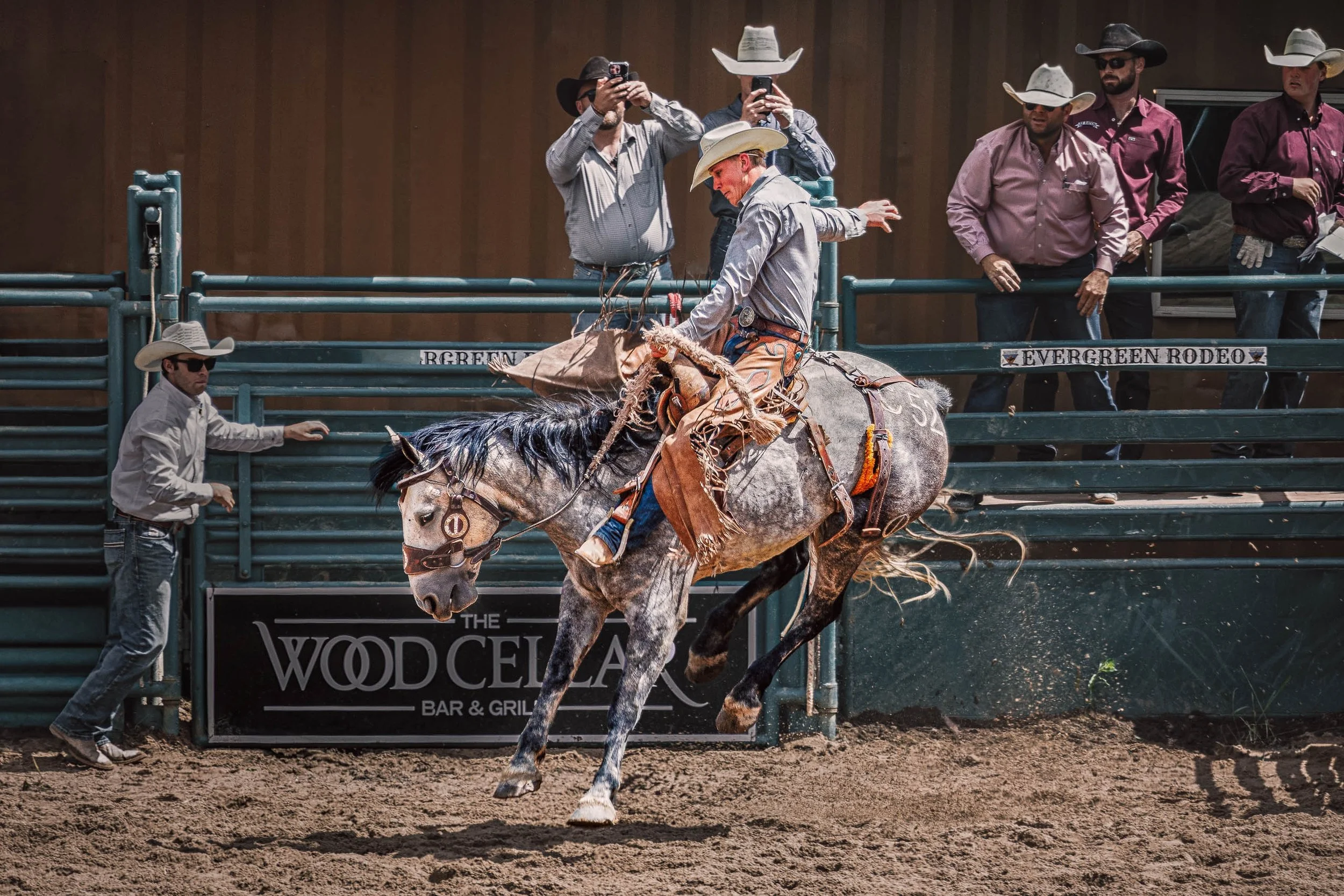
Between Sky and Dirt is a study of raw athleticism, western tradition, and the suspended moment between control and chaos. Photographed during the Evergreen Rodeo as horse and rider reach full extension above the arena dirt, the image is built around a single unrepeatable instant: both animal and athlete completely airborne, the outcome still unresolved. The result is a photograph that feels both kinetic and oddly still, holding the tension between power and balance, resistance and commitment, gravity and will.
The composition is anchored by the horse, a gray animal of considerable presence whose muscular form dominates the lower frame as it drives upward against the weight of its rider. The chaps fringe fans outward, the rigging pulls tight, and the rider's free hand reaches wide for counterbalance — every element in the frame is in motion, yet the 1/500th second exposure holds it all in sharp suspension. The crowd behind the arena rail provides human scale and context without competing with the central drama.
Rather than treating the scene as simple sports documentation, the photograph focuses on atmosphere and presence. The rider occupies the space with concentration and physical intelligence, not as a performer, but as someone engaged in a deeply practiced conversation with an unpredictable animal. The arena fencing, the watching crowd, the dust caught in the light — these elements frame the moment without diminishing it.
The restrained color palette strengthens the emotional pull of the image. Warm earth tones in the leather, chaps, and arena dirt create a grounded western foundation, while the horse's silver-gray coat carries light across the center of the frame. The teal arena railing provides just enough color contrast to define the space without pulling focus. This balance of warm foreground and cooler structural elements gives the photograph its central energy — a fleeting moment of pure effort suspended between sky and dirt on a Colorado afternoon.
Design & Styling
The suspended, kinetic moment of Between Sky and Dirt suits western lodges, ranch homes, sports bars, dens, and hospitality spaces that celebrate the working West. Its restrained palette keeps it sophisticated on warm-neutral or dark, wood-paneled walls.
Curated Pairings
To build a wall around the working West, consider these companion pieces:
For the same arena: Pair with Out of the Chute, another explosive moment at the Evergreen Rodeo, in panoramic width.
For held force: Complement with The Painted Storm, a paint bronc in full buck with the rider locked in, the same suspended instant of power and control.
For a vertical rise: Add Flying Colors, a paint horse clearing the chute in a burst of straw, the same unresolved moment from a different angle.
Fine Art Presentation
Available as a signed fine art print on ChromaLuxe® Metal (gloss, semi-gloss, or matte), Glossy Anti-Glare Acrylic (TruLife), canvas, wood, and archival paper (framed or unframed). ChromaLuxe® Metal is the recommended presentation: it emphasizes the sharpness of the suspended moment and the contrast between warm leather tones and the arena dirt. Framed archival paper is the alternative for a quieter, more documentary read of the restrained palette.
Note: Custom and oversized photographic prints are available. Please contact the studio directly to discuss custom framing, matting, or specialized museum glass options.
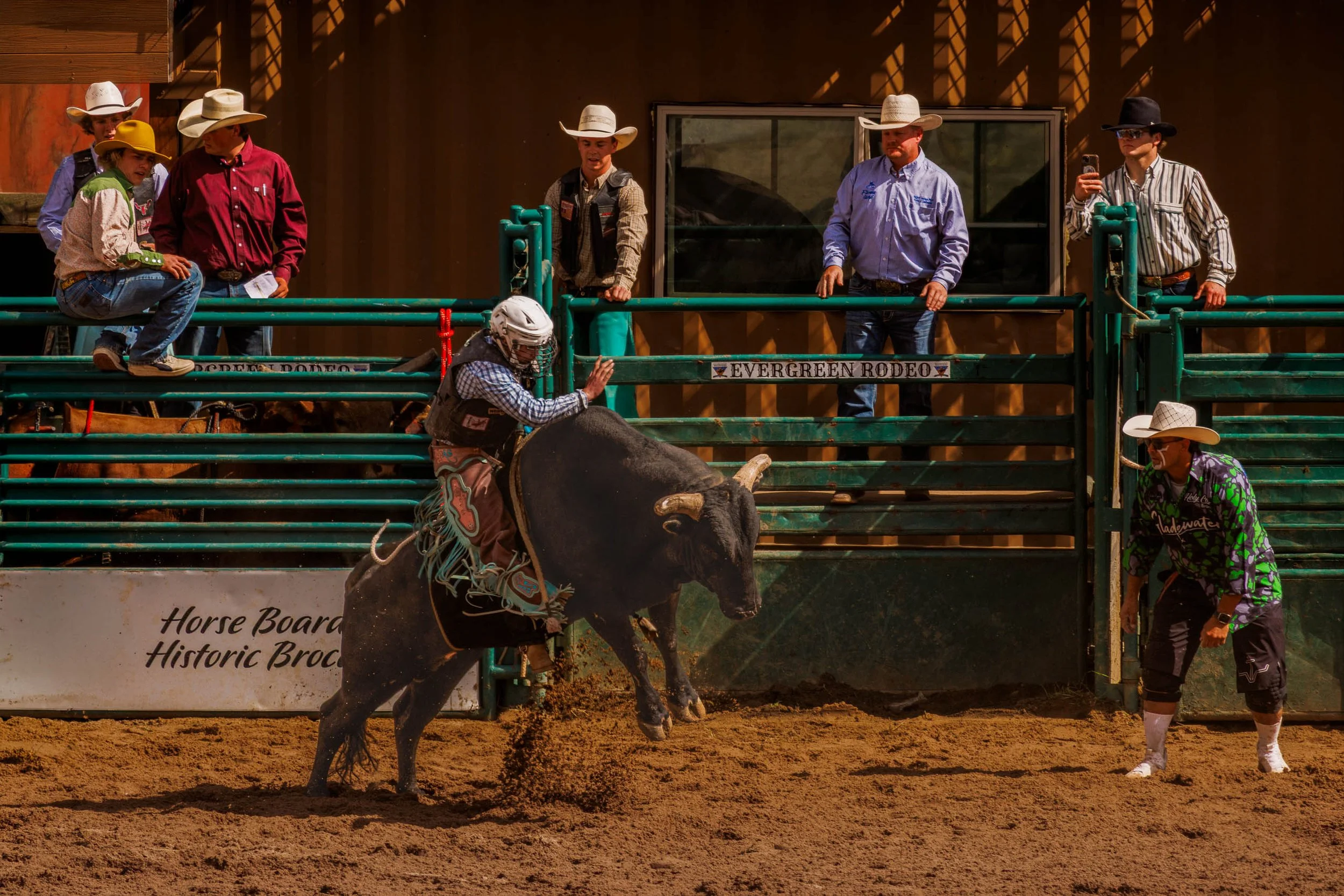
A thousand pounds of animal has already decided. Black Thunder is about mass in motion: a black bull mid-buck at the Evergreen Rodeo in the Colorado foothills, a rider locked on by will and training alone, the outcome being settled by physics. Everyone at the rail above knows exactly what they are seeing.
The bull is the undeniable center of gravity. Its black coat absorbs the harsh afternoon light while the horns catch just enough sun to define its mass and direction. Above it, the rider, helmet down, free arm out, rigging hand locked, is reduced to pure athletic response. The Evergreen Rodeo sign anchors the frame to its place, the bullfighter in his patterned shirt leans in at the right, and the crowd above the rail watches with the stillness of people who understand the stakes.
Drawing on the documentary intensity of Ernst Haas's arena work and the compressed human drama of Wim Wenders, the image finds its power in the relationship between the massive dark animal and the small figure on top. The Evergreen Rodeo has run for over a century in the Colorado foothills, and this is one afternoon of that tradition, held in a single frame.
Design & Styling
With its dramatic contrast, dark palette, and explosive central subject, Black Thunder commands attention in mountain homes, ranch properties, sporting lodges, western hospitality spaces, and executive offices that value authentic American West culture. The deep blacks of the bull, the warm arena sand, and the dappled light on the background wall suit both rustic lodges and clean contemporary rooms. The 3:2 format scales from 20×30 to statement sizes of 30×45 and above, where the bull's mass becomes immersive.
Curated Pairings
To build a rodeo wall, consider these companion pieces from the same arena:
For a bull and bronc pairing: Pair with Out of the Chute, contrasting the raw power of bull riding with the explosive gate burst of a bronc, two of rodeo's most demanding events, in landscape and panoramic format.
For a two-image statement wall: Complement with The Painted Storm, a chestnut paint horse in full buck at matching sizes: two animals, two energies, one arena, one afternoon.
For a mixed-format pairing: Pair with The Conversation, the square-format image of a rider mid-ride, whose tight square frame sets off this piece's landscape sweep.
Fine Art Presentation
Available as a signed fine art print on ChromaLuxe® Metal (gloss, semi-gloss, or matte), Glossy Anti-Glare Acrylic (TruLife), canvas, wood, and archival paper (framed or unframed). ChromaLuxe® Metal is the strongest choice: the deep blacks of the bull, the dappled arena light, and the fine detail in the horns, rigging, and dirt spray all benefit from metal's luminosity and tonal range, and 24×36 is the recommended primary size, where the bull reads at near life scale. Framed archival paper gives a warmer, more tactile read with natural depth in the shadows, and canvas or wood suits lodge and ranch settings.
Note: Custom and oversized photographic prints are available. Please contact the studio directly to discuss custom framing, matting, or specialized museum glass options.
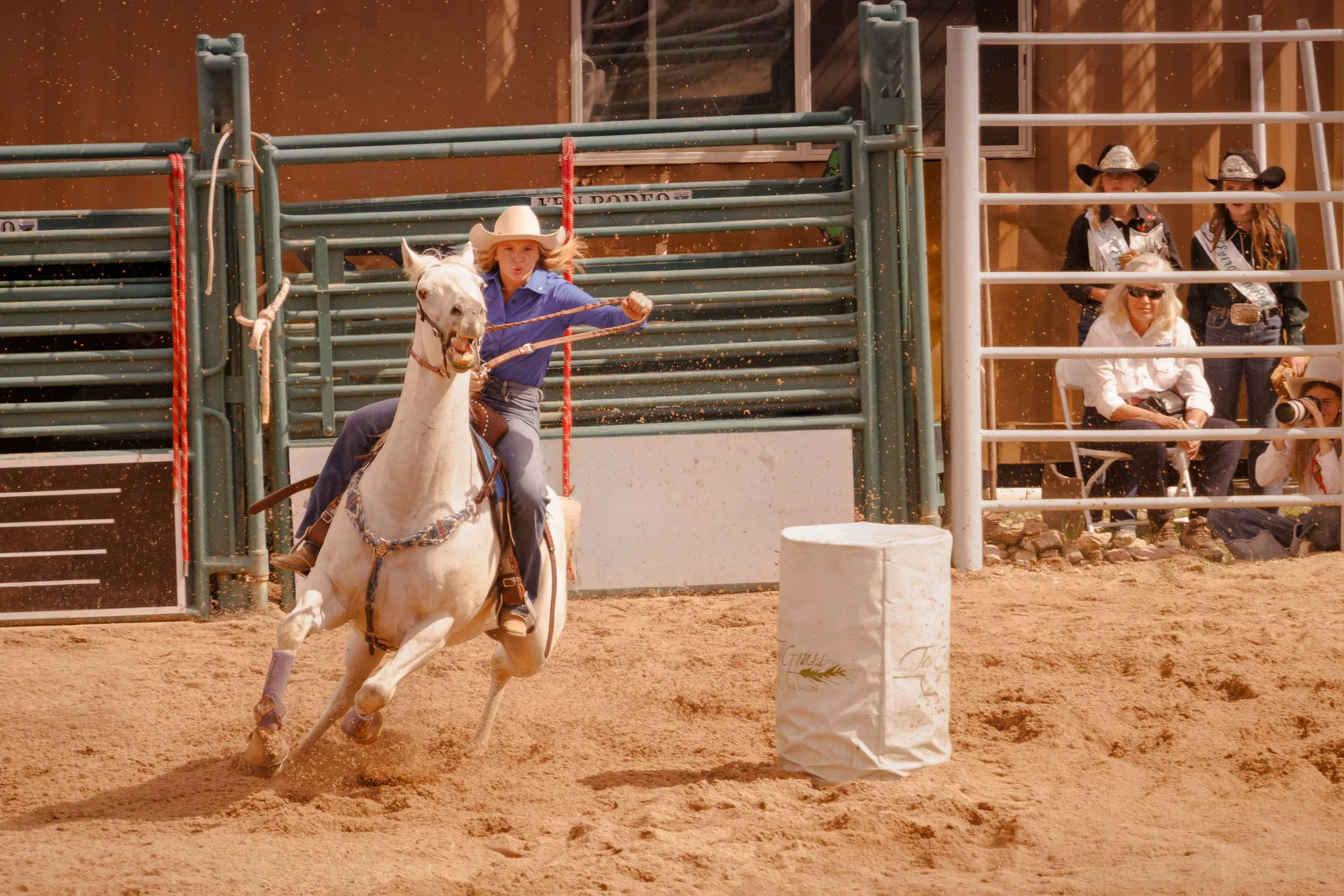
There is one rodeo event that has always belonged to women. Her Run arrives at the moment barrel racing becomes something beyond sport: a white horse at full extension, a rider leaning into the turn with complete authority, hair flying, the barrel just cleared, the clock still running. Photographed at the Evergreen Rodeo in the Colorado foothills, it is a discipline built on partnership, precision, and the kind of speed that takes years to earn.
The white horse is the luminous center of the frame, its coat catching the afternoon light, the braided headstall and purple leg wraps adding flashes of color. The rider is all forward intention, her blue shirt vivid against the teal chute panels, fist clenched on the reins, eyes already on the next barrel. Arena dust and sand caught mid-flight give the image its speed without blurring the subject, and rodeo queens watch from the rail with the attention of people who know what a good run looks like.
Drawing on the kinetic color sensibilities of Ernst Haas and the documentary human presence of Wim Wenders, Her Run treats barrel racing as a central expression of western culture, athletic, precise, and rooted in the bond between a woman and her horse. The Evergreen Rodeo has carried this tradition for over a century; this is one run, held at the moment it matters most.
Design & Styling
The blue-and-white palette of Her Run brings light, energy, and a distinctly feminine western identity to mountain homes, ranch properties, hospitality spaces, and rooms designed for or by women. The warm sand and amber arena light pair with cream, white, linen, and soft earth tones, extending its range beyond the darker bronc and bull images. The 3:2 format scales from 20×30 to 30×45, as a standalone piece or part of a multi-image western wall.
Curated Pairings
To build a rodeo wall around Her Run, consider these companion pieces from the same arena:
For a two-image contrast wall: Pair with The Painted Storm, white horse and chestnut paint, barrel racing and bronc riding, blue and amber: two visual energies from the same arena on the same afternoon.
For a three-event wall: Add Out of the Chute, the bronc bursting from the gate, and Black Thunder, the bull, for bronc, bull, and barrel in three tonal registers; the blue and white of Her Run gives natural relief between the darker images.
For the full Evergreen Rodeo wall: Add The Conversation, the square-format bareback ride, for a five-image wall across every major event.
Fine Art Presentation
Available as a signed fine art print on ChromaLuxe® Metal (gloss, semi-gloss, or matte), Glossy Anti-Glare Acrylic (TruLife), canvas, wood, and archival paper (framed or unframed). ChromaLuxe® Metal is the strongest choice: the white horse coat keeps its highlight detail, the rider's blue shirt stays vivid, and the suspended arena debris and braided headstall render with a clarity that paper and canvas cannot fully match; 24×36 is the recommended primary size. Acrylic suits a lighter, open interior where the blue and white can anchor the room, and framed archival paper gives a softer, warmer read for traditional and ranch residential spaces.
Note: Custom and oversized photographic prints are available. Please contact the studio directly to discuss custom framing, matting, or specialized museum glass options.

A bald eagle stands motionless at the exact line where winter surrenders to water on Evergreen Lake, Colorado — the last stronghold of ice before the thaw takes it.
The composition splits the frame along a razor-sharp diagonal: a pale, wind-scoured ice field above, a dense cobalt reflection below, broken only by the ghost-warm glow of unseen trees caught in the water's mirror. The eagle sits small and deliberate within all that emptiness — not centered, not announced, simply present at the threshold. The eye lands on the bird, drops to its faint inverted reflection at the ice edge, then drifts into the color field beneath. Nothing competes for attention; the negative space is the subject as much as the bird is.
This piece sits closer to minimalist color-field photography than traditional wildlife work — the restraint recalls Ernst Haas's tonal discipline, while the hard geometric division of the frame edges toward Hiroshi Sugimoto's horizon studies. It is a photograph about scale and threshold as much as about the animal within it.
Design & Styling
The deep cobalt and pale ice tones make this a strong fit for modern minimalist interiors, lake or mountain homes, spa and wellness spaces, or a corporate lobby seeking a quiet, graphic focal point rather than a literal nature scene. Works well as a single large-format statement piece given the expanse of negative space.
Curated Pairings
Enduring Silence— a kindred study in stillness and reflection
The Silent Assembly — shared quiet-water restraint
Storm Gate— atmospheric tension as a counterpoint in monochrome
Fine Art Presentation
Available on ChromaLuxe® Metal (gloss, semi-gloss, or matte) or TruLife acrylic for maximum depth in the water tones, or as a framed/unframed print on archival fine art paper. Larger formats are recommended to let the negative space breathe.
Note: Custom and oversized photographic prints are available. Please contact the studio directly to discuss custom framing, matting, or specialized museum glass options.
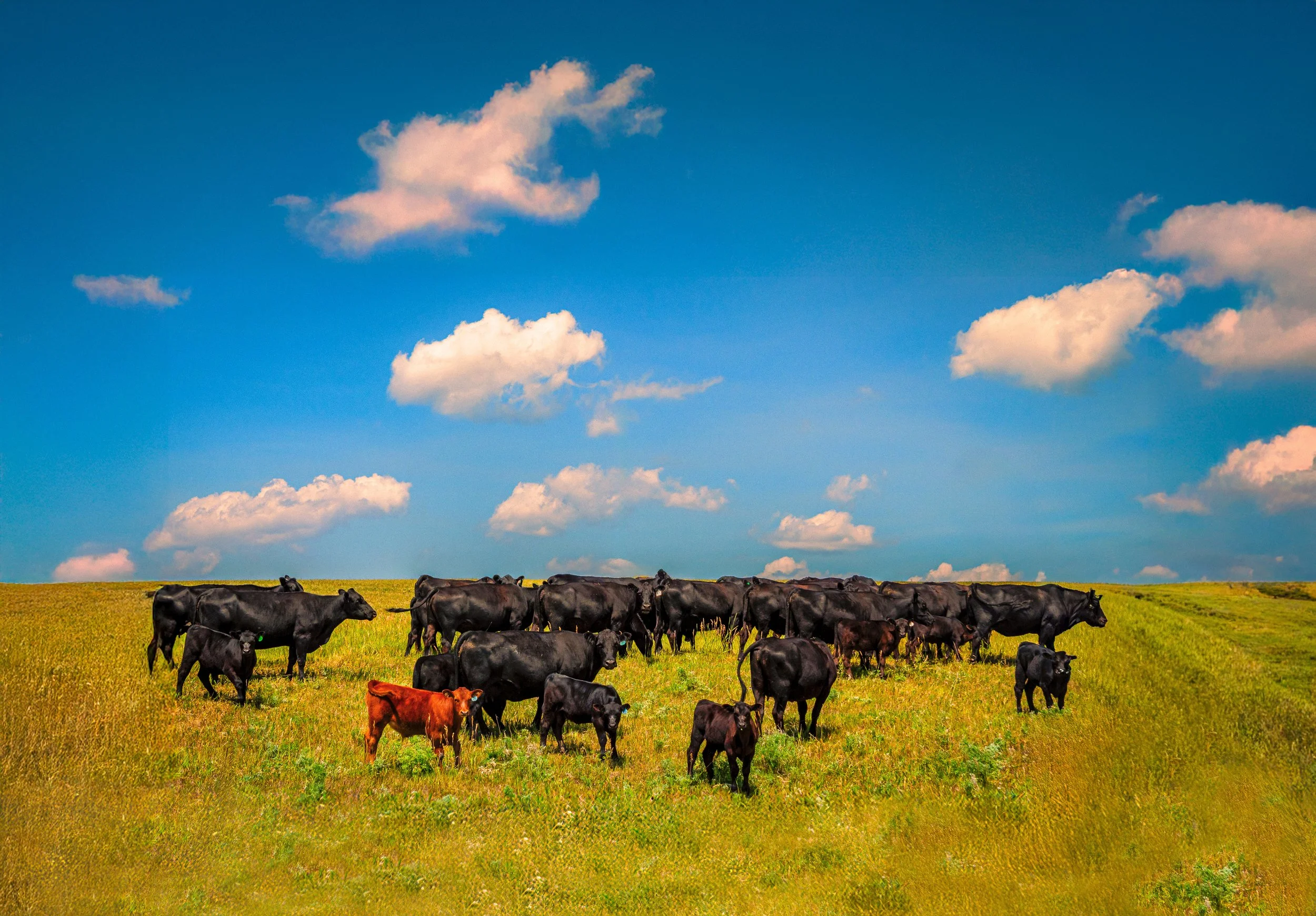
Standing Ground is a study of individuality, belonging, and the quiet character of the American prairie. Photographed in the Flint Hills region of Kansas beneath scattered clouds, the image centers on a single red cow standing among a herd of black cattle. The contrast is immediate yet unforced, creating a visual narrative about distinction within community and presence within a larger landscape.
The rolling prairie provides both setting and context, connecting the animals to one of North America's most enduring grassland ecosystems. Rather than isolating the red cow from its surroundings, the photograph embraces the relationship between the individual and the herd. The result is an image that speaks to resilience, identity, and the subtle ways difference reveals itself within familiar patterns.
Drawing inspiration from the regional landscapes of Thomas Hart Benton and the color sensibilities of Ernst Haas, Standing Ground celebrates the quiet beauty of rural America. The scattered clouds, open grasslands, and earthy palette create a sense of space and permanence, while the lone red figure offers a natural focal point that anchors the composition.
Design & Styling
With its warm prairie colors, recognizable subject matter, and strong visual focal point, Standing Ground is particularly well suited for ranch homes, healthcare environments, hospitality settings, executive offices, and contemporary residential interiors. The image introduces both narrative and landscape, creating a welcoming presence without overwhelming a space.
Curated Pairings
To create a cohesive gallery wall, consider these two companions that share themes of place, resilience, and the American landscape:
For a complementary focal point: Pair with Stillness Over Flint Hills to continue the story of the Kansas prairie through a broader landscape perspective.
For tonal harmony: Complement the warm earth tones of this piece with Where the Sky Breaks, where weather and open country similarly become central elements of the visual narrative.
Fine Art Presentation
Available as a signed fine art print in ChromaLuxe® Metal (gloss, semi-gloss, or matte), framed paper, framed canvas, and acrylic presentation formats. For this image, ChromaLuxe® Metal is highly recommended, preserving the rich color contrast between the red and black cattle. Framed fine art paper also presents beautifully, emphasizing the photograph's pastoral character and subtle tonal relationships.
Note: Custom and oversized photographic prints are available. Please contact the studio directly to discuss custom framing, matting, or specialized museum glass options.
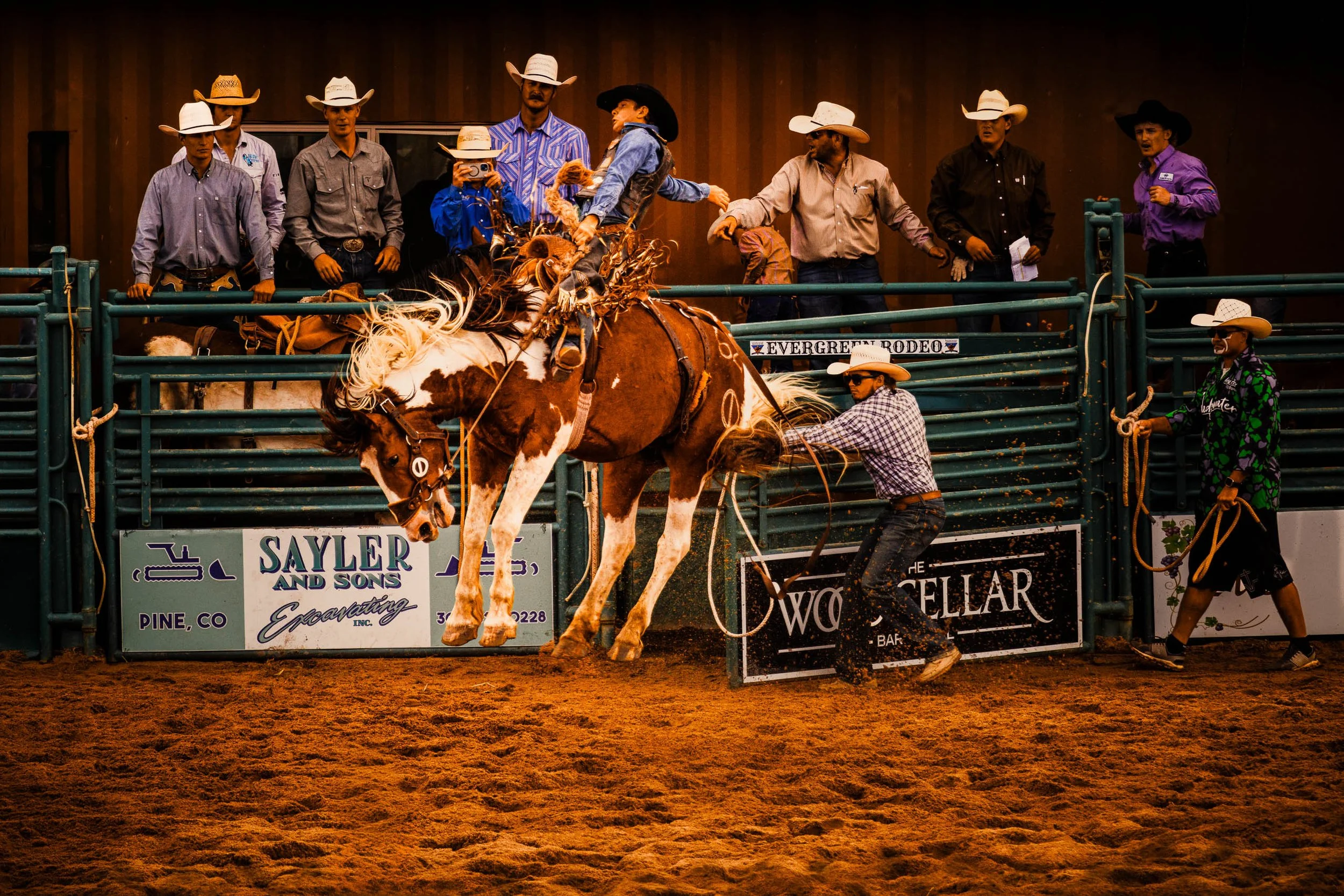
The moment a paint bronc becomes pure force. The Painted Storm arrives with hindquarters driving skyward, mane exploding outward, and the rider locked in position against an animal that has decided the outcome on its own terms. Photographed at the Evergreen Rodeo in the Colorado foothills, it holds horse and rider suspended in a single unrepeatable instant, the Evergreen Rodeo sign in the background, the gate handler braced on the rope, the crowd leaning forward at the rail.
The chestnut-and-white paint horse is the dominant visual force: its coat, animated by the violence of the buck, pulls the eye immediately and holds it, and the flying mane carries the motion through the upper third of the frame. The crowd of cowboys above the rail gives human scale, their reactions ranging from focused intensity to open-mouthed surprise, and warm arena light unifies the chestnut tones, leather gear, and sand into one palette.
Drawing on the kinetic color work of Ernst Haas and the documentary authenticity of Wim Wenders, the image treats rodeo as a living tradition, and the specificity matters: a particular horse, a particular rider, and a particular afternoon at the Evergreen Rodeo, which has run for over a century in the foothills west of Denver.
Design & Styling
With its dramatic contrast, warm chestnut and amber tones, and explosive central subject, The Painted Storm commands attention in mountain homes, ranch properties, sporting lodges, western hospitality spaces, and executive offices. The 3:2 format scales from statement pieces above a fireplace or sofa to mid-size presentations in hallways and guest rooms, reaching full power at 24×36 and above, and its chestnut, sand, leather, and denim palette pairs with reclaimed wood, iron, and aged leather.
Curated Pairings
To build a rodeo wall around The Painted Storm, consider these companion pieces from the same arena:
For a complete Evergreen Rodeo narrative: Pair with Out of the Chute, two horses, two moments, one arena: together they tell the story of the rodeo from gate burst to full ride.
For another paint horse: Complement with Flying Colors, a paint horse clearing the top rail of the chute with straw and mane torn loose, the bareback rider counterbalancing with a free arm thrown wide.
For horse and rider in the air: Pair with Between Sky and Dirt, where horse and rider reach full extension above the arena dirt, both airborne, the outcome still unresolved.
Fine Art Presentation
Available as a signed fine art print on ChromaLuxe® Metal (gloss, semi-gloss, or matte), Glossy Anti-Glare Acrylic (TruLife), canvas, wood, and archival paper (framed or unframed). ChromaLuxe® Metal is the strongest choice: the contrast between the chestnut coat, the white markings, and the dark arena background benefits from metal's luminosity, and the flying mane renders with exceptional sharpness at larger sizes; 24×36 is the recommended primary size. Framed archival paper offers a warmer, more tactile read for traditional and rustic rooms, and canvas or wood adds texture for lodge and ranch settings.
Note: Custom and oversized photographic prints are available. Please contact the studio directly to discuss custom framing, matting, or specialized museum glass options.

The oldest negotiation in rodeo has no guaranteed answer. The Conversation catches a rider mid-ride at the Evergreen Rodeo in the Colorado foothills, body torqued forward over a dark bay horse in full buck, the rigging hand locked and the free arm reaching for balance that may or may not come: a conversation conducted at full speed, in front of everyone.
The square composition compresses the action into a tight, almost claustrophobic frame. The horse fills the lower two-thirds, dark coat against warm sand, hindquarters driving into the dirt, while the rider's black vest and lavender shirt stand out against the teal arena panels. Behind them the crowd watches with the stillness of people who understand what they are seeing: a television cameraman steady on his shot, a cowboy with a hand raised mid-gesture, a young man on the left simply watching.
Drawing on the compressed intensity of Ernst Haas's rodeo work and the human-scale documentary presence of Wim Wenders, the image finds its power in one rider and one horse working something out in real time: the Evergreen Rodeo, a century-old Colorado tradition, distilled to its essential human moment.
Design & Styling
The square format gives The Conversation exceptional versatility: a single centered anchor on a feature wall, part of a grid with other square prints, or a centerpiece flanked by the panoramic rodeo images. It suits mountain homes, ranch properties, sporting lodges, western hospitality spaces, and executive offices, and its warm sand, chestnut, and teal palette pairs with leather, reclaimed wood, iron, and aged bronze. The image holds from 20×20 to 30×30 and scales to immersive statement sizes.
Curated Pairings
To build a rodeo wall around The Conversation, consider these companion pieces from the same arena:
For the gate burst: Pair with Out of the Chute, the panoramic bronc explosion; hung with this square above or below it, the format contrast keeps the eye moving across the wall.
For a two-image rodeo pairing: Complement with The Painted Storm, two horses, two riders, two visual energies at matching sizes.
For another split second of the arena: Pair with Flying Colors, a paint horse clearing the chute rail with straw and mane torn loose and the bareback rider's free arm thrown wide.
Fine Art Presentation
Available as a signed fine art print on ChromaLuxe® Metal (gloss, semi-gloss, or matte), Glossy Anti-Glare Acrylic (TruLife), canvas, wood, and archival paper (framed or unframed). ChromaLuxe® Metal brings out the full tonal range: the dark bay coat against warm sand, the lavender shirt, and the flying dirt and rigging, and at 24×24 or 30×30 the square format has an almost portrait-like presence. Framed archival paper gives a warmer, more tactile read for traditional and rustic rooms, and canvas adds natural texture for lodge and ranch settings.
Note: Custom and oversized photographic prints are available. Please contact the studio directly to discuss custom framing, matting, or specialized museum glass options.

The outcome is still unresolved. Out of the Chute is a study in suspended force: the precise instant a bronc and rider explode from the arena gate into open air at the Evergreen Rodeo in the Colorado foothills, the horse fully airborne, hindquarters driving upward, the rider holding position against pure animal power, the gate handler braced against the rope. Every element is in motion, yet the exposure holds it in sharp stillness.
The panoramic composition works because of what surrounds the action. Cowboys in white hats lean forward at the rail, phones raised, giving the moment human scale; teal arena panels frame the burst without competing with it; and warm foreground sand grounds the image in the Colorado afternoon. The eye moves from the gate explosion outward through the watching crowd, then back to the horse and rider, a circuit that keeps returning to the moment of release.
Drawing on the kinetic color sensibilities of Ernst Haas and the documentary presence of Wim Wenders, the image treats a western tradition not as spectacle but as lived experience: the working West at full intensity, at a summer rodeo that has run for over a century.
Design & Styling
With its warm gold and amber tones, dynamic panoramic composition, and unmistakably western subject, Out of the Chute brings energy and authenticity to mountain homes, ranch properties, rustic-modern interiors, sporting lodges, western hospitality spaces, and executive offices. The panoramic format suits the width above a sofa, credenza, or conference table, and its leather, sand, and denim tones pair with reclaimed wood, iron, linen, and hide.
Curated Pairings
To build a rodeo wall around Out of the Chute, consider these companion pieces from the same arena:
For a two-image contrast wall: Pair with The Painted Storm, grey bronc and chestnut paint: two horses, two moments, one arena.
For three events: Add Black Thunder, for bronc riding, paint horse fury, and bull riding: three events, three tonal registers, one century-old Colorado tradition.
For the full Evergreen Rodeo wall: Add The Conversation and Her Run, for a five-image wall across every major event and across panoramic, landscape, and square formats.
Fine Art Presentation
Available as a signed fine art print on ChromaLuxe® Metal (gloss, semi-gloss, or matte), Glossy Anti-Glare Acrylic (TruLife), canvas, wood, and archival paper (framed or unframed). ChromaLuxe® Metal gives the image its strongest impact: the sharpness of the suspended moment, the contrast between warm leather tones and cool arena panels, and the texture of the sand all benefit from metal's luminosity, and larger panoramic sizes make the horse, rider, crowd, and arena more immersive. Framed archival paper gives a softer read with greater subtlety in the crowd and atmosphere, and framed canvas adds warmth for rustic and lodge-style spaces.
Note: Custom and oversized photographic prints are available. Please contact the studio directly to discuss custom framing, matting, or specialized museum glass options.
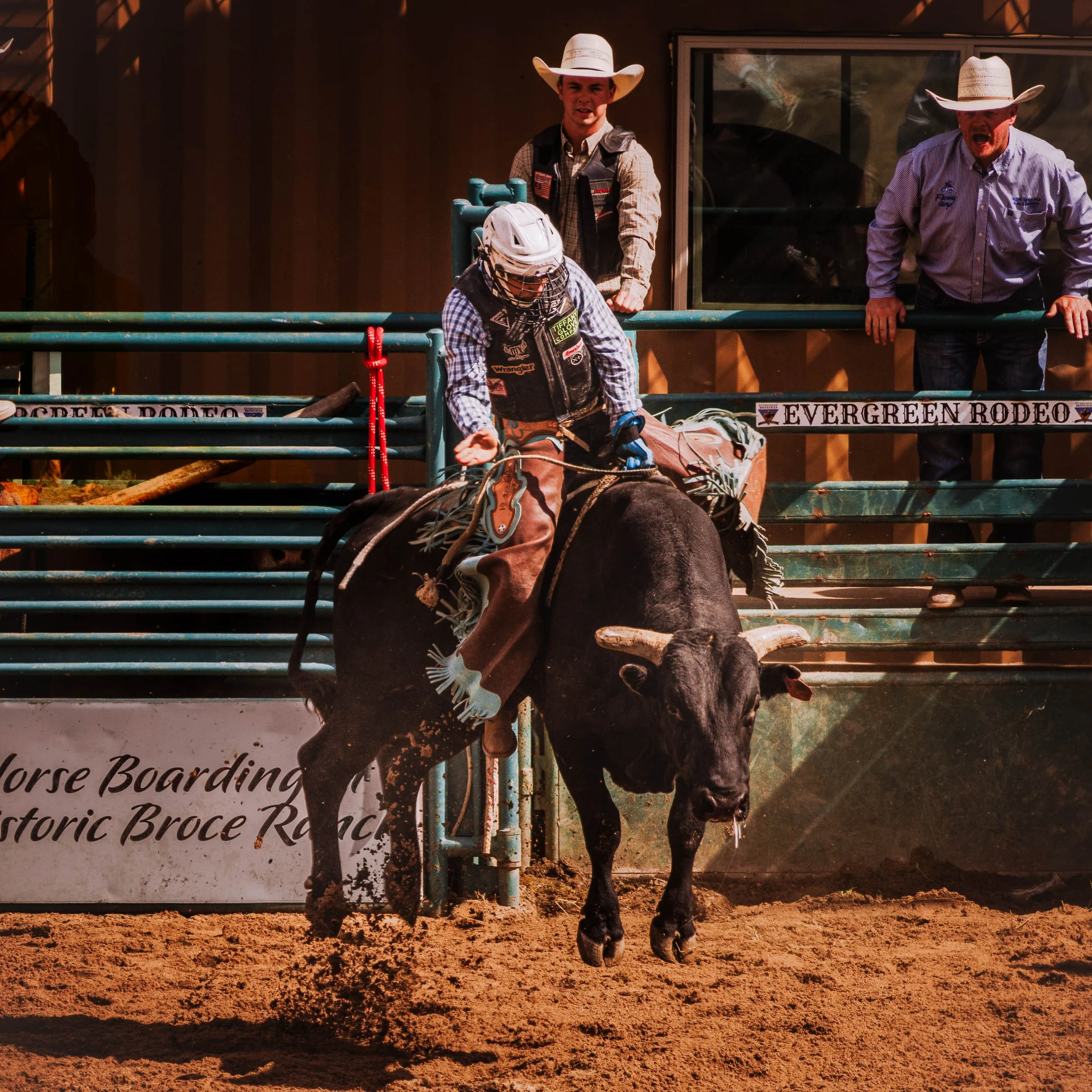
Once the gate opens, there is only one instruction. Hold On distills bull riding to those two words: a thousand pounds of animal has made its decision, and a rider leans into the motion with one hand locked on the rope and the other reaching for balance that may or may not come. Photographed at the Evergreen Rodeo in the Colorado foothills, the image catches a massive black bull, head turned forward and horns fully visible, at the moment the ride becomes most human.
The square composition compresses the action into a tight, immediate frame. The black bull fills the lower two-thirds, its coat absorbing the Colorado afternoon light while the long curved horns catch just enough sun to define the animal's mass and direction. Above it, the rider is all forward commitment, helmet down. Behind them, two figures at the rail watch with focused intensity, one steady and one with hands raised, while the Evergreen Rodeo sign stays sharp in the background, tying the moment to a specific place and tradition.
Drawing on the compressed documentary intensity of Ernst Haas and the human-scale authenticity of Wim Wenders, Hold On finds its power in the relationship between the massive dark animal and the small human figure trying to stay connected to it. The Evergreen Rodeo has run for over a century in the foothills west of Denver; this image is one afternoon of that tradition.
Design & Styling
With its dramatic contrast, dark tonal palette, and square-format intensity, Hold On commands attention as a standalone statement piece. The deep blacks of the bull, the warm amber sand and leather tones, and the readable crowd reaction create a palette that works in rustic lodges, mountain homes, ranch properties, western hospitality spaces, and executive offices that value authentic American West culture.
Curated Pairings
To build a bull riding wall with range, consider these companion pieces from the same arena:
For the definitive bull riding wall: Pair with Black Thunder at matching sizes — two black bulls, two riders, two different moments from the same arena on the same afternoon. Black Thunder shows the bull from the side; Hold On shows it facing the camera.
For the moment before landing: Complement with Between Sky and Dirt, where horse and rider reach full extension above the arena dirt, both airborne, the outcome still unresolved.
For another split second of the same tradition: Pair with Flying Colors, a paint horse clearing the top rail of the chute with straw and mane torn loose and the bareback rider's free arm thrown wide for balance.
Fine Art Presentation
Available as a signed fine art print on ChromaLuxe® Metal (gloss, semi-gloss, or matte), Glossy Anti-Glare Acrylic (TruLife), canvas, and archival paper (framed or unframed). ChromaLuxe® Metal is the strongest choice: the deep blacks of the bull, the fine detail in the horns and rope, and the sharp rodeo sign all benefit from metal's luminosity and tonal range, and the bull's face renders with exceptional clarity at larger sizes. Canvas and framed canvas bring warmth and texture that suit lodge and ranch settings. The square format scales from 20×20 through 36×36; 24×24 or 30×30 on ChromaLuxe® Metal is the recommended primary size.
Note: Custom and oversized photographic prints are available. Please contact the studio directly to discuss custom framing, matting, or specialized museum glass options.
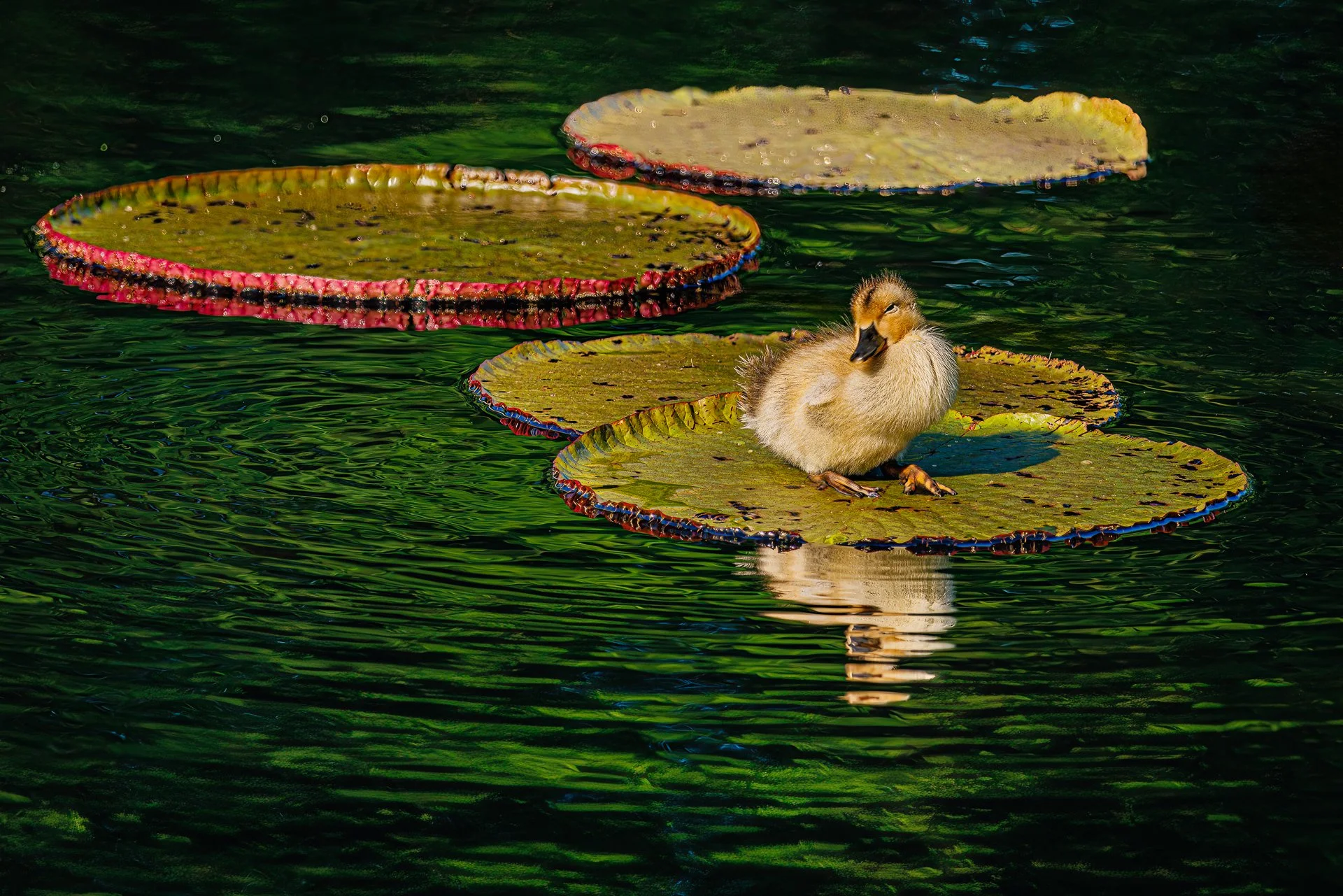
Some mornings the whole garden holds its breath. First Light, Clear Water finds a lone duckling resting on a textured water lily pad at the Missouri Botanical Garden, where the vibrant greens of the pad and the soft, atmospheric light reflecting off the water build a disciplined, nearly monochromatic calm.
The ridged surface of the pad and the small bird resting on it are the picture; everything else is water and light. It is a rhythmic study of grace, fragility, and the architecture of a botanical sanctuary, drawing on the cinematic color theory of Ernst Haas — a moment of quiet resilience in the garden's aquatic landscape, presented with peaceful, unblinking clarity.
A small subject on a quiet surface leaves the whole frame for stillness. The textured pad, the clear water, and the soft morning light give the duckling room to be the entire picture.
Design & Styling
With its intricate textures and soft tonal range, First Light, Clear Water suits nurseries and children's rooms, private galleries, garden rooms, and healthcare waiting areas, adding grounded, peaceful gravity to a room. Against white or pale-wood walls, the greens read as one calm field.
Curated Pairings
To create a cohesive gallery wall, consider these companion pieces that share the same atmospheric light:
For a complementary focal point: Pair with After the Rain, to echo the lush, water-touched textures of the garden.
For tonal harmony: Complement the rich greens of this piece with Unfolding Light, which mirrors the soft, organic forms found throughout this collection.
For the same garden pond: Pair with Amber Morning, the low-light hours of a garden morning, where soft reflections and the surface of a lily pad carry the same quiet stillness.
Fine Art Presentation
Available as a signed fine art print on ChromaLuxe® Metal (gloss, semi-gloss, or matte), Glossy Anti-Glare Acrylic (TruLife), canvas, wood, and archival paper (framed or unframed). Acrylic is the recommended presentation: its depth suits water and soft reflected light, and it keeps the ridges of the lily pad and the fine texture of the duckling luminous. Canvas is the softer, more forgiving choice for a nursery or private gallery, and wood suits an organic garden subject, where the grain of the print echoes the pad and the water.
Note: Custom and oversized photographic prints are available. Please contact the studio directly to discuss custom framing, matting, or specialized museum glass options.
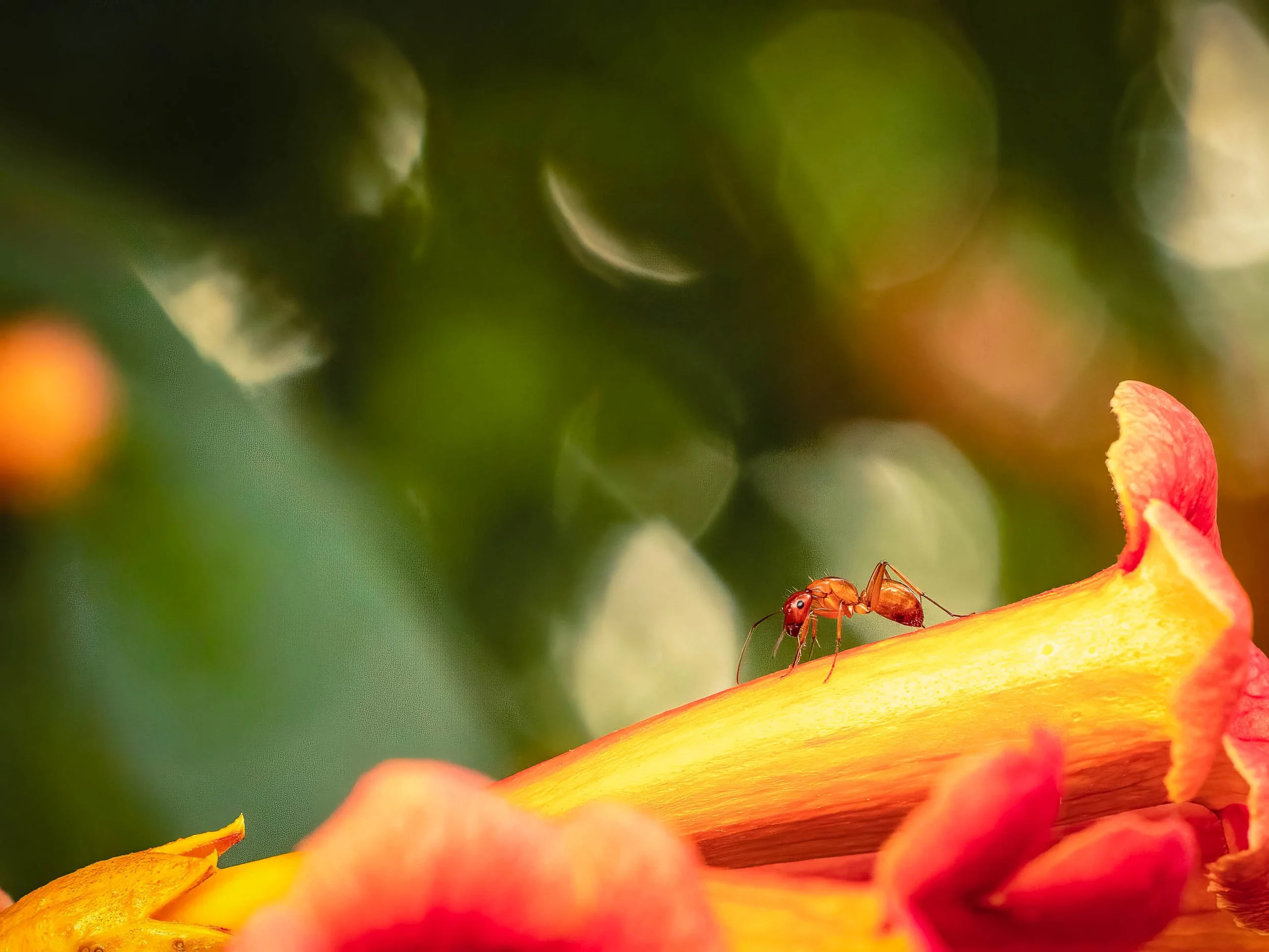
The Long Way Across is an intimate, high-contrast macro study that reveals the epic scale hidden within the smallest corners of the natural world. The composition features a single, highly detailed ant embarking on a journey across a sweeping, luminous orange-gold organic form. Bathed in directional, dramatic light, the scene contrasts the crisp, delicate geometry of the insect against a deeply shadowed, atmospheric background. Influenced by the sharp formal precision of Edward Weston and the dramatic chiaroscuro of classic fine art printmaking, this photograph transforms a fleeting micro-moment into a powerful narrative of exploration, survival, and quiet persistence.
A worker ant can carry many times its own weight, which is why a crossing of a few inches becomes a journey at this scale. The photograph gives the ant the same presence a mountaineer would have on a ridge.
Design & Styling
The tiny ant crossing a sweeping orange-gold form in The Long Way Across turns a small wall into an epic journey for studies, offices, kitchens, and hallways. Its warm glow suits cream, white, and warm gray walls.
Curated Pairings
To build a gallery wall around the intricate beauty of nature, consider these companion pieces:
For tonal harmony: Pair with Gold Inversion, mirroring the vibrant, sun-drenched warm tones.
For textural contrast: Complement the crisp macro detail with After the Rain, echoing the organic, water-touched textures of the garden.
For the same ant: Pair with The Weight It Carries, another lone ant at work, hauling a wasp across stone.
Fine Art Presentation
Available as a signed fine art print on ChromaLuxe® Metal (gloss, semi-gloss, or matte), Glossy Anti-Glare Acrylic (TruLife), canvas, wood, and archival paper (framed or unframed). ChromaLuxe® Metal is the recommended presentation: it accentuates the razor-thin detail of the ant and the glowing gradients of the warm background. Acrylic is the alternative for extra depth.
Note: Custom and oversized photographic prints are available. Please contact the studio directly to discuss custom framing, matting, or specialized museum glass options.
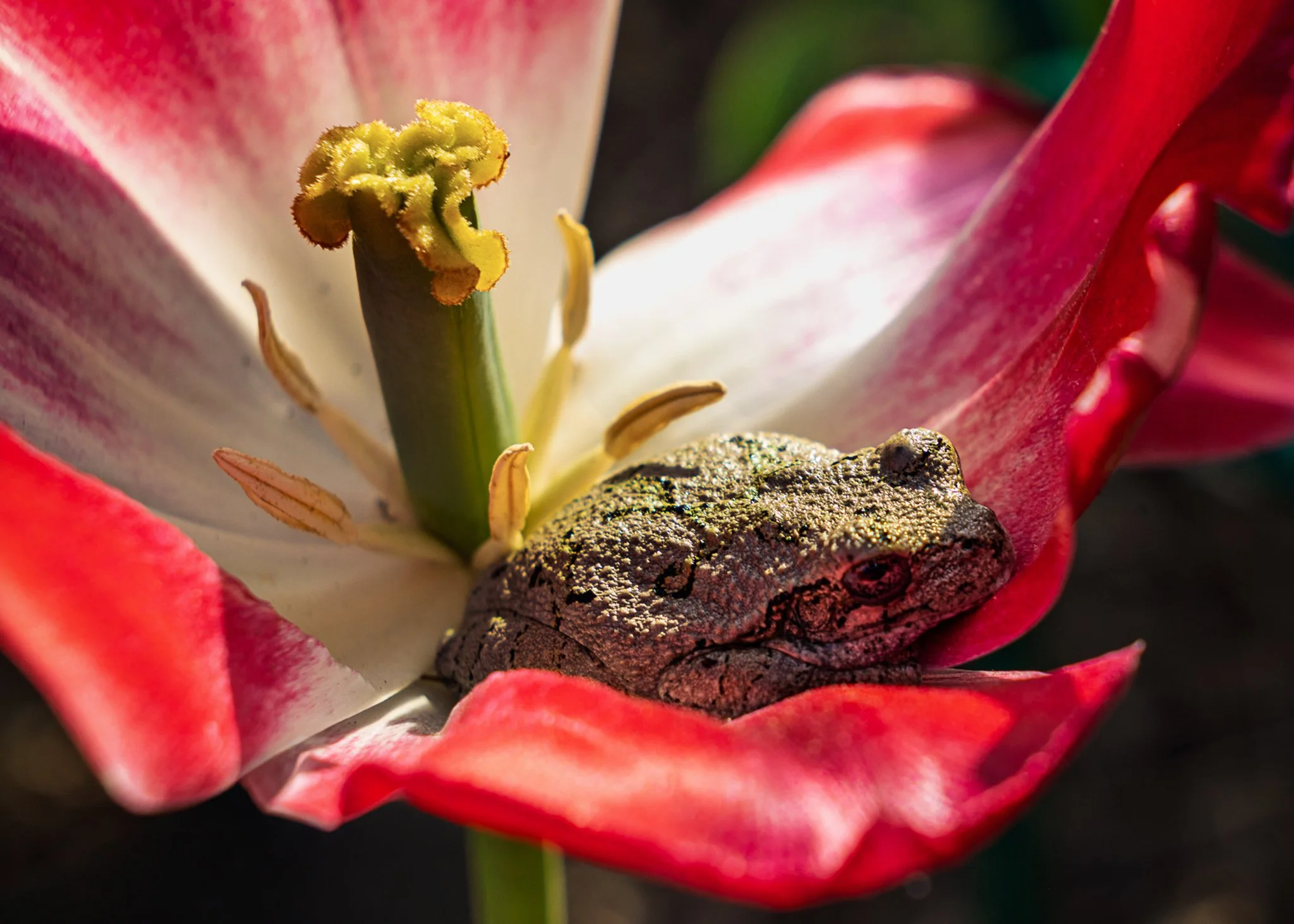
In the quiet, deliberate moments of a morning garden, light doesn't just reveal—it defines. Waiting for the Sun captures a serene, intimate encounter between a small frog and the unfolding architecture of a bloom, frozen in a state of suspended anticipation. This macro study focuses on the stillness of the subject against the rhythmic, organic geometry of the petals. Through a lens of high-contrast chiaroscuro, the image elevates a fleeting, natural occurrence into a timeless meditation on patience and existence. Much like the formal precision of early 20th-century masters, this piece emphasizes texture, tonal range, and the quiet dignity of the natural world.
Frogs are cold-blooded, so a cool morning slows them and they wait for the sun to warm them. That patience is the picture: a small animal doing nothing at all, and the whole bloom arranged around it.
Design & Styling
A small frog on an unfolding tulip gives Waiting for the Sun a gentle, suspended quality for bedrooms, studies, kitchens, and offices. Its moody garden light suits quiet, muted walls.
Curated Pairings
To create a cohesive display around small creatures in the garden, consider these companion pieces:
For textural harmony: Pair with A Brief Landing, mirroring the intricate focus on small creatures within the garden.
For a cohesive aesthetic: Complement the moody atmosphere with Seeds of the Meadow, highlighting the delicate, fine-line textures found throughout the collection.
For the same flower: Pair with After the Rain, another close study of a tulip, here resting after a spring shower.
Fine Art Presentation
Available as a signed fine art print on ChromaLuxe® Metal (gloss, semi-gloss, or matte), Glossy Anti-Glare Acrylic (TruLife), canvas, wood, and archival paper (framed or unframed). Acrylic is the recommended presentation: its depth suits the soft skin texture of the frog and the deep, ink-like shadows. ChromaLuxe® Metal is the alternative for crisper petal detail.
Note: Custom and oversized photographic prints are available. Please contact the studio directly to discuss custom framing, matting, or specialized museum glass options.
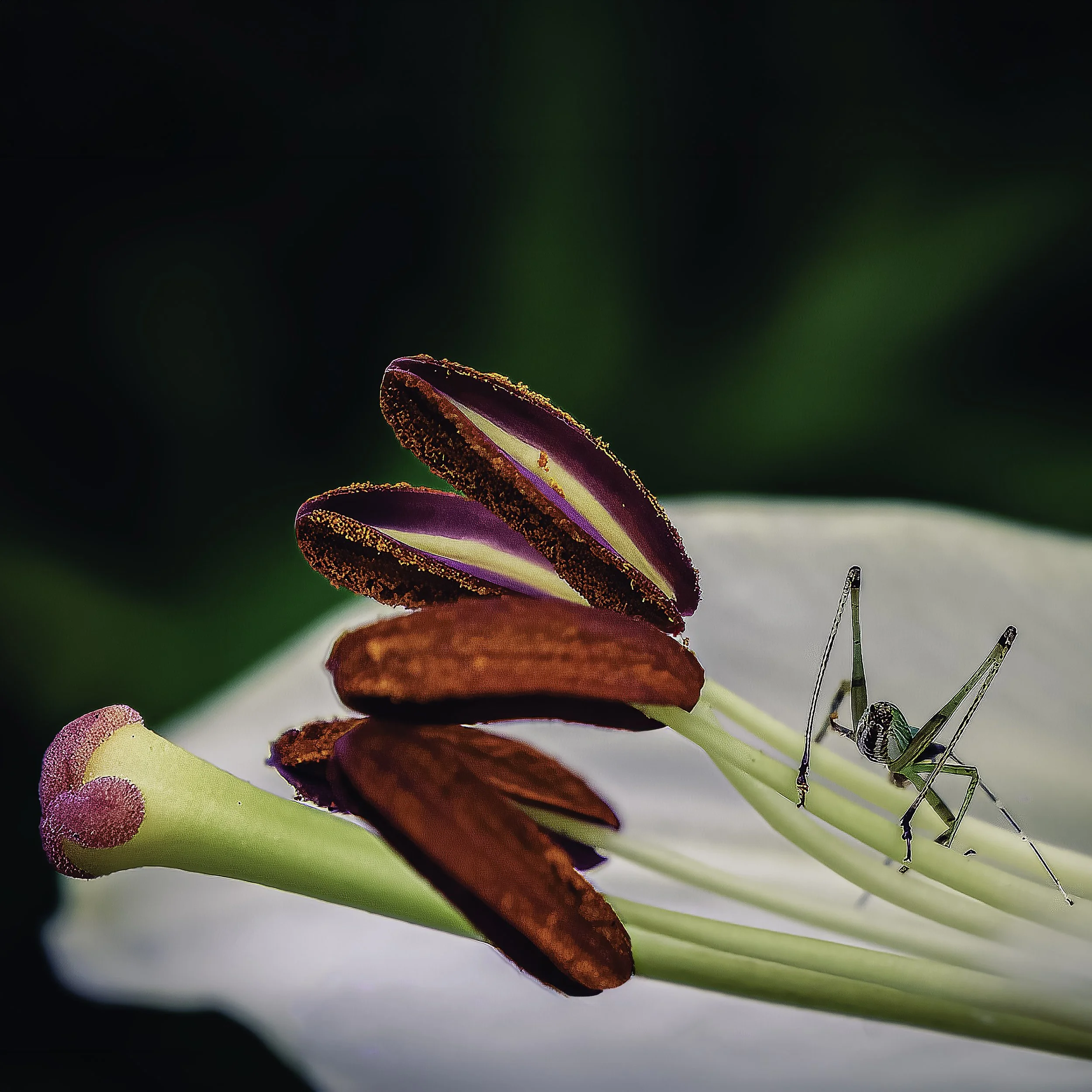
Guardian of the Bloom:
This photograph captures the remarkable architectural beauty hidden within a single flower, and the small dramas that unfold inside it. Photographed at macro scale, the image reveals the intricate reproductive structure of a white lily, its deep crimson anthers curling open to expose bands of pollen-dusted texture, while a young grasshopper pauses among the filaments as if surveying its surroundings. What might otherwise be a purely botanical study becomes something closer to a narrative moment, transforming a familiar garden subject into a scene of quiet tension and discovery. Rather than presenting the flower as a whole, the photograph invites viewers into its inner architecture. The lily's pale, luminous petal dissolves into a soft field of white and green behind the sharply rendered center, creating a visual transition between abstraction and realism. The maroon anthers curve outward like petals of their own, their pollen-flecked surfaces catching the light, while the pink-capped pistil below anchors the composition with quiet symmetry. The grasshopper, caught mid-step along the stamen filaments, introduces an element of life and unpredictability, its slender legs echoing the fine lines of the flower's own architecture. Color plays a central role throughout the image. Deep burgundy and warm ochre tones dominate the flower's core, set against the cool purity of the white petal and the soft, dark green of the blurred background. This contrast allows the anthers to emerge with striking clarity, while the grasshopper's muted greens and grays offer a quiet counterpoint to the flower's saturated palette. The result is a composition that feels both sculptural and alive, revealing the elegance that exists at nature's smallest scales, and the unexpected encounters that occur within it.
Design & Styling
The architecture hidden inside a flower, and a small grasshopper standing guard, make Guardian of the Bloom a natural fit for studies, kitchens, spa and wellness spaces, boutique hospitality, and homes with nature-minded owners. The white and crimson read well against soft neutral walls.
Curated Pairings
To create a cohesive gallery wall around macro botanical detail, consider these companion pieces:
For botanical continuity: Pair with Scarlet Crown, exploring a contrasting floral form while keeping the same emphasis on macro botanical detail.
For color harmony: Complement this piece with After the Heat, extending the warm red and ochre tones found throughout the composition.
For color at landscape scale: Pair with Standing Stone, a red-rock landscape built on the same single, saturated subject, at a very different scale.
Fine Art Presentation
Available as a signed fine art print on ChromaLuxe® Metal (gloss, semi-gloss, or matte), Glossy Anti-Glare Acrylic (TruLife), canvas, wood, and archival paper (framed or unframed). ChromaLuxe® Metal is a strong choice, but Acrylic is the recommended presentation: its luminous depth suits the pollen-dusted texture of the anthers and the soft transitions inside the bloom. Framed archival paper is the alternative for a quieter, more traditional botanical read.
Note: Custom and oversized photographic prints are available. Please contact the studio directly to discuss custom framing, matting, or specialized museum glass options.

Kali — Grace in Profile is a contemplative wildlife portrait exploring quiet presence, elegance, and the emotional stillness carried within a single moment of observation. Captured at the Saint Louis Zoo, the photograph isolates Kali’s elongated profile against softened natural surroundings, emphasizing the sculptural rhythm, texture, and calm intelligence of the giraffe’s expression. Drawing from the restrained observational pacing of contemplative portrait photography and the atmospheric color sensibilities of Wim Wenders, the image explores dignity, gentleness, and the quiet emotional connection that can emerge between viewer and subject.
The composition balances graceful vertical form against softened background atmosphere, allowing the portrait to function simultaneously as wildlife study, emotional portrait, and meditation on presence. Rather than emphasizing spectacle or exoticism, the photograph focuses on subtle expression, posture, and stillness, creating an atmosphere centered on calm observation and reflective connection.
A giraffe's profile is one of the most graphic shapes in the animal world: the long upward line of the neck, a small, calm head, and a coat whose pattern repeats like a quiet rhythm. Kali is treated as a portrait in the older sense of the word, a picture of one particular individual, and the frame keeps enough air around her that her stillness has room to register. It rewards the same patient looking that a giraffe's own unhurried gaze seems to invite.
Design & Styling
The calm, elongated profile of Kali — Grace in Profile suits children's spaces, family rooms, offices, lobbies, and homes of anyone with a connection to the Saint Louis Zoo. Its soft, quiet atmosphere keeps it easy to live with in a bedroom or waiting area.
Curated Pairings
To create a cohesive gallery presentation around quiet presence, consider these companion pieces:
For emotional stillness: Pair with Waiting, extending the quiet observational atmosphere and reflective pacing.
For restrained calm: Complement this piece with Quiet Crossing, sharing the same restrained visual calm and quiet atmosphere.
For another quiet wildlife portrait: Pair with Kingfisher on Watch, another wildlife portrait held in a single, watchful moment.
Fine Art Presentation
Available as a signed fine art print on ChromaLuxe® Metal (gloss, semi-gloss, or matte), Glossy Anti-Glare Acrylic (TruLife), canvas, wood, and archival paper (framed or unframed). Framed archival paper is the recommended presentation: its matte surface suits the soft natural textures and quiet tonal transitions of a contemplative portrait. Canvas is the alternative for a gentler, more painterly presence.
Note: Custom and oversized photographic prints are available. Please contact the studio directly to discuss custom framing, matting, or specialized museum glass options.

The Weight It Carries is a study of perseverance, determination, and the often-overlooked dramas unfolding within the natural world. Captured in close detail, the photograph follows a single ant as it pulls a wasp across the rough surface of a stone wall. What might easily pass unnoticed becomes an extraordinary display of strength and purpose when viewed at a human scale. Drawing inspiration from the observational precision of Karl Blossfeldt and the quiet attentiveness found in the best nature photography, the image transforms a fleeting moment into a meditation on effort, resilience, and survival.
The composition balances the small scale of the subjects against the textured surface of the stone, creating a sense of both struggle and momentum. The ant's determination becomes the emotional center of the image, while the wasp serves as both burden and objective. Rather than focusing solely on the biological event itself, the photograph invites viewers to reflect on broader themes of work, persistence, and the unseen challenges carried through everyday life.
The result is a photograph that reveals the remarkable complexity of ordinary moments while celebrating the endurance and purpose found throughout the natural world.
Design & Styling
As a small, close-viewing piece, The Weight It Carries rewards a hallway, study, or desk wall where people stop and look closely. It suits offices, homes, and boutique spaces that value perseverance as a theme.
Curated Pairings
To create a cohesive gallery wall around small dramas in nature, consider these companion pieces:
For overlooked dramas: Pair with The Long Way Across, another small creature at work on a flower, in the same intimate macro view.
For careful observation: Complement this piece with Seeds of the Meadow, sharing the same close observation of small subjects and the beauty in everyday natural forms.
For insects up close: Pair with A Brief Landing, another insect caught in a suspended moment, at macro scale.
Fine Art Presentation
Available as a signed fine art print on ChromaLuxe® Metal (gloss, semi-gloss, or matte), Glossy Anti-Glare Acrylic (TruLife), canvas, wood, and archival paper (framed or unframed). ChromaLuxe® Metal is the recommended presentation: it keeps the rough stone texture and the fine detail of the ant and wasp crisp, and it is how this small piece is shown at fairs. Acrylic is the alternative for extra depth in the macro subject.
Note: Custom and oversized photographic prints are available. Please contact the studio directly to discuss custom framing, matting, or specialized museum glass options.
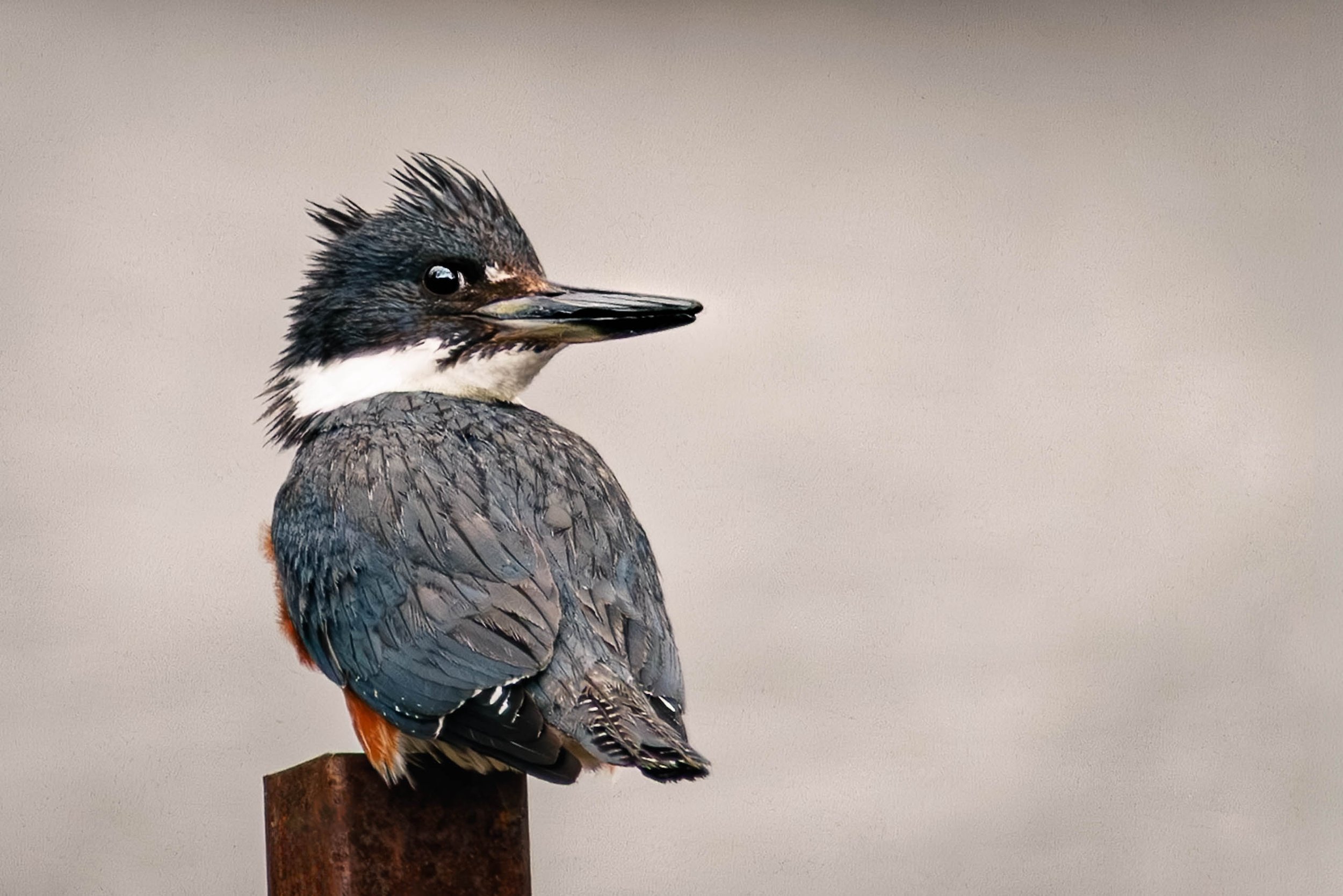
A female Belted Kingfisher stands alert atop a weathered rust post at Evergreen Lake, Colorado, her ragged crest catching the light against a soft, neutral sky. Caught in profile, she surveys her territory with the sharp, watchful stillness kingfishers are known for — a moment of quiet tension before the next dive.
The photograph isolates her completely from environment or clutter, letting the bird's own architecture carry the composition: the dagger-like bill, the white collar breaking the dark plumage, and the warm rust band across her belly — the marking that identifies her as female, since male Belted Kingfishers lack this color entirely. The muted gray backdrop and rusted perch let her natural palette of slate blue, white, and burnt orange read as the focal point without distraction.
There's a rawness to the image that feels closer to a candid portrait than a typical bird photograph — feathers slightly windblown, posture alert rather than posed, capturing the restless energy of a bird that rarely holds still for long.
Belted Kingfishers hunt by watching from a perch and then plunging headfirst into the water for fish, so a bird holding still on a post is a moment of stored energy. The pause before the dive is as much the subject as the bird herself.
Design & Styling
The slate blue, white, and burnt-orange palette of Kingfisher on Watch, set against a soft neutral sky, suits lake and cabin homes, studies, offices, and boutique hospitality where wildlife is welcome. The clean, uncluttered background lets it sit comfortably on a small wall.
Curated Pairings
To create a cohesive gallery wall around wildlife in a single moment, consider these companion pieces:
For the same lake: Pair with Edge of Stillness, a bald eagle motionless at the line between ice and water on Evergreen Lake, another bird held in a single, watchful moment.
For wildlife continuity: Complement this piece with Where the Water Rests, extending the theme of wildlife captured in quiet, watchful moments.
For small creatures: Pair with A Brief Landing, extending the theme of small creatures caught in a single suspended moment.
For scale contrast: Add The Long Way Across, a dialogue between large-scale wildlife portraiture and intimate macro detail.
Fine Art Presentation
Available as a signed fine art print on ChromaLuxe® Metal (gloss, semi-gloss, or matte), Glossy Anti-Glare Acrylic (TruLife), canvas, wood, and archival paper (framed or unframed). Framed archival paper is the recommended presentation: its matte surface preserves the fine feather texture and the subtle gradation across the neutral background. ChromaLuxe® Metal is the alternative for crisper detail in the crest and bill.
Note: Custom and oversized photographic prints are available. Please contact the studio directly to discuss custom framing, matting, or specialized museum glass options.
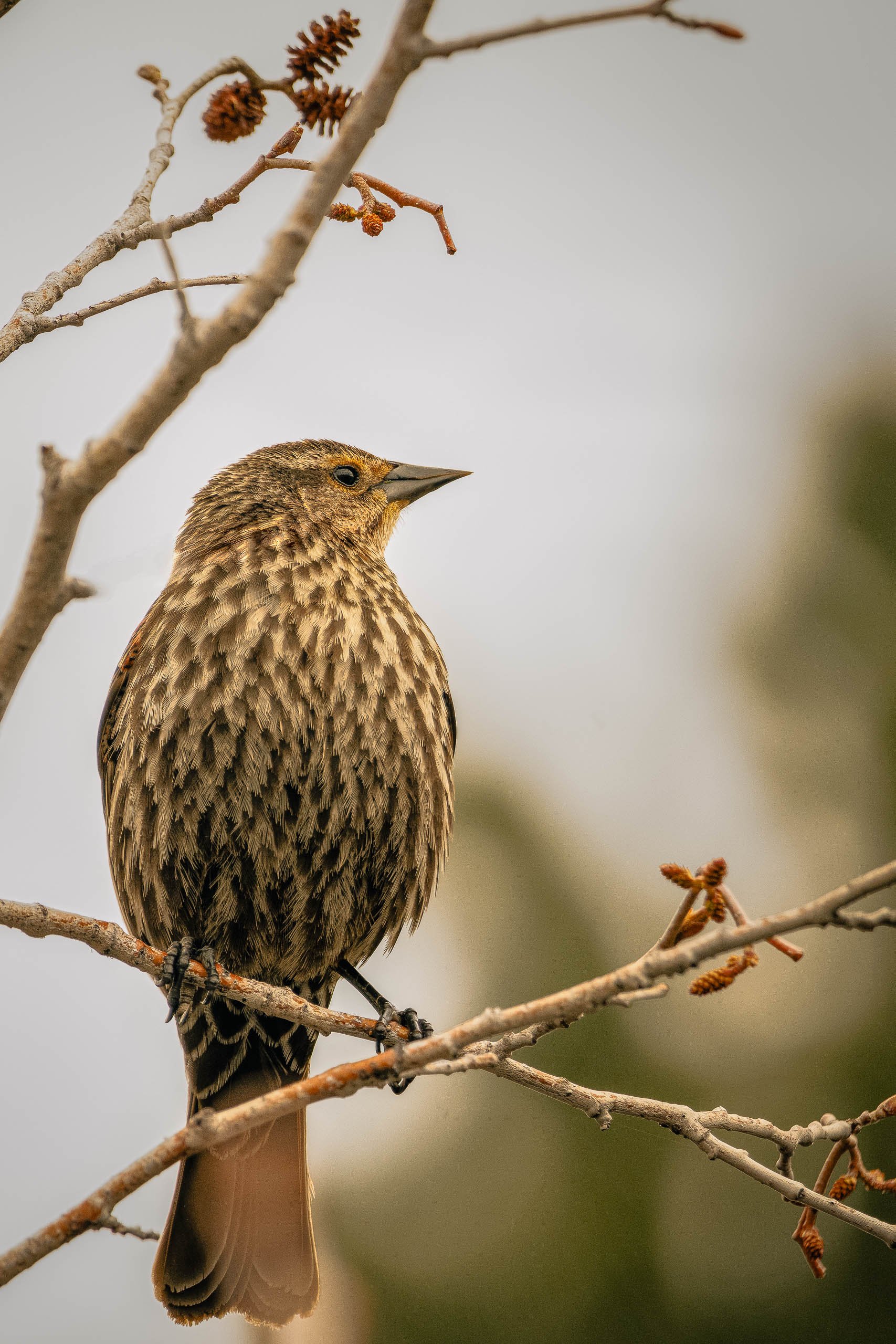
A female red-winged blackbird holds still against a pale winter sky, her streaked plumage catching low, warm light while bare alder branches trace quiet lines above and around her. The catkins haven't opened yet — small, tight cones still waiting on the season to turn — and that sense of anticipation carries through the whole frame. She's alert, head turned, watching something just out of view, one foot gripping the branch and the other braced against a crossing twig below.
The palette is restrained: soft grays and warm buff tones in the feathers, a hazy neutral sky, and a deep, unfocused green ghosting the lower right corner where the background falls away into shadow. It's an intimate, close crop — the kind of patient, still attention that recalls Wim Wenders' eye for stillness inside movement, and Ernst Haas' instinct for finding color and atmosphere in the overlooked moment.
This is a study in quiet watchfulness — the pause before spring, held in a single frame.
Design & Styling
This piece brings a grounded, natural warmth to spaces that want texture without noise. Its neutral palette and intimate subject work especially well in:
Wellness centers and healthcare spaces — the soft tones and natural subject matter support a calming, restorative atmosphere
Residential settings — reading nooks, bedrooms, or entryways where a quieter, contemplative piece suits the scale of the room
Hospitality spaces — lobbies, lounges, or guest rooms looking for understated nature photography that doesn't compete with other design elements
Curated Pairings
For wildlife continuity: Where the Water Rests — a Canada goose at rest on still water, another quiet moment of Colorado wildlife watching and being watched
For color harmony: Amber Morning — matching warm, muted golds and neutral tones in a botanical study
For visual contrast: Kali - Grace in Profile — a black-and-white wildlife portrait that plays against this piece's warmth and color with quiet, monochrome stillness
Fine Art Presentation
Available in framed archival paper, ChromaLuxe® Metal (gloss, semi-gloss, or matte), canvas, and gallery-grade acrylic. Given the fine feather detail and the softness of the background bokeh, metal print is especially well suited to this image — it holds the sharpness of the bird's plumage while letting the out-of-focus branches and sky recede naturally. A smaller format (12x12 or 12x16) keeps the intimacy of the original composition; framed archival paper is a strong alternative for a more traditional presentation.
Note: Custom and oversized photographic prints are available. Please contact the studio directly to discuss custom framing, matting, or specialized museum glass options.
Animals
Animals
Filters
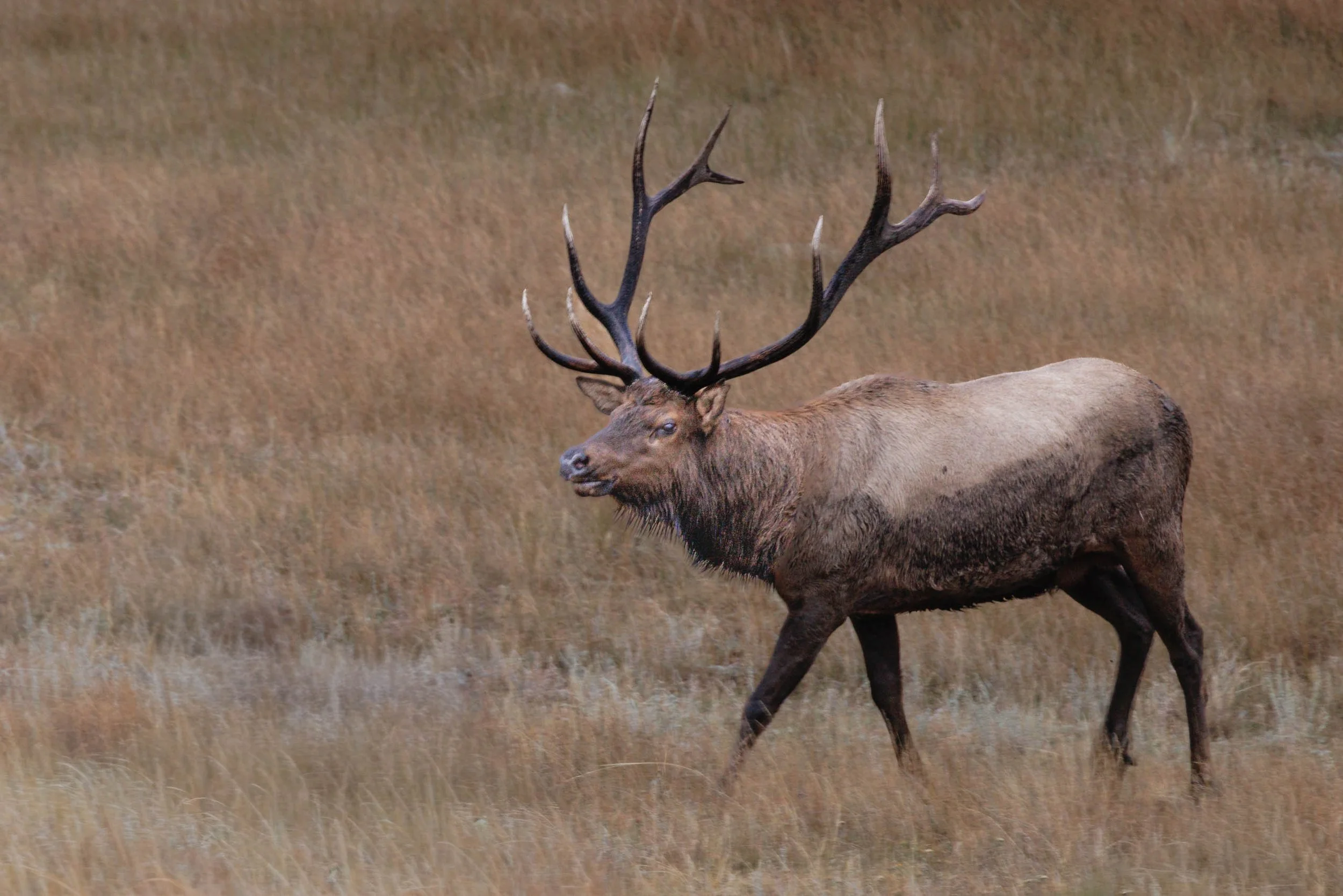
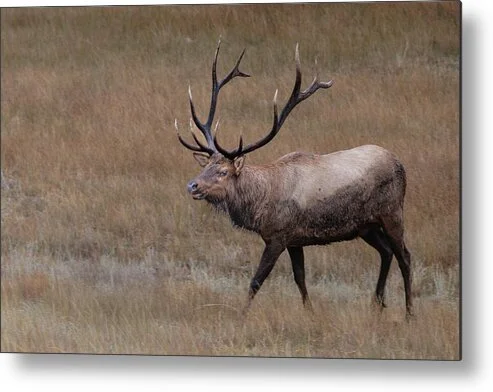
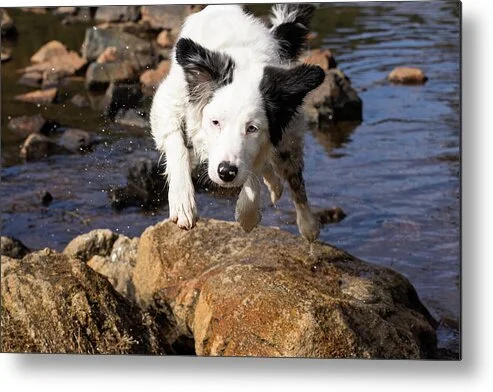
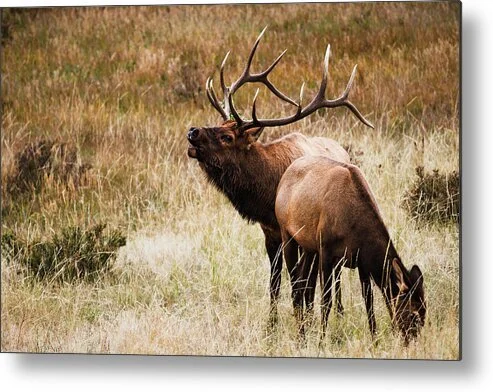
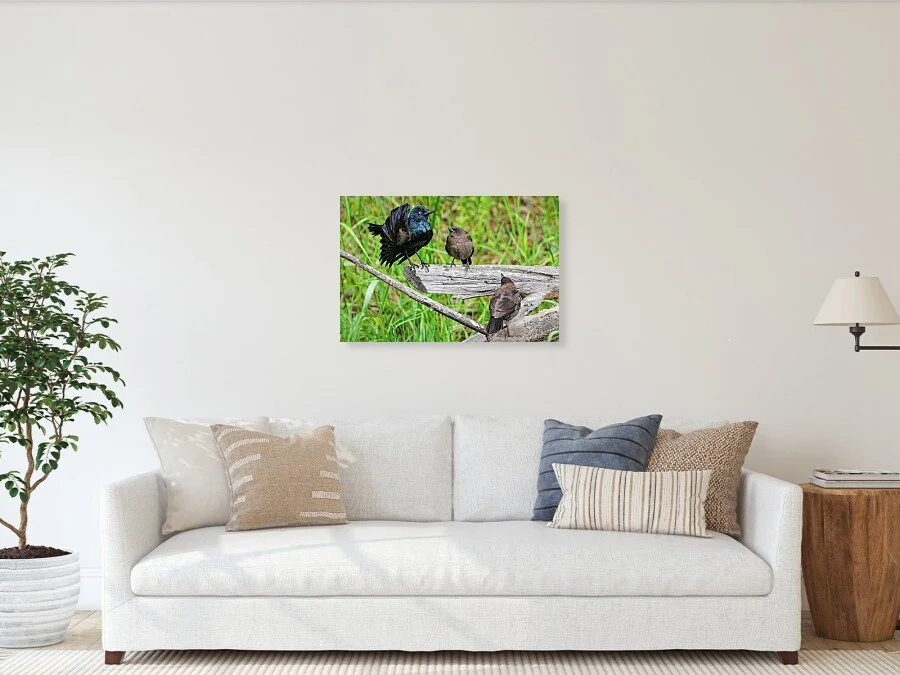
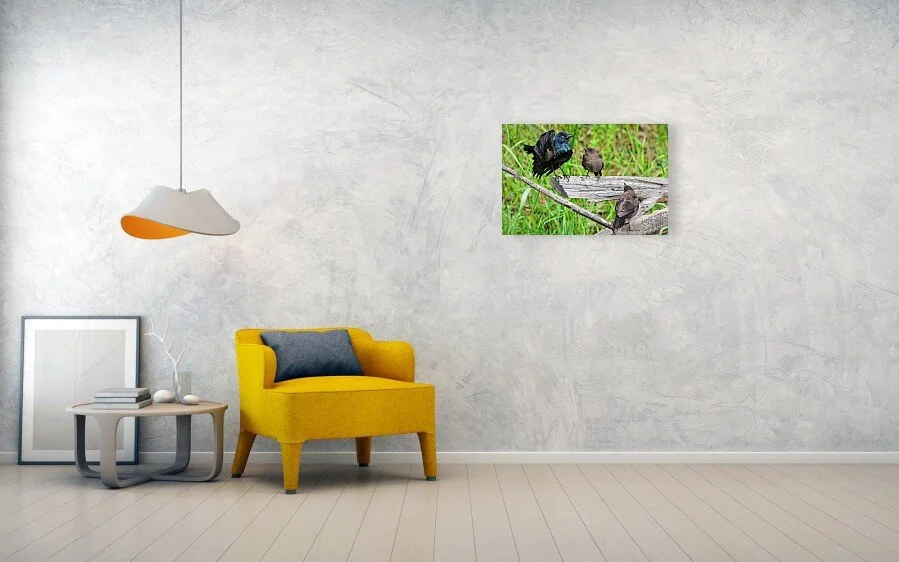

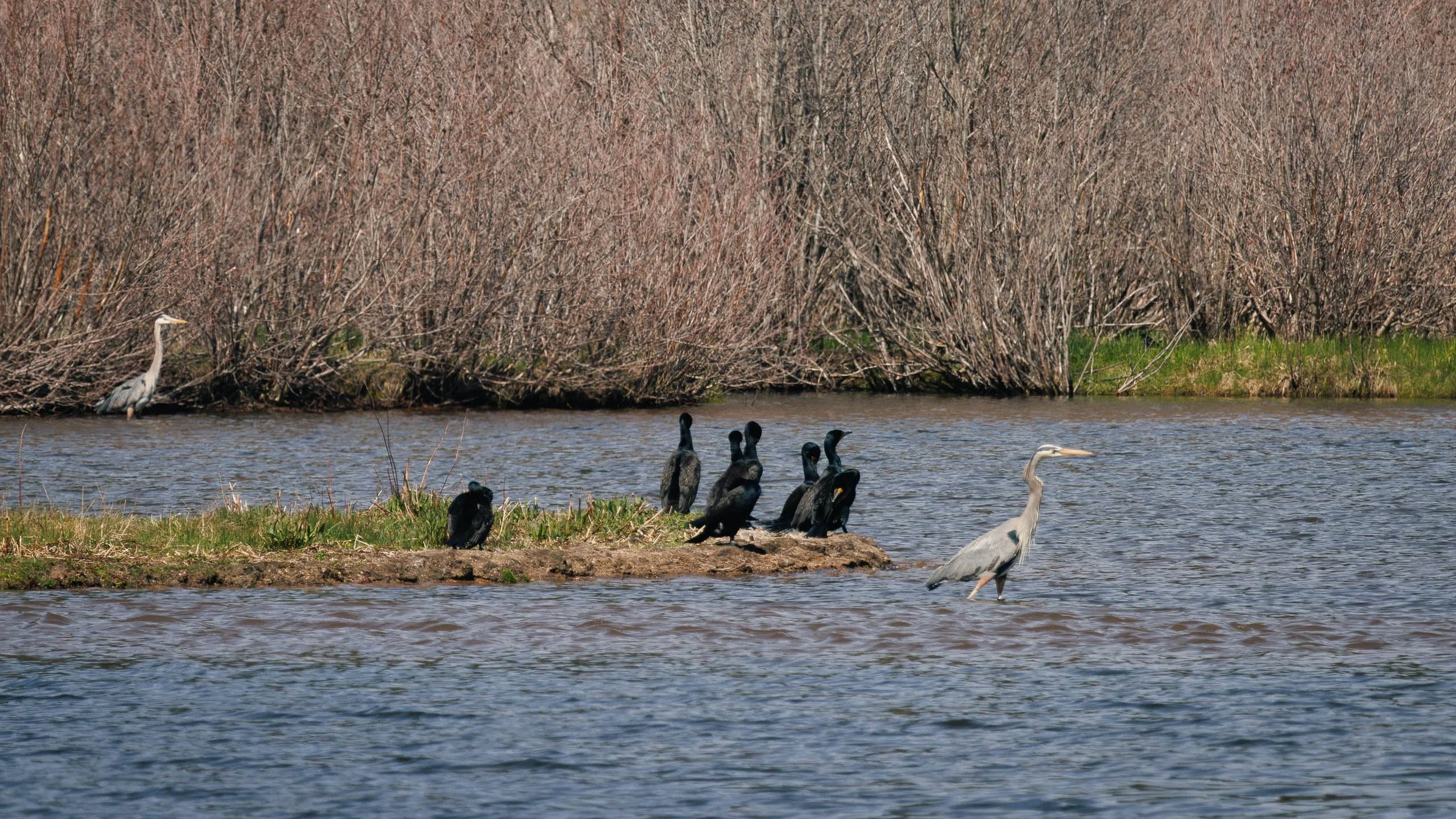
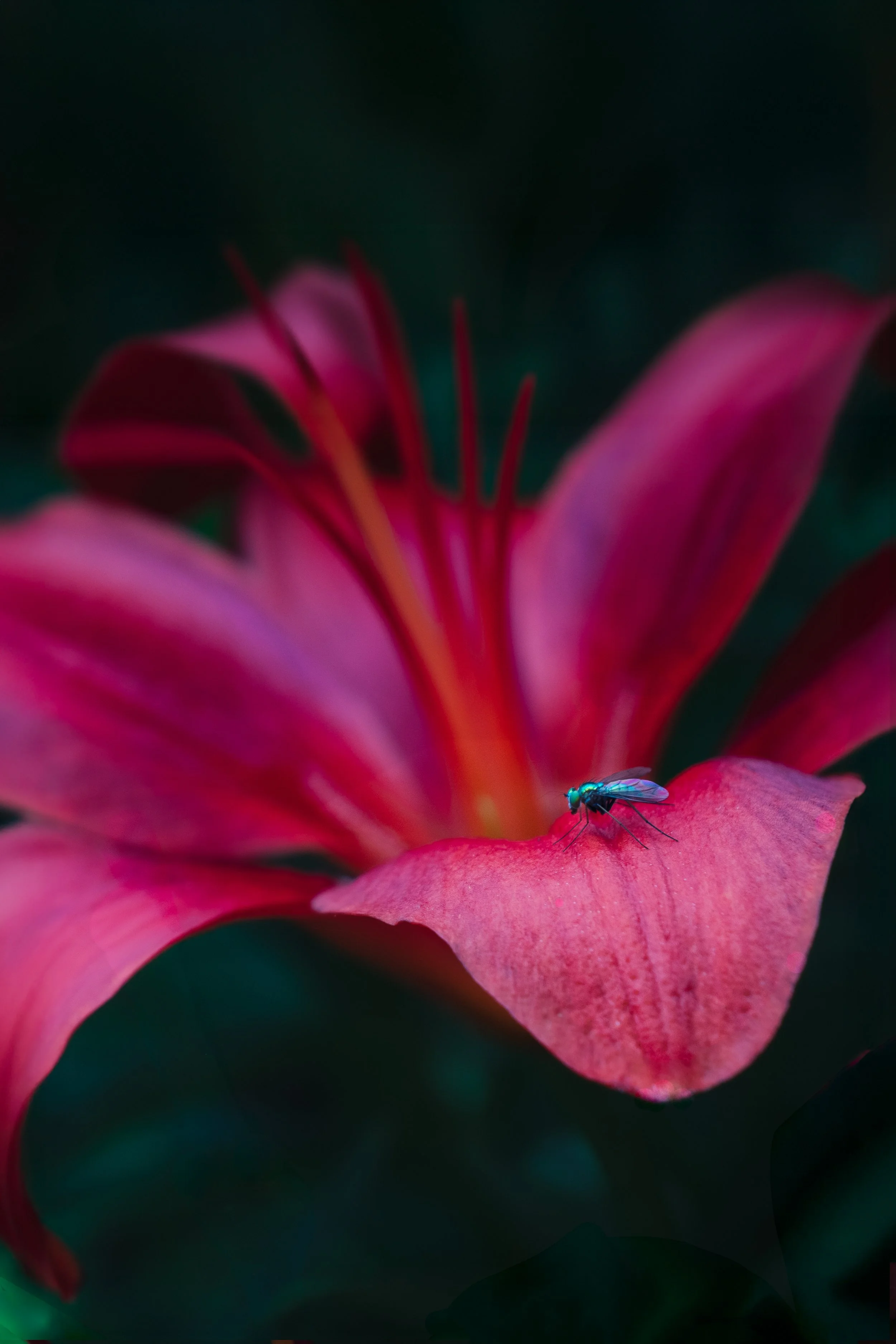
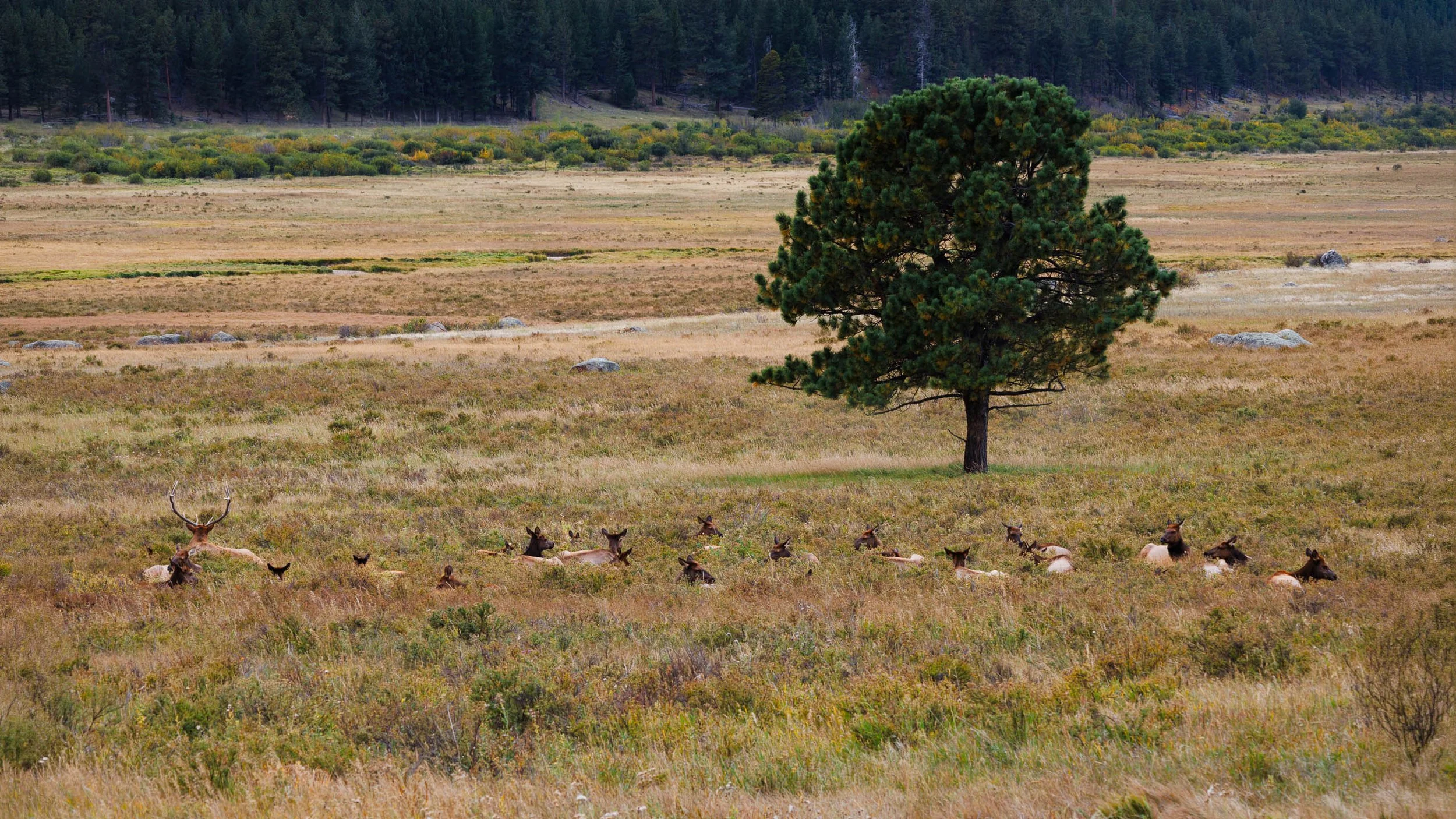
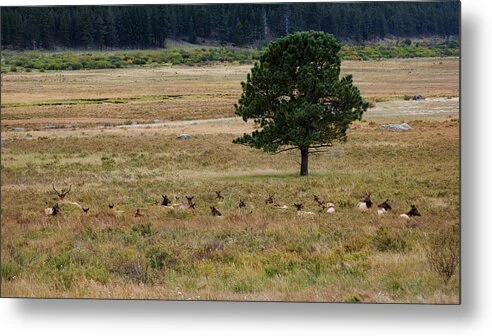
No results found
No results match your search. Try removing a few filters.
The Quiet Crossing finds a mature bull elk moving alone through golden autumn grass in Rocky Mountain National Park, antlers rising against the open meadow as he crosses at an unhurried pace. Where a bugling display announces itself, this is the opposite gesture — quiet, private, a moment easy to miss in the middle of a much louder season.
A large, softly blurred foreground element anchors the lower left of the frame, giving the image real depth and a sense of vantage — the viewer is tucked in close, watching from behind cover as the bull passes through the middle distance. Warm, even natural light holds full detail across his coat and antlers, letting the animal's individual character — the specific rack, the specific gait — carry the frame rather than dramatic lighting doing the work for it.
Solo elk portraits are as common as the species itself in Western wildlife photography, but the depth of field, the vantage, and the unhurried, private nature of the moment set this apart from a straightforward documentation shot — continuing the same interest in quiet, specific narrative found across Robert Niemeier's animal work, and the direct, deliberate counterpart to Falling on Deaf Ears within the same rut season.
Design & Styling
The Quiet Crossing works well as a statement piece in mountain lodge and ranch great rooms, executive offices, and ski resort lobbies looking for an authentic, high-impact Colorado presence, and its calm, unhurried subject also suits healthcare and senior-living spaces where nature imagery without visual tension is preferred.
Curated Pairings
For shared subject: Pair with Held at Rest, the same species and park, offering a herd's collective stillness against this piece's solitary motion.
For shared subject, direct contrast: Complement with Falling on Deaf Ears, the loud, assertive counterpart to this quiet passage — same bull elk rut, opposite register entirely.
For formal treatment: Pair with Standing Ground, which shares the same full-light, full-detail rendering of a distinguished individual held within open grassland.
Fine Art Presentation
Available as a signed, numbered limited edition print (edition of 15) in Gallery Metal, ChromaLuxe® Metal, TruLife Acrylic, archival paper, canvas, and wood presentation formats. The warm, evenly rendered palette and organic subject suit Canvas particularly well, giving the coat and grass a soft, painterly quality; ChromaLuxe® Metal is a strong alternative where crisper antler detail and richer color are the priority.