
 Image 1 of 3
 Image 2 of 3
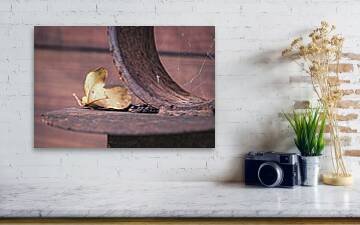 Image 3 of 3
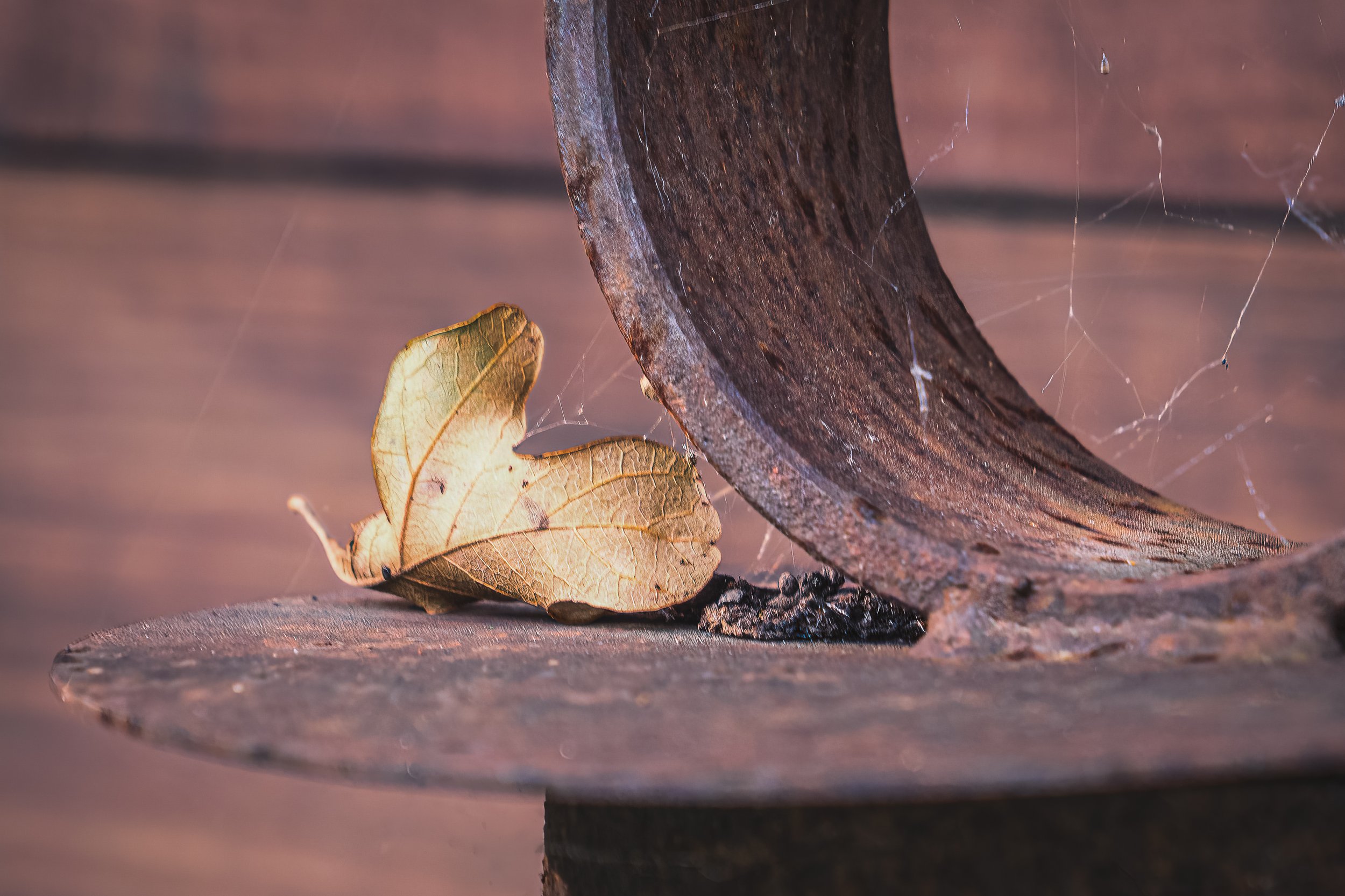
What the Web Kept is a quiet study in fragility and time — a single dried leaf, caught mid-fall in the threads of a spider's web, resting against the weathered curve of a rusted iron hook. Backlit by low, warm light, the leaf glows amber from within, its veins traced in fine red-gold lines, while the ironwork behind it curves away into shadow, dusted with the same threads that hold the leaf in place. Nothing here was arranged. The scene was found exactly as it appears — a small, overlooked corner where two very different kinds of decay, organic and industrial, happened to meet.
The composition moves from the glowing leaf at lower left, along the sweep of the rusted curve, and up into a loose scatter of web strands catching light in the upper right — three unrelated materials, wood, iron, and silk, unified by a single warm palette and a single fading light. The dark tangle of debris at the base of the hook anchors the frame with real shadow, giving the warm midtones somewhere to rest and the leaf's glow real contrast to push against.
Drawing on the quiet still-life tradition of Josef Sudek and the tightly rhymed found-object framing of Harry Callahan, with a restrained, autumnal warmth that also recalls Andrew Wyeth's interiors, the photograph treats a discarded leaf and a stretch of rusted hardware not as debris but as a small, self-contained composition — a reminder that the most rewarding subjects are often the ones that ask to be noticed rather than announced.
Design & Styling
With its warm amber-and-rust palette and intimate scale, What the Web Kept works well as an accent piece in reading nooks, home offices, and quiet residential corners, as well as in healthcare and hospitality settings where a calm, nature-adjacent image with no unsettling content is welcome — waiting rooms, patient corridors, and boutique guest rooms alike. It reads as a smaller, contemplative companion piece rather than a large-format anchor image; it rewards close viewing more than it commands a room from a distance.
Curated Pairings
To build a cohesive botanical or quiet-detail grouping, consider these companion pieces from the Botanical Studies collection:
For thematic echo: Pair with A Brief Landing, continuing the study of small, discovered creatures resting on natural forms.
For tonal harmony: Complement with Gold Inversion, extending the same warm amber-gold palette in a purely botanical register.
For quiet contrast: Pair with Center of Grace, introducing a monochrome counterpoint that shares the same restrained, close-looking sensibility.
Fine Art Presentation
Available as a signed fine art print in metal, framed paper, framed canvas, and acrylic presentation formats. Acrylic prints are produced on low-glare TruLife acrylic; framed and unframed paper prints are produced on Photo Rag unless otherwise specified. Given the fine detail in the leaf's venation and the web strands, Chromaluxe Metal or framed Photo Rag paper at a modest-to-mid size is recommended to preserve edge sharpness; the piece is better suited to intimate viewing distances than very large-format installation.
Note: Custom and oversized photographic prints are available. Please contact the studio directly to discuss custom framing, matting, or specialized museum glass options.
What the Web Kept is a quiet study in fragility and time — a single dried leaf, caught mid-fall in the threads of a spider's web, resting against the weathered curve of a rusted iron hook. Backlit by low, warm light, the leaf glows amber from within, its veins traced in fine red-gold lines, while the ironwork behind it curves away into shadow, dusted with the same threads that hold the leaf in place. Nothing here was arranged. The scene was found exactly as it appears — a small, overlooked corner where two very different kinds of decay, organic and industrial, happened to meet.
The composition moves from the glowing leaf at lower left, along the sweep of the rusted curve, and up into a loose scatter of web strands catching light in the upper right — three unrelated materials, wood, iron, and silk, unified by a single warm palette and a single fading light. The dark tangle of debris at the base of the hook anchors the frame with real shadow, giving the warm midtones somewhere to rest and the leaf's glow real contrast to push against.
Drawing on the quiet still-life tradition of Josef Sudek and the tightly rhymed found-object framing of Harry Callahan, with a restrained, autumnal warmth that also recalls Andrew Wyeth's interiors, the photograph treats a discarded leaf and a stretch of rusted hardware not as debris but as a small, self-contained composition — a reminder that the most rewarding subjects are often the ones that ask to be noticed rather than announced.
Design & Styling
With its warm amber-and-rust palette and intimate scale, What the Web Kept works well as an accent piece in reading nooks, home offices, and quiet residential corners, as well as in healthcare and hospitality settings where a calm, nature-adjacent image with no unsettling content is welcome — waiting rooms, patient corridors, and boutique guest rooms alike. It reads as a smaller, contemplative companion piece rather than a large-format anchor image; it rewards close viewing more than it commands a room from a distance.
Curated Pairings
To build a cohesive botanical or quiet-detail grouping, consider these companion pieces from the Botanical Studies collection:
For thematic echo: Pair with A Brief Landing, continuing the study of small, discovered creatures resting on natural forms.
For tonal harmony: Complement with Gold Inversion, extending the same warm amber-gold palette in a purely botanical register.
For quiet contrast: Pair with Center of Grace, introducing a monochrome counterpoint that shares the same restrained, close-looking sensibility.
Fine Art Presentation
Available as a signed fine art print in metal, framed paper, framed canvas, and acrylic presentation formats. Acrylic prints are produced on low-glare TruLife acrylic; framed and unframed paper prints are produced on Photo Rag unless otherwise specified. Given the fine detail in the leaf's venation and the web strands, Chromaluxe Metal or framed Photo Rag paper at a modest-to-mid size is recommended to preserve edge sharpness; the piece is better suited to intimate viewing distances than very large-format installation.
Note: Custom and oversized photographic prints are available. Please contact the studio directly to discuss custom framing, matting, or specialized museum glass options.