
New Mexico | The High Desert & Adobe Traditions
New Mexico Fine Art Landscape Photography
The light in New Mexico carries a rare clarity that defines every weathered edge of an adobe wall and every distant mesa.
Moving beyond the vibrant travel clichés, this collection explores the quiet, enduring spirit of the high desert—focusing on the intersection of cultural history and the vastness of the Southwest landscape.
Influenced by the restraint of tonalist painting, these images seek the stillness found in the morning mist around Shiprock and the winding, shadow-filled backroads of Taos. It is a study of a landscape that feels both ancient and permanent, captured for spaces that value grounding and architectural silence.
“When I got to New Mexico, that was mine. As soon as I saw it, that was my country... It’s something that’s in the air, it’s just different. The sky is different, the stars are different, the wind is different.
”
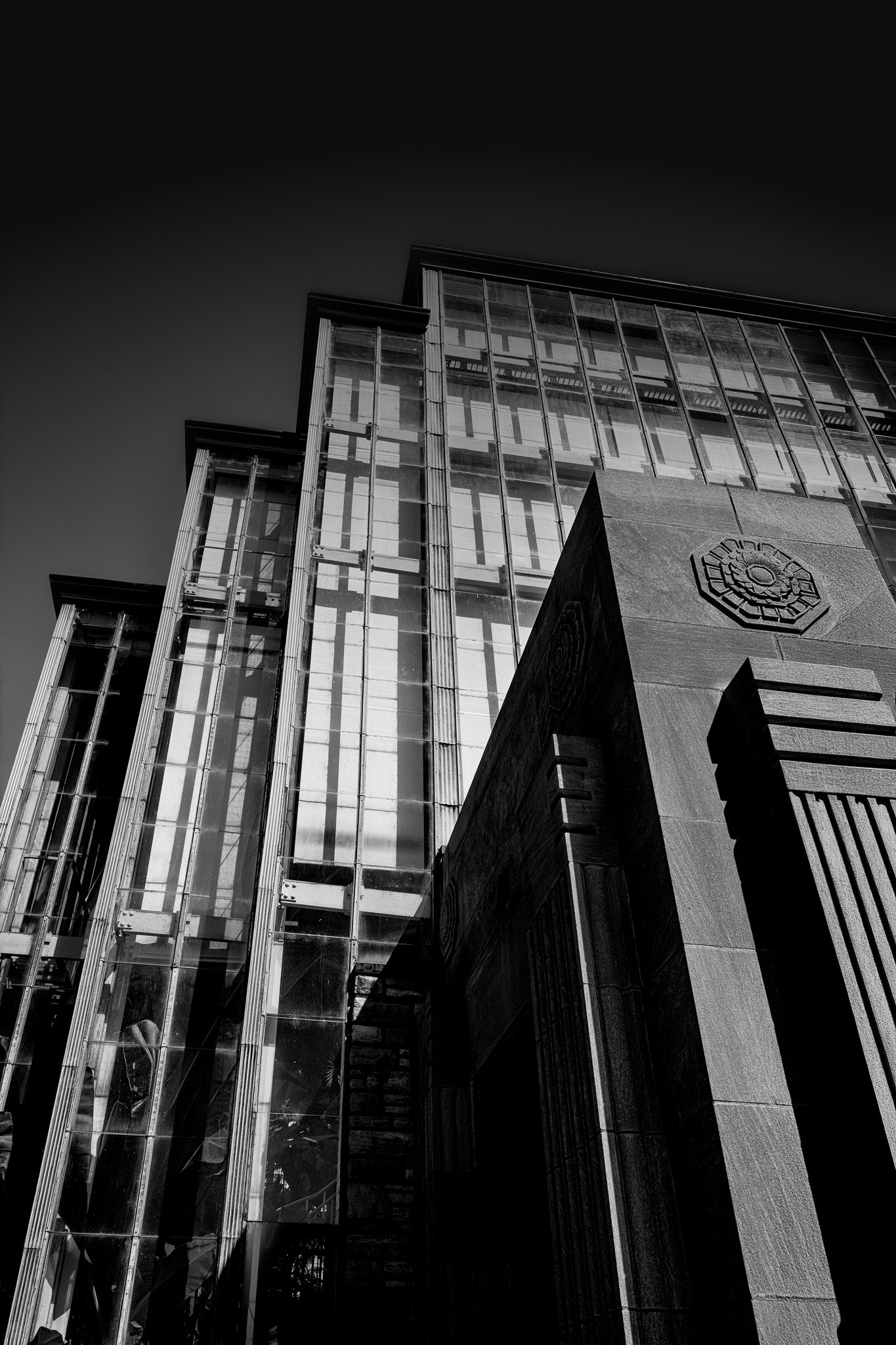
Silver-gray glass and illuminated stone rise against a charcoal sky at the Jewel Box in Forest Park, St. Louis. Seen from below, four stepped rooflines establish an ascending rhythm, while the carved stone entrance gives the foreground weight and texture.
The monochrome photograph brings transparency and solidity into the same frame. Through the glass, repeated structural panels create a layered pattern of light and shadow. Beside them, the entrance’s ornament and projecting stonework become sculptural forms. The upward viewpoint reveals the building through its geometry, making an arrival at a familiar landmark an invitation to look more closely.
Design & Styling
This vertical architectural study suits contemporary living spaces, architectural offices, and hospitality interiors. Its monochrome palette connects naturally with stone, concrete, metal, and neutral furnishings. The stepped silhouette reads across a room, while the glass framework and carved detail reward closer attention.
Curated Pairings
To build a wall around ascending geometry and glass, consider these companion pieces:
For the same building in garden green: Pair with The Jewel Box Garden, the glass conservatory rising between mature trees, with red-rimmed lily pads in the foreground.
For the same building at the end of the day: Complement with Held in Afterglow, the glass still lit as the sky cools above it.
For vertical movement and light: Add Vertical Interval, structure and light inside an unexpected Prague tower.
For rhythm in public structure: Round out the wall with Steel Echoes, a run of stainless steel rings turned into a pattern.
Fine Art Presentation
Framed archival paper is a strong choice for the photograph’s tonal transitions and stone texture. ChromaLuxe® Metal, available in gloss, semi-gloss, or matte, emphasizes the clean structural lines and contrast. Acrylic offers additional visual depth in the layered glass facade.
Note: Custom and oversized photographic prints are available. Please contact the studio directly to discuss custom framing, matting, or specialized museum glass options.
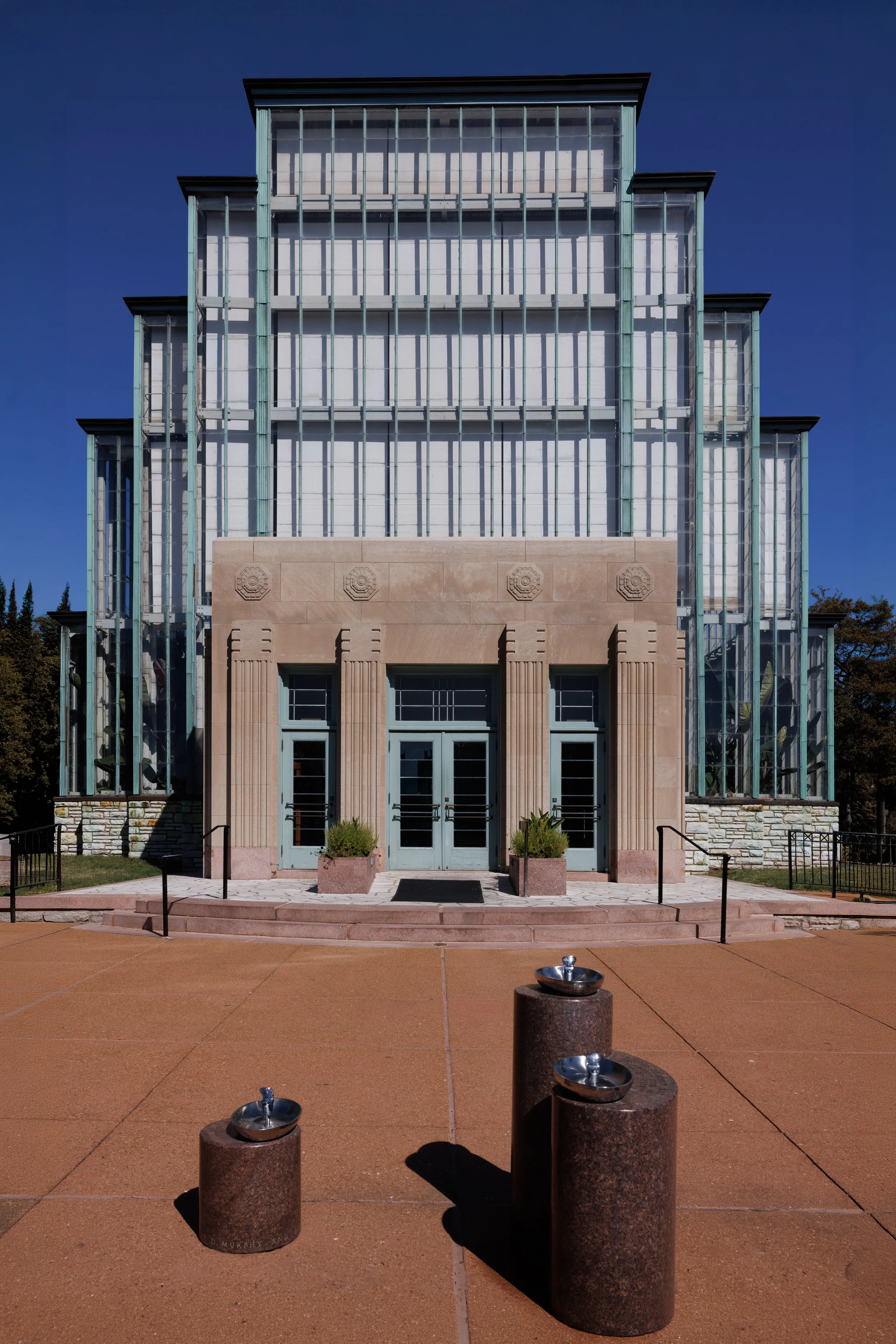
Deep blue sky and terracotta pavement frame the Jewel Box entrance in Forest Park, St. Louis. The stepped glass façade rises above pale stone columns and blue-green doors, while three drinking fountains occupy the foreground. Their polished bowls catch the daylight, introducing rounded forms beneath the building’s repeated vertical lines.
The fountains are part of the portrait. Their different heights establish a smaller rhythm in front of the rising roofline, and their substantial stone bases cast distinct shadows across the pavement. They bring the scale of the photograph back to an everyday encounter: approaching the doors, pausing for water, spending time in the park.
No visitors appear, but the entrance remains a place built for people. Doors, steps, handrails, planters, and fountains describe how the landmark is used as well as how it looks. At the Jewel Box Entrance brings those ordinary details into a formal daylight view of a familiar St. Louis building.
Design & Styling
The vertical composition suits an entryway, an office, or a narrower wall where the building’s upward rhythm can register. Deep blue, blue-green, warm stone, and terracotta connect naturally with wood furniture, cream walls, and restrained earth tones.
The photograph offers a recognizable local subject for St. Louis homes, hospitality spaces, and architecture or design offices. For someone with memories of the Jewel Box, the direct view of its doors and approach provides a personal connection to the place.
Curated Pairings
For another view of the same landmark: Pair with Held in Glass. Its cooler pond reflection complements this close daylight portrait of the entrance and drinking fountains.
For Forest Park architecture: Pair with Evening at the Pavilion. The bandstand’s open curves and evening light contrast with the Jewel Box’s upright glass grid and sunlit stonework.
For glass, geometry, and blue: Complement with Blue Interval. Its reflected clouds and repeated window patterns extend the architectural rhythm into a more abstract view.
For a deliberate architectural comparison: Pair with El Santuario de Chimayó. Both compositions approach a centered entrance through a prominent foreground feature, setting warm building materials against deep blue sky; glass and stone here contrast with the church’s adobe forms.
Fine Art Presentation
Gallery Metal offers a clean presentation for the façade’s fine lines, carved stone, and foreground textures. ChromaLuxe® Metal in gloss, semi-gloss, or matte provides an alternative for emphasizing the blue sky and warm pavement.
Framed archival paper suits a quieter presentation, with a warm white mat and a simple frame that supports the architectural geometry. TruLife Acrylic offers additional visual depth, while canvas gives the fine detail a softer treatment.
The full composition, including all three drinking fountains, is preserved in standard vertical 2:3 proportions.
Note: Custom and oversized photographic prints are available. Please contact the studio directly to discuss custom framing, matting, or specialized museum glass options.
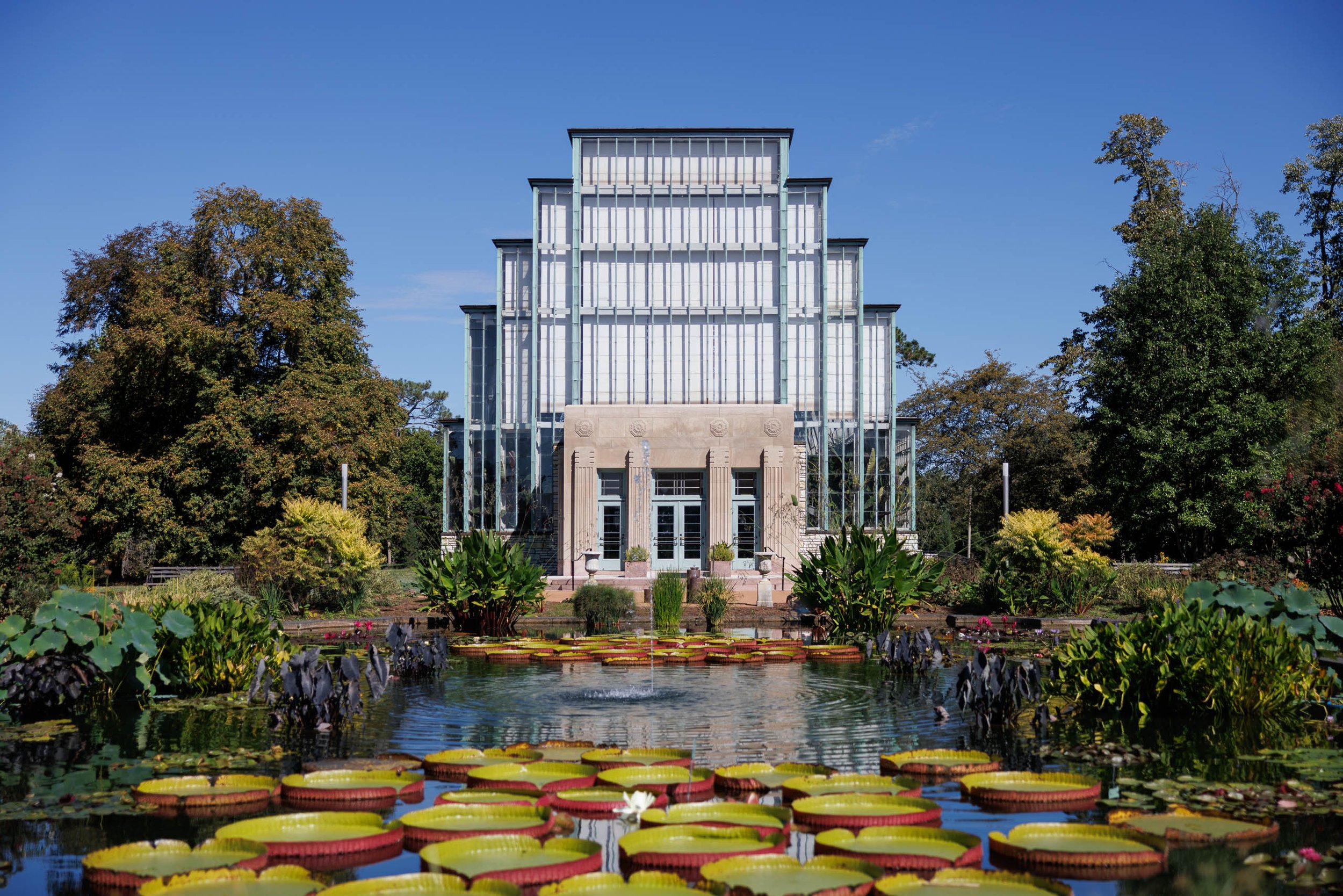
Blue sky and garden green surround the Jewel Box in this daylight photograph from Forest Park in St. Louis. The glass conservatory rises between mature trees, while broad lily pads with deep red rims spread across the foreground pond. A small fountain sends ripples through the reflected façade, connecting the building’s straight lines with the movement of water.
The centered entrance anchors the composition. Repeated glass panels climb toward the stepped roofline, while the planting opens around a clear stretch of water leading toward the doors. Near the viewer, rounded leaves and white water lilies introduce a different rhythm: overlapping, irregular, and close enough to reveal the garden’s changing textures.
The Jewel Box Garden holds the landmark within its surroundings. It offers a daylight view for those who remember the conservatory through garden visits, Forest Park walks, or celebrations connected to this familiar St. Louis place.
Design & Styling
The horizontal composition suits a wall above a sofa, console, or office credenza. Blue, green, pale stone, and burgundy-red accents work comfortably with warm neutrals, natural wood, and interiors that connect architecture with the outdoors.
For St. Louis homes, hospitality spaces, and professional offices, the recognizable building gives the photograph a local connection. The garden and fountain broaden its appeal to viewers drawn to conservatories, water gardens, and botanical subjects.
Curated Pairings
For Forest Park in different light: Pair with Evening at the Pavilion. Both photographs place Forest Park architecture beside water, with the pavilion’s evening glow offering a contrast to this garden’s clear daylight.
For another interpretation of the Jewel Box: Pair with Held in Glass. Its cooler light and emphasis on reflection complement the wider garden setting and red-rimmed lily pads here.
For architectural rhythm: Complement with Blue Interval. Reflected sky and repeated glass lines connect the two photographs, moving from a recognizable garden landmark to a closer architectural abstraction.
Fine Art Presentation
ChromaLuxe® Metal is the recommended presentation for the building’s defined glass lines and the contrasting green and burgundy tones of the lily pads. Gloss, semi-gloss, and matte finishes offer different surface treatments for the intended setting.
TruLife Acrylic is an alternative for emphasizing depth in the water and reflected architecture. Framed archival paper gives the scene a quieter presentation, especially with a warm white mat and a simple wood or dark frame. Canvas softens the fine architectural detail, while wood introduces a warmer surface character.
The complete horizontal composition is preserved in standard 3:2 proportions.
Note: Custom and oversized photographic prints are available. Please contact the studio directly to discuss custom framing, matting, or specialized museum glass options.
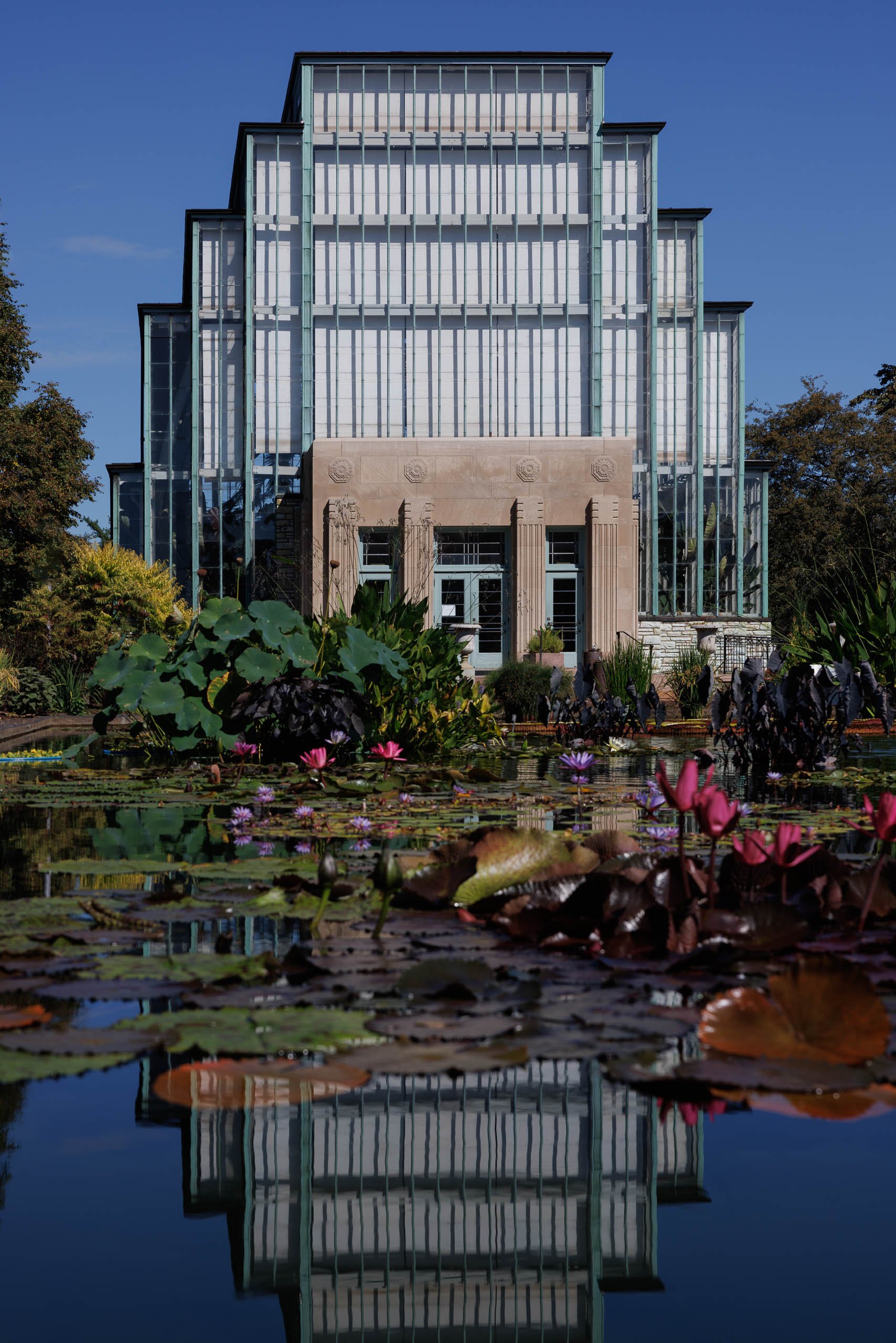
Blue sky and garden green surround the Jewel Box in this daylight photograph from Forest Park in St. Louis. Its stepped glass façade rises above a pond of lily pads and pink blossoms, then appears again in the darker water below. Pale glass, warm stone, and deep foliage give the familiar landmark a distinct presence within its garden.
The building establishes the composition’s order: repeated vertical lines, a centered entrance, and a roofline that climbs toward the middle. Across the pond, broad leaves and scattered flowers interrupt that geometry. The reflection brings the two together, carrying the architecture into the garden without losing its recognizable shape.
For those who know the Jewel Box through visits, celebrations, or everyday walks in Forest Park, this photograph offers a clear daylight view of a place tied to personal memories.
Design & Styling
The vertical composition suits an entryway, a reading corner, or a narrower wall in a professional office. Blue, green, and warm stone tones work naturally with cream walls, wood furniture, and restrained blue accents, while the pink flowers provide a small point of contrasting color.
Jewel Box Reflections also suits St. Louis hospitality spaces and architecture or design offices seeking a recognizable local subject. For someone with a personal connection to the conservatory, it offers a place-specific gift with both architectural detail and garden character.
Curated Pairings
For the same place in different light: Pair with Held in Glass. Its cooler evening interpretation creates a direct comparison with the blue sky, flowers, and defined daylight of Jewel Box Reflections.
For a Forest Park pairing: Pair with Evening at the Pavilion. Two Forest Park structures connect through water reflections, with the pavilion’s evening glow complementing the Jewel Box’s daylight clarity.
For glass and reflected sky: Complement with Blue Interval. Its closer, more abstract treatment of glass architecture echoes the façade’s repeated lines while changing the scale of the view.
Fine Art Presentation
ChromaLuxe® Metal in gloss, semi-gloss, or matte suits the defined architectural lines and blue-green palette. TruLife Acrylic offers an alternative presentation emphasizing the depth of the water and reflection. Framed archival paper provides a quieter treatment, particularly with a warm white mat and a simple frame that echoes the building’s geometry.
Canvas softens the fine architectural detail, while wood introduces a warmer material character. The full vertical composition is maintained in standard 2:3 proportions.
Note: Custom and oversized photographic prints are available. Please contact the studio directly to discuss custom framing, matting, or specialized museum glass options.
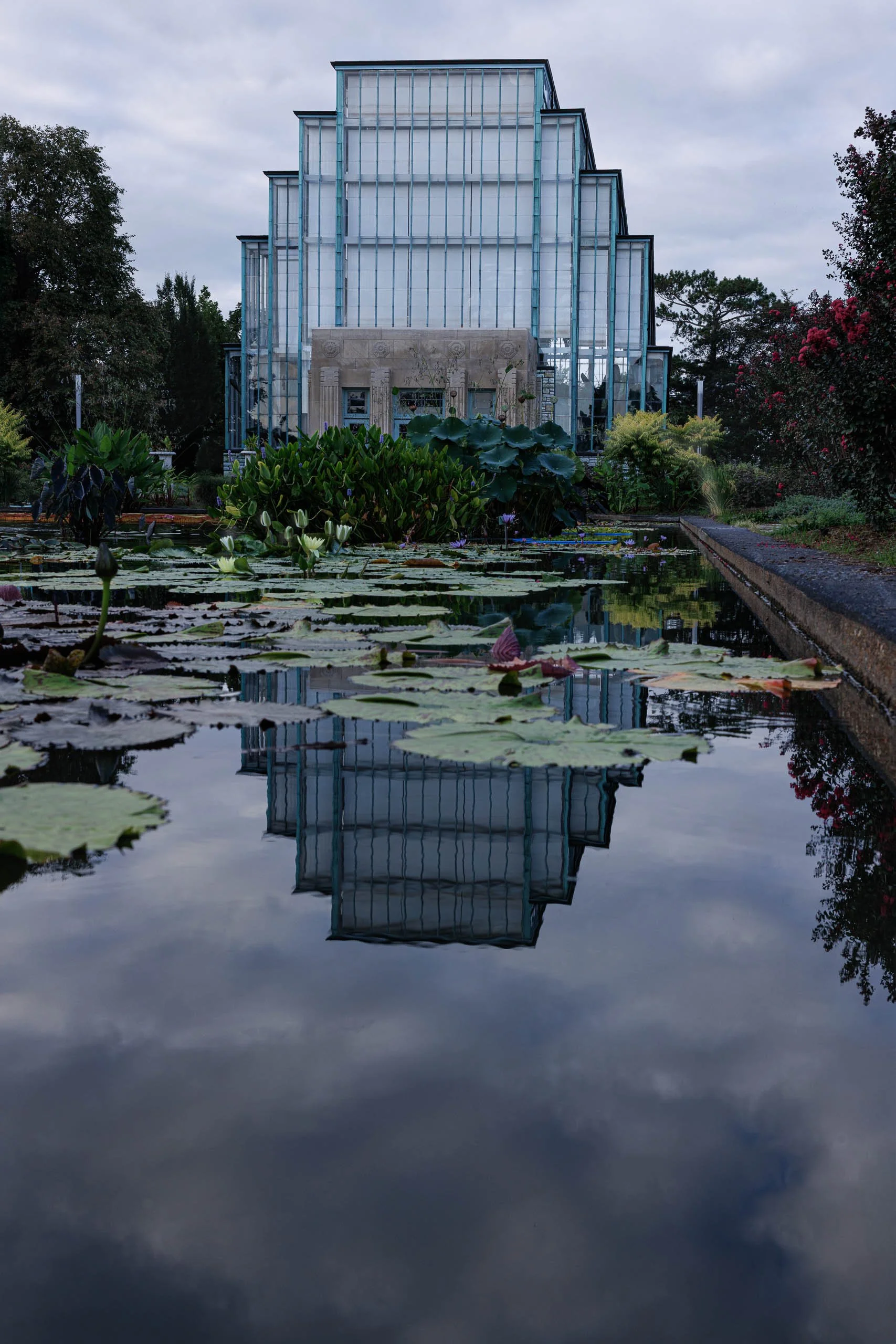
Held in Glass finds the Jewel Box, Forest Park’s, Art Deco glass conservatory, doubled almost perfectly in the still surface of its reflecting pool at blue hour, a dense foreground of lily pads and a single white water lily blossom breaking the symmetry below.
The stepped-pyramid glass structure rises center-frame, its vertical mullions catching the last cool light of dusk, while the pool beneath mirrors the whole building back into the water — look closely and the reflection holds real color, not just silhouette. The overcast sky sits flat and even above, giving the scene a quiet, held-breath calm rather than any drama.
Forest Park’s Jewel Box is one of the most recognizable buildings in St. Louis, and this particular vantage — the reflecting pool, straight on — is close to the view most visitors come away with. What sets this apart is the blue-hour timing and the density of the lily pads pressed right up to the lens, continuing the same interest in still-water doubling found in pieces like The Silent Assembly, here turned toward architecture instead of landscape.
Design & Styling
With its cool, restrained palette and unmistakable architectural subject, Held in Glass suits hospitality lobbies, hotel and resort interiors, architecture and design firm offices, and healthcare or senior-living settings where a calm, non-jarring image is preferred. The Jewel Box is also one of St. Louis's most popular wedding venues, making this a natural anniversary gift or keepsake for couples married there.
Curated Pairings
To build a wall around the Jewel Box and Forest Park glass, consider these companion pieces:
For the same building, by daylight: Pair with At the Jewel Box Entrance, deep blue sky, terracotta pavement and the stepped glass façade above pale stone columns.
For the same reflections, in a lily pond: Complement with Jewel Box Reflections, the glass façade above a pond of lily pads and pink blossoms, then doubled in the water.
For shared evening light in Forest Park: Add Evening at the Pavilion, light, architecture and water as the day fades.
For the same building in black and white: Round out the wall with The Shape of Ascent, the stepped glass and stone rising into a charcoal sky.
Fine Art Presentation
Available as a signed, numbered limited edition print (edition of 15) in Gallery Metal, ChromaLuxe® Metal, TruLife Acrylic, archival paper, canvas, and wood presentation formats. The glass structure and its water reflection suit TruLife (Low-Glare) Acrylic particularly well, giving both the architecture and the pool real depth and luminosity; ChromaLuxe® Metal is a strong alternate, its cool sheen echoing the blue-hour palette and the building's own glass surfaces.
Note: Custom and oversized photographic prints are available. Please contact the studio directly to discuss custom framing, matting, or specialized museum glass options.

A wide, symmetrical panorama down the central nave of the Cathedral Basilica of St. Louis, framed by two massive corner piers rising into the mosaic-covered arches above. Rows of dark wood pews lead the eye down a polished marble aisle toward the altar and crucifix, with the great dome and its mosaic saints visible beyond — the whole architectural sequence held in a single, monumental frame.
Stitched from multiple exposures to capture the full breadth of the space, this black and white panorama treats the nave itself as the subject — not a single ornamental detail, but the entire architectural rhythm: pier, arch, pew, aisle, dome, altar, repeated in near-perfect symmetry on both sides of the frame. The tonal range holds real detail throughout, from the deep shadow within the corner piers to the luminous mosaic work overhead.
This is one of several studies from the Cathedral Basilica of St. Louis, each finding a different formal relationship within the same extraordinary space — this one, the widest and most architecturally complete view of them all.
Design & Styling
The scale and symmetry of this panorama make it a natural fit for large-format placement — a wide wall in an entryway, office, or gallery space where its full width can register. Its black and white treatment and reverent subject also suit religious and institutional settings, chapels, and classical residential interiors.
Curated Pairings
For same-building continuity — "Sanctuary of Light", a color view of the same nave and altar.
For same-building continuity — "Christ Has Not Risen", a black and white study of the resurrection mosaic in the same cathedral's dome.
For same-building continuity — "Where the Light Finds the Cross", another black and white interior study from the Cathedral Basilica of St. Louis.
Fine Art Presentation
Given the panoramic format and wide tonal range, this piece is especially well suited to ChromaLuxe® Metal (gloss, semi-gloss, or matte) print at large scale, which will hold fine detail across the full width, or an archival paper print for a softer, classical rendering. Framed and unframed options available on request.
Note: Custom and oversized photographic prints are available. Please contact the studio directly to discuss custom framing, matting, or specialized museum glass options.

High in the Cathedral Basilica of St. Louis, a small cross crowns the cupola above the baldachin — and it is, quite literally, where the light comes from. Everything else in this dense, overwhelming field of mosaic saints, stained glass, and gilded ornament radiates outward from that single point: Peter, John, Andrew, and James rendered in luminous tesserae under the half-dome; St. Ambrosius and a Star of David set into the surrounding arch; the inscription "God Will Provide a Lamb" curving along the right pier. All of it dense, all of it simultaneous — and all of it organized, finally, around one small, quietly lit cross.
Rendered in black and white, the mosaic's gold and color give way to a wide, carefully held tonal range: the illuminated saints and cross hold real highlight detail without blowing out, while the deep stone piers at the frame's edge fall into true, textured shadow. The photograph doesn't simplify this space's overwhelming richness — it couldn't, and shouldn't. Instead, it finds the one true point of light the architecture itself provides, and lets everything else arrange itself around it.
Design & Styling
The density and reverence of this piece make it especially well suited to religious and institutional settings — chapels, meditation spaces, Catholic health system administrative halls, and donor-facing areas where imagery can reinforce mission and identity. It also holds its own in classical, contemplative residential interiors and libraries.
Curated Pairings
For same-building continuity — "Christ Has Not Risen", another black and white interior study from the Cathedral Basilica of St. Louis.
For same-building continuity — "Sanctuary of Light", a full nave-to-altar view of the same cathedral in color.
For grand interior continuity — "Beneath the Gilded Eye", an Ottawa Parliament Hill interior whose ribs carry the eye upward the way this nave does.
Fine Art Presentation
Given the wide tonal range and fine mosaic detail, this piece is especially well suited to an archival paper print for a classic, painterly rendering, or ChromaLuxe® Metal (gloss, semi-gloss, or matte) print for added depth in the highlight-to-shadow transition. Framed and unframed options available on request.
Note: Custom and oversized photographic prints are available. Please contact the studio directly to discuss custom framing, matting, or specialized museum glass options.
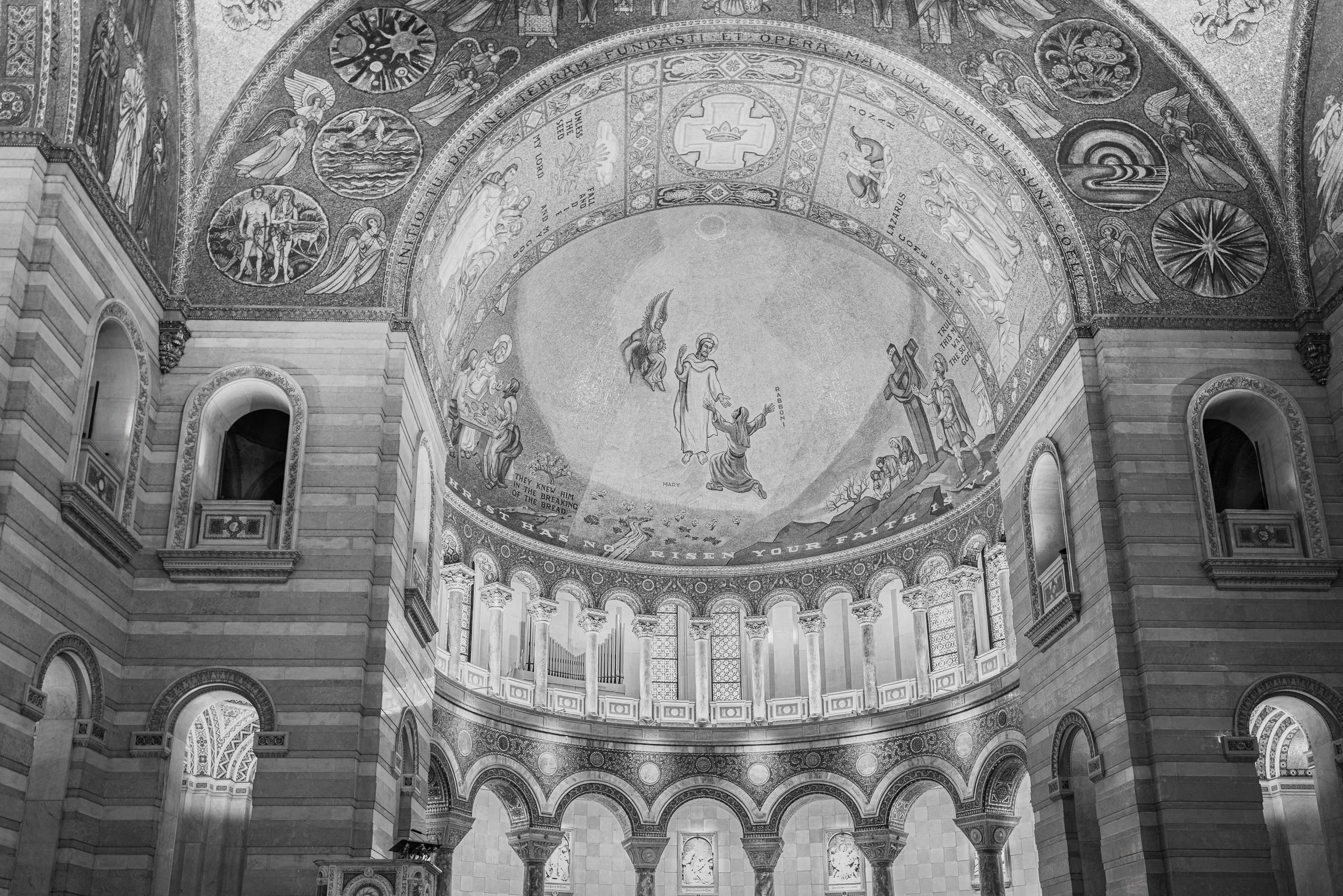
Beneath the great dome of the Cathedral Basilica of St. Louis, a mosaic depicts the Gospel's first resurrection scene — Mary Magdalene reaching toward the risen Christ at the empty tomb, an angel hovering above, the word "RABBONI" inscribed at the moment of recognition. Below, an inscription drawn from First Corinthians runs the curve of the dome: "...CHRIST HAS NOT...RISEN YOUR FAITH IS..." — the theological stakes of the scene, spelled out in tile.
Rendered in black and white, the mosaic's original color and gold leaf give way to a rich range of gray that emphasizes pattern, texture, and form — the countless individual tesserae, the carved stone archway framing the scene, the organ pipes and colonnade anchoring the space below. The composition looks up and slightly off-axis rather than straight on, giving the dome real depth and drawing the eye through a considered path: from the architecture at the frame's edges, up through the surrounding mosaic saints and symbols, to the central resurrection scene itself.
This is one of St. Louis's great interior spaces, photographed with the same patient attention given to any of the West's cathedral-scale landscapes — architecture as sacred space, and sacred space as architecture.
Design & Styling
The rich black-and-white tonal range and formal architectural composition suit spaces with a contemplative or classical sensibility — libraries, studies, entryways, and any interior where a piece with genuine gravity and craft is welcome. Its St. Louis subject matter also makes it a natural fit for collectors with a connection to the city or its architectural history.
Curated Pairings
For same-building continuity — "Sanctuary of Light", another interior study of the Cathedral Basilica of St. Louis.
For church interior continuity — "The Gothic Sentinel", a Prague church interior sharing this piece's reverence for sacred architectural space.
For religious architecture continuity — "Standing Grace - Southfork", a Colorado Catholic church treated with the same formal attention.
Fine Art Presentation
Given the fine mosaic detail and black-and-white tonal range, this piece is especially well suited to an archival paper print for a classic, painterly rendering, or ChromaLuxe® Metal (gloss, semi-gloss, or matte) print for added depth and a more contemporary presentation. Framed and unframed options available on request.
Note: Custom and oversized photographic prints are available. Please contact the studio directly to discuss custom framing, matting, or specialized museum glass options.
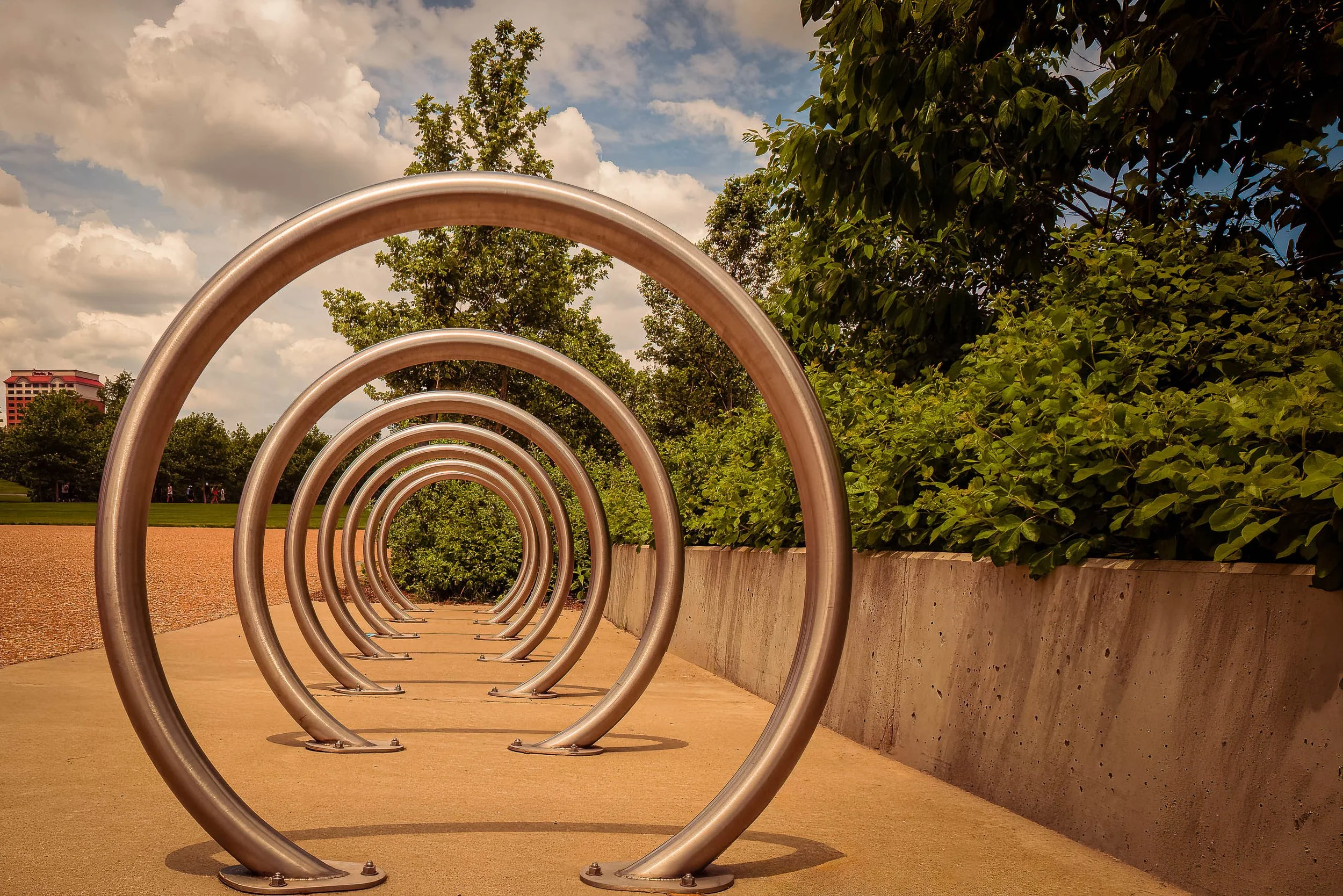
Steel Echoes finds a quiet piece of public infrastructure — a run of stainless steel bike-rack rings — and turns it into a study of repetition and depth. Photographed low and close to the first ring, the composition uses the receding circles like a series of apertures, each one framing a smaller, softer version of the same green park beyond. The effect reads almost architectural: a tunnel built not of stone but of brushed steel and daylight.
The late-day light does real work here, warming the concrete path to a rich ochre while keeping the sky a cool, cloud-stacked blue — two temperatures meeting at the horizon just past the final ring. Each loop catches the light a little differently depending on its angle to the sun, so the sequence reads less like flat repetition and more like a series of related, individually lit gestures.
In the same spirit as Steel Wave's industrial minimalism, and drawing on Aaron Siskind's eye for abstraction hidden in plain civic objects, Steel Echoes treats an ordinary piece of municipal design as worthy of the same attention as any landscape — proof that geometry and light don't need a dramatic subject, just the right angle on an ordinary one.
DESIGN & STYLING
Steel Echoes suits contemporary and minimalist interiors built around geometry and repetition rather than literal subject matter — offices, tech company lobbies, design studios, modern residences, and any space where clean lines and quiet rhythm do more work than color or drama. The warm-cool palette (ochre path, blue sky, brushed steel) gives it real flexibility as a neutral-leaning accent piece.
The strong linear perspective also suits long hallways or narrow walls particularly well, where the receding rings create a sense of depth even in a tight space.
CURATED PAIRINGS
For material and mood: Pair with Steel Wave — both find abstraction in industrial steel, one through rust and reflection, one through repetition and light.
For repetition and pattern: Complement with A Break in the Pattern — a very different setting, same interest in rhythm and geometric repetition.
For public art in a garden setting: Add Glass and Gesture, another St. Louis-area piece finding art in public architecture.
FINE ART PRESENTATION
Steel Echoes is available as a signed fine art photographic print in multiple presentation styles. ChromaLuxe® Metal (gloss, semi-gloss, or matte) is the natural match — printing a photograph of polished steel onto a metal substrate doubles down on the subject's own material, and the format's brightness and sharpness suit the clean geometric lines especially well. Acrylic offers a similar high-contrast pop with added depth. Framed archival paper and Canvas Framed are both available for a softer, more traditional presentation if the space calls for it.
Note: Custom and oversized photographic prints are available. Please contact the studio directly to discuss custom framing, matting, or specialized museum glass options.
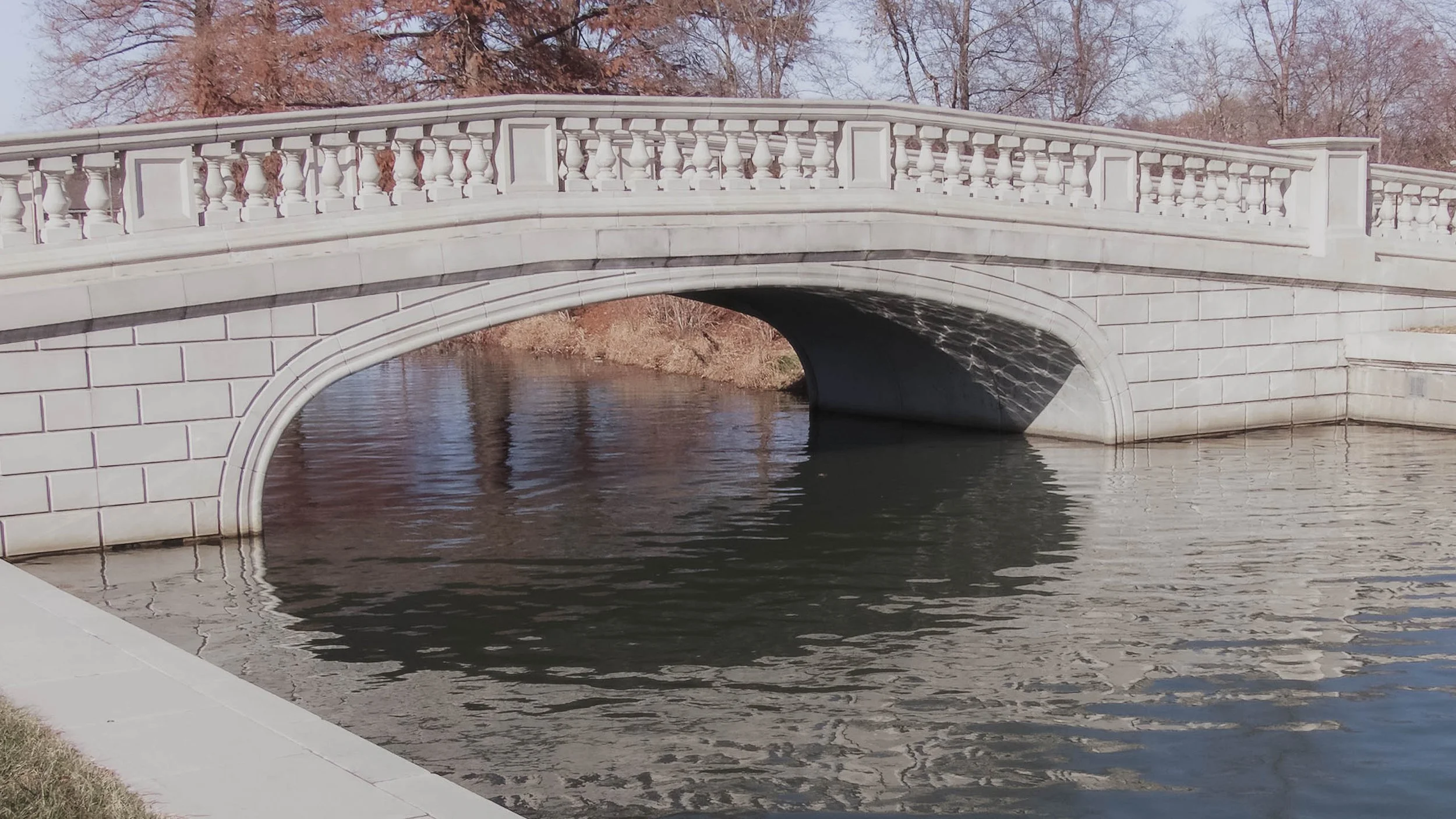
Quiet Crossing is a contemplative architectural landscape exploring symmetry, reflection, and the calming geometry of classical design. Captured beneath soft winter light, the photograph features a pale stone bridge arching quietly across still water, where muted reflections and restrained tonal transitions transform the scene into a study of balance, structure, and visual stillness. Drawing from the quiet formalism of modern architectural photography and the restrained pacing of minimalist landscape imagery, the composition emphasizes calm repetition, softened contrast, and restorative atmosphere.
The image balances the graceful curvature of the bridge against the subtle movement of reflected water, allowing the composition to function as both architectural study and meditative landscape. Rather than focusing on dramatic light or spectacle, the photograph explores the quiet emotional rhythm created through symmetry, reflection, and negative space.
A stone bridge over still water doubles itself: the arch and its reflection form a near-complete circle, which is the geometry that gives classical bridges their calm. Low, even winter light keeps the surface quiet and lets the symmetry do the work.
Design & Styling
A pale stone bridge over still water in soft winter light gives Quiet Crossing a calm, symmetrical presence for spas, waiting rooms, bedrooms, offices, and any space that benefits from stillness. Its restrained palette sits well with white, gray, and natural materials.
Curated Pairings
To create a cohesive gallery presentation around reflection and quiet geometry, consider these companion pieces:
For architectural rhythm: Pair with Reflections of Glass and Stone, extending the visual dialogue between structure, reflection, and quiet abstraction.
For atmospheric harmony: Complement this piece with Waiting Out the Storm, sharing the same restrained pacing and contemplative tonal atmosphere.
For winter and water: Pair with Where Winter Waited, a bridge into a snow-softened winter scene at Evergreen Lake.
Fine Art Presentation
Available as a signed fine art print on ChromaLuxe® Metal (gloss, semi-gloss, or matte), Glossy Anti-Glare Acrylic (TruLife), canvas, wood, and archival paper (framed or unframed). Framed archival paper is the recommended presentation: its matte surface suits the subtle tonal transitions, soft architectural detail, and muted reflections. Acrylic is the alternative for a deeper, more luminous water surface.
Note: Custom and oversized photographic prints are available. Please contact the studio directly to discuss custom framing, matting, or specialized museum glass options.
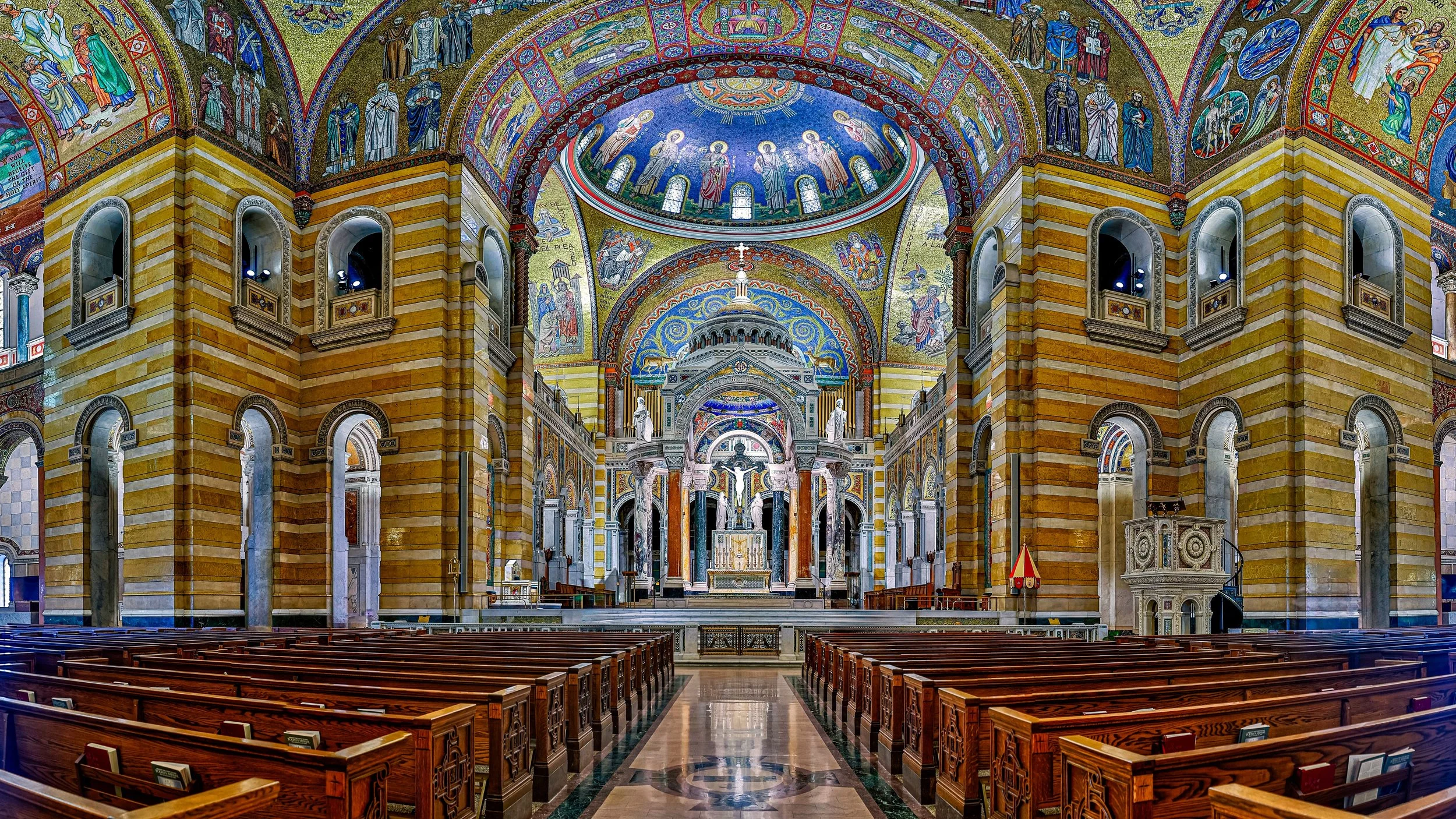
Sanctuary of Light is a study of illumination, craftsmanship, and the enduring power of sacred space. Photographed within the Cathedral Basilica of St. Louis, the image captures the remarkable interplay of light across one of the world's most celebrated mosaic interiors. Rich color, intricate detail, and luminous architectural forms transform the space into an experience of contemplation and wonder. Drawing inspiration from the architectural photography of Frederick H. Evans and the reverence for light found throughout sacred art traditions, the photograph explores how architecture can elevate ordinary experience into something transcendent.
The composition balances the grandeur of the basilica's soaring architecture with the intimate details of its mosaic surfaces, allowing light itself to become the central subject. Layers of color and ornamentation guide the viewer through the image, revealing the extraordinary craftsmanship embedded within the structure while maintaining a sense of stillness and visual harmony. Rather than focusing solely on architecture, the photograph seeks to capture the emotional atmosphere created when light, space, and devotion converge.
The mosaics of the Cathedral Basilica are one of the largest collections of mosaic art in the world, and standing inside them the light seems to come from the walls themselves. The photograph gives that surface the time it needs.
Design & Styling
The color and mosaic detail of the Cathedral Basilica of St. Louis make Sanctuary of Light a rich piece for hospitality lobbies, libraries, professional offices, sacred and cultural spaces, and St. Louis homes. It can carry a large wall and reward a long look.
Curated Pairings
To create a cohesive gallery wall around light and sacred architecture, consider these companion pieces:
For sacred architecture in the landscape: Pair with Standing Grace - Southfork, extending themes of faith, community, and the role of sacred architecture within the landscape.
For historic craftsmanship: Complement this piece with Old Friends, Windows and Glass, sharing an appreciation for historic craftsmanship, luminous light, and the passage of time.
For grand interiors: Pair with Beneath the Gilded Eye, an Ottawa Parliament Hill interior where gold and blue carry the eye upward, another study of illumination in a historic room.
Fine Art Presentation
Available as a signed fine art print on ChromaLuxe® Metal (gloss, semi-gloss, or matte), Glossy Anti-Glare Acrylic (TruLife), canvas, wood, and archival paper (framed or unframed). Acrylic is the recommended presentation: its depth and luminosity carry the mosaic's color and the interplay of light across gold and glass. ChromaLuxe® Metal is the alternative for crisper detail.
Note: Custom and oversized photographic prints are available. Please contact the studio directly to discuss custom framing, matting, or specialized museum glass options.
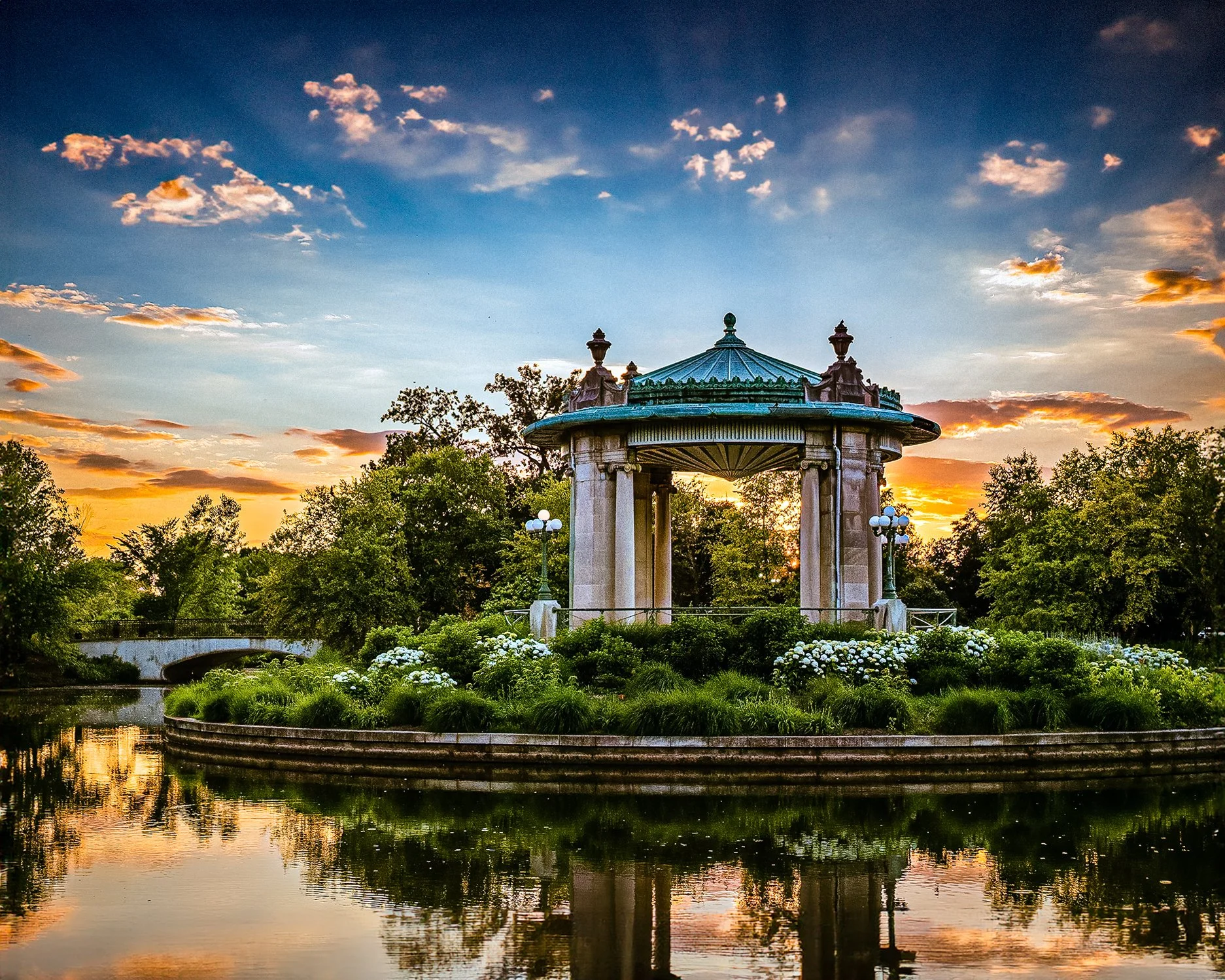
Evening at the Pavilion is a study of light, architecture, and the quiet elegance of one of St. Louis' most beloved landmarks. Photographed at dusk in Forest Park, the image centers on the Nathan Frank Bandstand as evening light settles across the landscape and the structure begins to glow against the deepening sky. Reflections, architectural detail, and carefully balanced color create a scene that feels both timeless and contemporary. Drawing inspiration from the luminous color sensibilities of Ernst Haas and the atmospheric storytelling of Edward Hopper, the photograph explores the emotional character of public spaces during the transitional moments between day and night.
The composition balances the graceful architecture of the bandstand against the surrounding landscape and sky, allowing light itself to become a defining element of the image. The structure serves as both gathering place and visual anchor, representing the cultural and civic history woven throughout Forest Park. Rather than emphasizing activity, the photograph focuses on atmosphere and anticipation—the quiet interval when a familiar place takes on a different character as daylight fades.
The result is a photograph that celebrates the relationship between architecture, community, and the enduring beauty of urban public spaces.
Design & Styling
The glow of the Nathan Frank Bandstand at dusk makes Evening at the Pavilion a natural fit for St. Louis homes, law and financial offices, hospitality spaces, and civic buildings. Its rich evening color reads well on deep blue, charcoal, or warm neutral walls.
Curated Pairings
To create a cohesive gallery wall around St. Louis architecture at dusk, consider these companion pieces:
For sacred and civic architecture: Pair with Sanctuary of Light, two distinct expressions of architectural beauty, one civic and one sacred.
For glass and ascending geometry: Pair with The Shape of Ascent, stepped rooflines of glass and stone climbing into a charcoal sky, in black and white where this piece is all evening color.
For the same Forest Park evening: Pair with Held in Afterglow, the Jewel Box glass still lit as the sky cools above it, in soft peach light.
Fine Art Presentation
Available as a signed fine art print on ChromaLuxe® Metal (gloss, semi-gloss, or matte), Glossy Anti-Glare Acrylic (TruLife), canvas, wood, and archival paper (framed or unframed). Acrylic is the recommended presentation: its luminosity and depth suit the rich evening color and the reflections on the water. ChromaLuxe® Metal is the alternative for crisper architectural detail.
Note: Custom and oversized photographic prints are available. Please contact the studio directly to discuss custom framing, matting, or specialized museum glass options.
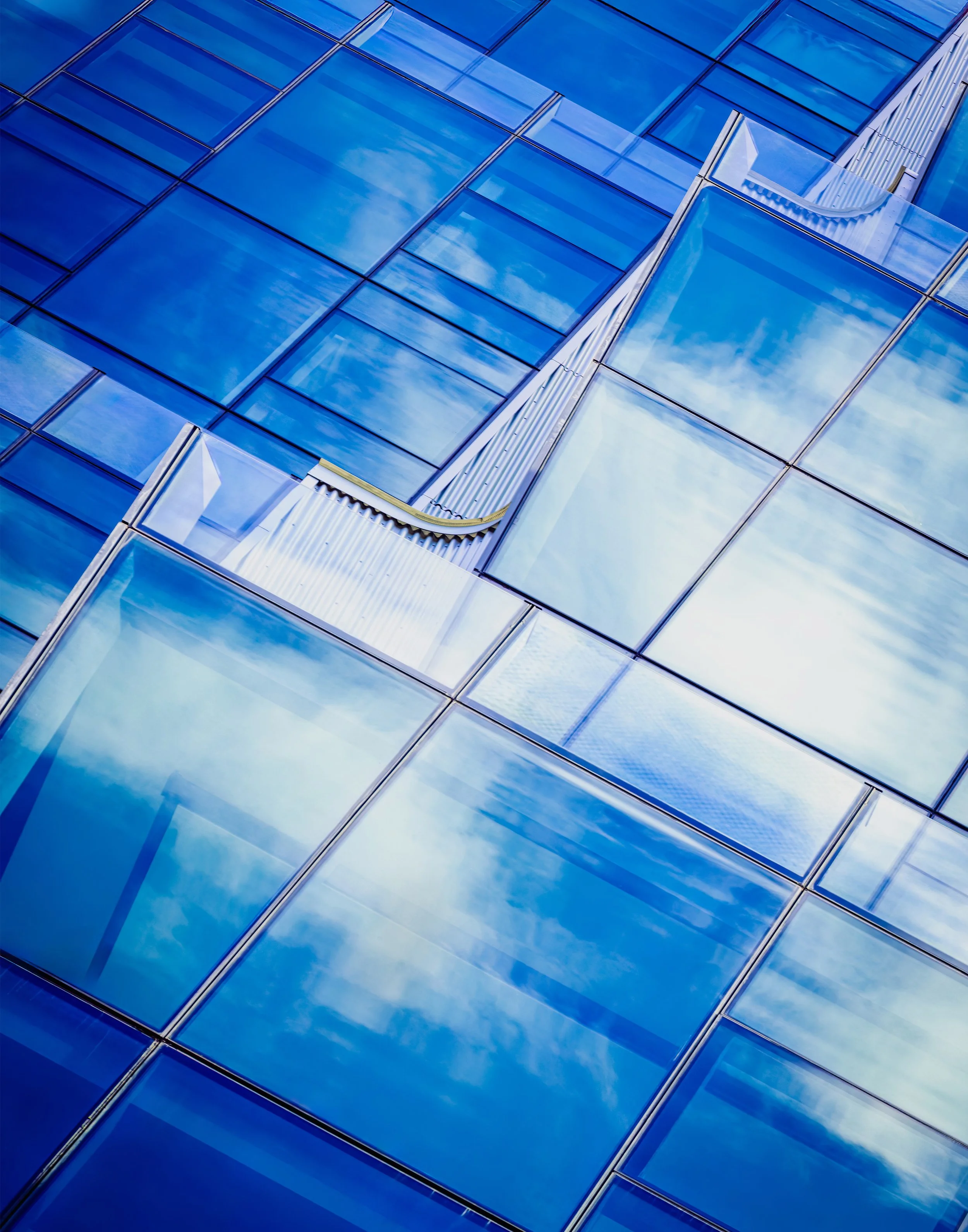
Blue Interval is a study of reflection, atmosphere, and the transformative power of light. Photographed in St. Louis, Missouri, the image dissolves the boundary between architecture and sky as drifting clouds become woven into the mirrored surface of a contemporary building. Through reflection and abstraction, the familiar urban environment is reinterpreted as a composition of color, pattern, and movement. Drawing inspiration from the luminous color relationships of Ernst Haas and the visual minimalism of Hiroshi Sugimoto, the photograph explores the fleeting moments when architecture becomes less about structure and more about perception.
Glass curtain walls take on the color of whatever is around them, which is why a building can seem to borrow the sky. Here the reflection is so complete that the boundary between structure and cloud dissolves, and the image works as much as a painting of weather as a picture of a building.
Design & Styling
The mirrored surfaces and drifting clouds of Blue Interval suit corporate lobbies, professional offices, medical and wellness spaces, and modern homes that want calm, cool color without literal subject matter. It is clean enough for a conference room and soft enough for a bedroom.
Curated Pairings
To create a cohesive gallery wall around glass, sky, and reflected light, consider these companion pieces:
For contrasting palette: Pair with Where Sisters Rise, exploring the relationship between color, form, and abstraction through a contrasting warm-and-cool palette.
For architecture and reflection: Complement this piece with Reflections of Glass and Stone, sharing the same fascination with architecture, reflection, and the visual transformation of ordinary surfaces.
For St. Louis after dark: Pair with As the Glow Ends, another St. Louis structure that dissolves into its atmosphere, at night instead of by day.
Fine Art Presentation
Available as a signed fine art print on ChromaLuxe® Metal (gloss, semi-gloss, or matte), Glossy Anti-Glare Acrylic (TruLife), canvas, wood, and archival paper (framed or unframed). Acrylic is the recommended presentation: its depth and luminosity carry the blue tonal fields and the clouds woven into the glass. ChromaLuxe® Metal is the alternative for crisper reflective detail.
Note: Custom and oversized photographic prints are available. Please contact the studio directly to discuss custom framing, matting, or specialized museum glass options.
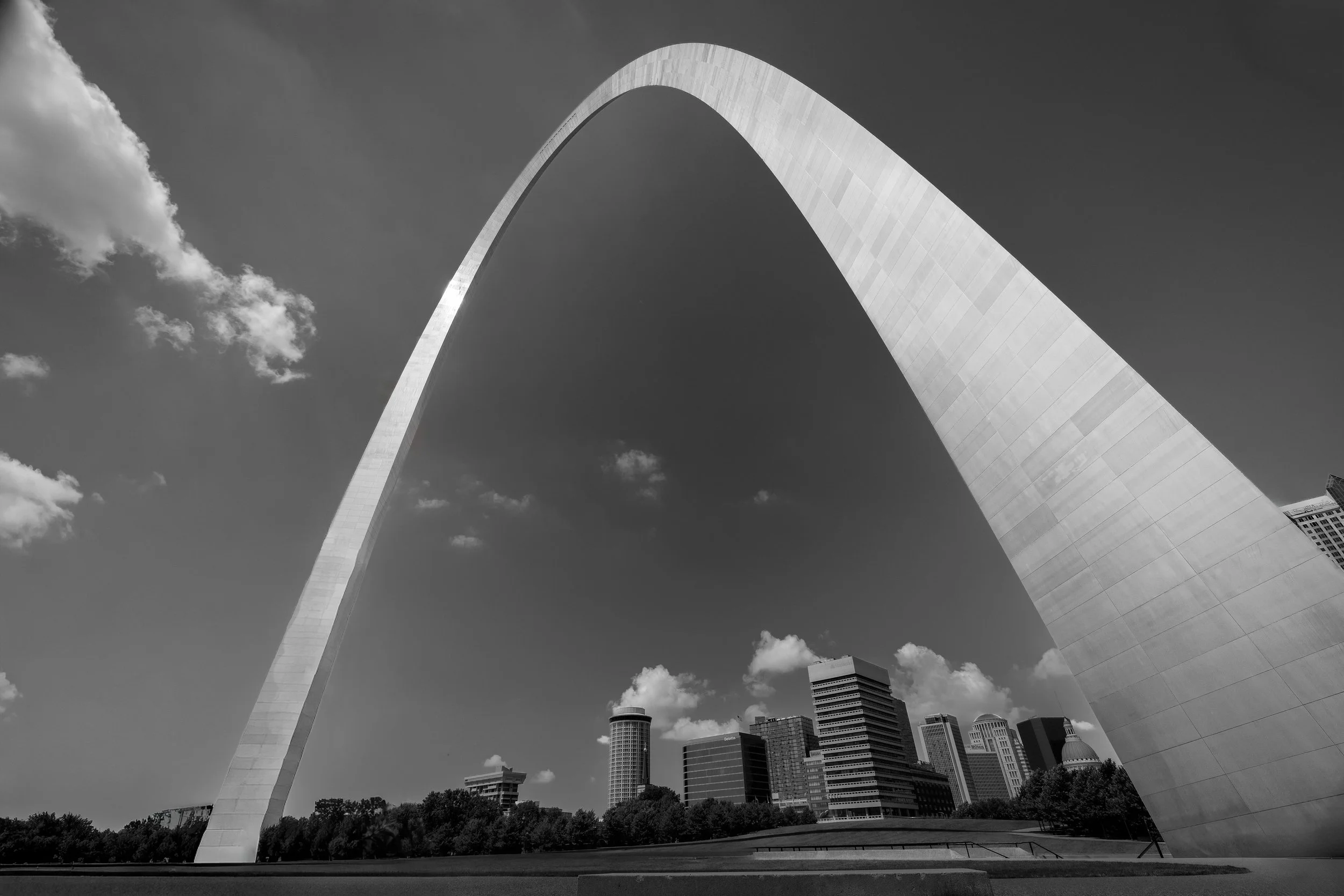
Held Arch is a study of scale, permanence, and the relationship between architecture and place. Photographed from a dramatic wide-angle perspective in downtown St. Louis, the image presents the Gateway Arch as an overwhelming presence rising above the city it has come to symbolize. Rendered in monochrome, the photograph strips away distraction and color, allowing form, light, and structure to define the experience. Drawing inspiration from the architectural clarity of Ansel Adams and the urban contemplations of Wim Wenders, the image explores the dialogue between monument and city, between human ambition and the landscapes it seeks to define.
The composition emphasizes the immense curvature of the Arch as it looms over the surrounding skyline. Buildings that normally command attention become secondary elements beneath the monument's sweeping form. The wide-angle perspective exaggerates scale and creates a sense of tension between the permanence of the Arch and the ever-changing city below. Rather than functioning as a traditional skyline photograph, the image transforms a familiar landmark into a powerful sculptural presence that appears to hold the city within its embrace.
The result is a photograph that celebrates one of America's most recognizable monuments while inviting reflection on identity, place, and the enduring role of architecture in shaping collective memory.
Design & Styling
The Gateway Arch rendered in monochrome from a wide angle gives Held Arch a graphic, monumental authority for law and financial offices, civic lobbies, corporate headquarters, and St. Louis homes. It suits large walls with plenty of room.
Curated Pairings
To create a cohesive gallery wall around St. Louis architecture, consider these companion pieces:
For two perspectives on the city: Pair with Reflections of Glass and Stone, two distinct views of the architectural character of St. Louis.
For civic architecture: Complement this piece with Evening at the Pavilion, sharing the same appreciation for civic architecture, public space, and the identity of the city.
For the Arch in color: Pair with Crowned in Light, the Arch and Old Courthouse beneath fireworks, the same monument in color and celebration.
Fine Art Presentation
Available as a signed fine art print on ChromaLuxe® Metal (gloss, semi-gloss, or matte), Glossy Anti-Glare Acrylic (TruLife), canvas, wood, and archival paper (framed or unframed). ChromaLuxe® Metal is the recommended presentation: it holds the graphic impact of the wide-angle geometry and the full monochrome range with crisp edges. Framed archival paper is the alternative for a more classic, darkroom-print reading.
Note: Custom and oversized photographic prints are available. Please contact the studio directly to discuss custom framing, matting, or specialized museum glass options.
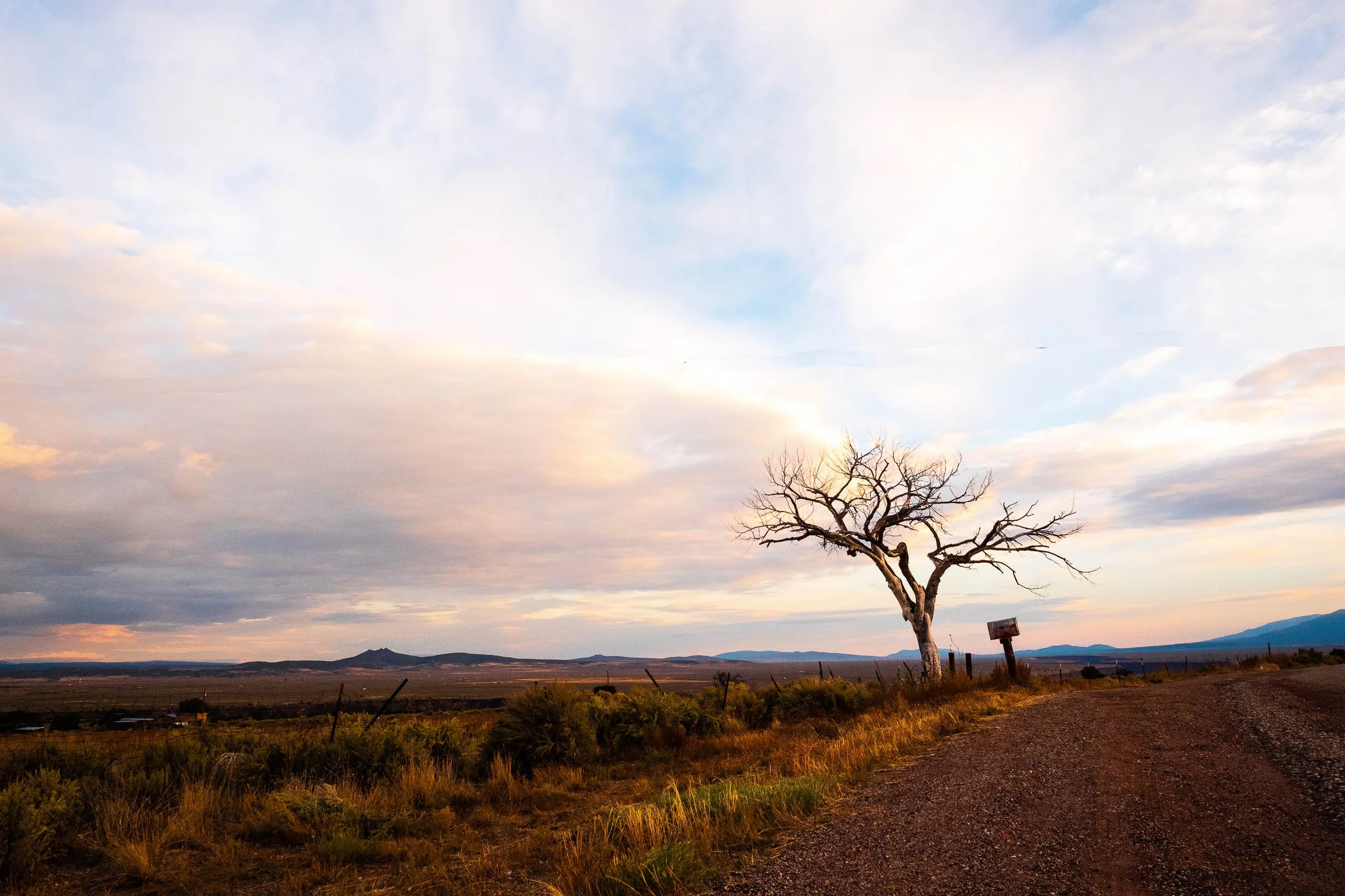
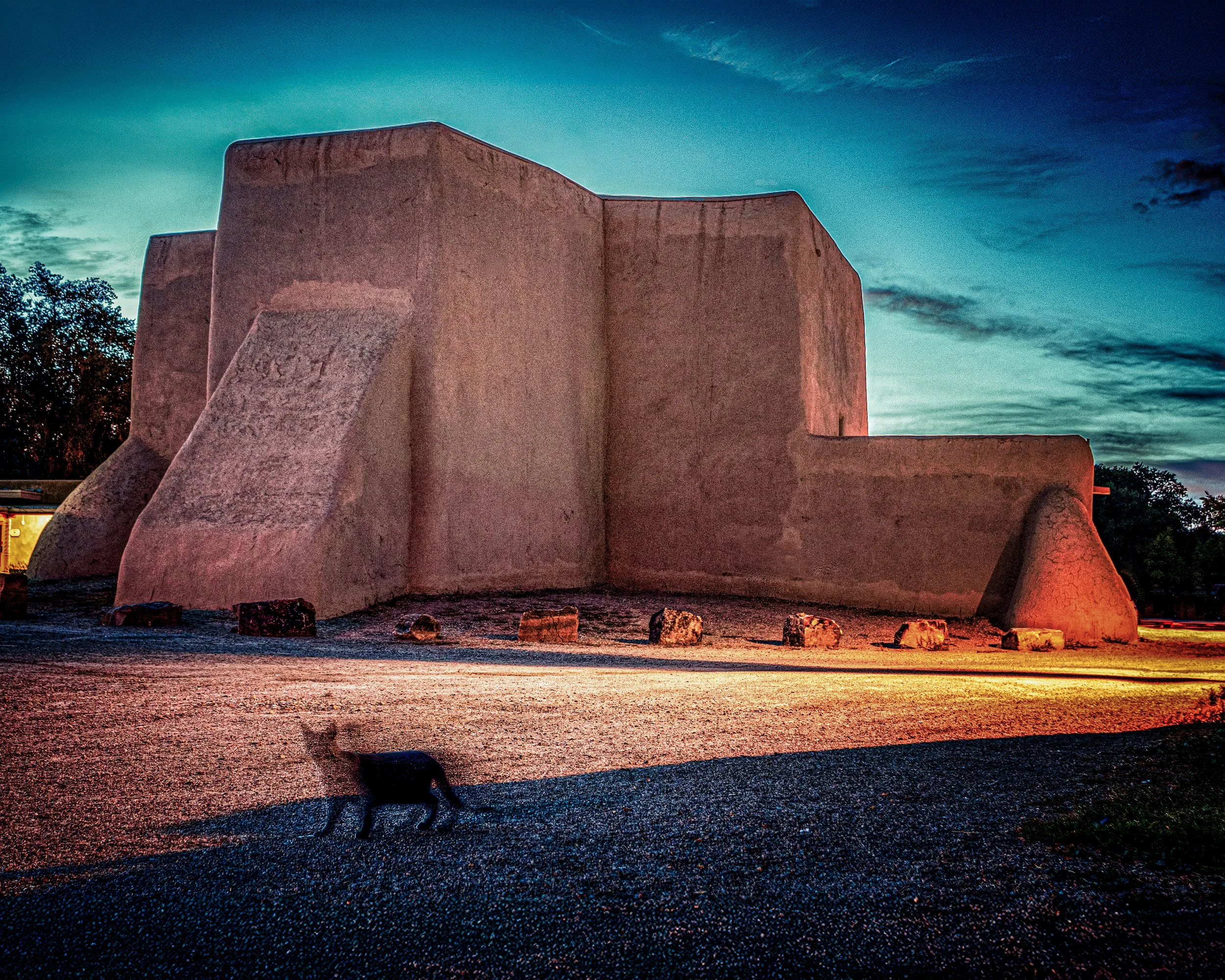
The New Mexico collection captures the ancient, high-desert stillness of the Southwest, where clear, expansive light reveals the raw beauty of weathered adobe and vast, permanent horizons.
For Designers & Consultants:
The New Mexico series offers a sophisticated, biophilic connection for hospitality and corporate environments. These works are available as large-scale archival prints on paper or sublimated metal, providing a durable and evocative focal point for modern professional interiors.
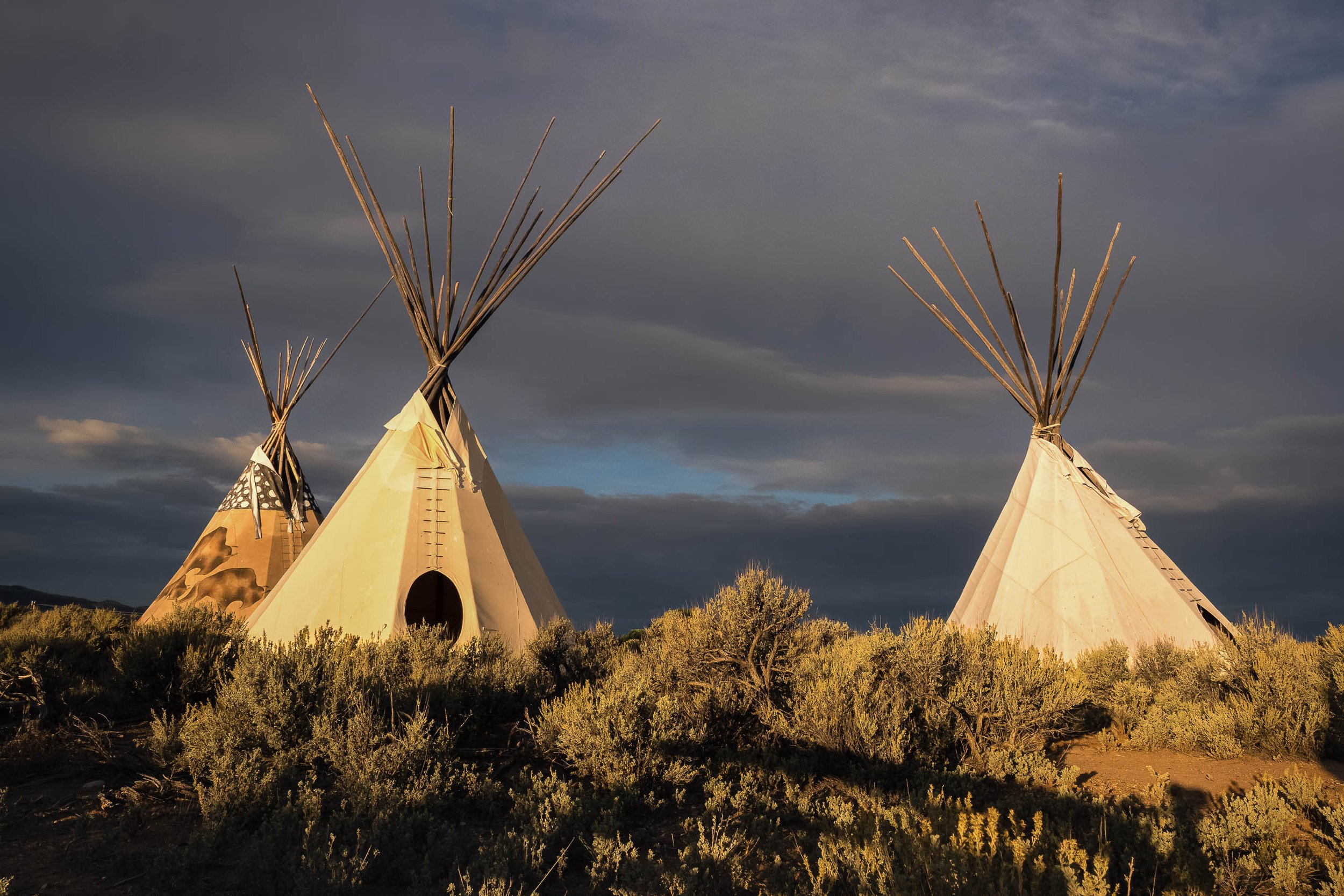
The day lets go slowly here, and Held in Afterglow is the hour when the garden is still warm but the light has already gone soft. At the end of the evening, the glass stays lit while the sky cools above it.
The Jewel Box rises at the center of the frame, a stepped glass front that holds the last of the daylight. The eye starts at the lit facade, drops to the single thread of the fountain, and then moves out across the water through the ring of giant Victoria lily pads. Their copper rims lead back toward the building. The sky grades from a clear blue overhead to peach at the horizon, so the building is the brightest thing in a quiet frame.
The picture sits between Ernst Haas's feeling for color as atmosphere and Wim Wenders's patience with architecture left alone at the edge of the day. Nothing is announced. The architecture, the water and the sky share the same low light.
Design & Styling: Held in Afterglow suits hotel lobbies, boutique hospitality spaces and executive suites, where cool blues and warm peach set a calm, unhurried mood. In healthcare settings such as waiting rooms, infusion suites and patient corridors, the symmetry and soft light give the eye somewhere restful to land. At home it works over a console in an entry, a dining room or a quiet reading space, especially with plaster, pale oak or sage and brass.
Curated Pairings:
Blue Interval: Another St. Louis glass building, where drifting clouds dissolve into a mirrored facade and architecture becomes color and sky, the abstract counterpart to the Jewel Box held in the same cool blues.
The Garden's Glow: A macro of a single fire-lit blossom against deep shadow, the saturated, close-up answer to the soft peach light in Held in Afterglow.
Held Arch: A monochrome wide-angle study of the Gateway Arch rising over downtown St. Louis, the city's other great monument, in black and white where Held in Afterglow is all color.
Fine Art Presentation: Printed to order on Chromaluxe metal for the clearest glow in the glass and sky, or on TruLife acrylic with a low-glare or anti-glare surface where the room has windows. Framed and unframed paper prints are made on Photo Rag. Each print is made to order and signed.