
 Image 1 of 5
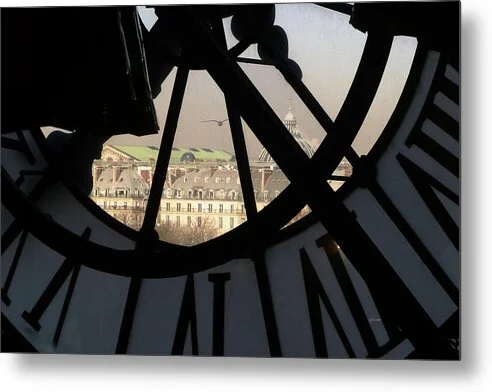 Image 2 of 5
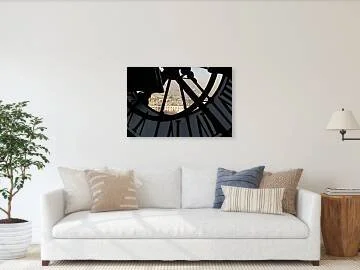 Image 3 of 5
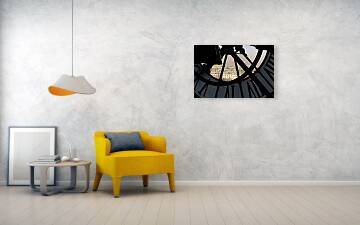 Image 4 of 5
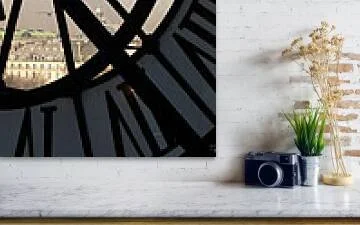 Image 5 of 5
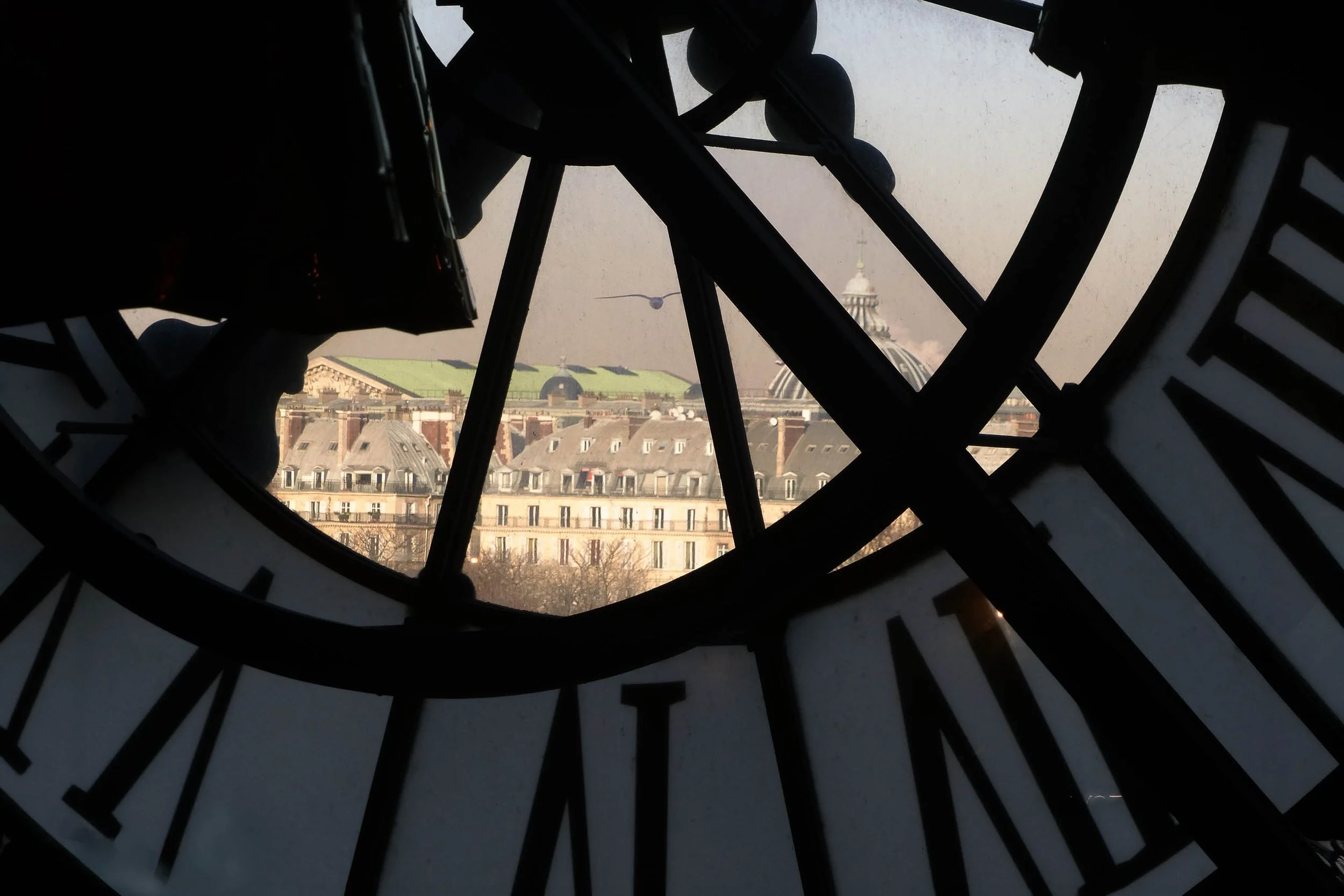
Behind the Hour is a study of time seen from the inside, where a city that usually looks up at the clock is shown looking back through it. Photographed from behind the great glass clock of the Musée d'Orsay, the former railway station on the Seine, the image holds Paris in a single opening of light while the machinery of the hour fills the rest of the frame in silhouette.
The eye begins at the gap. A seagull crosses the top of the opening, small and exact, and the diagonal sweep of a clock hand carries the gaze down through the iron ring to a row of Haussmann rooftops, a green copper roof and a pale dome in the haze. Roman numerals curve around the edges, their pale backing set against black ironwork. Half the frame stays in near-total shadow, so the one lit passage reads as the whole picture. On the dark metal, a faint scratch and a single warm glint reward a second look. The sensibility is Henri Cartier-Bresson's decisive moment, a living figure caught inside a frame that was already built, with an Ernst Haas restraint in the color: pale gold, dusty rose and verdigris green held quiet against black.
Behind the Hour suits hotel lobbies, restaurants, private clubs, law and consulting offices, and libraries, where a piece about time and place sets the tone without crowding the room. The deep black field works well on warm walnut, dark plaster or charcoal paint, and the muted palette sits comfortably beside brass, leather and aged wood.
City of Light — amber dusk over the Eiffel Tower from the Pont Alexandre III, the same city in a warmer register.
Where She Paused — a lone silhouette in the Louvre's Grande Galerie, another study of a figure inside a built frame.
One Hour Tour — a Paris pedicab driver shielding his eyes from the winter sun, a human moment from the same trip.
Where Stone Meets Glass — the Louvre's Pavillon Sully against the edge of the glass Pyramid, where old Paris meets the new.
Acrylic prints are best on TrueVue or low/anti-glare acrylic, which keeps the black field deep without reflections. Framed and unframed paper prints are on Photo Rag. Chromaluxe Metal is also available.
Note: Custom and oversized photographic prints are available. Please contact the studio directly to discuss custom framing, matting, or specialized museum glass options.
Behind the Hour is a study of time seen from the inside, where a city that usually looks up at the clock is shown looking back through it. Photographed from behind the great glass clock of the Musée d'Orsay, the former railway station on the Seine, the image holds Paris in a single opening of light while the machinery of the hour fills the rest of the frame in silhouette.
The eye begins at the gap. A seagull crosses the top of the opening, small and exact, and the diagonal sweep of a clock hand carries the gaze down through the iron ring to a row of Haussmann rooftops, a green copper roof and a pale dome in the haze. Roman numerals curve around the edges, their pale backing set against black ironwork. Half the frame stays in near-total shadow, so the one lit passage reads as the whole picture. On the dark metal, a faint scratch and a single warm glint reward a second look. The sensibility is Henri Cartier-Bresson's decisive moment, a living figure caught inside a frame that was already built, with an Ernst Haas restraint in the color: pale gold, dusty rose and verdigris green held quiet against black.
Behind the Hour suits hotel lobbies, restaurants, private clubs, law and consulting offices, and libraries, where a piece about time and place sets the tone without crowding the room. The deep black field works well on warm walnut, dark plaster or charcoal paint, and the muted palette sits comfortably beside brass, leather and aged wood.
City of Light — amber dusk over the Eiffel Tower from the Pont Alexandre III, the same city in a warmer register.
Where She Paused — a lone silhouette in the Louvre's Grande Galerie, another study of a figure inside a built frame.
One Hour Tour — a Paris pedicab driver shielding his eyes from the winter sun, a human moment from the same trip.
Where Stone Meets Glass — the Louvre's Pavillon Sully against the edge of the glass Pyramid, where old Paris meets the new.
Acrylic prints are best on TrueVue or low/anti-glare acrylic, which keeps the black field deep without reflections. Framed and unframed paper prints are on Photo Rag. Chromaluxe Metal is also available.
Note: Custom and oversized photographic prints are available. Please contact the studio directly to discuss custom framing, matting, or specialized museum glass options.