
 Image 1 of 5
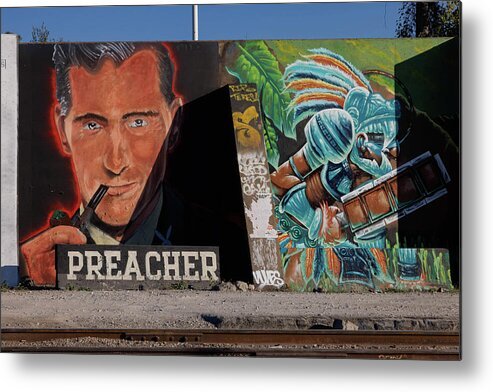 Image 2 of 5
 Image 3 of 5
 Image 4 of 5
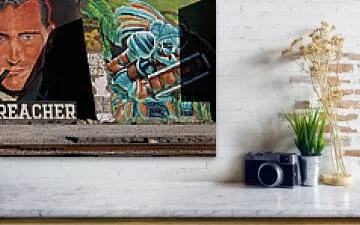 Image 5 of 5
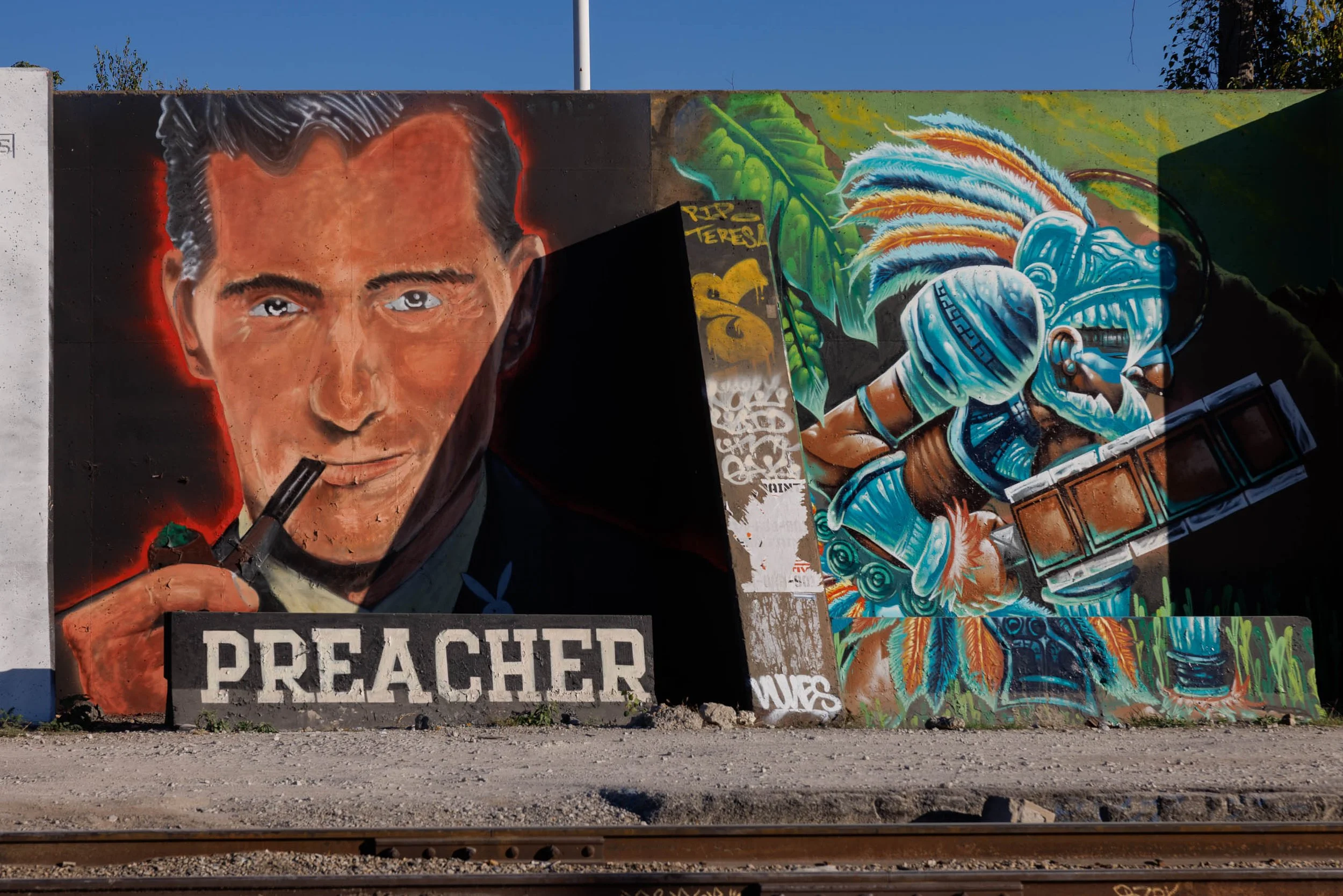
Light decides what a wall is allowed to say. Where the Shadow Falls finds a painted portrait of a man in a dark suit, a pipe held to his lips and a thin red glow outlining his shoulders, on a black concrete wall in St. Louis. A slab-serif PREACHER sits on a block at his feet, and a hard wedge of real shadow, cast by the neighboring barrier, cuts across his chest and darkens the wall beside him.
The eye lands first on the pale blue-gray eyes, the brightest point on the face, then follows the line of the pipe down to the white lettering. From there the shadow wedge takes over, its straight edge running diagonally from the portrait toward the lower right and pushing the eye across to the second mural: a turquoise warrior in a feathered headdress, bright against deep green. A pair of rails crosses the foreground and ties the whole wall to its place.
This is Edward Hopper's logic, hard-edged light as the real subject of a flat wall, with the Ernst Haas habit of letting a saturated color, here the turquoise, steal the second beat of the picture.
Where the Shadow Falls suits cigar and whiskey bars, lounges, libraries and studies, media rooms, and lofts that want a moody portrait with real graphic punch. The intense gaze and heavy shadow make it less suited to calming-focused environments such as healthcare or senior living.
To build a wall around this piece, consider these companion pieces:
For a deliberate contrast: Pair with What the Wall Remembers, a faded painted figure on old brick, the same idea of a man painted onto a city wall, ghostly with age where this portrait is vivid and freshly done.
For the same black wall: Pair with Saints in Black Glass, three painted figures emerging from black concrete under hand-lettered type, the same dark ground and thin colored glow.
For the same warm-on-dark treatment: Pair with The Bartender's Measure (Color), skin tones and warm light held against a dark ground, the same cinematic treatment applied to a living subject.
Available as an open edition print, unsigned and unnumbered, in ChromaLuxe® Metal (gloss, semi-gloss, or matte), Glossy Anti-Glare Acrylic (TruLife), canvas, wood, and archival paper (framed or unframed). ChromaLuxe® Metal (semi-gloss) is the recommended presentation: the red outline glow and the turquoise feathers hold their saturation, and the shadow wedge stays clean and sharp-edged. Glossy Anti-Glare Acrylic (TruLife) deepens the blacks for a more dramatic hang, and framed archival paper gives a softer, more traditional presentation.
Note: This is an open edition print, unsigned and unnumbered, available in the sizes and materials listed above.
Light decides what a wall is allowed to say. Where the Shadow Falls finds a painted portrait of a man in a dark suit, a pipe held to his lips and a thin red glow outlining his shoulders, on a black concrete wall in St. Louis. A slab-serif PREACHER sits on a block at his feet, and a hard wedge of real shadow, cast by the neighboring barrier, cuts across his chest and darkens the wall beside him.
The eye lands first on the pale blue-gray eyes, the brightest point on the face, then follows the line of the pipe down to the white lettering. From there the shadow wedge takes over, its straight edge running diagonally from the portrait toward the lower right and pushing the eye across to the second mural: a turquoise warrior in a feathered headdress, bright against deep green. A pair of rails crosses the foreground and ties the whole wall to its place.
This is Edward Hopper's logic, hard-edged light as the real subject of a flat wall, with the Ernst Haas habit of letting a saturated color, here the turquoise, steal the second beat of the picture.
Where the Shadow Falls suits cigar and whiskey bars, lounges, libraries and studies, media rooms, and lofts that want a moody portrait with real graphic punch. The intense gaze and heavy shadow make it less suited to calming-focused environments such as healthcare or senior living.
To build a wall around this piece, consider these companion pieces:
For a deliberate contrast: Pair with What the Wall Remembers, a faded painted figure on old brick, the same idea of a man painted onto a city wall, ghostly with age where this portrait is vivid and freshly done.
For the same black wall: Pair with Saints in Black Glass, three painted figures emerging from black concrete under hand-lettered type, the same dark ground and thin colored glow.
For the same warm-on-dark treatment: Pair with The Bartender's Measure (Color), skin tones and warm light held against a dark ground, the same cinematic treatment applied to a living subject.
Available as an open edition print, unsigned and unnumbered, in ChromaLuxe® Metal (gloss, semi-gloss, or matte), Glossy Anti-Glare Acrylic (TruLife), canvas, wood, and archival paper (framed or unframed). ChromaLuxe® Metal (semi-gloss) is the recommended presentation: the red outline glow and the turquoise feathers hold their saturation, and the shadow wedge stays clean and sharp-edged. Glossy Anti-Glare Acrylic (TruLife) deepens the blacks for a more dramatic hang, and framed archival paper gives a softer, more traditional presentation.
Note: This is an open edition print, unsigned and unnumbered, available in the sizes and materials listed above.