
 Image 1 of 1
Where Stone Meets Water
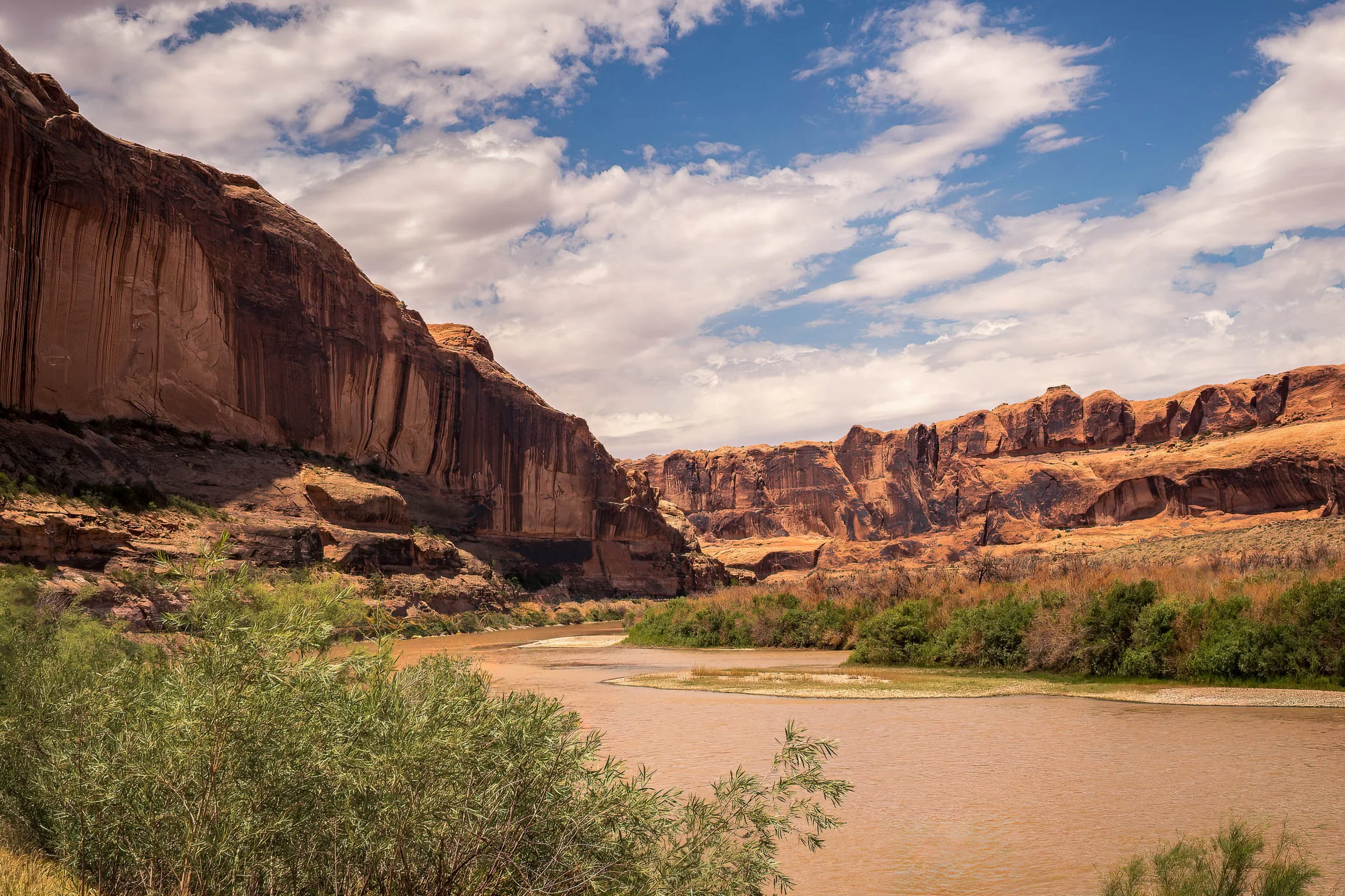
Where Stone Meets Water is a study of contrast, endurance, and the quiet forces that shape the landscape over time. Photographed in the canyon country of the American Southwest, the image captures a winding river as it curves beneath towering sandstone walls streaked with desert varnish and marked by centuries of erosion. The scene reveals a meeting of opposites: water in constant motion and stone that appears timeless, each slowly transforming the other across vast spans of time.
The composition is anchored by the dramatic canyon wall rising along the left side of the frame. Dark mineral stains trace the face of the sandstone, creating patterns that speak to the passage of water, weather, and geological change. Below, the river bends gently through the canyon floor, guiding the eye toward distant cliffs illuminated by warm light. Together, the river and canyon create a visual journey through a landscape shaped by both persistence and patience.
Rather than emphasizing a specific destination, the photograph invites viewers to consider the relationship between permanence and change. The sandstone cliffs suggest endurance and stability, while the river reminds us that even the most enduring landscapes are continually evolving. The resulting image becomes less a record of place and more a meditation on time, scale, and the subtle beauty of natural processes.
Drawing inspiration from the Western landscape traditions of Ansel Adams, the contemplative minimalism of Hiroshi Sugimoto, and the atmospheric sense of place found in the work of Wim Wenders, Where Stone Meets Water explores themes of stillness, transformation, and the enduring dialogue between land and water.
Design & Styling
The warm sandstone walls and winding river of Where Stone Meets Water bring depth and tranquility to mountain homes, offices, lobbies, and spas. It suits natural stone, wood, and warm neutrals.
Curated Pairings
To create a cohesive display around canyon country, consider these companion pieces:
For canyon country: Pair with Where the Canyon Waits, with Between Walls of Stone, creating a visual exploration of canyon country and the roads and rivers that move through it.
For stillness and geological scale: Complement with Enduring Silence, with Stillness After Rain, linking the enduring forms of the Western landscape with moments of quiet reflection.
For atmosphere and discovery: Pair with The Long Way West 3:2, emphasizing the experience of moving through landscapes shaped by distance, time, and place.
Fine Art Presentation
Available as a signed fine art print on ChromaLuxe® Metal (gloss, semi-gloss, or matte), Glossy Anti-Glare Acrylic (TruLife), canvas, wood, and archival paper (framed or unframed). ChromaLuxe® Metal is the recommended presentation: it emphasizes the subtle color variations of the sandstone and the flow of the river. Acrylic is the alternative for extra depth.
Note: Custom and oversized photographic prints are available. Please contact the studio directly to discuss custom framing, matting, or specialized museum glass options.
Where Stone Meets Water is a study of contrast, endurance, and the quiet forces that shape the landscape over time. Photographed in the canyon country of the American Southwest, the image captures a winding river as it curves beneath towering sandstone walls streaked with desert varnish and marked by centuries of erosion. The scene reveals a meeting of opposites: water in constant motion and stone that appears timeless, each slowly transforming the other across vast spans of time.
The composition is anchored by the dramatic canyon wall rising along the left side of the frame. Dark mineral stains trace the face of the sandstone, creating patterns that speak to the passage of water, weather, and geological change. Below, the river bends gently through the canyon floor, guiding the eye toward distant cliffs illuminated by warm light. Together, the river and canyon create a visual journey through a landscape shaped by both persistence and patience.
Rather than emphasizing a specific destination, the photograph invites viewers to consider the relationship between permanence and change. The sandstone cliffs suggest endurance and stability, while the river reminds us that even the most enduring landscapes are continually evolving. The resulting image becomes less a record of place and more a meditation on time, scale, and the subtle beauty of natural processes.
Drawing inspiration from the Western landscape traditions of Ansel Adams, the contemplative minimalism of Hiroshi Sugimoto, and the atmospheric sense of place found in the work of Wim Wenders, Where Stone Meets Water explores themes of stillness, transformation, and the enduring dialogue between land and water.
Design & Styling
The warm sandstone walls and winding river of Where Stone Meets Water bring depth and tranquility to mountain homes, offices, lobbies, and spas. It suits natural stone, wood, and warm neutrals.
Curated Pairings
To create a cohesive display around canyon country, consider these companion pieces:
For canyon country: Pair with Where the Canyon Waits, with Between Walls of Stone, creating a visual exploration of canyon country and the roads and rivers that move through it.
For stillness and geological scale: Complement with Enduring Silence, with Stillness After Rain, linking the enduring forms of the Western landscape with moments of quiet reflection.
For atmosphere and discovery: Pair with The Long Way West 3:2, emphasizing the experience of moving through landscapes shaped by distance, time, and place.
Fine Art Presentation
Available as a signed fine art print on ChromaLuxe® Metal (gloss, semi-gloss, or matte), Glossy Anti-Glare Acrylic (TruLife), canvas, wood, and archival paper (framed or unframed). ChromaLuxe® Metal is the recommended presentation: it emphasizes the subtle color variations of the sandstone and the flow of the river. Acrylic is the alternative for extra depth.
Note: Custom and oversized photographic prints are available. Please contact the studio directly to discuss custom framing, matting, or specialized museum glass options.