
 Image 1 of 3
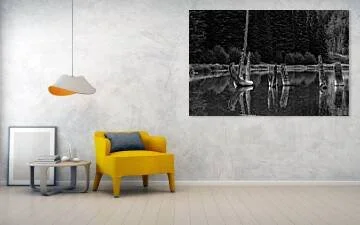 Image 2 of 3
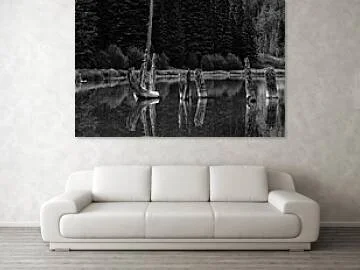 Image 3 of 3
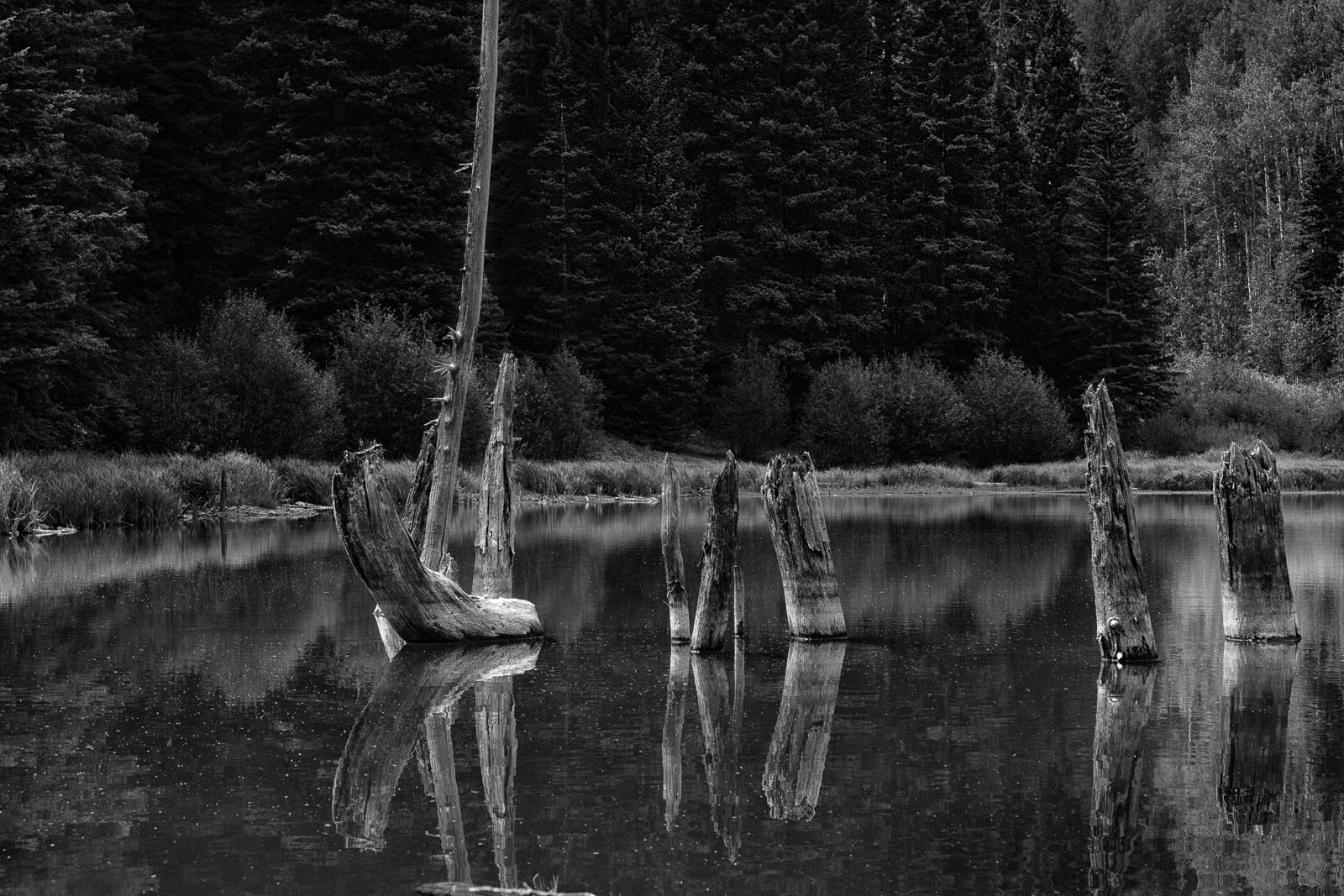
The Silent Assembly is a study of time, transformation, and the strange presence created by what remains. Rising from the still water of a mountain pond, weathered trunks and broken remnants of trees stand separated from the surrounding forest. Stripped of branches and foliage, they have been reduced to elemental forms—wood, water, light, and reflection.
The composition is built around repetition and individuality. No two remnants are alike. Some stand upright and narrow, others lean or twist, while one large fractured trunk reaches upward from the water like a figure caught in motion. Their reflections extend the forms below the surface, creating a second assembly that is less substantial and more transient than the one above.
In black and white, the landscape becomes increasingly sculptural. Color no longer identifies forest, grass, or water; instead, texture, shape, luminosity, and negative space determine how the scene is read. The dark wall of trees behind the pond isolates the weathered forms, while the quiet surface of the water allows each to occupy its own visual space.
There is an unavoidable suggestion of human presence despite the absence of people. The trunks seem to gather, face one another, and occupy the water like members of a silent congregation. The Silent Assembly explores that ambiguity—the point at which remnants of the natural world begin to suggest figures, monuments, or witnesses to a landscape changing around them.
With its deep blacks, silver-gray water, organic forms, and restrained monochrome palette, The Silent Assembly brings a contemplative and sculptural presence to an interior.
The photograph works particularly well in contemporary and transitional residences, mountain homes, executive offices, hospitality environments, healthcare settings, libraries, and quiet contemplative spaces. Its horizontal format makes it particularly effective above a sofa, credenza, bed, conference-room console, or other long architectural element.
From a distance, the photograph reads as a strong arrangement of dark and light vertical forms. At closer viewing distance, weathered wood, reflections, grasses, and the individual character of each remnant gradually emerge.
For a collection exploring silence and permanence, pair The Silent Assembly with Enduring Silence. Both use water, reflection, and isolation to explore the relationship between enduring physical forms and an atmosphere that is constantly changing.
For a monochrome landscape grouping, pair with Storm Gate. The photographs share a restrained tonal language while contrasting the constructed geometry of road and gate with the irregular organic forms of water and wood.
For a collection centered on what remains, combine The Silent Assembly with The Long Goodbye. Together, the works explore landscape through remnants, implied human presence, passage of time, and the quiet evidence of change.
Available as a signed fine art print in premium metal, acrylic, canvas, and archival photo paper formats. For The Silent Assembly, Matte Metal Print and archival fine art paper are especially recommended.
Matte Metal emphasizes the photograph's deep tonal range and sculptural forms while avoiding a highly reflective surface that could compete with the subtle reflections within the photograph itself. Archival paper offers a quieter, more traditional monochrome presentation with particularly strong reproduction of the weathered textures and middle-gray tonal transitions.
Larger sizes allow the individual trunks and their reflected counterparts to separate visually, strengthening the impression of standing among a silent gathering rather than simply viewing a pond.
Larger and custom gallery sizing may be available. If custom-scale photographic prints are required for your space, please contact us to discuss specialized framing, installation considerations, and presentation options.
The Silent Assembly is a study of time, transformation, and the strange presence created by what remains. Rising from the still water of a mountain pond, weathered trunks and broken remnants of trees stand separated from the surrounding forest. Stripped of branches and foliage, they have been reduced to elemental forms—wood, water, light, and reflection.
The composition is built around repetition and individuality. No two remnants are alike. Some stand upright and narrow, others lean or twist, while one large fractured trunk reaches upward from the water like a figure caught in motion. Their reflections extend the forms below the surface, creating a second assembly that is less substantial and more transient than the one above.
In black and white, the landscape becomes increasingly sculptural. Color no longer identifies forest, grass, or water; instead, texture, shape, luminosity, and negative space determine how the scene is read. The dark wall of trees behind the pond isolates the weathered forms, while the quiet surface of the water allows each to occupy its own visual space.
There is an unavoidable suggestion of human presence despite the absence of people. The trunks seem to gather, face one another, and occupy the water like members of a silent congregation. The Silent Assembly explores that ambiguity—the point at which remnants of the natural world begin to suggest figures, monuments, or witnesses to a landscape changing around them.
With its deep blacks, silver-gray water, organic forms, and restrained monochrome palette, The Silent Assembly brings a contemplative and sculptural presence to an interior.
The photograph works particularly well in contemporary and transitional residences, mountain homes, executive offices, hospitality environments, healthcare settings, libraries, and quiet contemplative spaces. Its horizontal format makes it particularly effective above a sofa, credenza, bed, conference-room console, or other long architectural element.
From a distance, the photograph reads as a strong arrangement of dark and light vertical forms. At closer viewing distance, weathered wood, reflections, grasses, and the individual character of each remnant gradually emerge.
For a collection exploring silence and permanence, pair The Silent Assembly with Enduring Silence. Both use water, reflection, and isolation to explore the relationship between enduring physical forms and an atmosphere that is constantly changing.
For a monochrome landscape grouping, pair with Storm Gate. The photographs share a restrained tonal language while contrasting the constructed geometry of road and gate with the irregular organic forms of water and wood.
For a collection centered on what remains, combine The Silent Assembly with The Long Goodbye. Together, the works explore landscape through remnants, implied human presence, passage of time, and the quiet evidence of change.
Available as a signed fine art print in premium metal, acrylic, canvas, and archival photo paper formats. For The Silent Assembly, Matte Metal Print and archival fine art paper are especially recommended.
Matte Metal emphasizes the photograph's deep tonal range and sculptural forms while avoiding a highly reflective surface that could compete with the subtle reflections within the photograph itself. Archival paper offers a quieter, more traditional monochrome presentation with particularly strong reproduction of the weathered textures and middle-gray tonal transitions.
Larger sizes allow the individual trunks and their reflected counterparts to separate visually, strengthening the impression of standing among a silent gathering rather than simply viewing a pond.
Larger and custom gallery sizing may be available. If custom-scale photographic prints are required for your space, please contact us to discuss specialized framing, installation considerations, and presentation options.