 Image 1 of 1
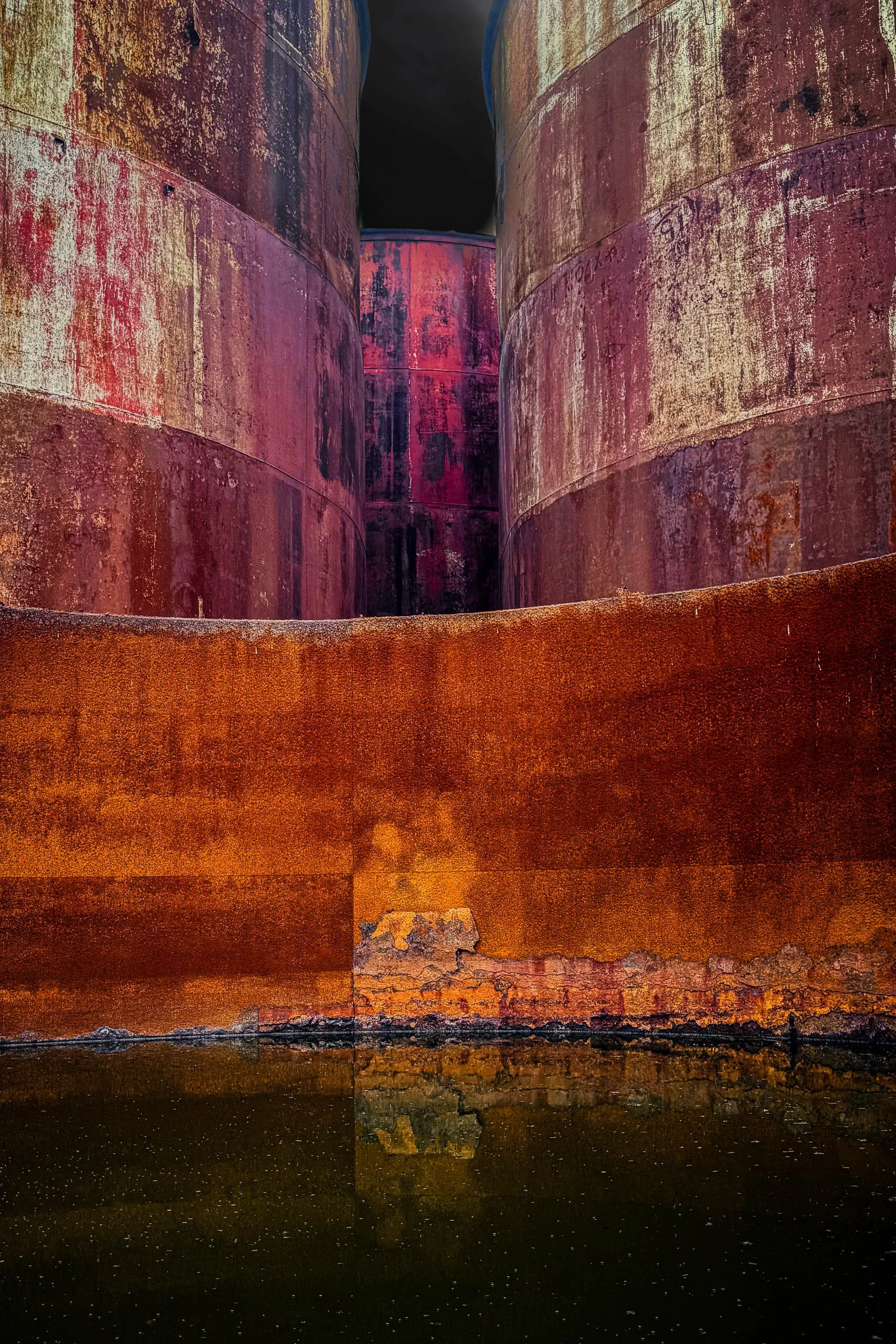
Iron Cathedral finds the sacred in the industrial — a cluster of massive storage tanks in New Haven, Missouri, photographed from within, looking up through the narrow gap between curved steel walls toward a void of dark sky above. The image does not announce itself as industrial photography. It announces itself as architecture — a cathedral of rust and oxidized iron, the curved walls rising like nave columns toward a black aperture that reads as open sky or as pure absence, depending on what the viewer brings to it.
The composition works because of the tonal journey it asks the eye to make. From the near-black water at the bottom — still, dark, reflecting the rust above in fractured amber — through the burnt orange and chestnut of the lower tank walls, through the cooler burgundy and deep red of the upper surfaces weathered by decades of Missouri weather, to the black void between the tank tops where the sky should be. It is a complete color narrative in a single vertical frame, moving from warmth to cool to darkness, from material to atmosphere to void.
The rust itself is the subject as much as the structure. Iron oxide in its various stages of weathering — from bright orange where it is freshest, through chestnut and sienna where it has settled, to the deep burgundy-red of long exposure — creates a surface as varied and rich as any painted canvas. The texture reads at every scale: from the overall color field visible across a room, to the granular surface detail that rewards close viewing on a large metal print.
Drawing on the abstract formalism of Edward Weston, the surface-as-subject philosophy of Aaron Siskind, and the documentary rigor of Bernd and Hilla Becher, Iron Cathedral occupies a space between straight industrial documentation and pure abstraction. The tanks in New Haven, Missouri are real — functional industrial infrastructure with a specific history in a specific place. But photographed from within, at ground level, looking up through the gap between them, they become something else: a meditation on scale, material, and the unintentional beauty of things built purely for use.
Design & Styling
Iron Cathedral brings exceptional color depth, material richness, and architectural scale to any interior. The warm rust palette — burnt orange, chestnut, sienna, deep burgundy — works naturally in contemporary interiors, industrial-modern spaces, healthcare environments, executive offices, and any setting where strong color and material presence are valued. The vertical 2:3 format creates a strong portrait-orientation statement piece well suited to spaces with vertical wall real estate — between windows, in entryways, beside doorways, or as a single centered anchor on a feature wall.
The rust palette pairs naturally with warm neutrals, concrete, raw steel, dark wood, leather, and deep earth-toned interiors. The image is equally at home in residential and commercial contexts — its abstract quality gives it a versatility that more literal industrial documentation does not have. Collectors drawn to Color Field painting, abstract expressionism, or the Becher tradition of industrial typology will respond immediately.
Curated Pairings
For a built environment statement wall: Pair with other images from the Built Environment collection for a grouping that explores the architecture of industry, infrastructure, and the made landscape across multiple scales and contexts.
For a color and atmosphere grouping: Pair with works from the Color and Atmosphere collection that share the warm rust, amber, and sienna palette — creating a wall unified by color rather than subject matter.
For a Missouri Americana narrative: Pair with western landscape and Americana images that share the warm earth palette, creating a grouping rooted in the material culture of the American midwest and west.
Fine Art Presentation
Iron Cathedral is available as a signed fine art photographic print in multiple presentation styles. Chromaluxe Metal is the strongest choice for this image — the micro-texture of the rust surface, the tonal range from near-black water through burnt orange to deep burgundy, and the fine detail in the weathered steel all render with exceptional depth and clarity on metal. At larger sizes the rust surface becomes genuinely immersive — the granular texture of oxidized iron reads at a scale that approaches the physical. TruLife Acrylic, printed on TrueVue or low-glare acrylic, adds dimensionality and depth that complements the layered tonal complexity of the image. Framed and unframed paper prints are produced on Photo Rag, offering a warmer, more painterly presentation that emphasizes the color field quality of the rust palette and draws comparisons to abstract expressionist painting. Canvas and Framed Canvas bring texture that reinforces the material richness of the subject.
For the strongest presentation, 20×30 or 24×36 on Chromaluxe Metal is the recommended primary size. At that scale the rust texture becomes a fully immersive surface and the tonal journey from water to void is experienced physically rather than merely seen.
Note: Custom and oversized prints are available. Please contact the studio directly to discuss custom framing, sizing, or specialized presentation options.
Iron Cathedral finds the sacred in the industrial — a cluster of massive storage tanks in New Haven, Missouri, photographed from within, looking up through the narrow gap between curved steel walls toward a void of dark sky above. The image does not announce itself as industrial photography. It announces itself as architecture — a cathedral of rust and oxidized iron, the curved walls rising like nave columns toward a black aperture that reads as open sky or as pure absence, depending on what the viewer brings to it.
The composition works because of the tonal journey it asks the eye to make. From the near-black water at the bottom — still, dark, reflecting the rust above in fractured amber — through the burnt orange and chestnut of the lower tank walls, through the cooler burgundy and deep red of the upper surfaces weathered by decades of Missouri weather, to the black void between the tank tops where the sky should be. It is a complete color narrative in a single vertical frame, moving from warmth to cool to darkness, from material to atmosphere to void.
The rust itself is the subject as much as the structure. Iron oxide in its various stages of weathering — from bright orange where it is freshest, through chestnut and sienna where it has settled, to the deep burgundy-red of long exposure — creates a surface as varied and rich as any painted canvas. The texture reads at every scale: from the overall color field visible across a room, to the granular surface detail that rewards close viewing on a large metal print.
Drawing on the abstract formalism of Edward Weston, the surface-as-subject philosophy of Aaron Siskind, and the documentary rigor of Bernd and Hilla Becher, Iron Cathedral occupies a space between straight industrial documentation and pure abstraction. The tanks in New Haven, Missouri are real — functional industrial infrastructure with a specific history in a specific place. But photographed from within, at ground level, looking up through the gap between them, they become something else: a meditation on scale, material, and the unintentional beauty of things built purely for use.
Design & Styling
Iron Cathedral brings exceptional color depth, material richness, and architectural scale to any interior. The warm rust palette — burnt orange, chestnut, sienna, deep burgundy — works naturally in contemporary interiors, industrial-modern spaces, healthcare environments, executive offices, and any setting where strong color and material presence are valued. The vertical 2:3 format creates a strong portrait-orientation statement piece well suited to spaces with vertical wall real estate — between windows, in entryways, beside doorways, or as a single centered anchor on a feature wall.
The rust palette pairs naturally with warm neutrals, concrete, raw steel, dark wood, leather, and deep earth-toned interiors. The image is equally at home in residential and commercial contexts — its abstract quality gives it a versatility that more literal industrial documentation does not have. Collectors drawn to Color Field painting, abstract expressionism, or the Becher tradition of industrial typology will respond immediately.
Curated Pairings
For a built environment statement wall: Pair with other images from the Built Environment collection for a grouping that explores the architecture of industry, infrastructure, and the made landscape across multiple scales and contexts.
For a color and atmosphere grouping: Pair with works from the Color and Atmosphere collection that share the warm rust, amber, and sienna palette — creating a wall unified by color rather than subject matter.
For a Missouri Americana narrative: Pair with western landscape and Americana images that share the warm earth palette, creating a grouping rooted in the material culture of the American midwest and west.
Fine Art Presentation
Iron Cathedral is available as a signed fine art photographic print in multiple presentation styles. Chromaluxe Metal is the strongest choice for this image — the micro-texture of the rust surface, the tonal range from near-black water through burnt orange to deep burgundy, and the fine detail in the weathered steel all render with exceptional depth and clarity on metal. At larger sizes the rust surface becomes genuinely immersive — the granular texture of oxidized iron reads at a scale that approaches the physical. TruLife Acrylic, printed on TrueVue or low-glare acrylic, adds dimensionality and depth that complements the layered tonal complexity of the image. Framed and unframed paper prints are produced on Photo Rag, offering a warmer, more painterly presentation that emphasizes the color field quality of the rust palette and draws comparisons to abstract expressionist painting. Canvas and Framed Canvas bring texture that reinforces the material richness of the subject.
For the strongest presentation, 20×30 or 24×36 on Chromaluxe Metal is the recommended primary size. At that scale the rust texture becomes a fully immersive surface and the tonal journey from water to void is experienced physically rather than merely seen.
Note: Custom and oversized prints are available. Please contact the studio directly to discuss custom framing, sizing, or specialized presentation options.