

What I Learned from Ansel Adams
What I admire most about Ansel Adams is not simply his technical mastery. It is his belief that a photograph should communicate an experience. That idea continues to shape the way I approach landscapes, printing, and the craft of photography.
Light, Landscape, and Craftsmanship
If Edward Weston taught me to see form and Frederick H. Evans taught me to see light, Ansel Adams taught me to respect craftsmanship.
Adams understood something that remains true today.
The camera does not create the photograph.
The photographer does.
His famous landscapes were never simply records of places. They were interpretations of experience. Every exposure, every tonal decision, and every darkroom adjustment contributed to a final image that communicated what he felt standing before the landscape.
That philosophy continues to influence my own work.
When I photograph Monument Valley, Shiprock, Canyonlands, Arches, or the Flint Hills, I am not simply documenting a location. I am trying to create a photograph that conveys atmosphere, scale, and emotional connection.
I see Adams' influence most clearly in photographs such as The First Aperture, Enduring Silence, Valley of Fire, Interrupted Silence, and Stillness After Rain.
These images depend on many of the same qualities that Adams valued.
Patience.
Timing.
Light.
Weather.
And perhaps most importantly, careful craftsmanship after the shutter is released.
Adams famously compared the negative to a musical score and the print to a performance. That idea resonates strongly with me because so much of my photographic process happens after capture.
Editing is not an afterthought.
Printing is not an afterthought.
Presentation is not an afterthought.
They are part of the creative process.
Whether I am refining tonal relationships in Lightroom, making selective adjustments in Photoshop, preparing a file for metal printing, or evaluating a final print under gallery lighting, I am continuing the conversation that began when I made the photograph.
Adams also reminds me to think about permanence.
Many of my favorite subjects are landscapes shaped by geological time. Monument Valley, Shiprock, Canyonlands, and the sandstone formations of the Southwest existed long before I arrived and will remain long after I am gone.
Photographs such as Enduring Silence and The First Aperture are, in part, responses to that realization.
They attempt to communicate the feeling of standing before something ancient and enduring.
Perhaps that is why Adams' work continues to matter.
His photographs are not merely beautiful.
They encourage viewers to pay attention.
To appreciate light.
To appreciate wilderness.
To appreciate craftsmanship.
And to recognize that photography can be both an artistic practice and a way of connecting more deeply with the world around us.
That remains one of the most valuable lessons Ansel Adams has to offer.
Introducing Ansel Adams
Few photographers are more closely associated with the American landscape than Ansel Adams. His photographs of mountains, deserts, rivers, and national parks helped shape both the history of photography and the way generations of people experience the natural world.
The Art of Seeing the Landscape
Few photographers have left a larger mark on photography than Ansel Adams. In fact one can argue that he was the most influential artists for every photographer. I wanted to wait to think about other photographers that influenced me so I could think about how to talk about Ansel Adams.
For many people, Adams is synonymous with the American landscape. His photographs of Yosemite, the Sierra Nevada, and the American West have become some of the most recognizable images ever created. Yet reducing Adams to simply a landscape photographer overlooks the depth of his contribution to the medium.
Adams was not merely photographing scenery.
He was interpreting it.
Working primarily in black and white, Adams developed photographs of extraordinary tonal richness and technical precision. Through careful exposure, meticulous darkroom craftsmanship, and an intimate understanding of light, he transformed mountains, clouds, forests, and rivers into powerful visual experiences.
One of his most important contributions was the development of the Zone System, a method that allowed photographers to visualize and control tonal values from the moment an image was conceived. The system remains influential today because it encourages photographers to think intentionally about light, contrast, and the final print.
What makes Adams' work endure is not simply technical excellence. Countless photographers have mastered technique. Adams combined technical skill with emotional response.
His photographs communicate awe.
They communicate scale.
They communicate the feeling of standing before something larger than oneself.
The landscapes in his photographs are not passive scenery. They become expressions of light, weather, atmosphere, and geological time.
Adams was also a committed conservationist. His photographs helped inspire appreciation for public lands and contributed to broader efforts to protect wilderness areas throughout the American West.
For Adams, photography was more than documentation.
It was a way of communicating the experience of being present in nature.
More than half a century later, his work continues to influence photographers around the world because it demonstrates a timeless truth: a great landscape photograph is not simply about where it was made. It is about what the photographer felt while standing there.
That connection between observation, craftsmanship, and emotional response remains Ansel Adams' enduring legacy.
What I Learned from Edward Weston
What I admire most about Edward Weston is his ability to find significance in ordinary subjects. His photographs remind me that a compelling image begins not with a dramatic location, but with the willingness to truly see.
Form, Texture, and Seeing:
When photographers talk about Edward Weston, they often mention his famous peppers.
I think the peppers matter less than the way he saw them.
Weston possessed an extraordinary ability to look beyond a subject's identity and recognize its visual character. He saw curves, lines, textures, shadows, and relationships. The object itself became secondary to the experience of seeing.
That lesson has influenced my own photography more than any specific technique.
Many of my favorite photographs begin with subjects that might seem ordinary at first glance. A flower. A seed head. A weathered surface. A reflection. A detail that others might pass without notice.
The challenge is not finding extraordinary subjects.
The challenge is seeing ordinary subjects extraordinarily well.
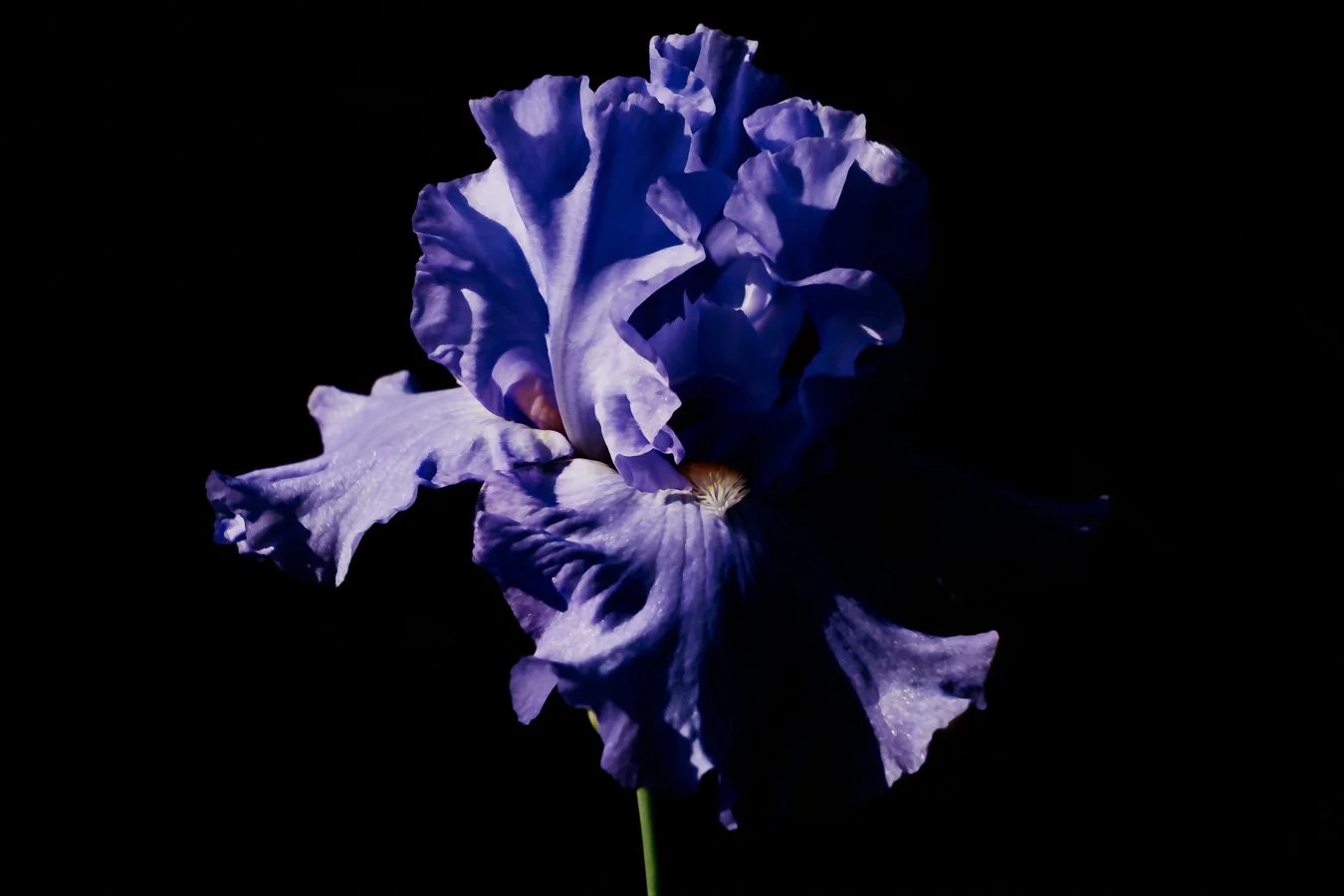
I see Weston's influence most clearly in my botanical work. Images such as Lavender Iris, Seeds of the Meadow, After the Heat, and many of my floral studies depend less on color and more on form. The shape of a petal, the texture of a seed head, or the rhythm of repeating structures becomes the foundation of the photograph.
Weston also reminds me of the importance of craftsmanship.
His photographs are meticulously composed. Every edge matters. Every tonal transition matters. Nothing feels accidental.
That same attention to detail influences the way I edit and print my photographs. Whether I am working on a macro botanical image or a large landscape, I want the final photograph to reward close viewing.
The longer I photograph, the more I appreciate Weston's commitment to observation.
Modern photography often encourages speed. We photograph more images than ever before and move quickly from one subject to the next.
Weston worked differently.
He studied.
He simplified.
He refined.
He looked again.
That process continues to resonate with me.
Some of my strongest photographs have emerged not from dramatic discoveries but from spending time with a subject and allowing it to reveal itself gradually. A flower becomes an abstract study of color and shape. A weathered object becomes a study of texture. A reflection becomes a meditation on form.
Weston reminds me that photography is ultimately an act of attention.
The camera records what stands before it.
The photographer decides what is worth seeing.
That remains one of Edward Weston's most enduring lessons.
Introducing Edward Weston
Edward Weston transformed peppers, shells, dunes, and everyday objects into some of the most iconic photographs in history. His work helped define modern photography by proving that beauty could be found through careful observation rather than manipulation.
The Pursuit of Pure Photography
Few photographers changed the course of photography as profoundly as Edward Weston.
Working during the first half of the twentieth century, Weston became one of the leading voices of what came to be known as "straight photography"—an approach that emphasized clarity, precision, and the inherent qualities of the photographic medium. Rather than imitating painting or relying on heavy manipulation, Weston believed photography should embrace what made it unique.
His subjects were often surprisingly simple.
Peppers.
Shells.
Driftwood.
Dunes.
Rocks.
Leaves.
Yet through careful composition and extraordinary attention to light, Weston transformed these ordinary objects into photographs of remarkable power and elegance.
What distinguished Weston was not the subject itself, but the way he saw it. He had an exceptional ability to recognize shape, texture, rhythm, and form. A pepper became sculpture. A shell became architecture. A sand dune became an abstract study of line and shadow.
His photographs encourage viewers to look more carefully at the world around them.
Weston believed that photography could reveal beauty hidden in plain sight. He often worked with large-format cameras, creating negatives rich in detail and tonal subtlety. The resulting prints possess a remarkable sense of presence, inviting viewers to engage with every curve, texture, and surface.
His influence extended beyond technique. Weston helped establish photography as a serious artistic medium and inspired generations of photographers to trust observation rather than manipulation.
Today, his work remains a reminder that extraordinary photographs do not require extraordinary subjects.
Sometimes the most compelling images begin with a simple act of attention.
Edward Weston teaches us that photography is not merely about recording what exists. It is about seeing what others overlook.