
Holiday preview
Title: The Second Look: Holiday Preview with Photographer Robert Niemeier
When: Friday, Dec. 18, 2026, 6:30 to 8:30 p.m.
Where: Citrine Events, 3212 Rue Royale St., St. Charles, MO 63301
Category: Art / Exhibition / Holiday
Cost: Free
Join photographer Robert Niemeier for a holiday evening among the photographs at Citrine Events. Enjoy food and drink, see five panels from his first solo exhibition, The Second Look, flip through a print bin, and browse cards and small prints for your gift list. Admission is free. The full show opens January 1 and runs through March 31, 2027, with an opening reception on Saturday, January 2.
More info: [email protected]
Opening reception
Title: Opening Reception: The Second Look, Photographs by Robert Niemeier
When: Saturday, Jan. 2, 2027, 6:30 to 8:30 p.m.
Where: Citrine Events, 3212 Rue Royale St., St. Charles, MO 63301
Category: Art / Exhibition / Reception
Cost: Free
The Second Look is Robert Niemeier's first solo exhibition. It takes its title from a belief that if all you see in a photograph is what you saw at first glance, the picture has failed. Come to the opening reception to see the work, meet the photographer and talk about the pieces. Admission is free. The exhibition is on view through March 31, 2027.
More info: 575 779-6480
Exhibition run
Title: The Second Look: Photographs by Robert Niemeier
Dates: Jan. 1 through March 31, 2027
Where: Citrine Events, 3212 Rue Royale St., St. Charles, MO 63301
Category: Art / Exhibition
Cost: Free
Hours: Viewing at Citrine Events or by appointment, [email protected]
Fine art photographs from the American West and the St. Louis region, in photographer Robert Niemeier's first solo exhibition. Free; viewing at events or by appointment.
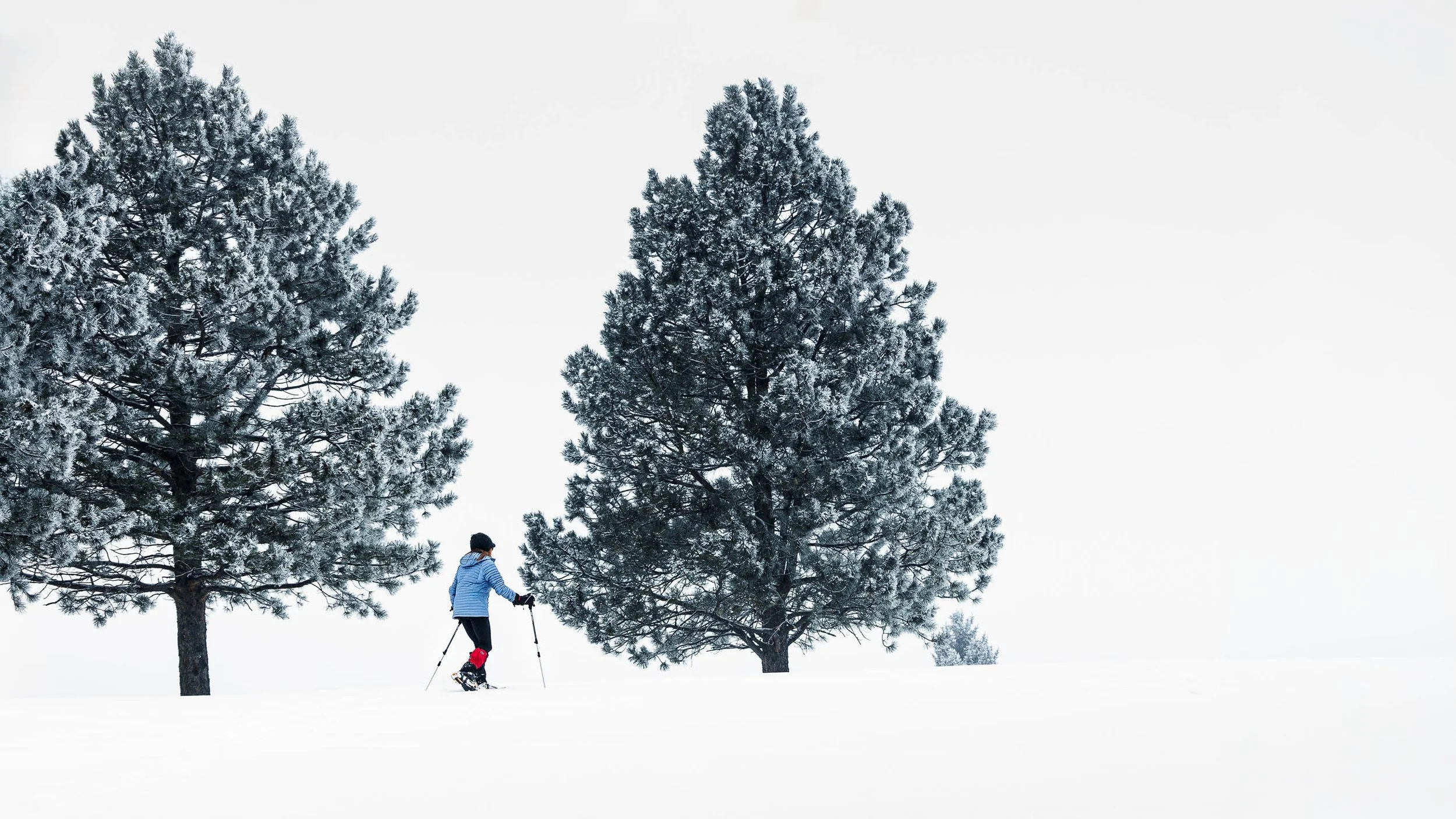
A single figure moves through snow between two towering, frost-rimed pines — small against the scale of the landscape, unhurried against the stillness of it. The high-key winter light flattens the scene toward white, leaving the trees' dark, textured silhouettes and the walker's blue jacket and red gaiter as the only real anchors in the frame.
The composition rests on a precise, almost mathematical relationship: the ratio between the figure's scale and the two pines' scale is the entire picture. Move the person a few feet closer or the trees a few feet farther and the quiet authority of the image collapses. This is not a generic outdoor-lifestyle photograph — it's a specific, considered study in how small a person becomes against enough winter and enough silence.
The near-monochrome palette, broken only by small warm accents of color, places this piece close to the restrained, architectural stillness of Hiroshi Sugimoto's seascapes, with a quiet, narrative solitude that also recalls Andrew Wyeth's winter fields. It rewards a slow look — the kind of patience the walker in the frame is clearly practicing.
Design & Styling
This piece's high-key, near-white palette makes it an unusually flexible interior choice — it reads as almost monochrome from a distance and adds color only on close inspection. It's a natural fit for ski lodge and mountain resort interiors, spa and wellness spaces, and hotel lobbies in alpine or winter-destination settings, where its quiet scale-and-silence quality matches the intended mood of the space. It also suits minimalist modern interiors with white or light neutral walls, where the piece can function almost as a graphic element until a viewer steps close enough to find the human figure within it.
Curated Pairings
For winter continuity — "Veil Over the Front Range", another Colorado winter mountain piece sharing this image's restrained, cold-season palette.
For scale and solitude — "Cathedral of Light", a vertical forest study working the same relationship between human scale and towering natural form.
For hospitality settings — "Where Winter Waited", a companion winter piece from the same Evergreen, Colorado area, well suited to the same lodge and resort interiors.
Fine Art Presentation
Given the high-key, near-monochrome palette, this piece is especially well suited to ChromaLuxe® Metal (gloss, semi-gloss, or matte) print, which will hold the subtle tonal gradation in the snow and sky without flattening it, or an archival paper print for a softer, more painterly rendering of the winter light. Acrylic face-mounting is also available for a glass-like presentation with added depth. Framed and unframed options available on request.
Note: Custom and oversized photographic prints are available. Please contact the studio directly to discuss custom framing, matting, or specialized museum glass options.
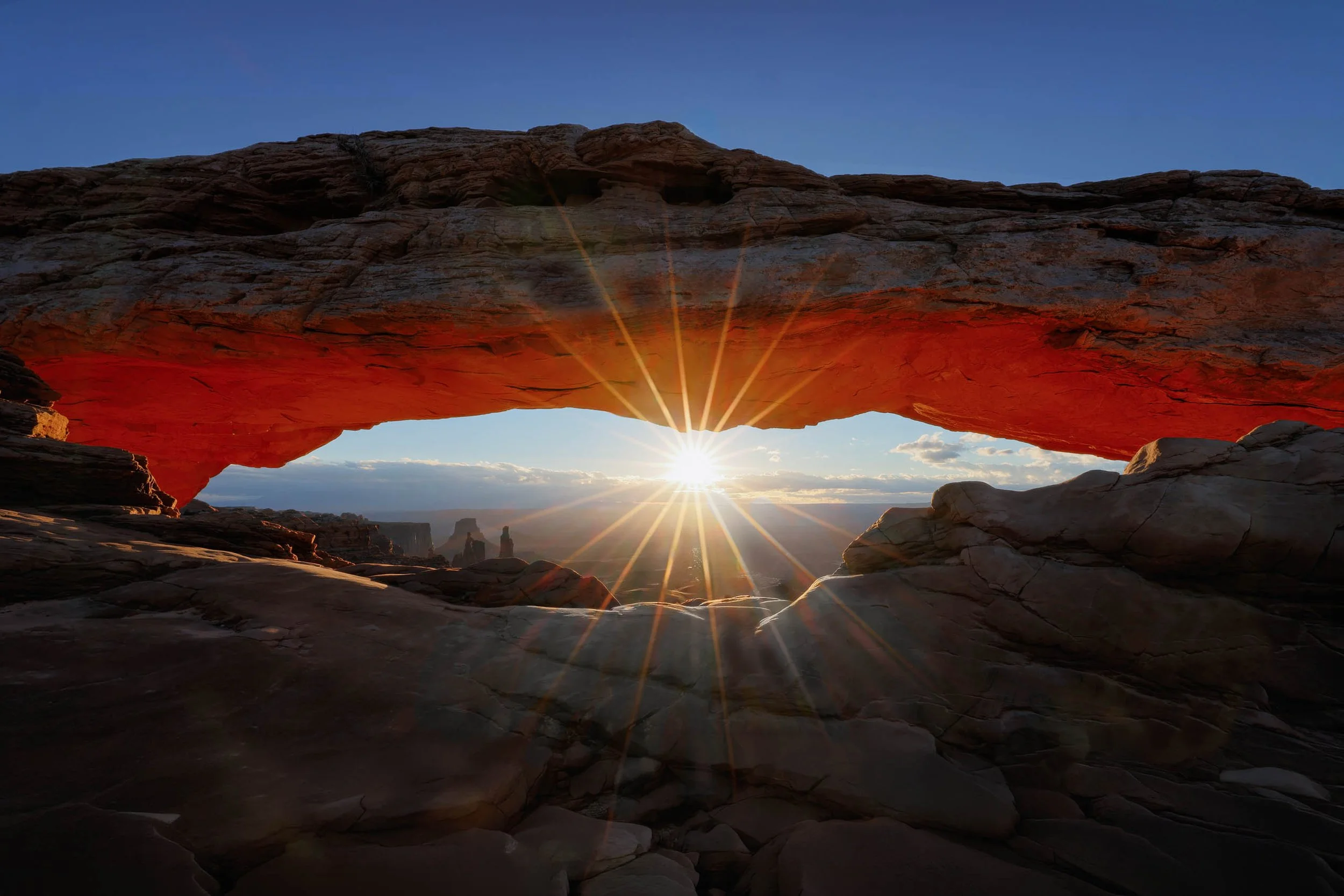
For a few minutes at sunrise the arch lights from below, and the sandstone turns the color of an ember against a deep blue sky. The First Aperture 3:2 looks through Mesa Arch in Canyonlands National Park, Utah, at a sunburst held at the center of the opening, the red-orange underside of the arch glowing above it and the canyon country spreading out below the sun.
The eye starts at the sunburst, where the arch pinches down to its narrowest point, then follows the rays out across the rock, up through the red underside and along the long horizontal span of the arch. Below the sun, the canyon steps back in layers, and in the notch just left of the sun the spires of Washer Woman and Monster Tower stand small in the haze, a second look for anyone who stays with the picture. Dark sandstone ledges fill the lower part of the frame and hold the weight, so the light above reads as the event.
This is color-driven Southwest landscape photography in the tradition of Ansel Adams' grand western views, with the color-as-light sensibility of Ernst Haas. It is presented here in the 3:2 frame, a taller composition than the panorama, with more rock and more sky around the arch.
Design & Styling
The red and the blue give the print real presence in hospitality interiors: hotel lobbies, restaurant and lounge walls, lodge entries and conference rooms where a strong focal point is wanted. In executive offices and residences it suits a wall above a fireplace, credenza or sofa, especially with warm neutrals, charcoal, leather or walnut around it, where the arch's red picks up the room's warm tones and the blue keeps it from overheating. It is a natural gift for anyone connected to Utah, the national parks or the Southwest.
Curated Pairings
For shared place: Pair with Beneath the Midnight Bow, the same arch under moonlight and stars, with a pool of water reflecting the moon where this one holds a rising sun.
For the wider view: Pair with The First Aperture (Panorama), the same sunrise in a panoramic crop that opens out the canyon country on either side.
For shared palette: Pair with Rising in Blue and Orange, where hot orange sandstone meets deep blue sky with nothing in between, the same two colors this arch builds on.
For shared formal treatment: Pair with Ember and Silence, which follows the curved underside of Double Arch and the line where warm sunlit stone meets cooler shade.
Fine Art Presentation
Available as a signed, numbered limited edition print (edition of 15) in Gallery Metal, ChromaLuxe® Metal (Gloss, Semi-Gloss or Matte), TruLife Acrylic, archival paper, canvas, and wood. ChromaLuxe® Metal is the strongest choice: the saturated red and blue and the fine rock detail around the sunburst hold their crispness and brightness there. Semi-Gloss keeps the large dark sandstone areas from mirroring the room, and TruLife (Low-Glare) Acrylic is the alternative where you want more depth in the sky and the glow.
Note: Custom and oversized photographic prints are available. Please contact the studio directly to discuss custom framing, matting, or specialized museum glass options.
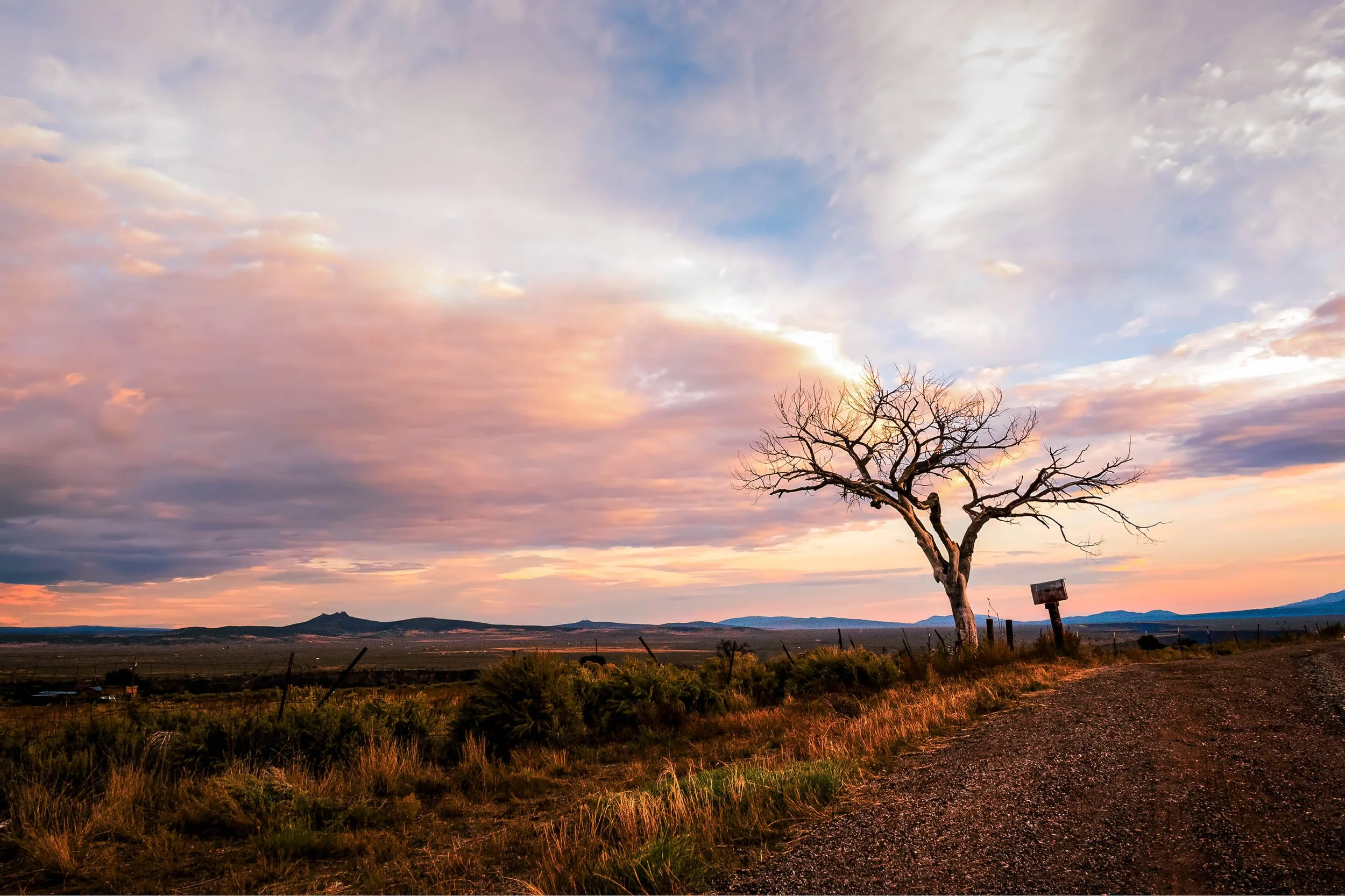
Some landmarks are only fully seen once they are gone. The Last Goodbye is a quiet farewell to the Welcome Tree, held in lavender and pale gold light above the Taos plateau, with a thread of amber grass catching the last warmth along the road.
The frame is built on a simple balance. A wide, softly lit sky fills most of the picture, and the tree stands low on the right third, its pale trunk and bare crown silhouetted against the glowing band behind it. The gravel road runs in from the lower right and the sage and fence posts carry the eye to the tree. A weathered mailbox at its base is the discovered detail: a small human trace beside the tree, easy to miss and worth finding. A twin-crested hill anchors the far horizon.
The Welcome Tree stood at the top of the Horseshoe Curve on Highway 68 south of Taos, greeting travelers on the way in and seeing them off on the way out. It fell in strong winds on June 8, 2026. This photograph was made in 2025, while it still stood.
The restraint is in the Andrew Wyeth tradition: muted tone, an honest subject, and feeling carried by what is left out. The empty road and the long American horizon also owe something to Wim Wenders, where distance and stillness do the storytelling.
Design & Styling
This piece suits a living room or den that wants a calm, wide, sky-led image, and it pairs well with warm woods, linen and muted earth tones. It also fits a hotel lobby, restaurant or suite that wants a sense of place without visual noise, and a study or office where reflection matters more than spectacle. The lavender and gold palette works with sand, clay, sage, warm gray and soft white walls.
Curated Pairings
For the same tree in a different light: The Welcome Tree
For the same road-and-horizon journey: The Long Way West
For deliberate contrast, a storm where this is a quiet dusk, with the same sky-dominant structure: Storm Gate
Fine Art Presentation
The luminous sky is the heart of this image, so Low-Glare or Anti-Glare Acrylic (printed on TrueVue) is the strongest choice; it keeps the depth of the dusk glow without reflections. Archival paper suits the soft, tonal palette and gives a classic gallery-print feel, framed or unframed. ChromaLuxe® Metal is also available in Gloss, Semi-Gloss and Matte, and the Matte finish suits this muted color best. Canvas and wood are available on request.
Note: Custom and oversized photographic prints are available. Please contact the studio directly to discuss custom framing, matting, or specialized museum glass options.
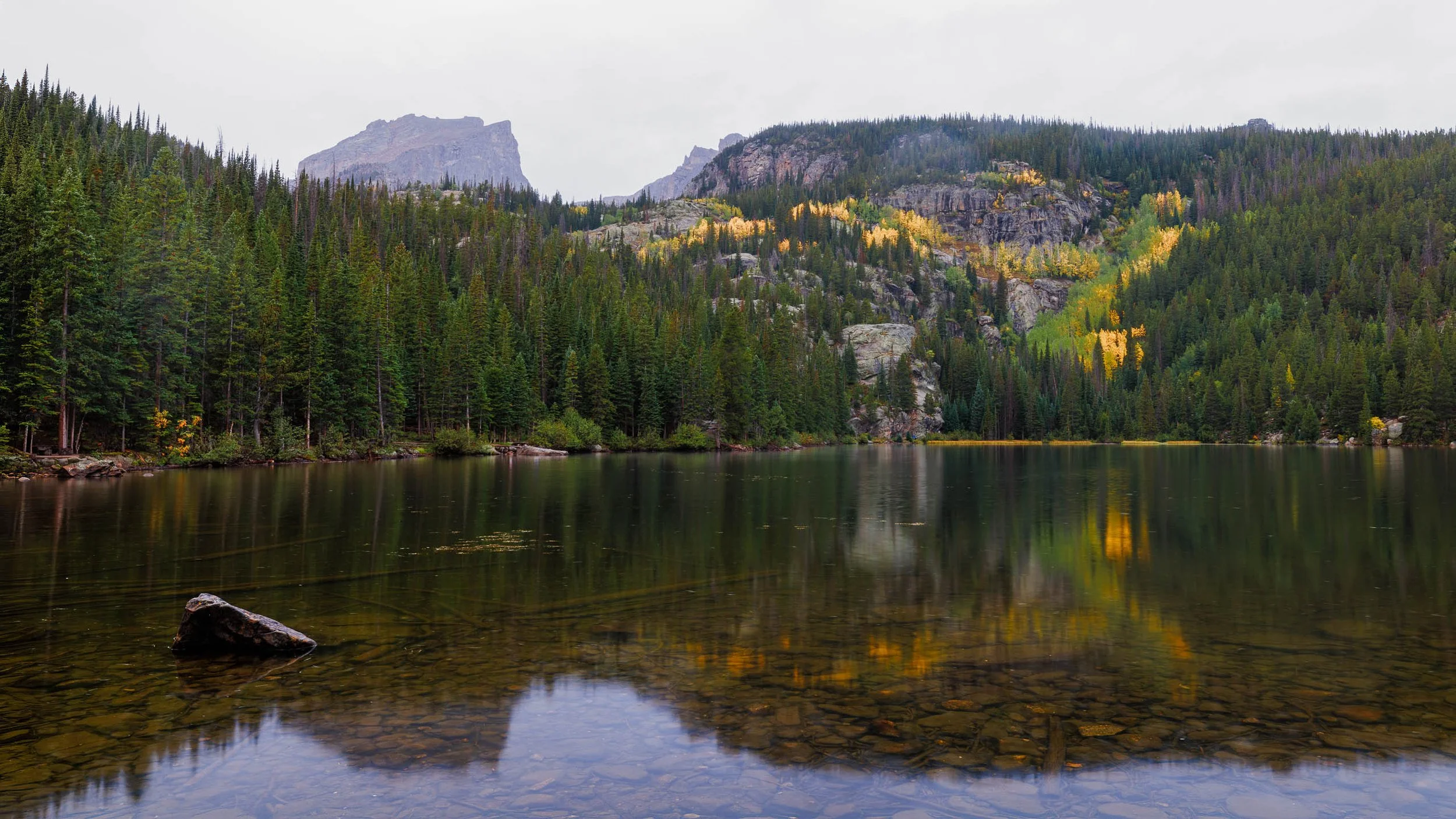
Between Seasons finds a single stand of golden aspen breaking the deep green monotony of the pine forest ringing Bear Lake in Rocky Mountain National Park, the whole scene doubled in the lake's still, clear water beneath an overcast autumn sky.
A large rock breaks the water's surface in the foreground, its texture and the submerged stones beneath it visible through the lake's remarkable clarity — a quiet anchor before the eye travels across calm water to the one patch of turning color on the far shore, then up to the granite face of Hallett Peak rising through the mist. The reflection doubles nearly the entire scene, mountain and forest both mirrored in the glass-still surface below.
Bear Lake is among the most photographed vantage points in Rocky Mountain National Park, but the flat, overcast light and the deliberate isolation of a single aspen stand — rather than a broad sweep of peak fall color — pull this away from the postcard version of the view, continuing the same interest in a quiet, singular detail found in pieces like What the Bark Remembers.
Design & Styling
With its muted, atmospheric palette and unmistakable Rocky Mountain setting, Between Seasons is well suited to mountain lodge and cabin interiors, ski resort lobbies, and healthcare or senior-living settings where a calm, non-jarring nature subject is preferred.
Curated Pairings
For shared place: Pair with Held at Rest, photographed in the same park — an elk herd rather than a lake, but the same quiet, muted Rocky Mountain register.
For shared formal device: Complement with What the Bark Remembers, which uses the identical visual idea of a single lit aspen note set against a dense wall of dark pine.
For shared formal treatment: Pair with The Silent Assembly, which shares the same device of a still, mirror-calm water surface doubling the scene above it against a darkened forest backdrop.
Fine Art Presentation
Available as a signed, numbered limited edition print (edition of 15) in Gallery Metal, ChromaLuxe® Metal, TruLife Acrylic, archival paper, canvas, and wood presentation formats. The clear, reflective water suits TruLife (Low-Glare) Acrylic particularly well, giving the reflection real depth and luminosity; canvas is a strong alternative for a softer, more painterly rendering of the misty, overcast palette.
Note: Custom and oversized photographic prints are available. Please contact the studio directly to discuss custom framing, matting, or specialized museum glass options.

A single figure moves through snow between two towering, frost-rimed pines — small against the scale of the landscape, unhurried against the stillness of it. The high-key winter light flattens the scene toward white, leaving the trees' dark, textured silhouettes and the walker's blue jacket and red gaiter as the only real anchors in the frame.
The composition rests on a precise, almost mathematical relationship: the ratio between the figure's scale and the two pines' scale is the entire picture. Move the person a few feet closer or the trees a few feet farther and the quiet authority of the image collapses. This is not a generic outdoor-lifestyle photograph — it's a specific, considered study in how small a person becomes against enough winter and enough silence.
The near-monochrome palette, broken only by small warm accents of color, places this piece close to the restrained, architectural stillness of Hiroshi Sugimoto's seascapes, with a quiet, narrative solitude that also recalls Andrew Wyeth's winter fields. It rewards a slow look — the kind of patience the walker in the frame is clearly practicing.
Design & Styling
This piece's high-key, near-white palette makes it an unusually flexible interior choice — it reads as almost monochrome from a distance and adds color only on close inspection. It's a natural fit for ski lodge and mountain resort interiors, spa and wellness spaces, and hotel lobbies in alpine or winter-destination settings, where its quiet scale-and-silence quality matches the intended mood of the space. It also suits minimalist modern interiors with white or light neutral walls, where the piece can function almost as a graphic element until a viewer steps close enough to find the human figure within it.
Curated Pairings
For winter continuity — "Veil Over the Front Range", another Colorado winter mountain piece sharing this image's restrained, cold-season palette.
For scale and solitude — "Cathedral of Light", a vertical forest study working the same relationship between human scale and towering natural form.
For hospitality settings — "Where Winter Waited", a companion winter piece from the same Evergreen, Colorado area, well suited to the same lodge and resort interiors.
Fine Art Presentation
Given the high-key, near-monochrome palette, this piece is especially well suited to ChromaLuxe® Metal (gloss, semi-gloss, or matte) print, which will hold the subtle tonal gradation in the snow and sky without flattening it, or an archival paper print for a softer, more painterly rendering of the winter light. Acrylic face-mounting is also available for a glass-like presentation with added depth. Framed and unframed options available on request.
Note: Custom and oversized photographic prints are available. Please contact the studio directly to discuss custom framing, matting, or specialized museum glass options.
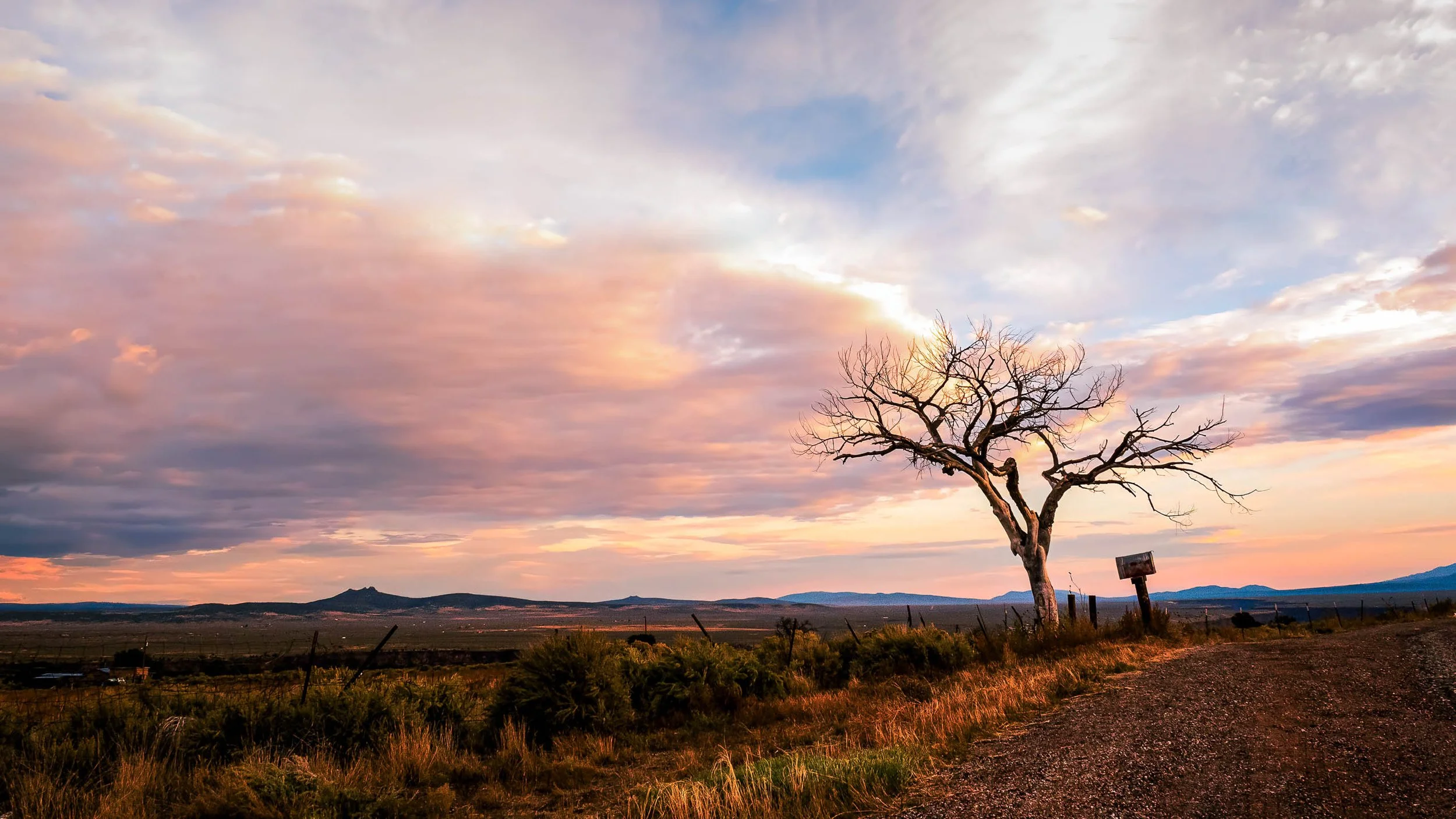
The Long Goodbye finds a single bare tree standing alone beside a gravel road outside Taos, New Mexico, its branches gesturing upward into a vast, layered sunset sky. For thirty years this tree marked the entrance and exit to town, a quiet fixture known locally as the Hello and Goodbye Tree — until a storm brought it down. This photograph, made not long before, has become something more than a landscape study: a record of a landmark that no longer stands.
The composition leans into stillness and scale rather than drama. A gravel road enters from the lower right, the tree's branches reach back to the left, and a warm diagonal band of cloud sweeps in from the upper left — three quiet lines of motion converging on a single point, with a weathered mailbox standing sentinel nearby as the only other sign of human presence. The vastness of the sky is not empty space to be filled; it is the subject, with the tree as a single, spare gesture within it.
The image carries a deliberate nod to Andrew Wyeth's muted American realism — restraint over spectacle, a quiet character study of the land rather than a dramatic vista. The title borrows its cadence from Raymond Chandler, whose novel of the same name concerns farewells that linger far longer than expected. Thirty years of standing watch, and one long, slow goodbye.
Design & Styling:
The Long Goodbye suits quiet residential spaces, reading rooms, and offices seeking a contemplative Southwest presence, as well as hospitality and wellness settings drawn to restrained, atmospheric color over bold statement pieces. Its wide panoramic format make it especially well suited to a long wall, hallway, or above a low console or headboard.
Curated Pairings:
For narrative harmony, pair with The Last Sentinel, continuing the theme of a solitary landmark standing watch over the land.
For compositional harmony, complement with Where the Sky Wanders, another study built around vast sky as the true subject of the frame.
For thematic harmony, pair with A Place Where Weather Waits, extending the quiet, Wyeth-adjacent study of the rural American West.
Fine Art Presentation:
Available as a signed fine art print in ChromaLuxe® Metal (gloss, semi-gloss, or matte), acrylic, framed paper, canvas, and wood presentation formats. Metal or acrylic is recommended to hold the depth of the sunset gradient and the tree's silhouette detail.
Note: Custom and oversized photographic prints are available. Please contact the studio directly to discuss custom framing, matting, or specialized museum glass options.

Some forests turn every line toward the light. Reaching Sky (Monochrome) looks straight up from the forest floor in a Colorado aspen grove, where towering pale trunks sweep in from every edge of a tall vertical frame and converge on a single sunburst breaking through the canopy.
Rendered in black and white, the image becomes an exercise in tonal separation: bright bark against dark foliage, sunlit fronds against black shadow, one star of light against the sky. The eye starts in the ferns at the bottom, where the light catches every frond, climbs the leaning trunks as they bow inward, and arrives at the sun at the center. A single bright trunk slashes diagonally across the top of the frame, and a bank of cloud in the upper right keeps the sky from feeling sealed. The ultra-wide vantage bends the trunks into an arch and closes the canopy in at the corners.
The luminous aspen bark and deep tonal range recall Ansel Adams's aspen studies, while the patient, quietly geometric view has something of Josef Sudek's attention — a study in scale, convergence, and the quiet architecture of a living forest.
Design & Styling
The strong converging lines and deep tonal range make Reaching Sky (Monochrome) well suited to wellness spaces, spas, and biophilic-design interiors, as well as mountain-view residences, lodges, and hospitality corridors. Its tall vertical composition suits stairwells, entryways, and tall wall spaces particularly well, and in black and white it sits comfortably with any color scheme.
Curated Pairings
To build a wall around Colorado light and forest, consider these companion pieces:
For Colorado high-country continuity: Pair with Before Guanella Pass, connecting forest and mountain within the same regional story.
For canopy and forest continuity: Complement this piece with The Quiet Cathedral, building a series around the same aspen grove.
For dramatic light continuity: Pair with Silver Thread, Silent Valley, connecting two pieces built around a break of sunlight.
Fine Art Presentation
Available as a signed fine art print on ChromaLuxe® Metal (gloss, semi-gloss, or matte), Glossy Anti-Glare Acrylic (TruLife), canvas, wood, and archival paper (framed or unframed). Framed archival paper is the recommended presentation: it suits the classic tonal range of a black-and-white aspen study and keeps the fern and bark detail smooth. ChromaLuxe® Metal is the alternative for the luminous sunburst and the deepest blacks, and wood is a natural fit for the subject, where the grain of the print echoes the trunks.
Note: Custom and oversized photographic prints are available. Please contact the studio directly to discuss custom framing, matting, or specialized museum glass options.
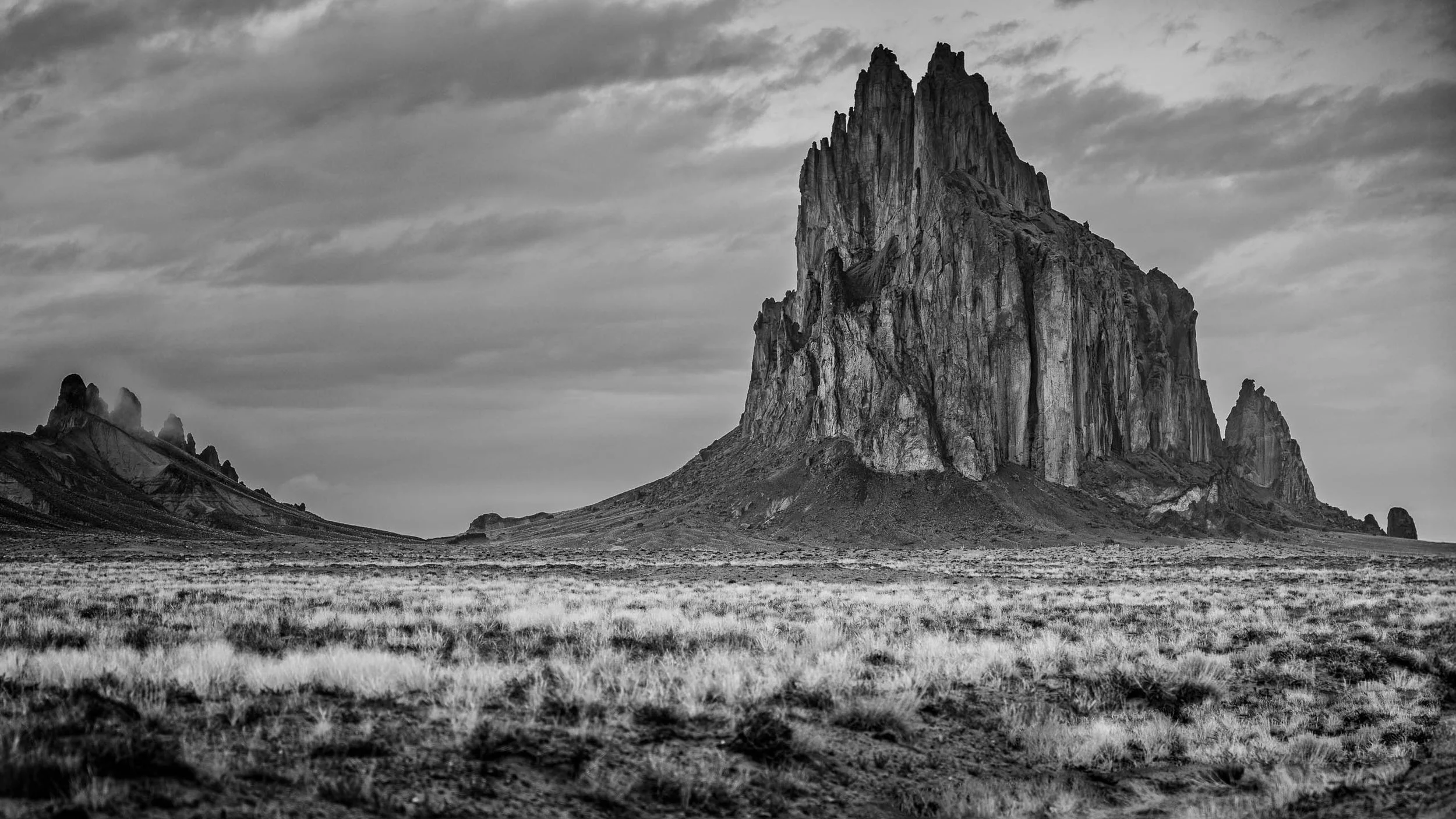
Rock with Wings is a monumental black & white study of Shiprock, the volcanic spire that rises nearly 1,600 feet above the high desert plain of northwestern New Mexico. Photographed from a low vantage point across open grassland, the image lets the formation's jagged, columnar peaks command the frame against a heavy, textured sky — a composition built in the spirit of Ansel Adams's zone-system landscapes, where tonal control does as much storytelling as the subject itself.
The title honors the formation's Navajo name, Tsé Bit'a'í, meaning "rock with wings." In Navajo tradition, the formation is said to be the remains of a great bird that carried the Navajo people from a distant, dangerous land to their present homeland, turning to stone upon landing. Shiprock remains a sacred site to the Navajo Nation, and this photograph was made respectfully, from public land, without approaching or climbing the formation.
Extensive work in the darkroom-equivalent digital process — a graduated tonal pull through the sky, targeted structure and texture enhancement on the rock face, and careful black-point control — gives the print the kind of depth and presence that rewards close viewing at large scale, while the foreground grassland grounds the formation's immensity in a human sense of place.
Design & Styling
With its bold graphic silhouette and restrained monochrome palette, Rock with Wings works especially well as a large-format anchor piece in executive offices, galleries, and residential spaces with a Southwest or contemporary Western sensibility. Its scale and tonal depth make it a strong candidate for oversized statement placement.
Curated Pairings
To create a cohesive gallery wall, consider these companion pieces from the Western Silence collection:
Pair with Enduring Silence, a misty, purple-toned color study of the same formation, for a striking two-treatment presentation of Shiprock in a single collection.
For tonal harmony: Complement with After the Storm Passed, continuing the exploration of this landmark's texture and scale.
For regional context: Pair with Where the Desert Meets Night, extending the Western Silence collection's exploration of iconic Southwest desert landmarks into a nocturnal register.
Fine Art Presentation
as a signed fine art print in ChromaLuxe® Metal (gloss, semi-gloss, or matte), acrylic, framed and unframed archival paper, and canvas presentation formats. Given the tonal range built into this edit, ChromaLuxe® Metal is highly recommended to preserve the deep blacks and highlight separation across the rock face and sky.
Note: Custom and oversized photographic prints are available. Please contact the studio directly to discuss custom framing, matting, or specialized museum glass options.
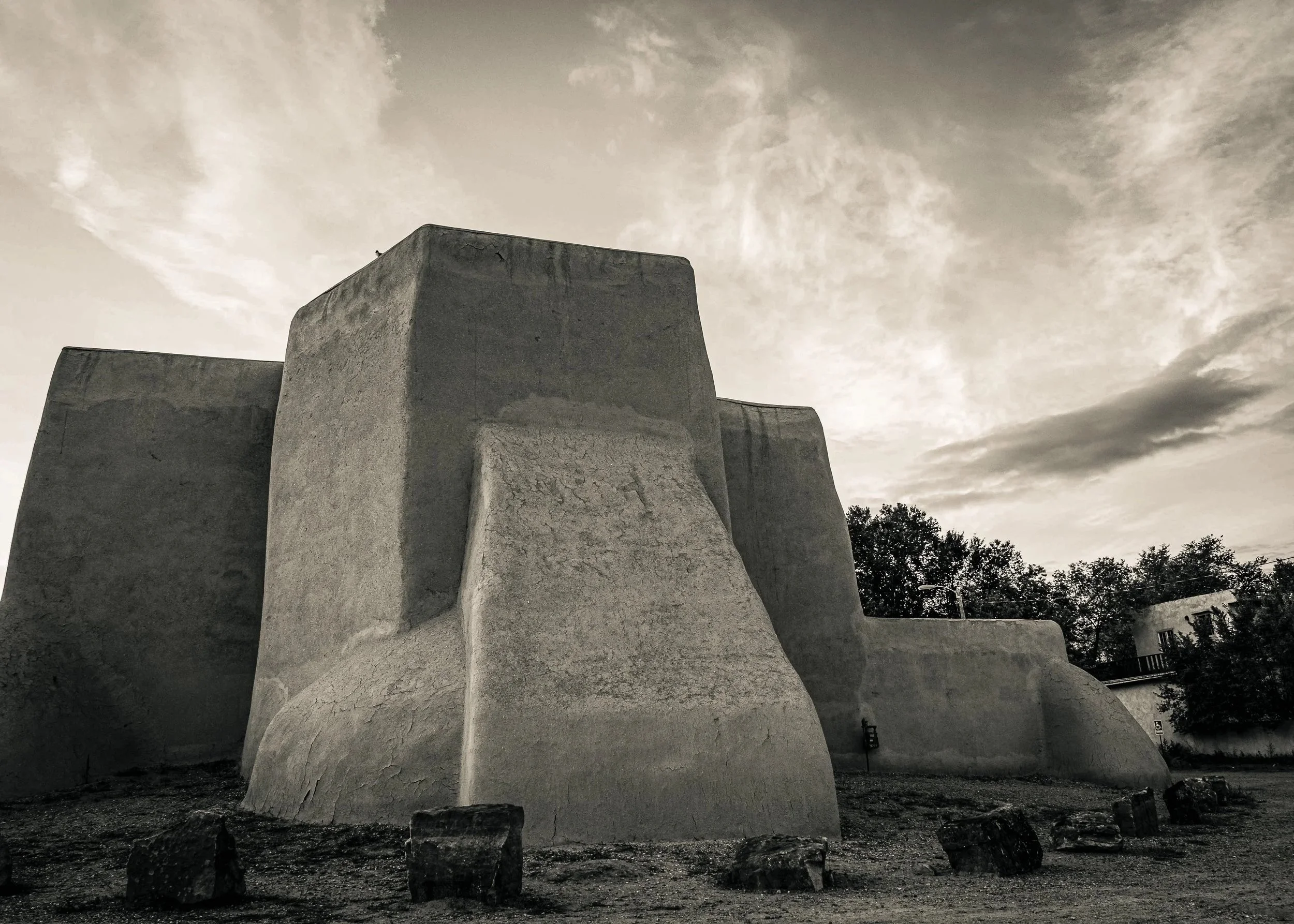
Enduring Forms is a study of light, architecture, and the timeless geometry of the American Southwest. Photographed at the historic St. Francis de Assisi Church in Ranchos de Taos, New Mexico, the image focuses on the powerful adobe forms that have made the church one of the most photographed and celebrated architectural landmarks in the United States. Drawing inspiration from the sculptural clarity of Edward Weston and the disciplined tonal approach of Ansel Adams, the photograph emphasizes shape, texture, and the interplay of light and shadow rather than ornament or narrative.
The composition distills the church into its essential elements: curved adobe buttresses, luminous walls, and carefully observed transitions between highlight and shadow. Generations of weather, craftsmanship, and devotion are embedded within these forms, creating an image that feels both monumental and deeply human. Rather than functioning as documentary architecture, the photograph becomes an exploration of permanence itself—revealing how simple forms can acquire profound visual and emotional weight through time.
The resulting image celebrates the enduring beauty of Southwestern architecture while inviting contemplation of faith, history, craftsmanship, and the universal relationship between light and form.
Design & Styling
The sculptural adobe forms of St. Francis de Assisi Church give Enduring Forms a warm, timeless geometry for Southwestern homes, libraries, offices, and hospitality spaces. It suits plaster walls, wood, and natural fibers.
Curated Pairings
To create a cohesive gallery wall around sacred architecture, consider these companion pieces:
For sacred architecture: Pair with Sanctuary of Light, two distinct expressions of sacred architecture, one defined by luminous ornament and the other by essential form.
For permanence and restraint: Complement this piece with Enduring Silence, sharing the same sense of permanence, restraint, and reverence for landscape.
For a small church in its landscape: Pair with Standing Grace - Southfork, a small mountain church in autumn, seen with the same quiet reverence.
Fine Art Presentation
Available as a signed fine art print on ChromaLuxe® Metal (gloss, semi-gloss, or matte), Glossy Anti-Glare Acrylic (TruLife), canvas, wood, and archival paper (framed or unframed). Framed archival paper is the recommended presentation: its matte surface suits the sculptural tonal transitions and the texture of adobe. ChromaLuxe® Metal is the alternative for crisper form and light.
Note: Custom and oversized photographic prints are available. Please contact the studio directly to discuss custom framing, matting, or specialized museum glass options.

Two colors, nothing between them. Rising in Blue and Orange shows a weathered sandstone monolith rising alone against a deep, saturated blue sky in Arches National Park, its terracotta face caught in the last warm light of the day. Hot orange rock and cold blue sky meet with no clouds, no haze, nothing to soften the contact.
The composition rests on restraint. One dominant formation is isolated against open sky, while a darker, silhouetted rock mass beside it holds just enough recovered shadow to show its structure without competing for the eye. At the base, a twisted piece of deadwood echoes the fractured vertical lines running up the monolith's face, a small, discovered detail that rewards a closer look instead of announcing itself.
This is Western landscape photography built on color and form rather than narrative: a study in the most direct complementary relationship the natural world offers, held with clean, uncomplicated attention.
Orange and blue sit opposite each other on the color wheel, which is why the two vibrate when they meet. With no cloud or haze to soften the boundary, the edge of the monolith against the sky becomes the picture's sharpest line.
Design & Styling
The bold, high-contrast blue-and-orange palette gives Rising in Blue and Orange real graphic presence in contemporary and Southwestern interiors alike, a strong choice for a room that wants color and drama without literal narrative. It works at large scale in an office, entryway, or living space with room for its clean, high-contrast punch.
Curated Pairings
To build a wall around the Southwest's most direct color relationship, consider these companion pieces:
For Monument Valley color-and-form continuity: Pair with Where Sisters Rise, another Southwestern formation study built on the same direct blue-and-orange relationship.
For the same location: Complement with Still Water, Stone Standing, another Arches National Park formation, reflected rather than lit.
For an isolated formation: Pair with Standing Grace - Kayenta, another Southwestern rock formation treated with the same clean, reverent attention.
Fine Art Presentation
Available as a signed fine art print on ChromaLuxe® Metal (gloss, semi-gloss, or matte), Glossy Anti-Glare Acrylic (TruLife), canvas, wood, and archival paper (framed or unframed). ChromaLuxe® Metal is the recommended presentation: it intensifies the blue-and-orange contrast and keeps the graphic edges of the monolith crisp. Acrylic adds depth and vibrancy for a lobby or entryway, and canvas gives the terracotta a warmer, more tactile read in a Southwestern living room.
Note: Custom and oversized photographic prints are available. Please contact the studio directly to discuss custom framing, matting, or specialized museum glass options.
Rain seldom reaches Mesa Arch, and on a night when it has, the water keeps a second arch. What the Water Kept looks across the slickrock at Mesa Arch in Canyonlands National Park, Utah, under a bright moon that throws a starburst into a sky thick with stars, while a rain puddle in the lower right holds the shape of the arch beside a scrap of pale cloud.
The eye goes first to the moon, then drops along the long span of the arch to the opening, where a bank of cloud glows against the dark stone. From there it steps down the layered slickrock to the puddle, the quiet counterweight in the lower right. The reflection there is faint, a dark mirrored span above a paler reflected sky, and it rewards a second look. The rock at left carries the weight of the frame, so the moon and the water read as the two quiet events in it.
Monumental sandstone held in restrained tones follows Ansel Adams, the stillness of the mirrored water echoes Hiroshi Sugimoto, and the warm brown stone set against a cool blue-gray sky owes a color debt to Ernst Haas.
Design & Styling
What the Water Kept suits hotel lounges and bars, restaurant dining rooms, lodge great rooms, executive offices, studies and bedrooms that want depth and calm. The brown stone and blue-gray sky sit well with walnut, leather, charcoal, deep navy and brass, and soft, warm lighting brings out the stars and the glow of the cloud. The 3:2 format works above a fireplace, a headboard, a console or a banquette.
Curated Pairings
For shared place: Pair with Beneath the Midnight Bow, the same arch on the same night, where a small pool carries the reflected moon. Here the puddle carries the arch instead, so the two images read as one night seen twice.
For the same rare rain: Pair with Stillness After Rain, a sandstone monolith mirrored in a large puddle after a desert rainstorm. Both show Utah rock doubled in borrowed water, one under a blue morning sky and one under a moonlit night.
For the same night sky: Pair with Where the Sky Breaks, Turret Arch under the Milky Way and a meteor. Another sandstone arch anchors a field of stars, with the sky as the event where this one has the moon.
Fine Art Presentation
Available as a signed, numbered limited edition print (edition of 15) in framed or unframed archival paper, ChromaLuxe® Metal (Semi-Gloss and Matte), TruLife Acrylic, canvas, and wood. ChromaLuxe® Metal in Semi-Gloss or Matte is the first recommendation: the stars and the points of the moon's starburst stay crisp, and the large dark areas of rock and sky do not mirror the room the way a gloss finish would. TruLife (Low-Glare) Acrylic is the alternative where you want more depth in the night sky. Framed archival paper gives a quieter, more tonal reading.