
 Image 1 of 1
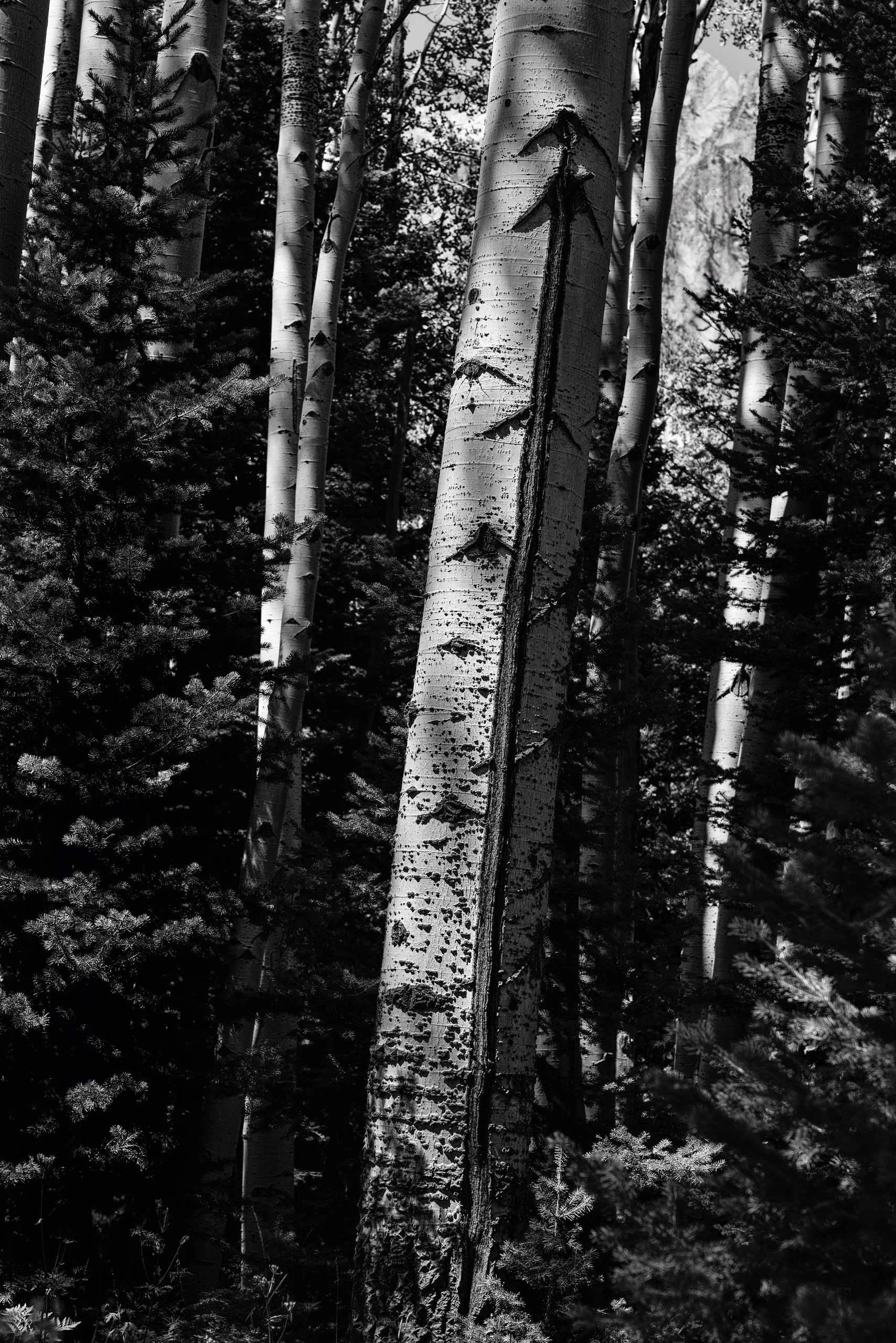
What the Bark Remembers is a study in contrast, history, and quiet endurance. A single aspen trunk stands lit against a dense wall of dark pine, its bark marked by old scars, claw marks and rub lines left by decades of wildlife passing through. Beyond it, barely visible through the trees, a granite peak catches the light. Drawing from the tonal discipline of Ansel Adams and the quiet formalism of Wynn Bullock, the photograph treats a single marked tree as a record of everything that has moved through this patch of forest without ever being seen.
The composition is built on restraint: nearly the entire frame sits in deep shadow, and that darkness is not absence but atmosphere, the felt presence of a forest at rest. Against it, the trunk's texture reads with unusual clarity, every scar and knot rendered in fine tonal detail, while the distant peak offers a quiet second point of interest for anyone willing to look twice.
The result is a black and white photograph built for a slow read: bold enough to hold a wall from across a room, detailed enough to reward standing close.
Design & Styling
The single lit aspen trunk against dark pine in What the Bark Remembers makes a bold, graphic statement for offices, lodges, mountain homes, and hospitality spaces. Its stark contrast suits plain, pale walls.
Curated Pairings
To create a cohesive display around aspens, scars, and memory, consider these companion pieces:
For a companion in the same forest: Pair with The Quiet Cathedral, another vertical study of Colorado aspens.
For tonal contrast: Complement this piece with Reaching Sky, the aspens in color, looking up through the canopy to the sun.
For the same theme of remembering: Pair with What the Door Remembers, another surface that keeps the marks of time, in black and white.
Fine Art Presentation
Available as a signed fine art print on ChromaLuxe® Metal (gloss, semi-gloss, or matte), Glossy Anti-Glare Acrylic (TruLife), canvas, wood, and archival paper (framed or unframed). ChromaLuxe® Metal is the recommended presentation: it holds the deep blacks and the fine texture of the bark. Framed archival paper is the alternative for a classic black-and-white reading.
Note: Custom and oversized photographic prints are available. Please contact the studio directly to discuss custom framing, matting, or specialized museum glass options.
What the Bark Remembers is a study in contrast, history, and quiet endurance. A single aspen trunk stands lit against a dense wall of dark pine, its bark marked by old scars, claw marks and rub lines left by decades of wildlife passing through. Beyond it, barely visible through the trees, a granite peak catches the light. Drawing from the tonal discipline of Ansel Adams and the quiet formalism of Wynn Bullock, the photograph treats a single marked tree as a record of everything that has moved through this patch of forest without ever being seen.
The composition is built on restraint: nearly the entire frame sits in deep shadow, and that darkness is not absence but atmosphere, the felt presence of a forest at rest. Against it, the trunk's texture reads with unusual clarity, every scar and knot rendered in fine tonal detail, while the distant peak offers a quiet second point of interest for anyone willing to look twice.
The result is a black and white photograph built for a slow read: bold enough to hold a wall from across a room, detailed enough to reward standing close.
Design & Styling
The single lit aspen trunk against dark pine in What the Bark Remembers makes a bold, graphic statement for offices, lodges, mountain homes, and hospitality spaces. Its stark contrast suits plain, pale walls.
Curated Pairings
To create a cohesive display around aspens, scars, and memory, consider these companion pieces:
For a companion in the same forest: Pair with The Quiet Cathedral, another vertical study of Colorado aspens.
For tonal contrast: Complement this piece with Reaching Sky, the aspens in color, looking up through the canopy to the sun.
For the same theme of remembering: Pair with What the Door Remembers, another surface that keeps the marks of time, in black and white.
Fine Art Presentation
Available as a signed fine art print on ChromaLuxe® Metal (gloss, semi-gloss, or matte), Glossy Anti-Glare Acrylic (TruLife), canvas, wood, and archival paper (framed or unframed). ChromaLuxe® Metal is the recommended presentation: it holds the deep blacks and the fine texture of the bark. Framed archival paper is the alternative for a classic black-and-white reading.
Note: Custom and oversized photographic prints are available. Please contact the studio directly to discuss custom framing, matting, or specialized museum glass options.