
 Image 1 of 1
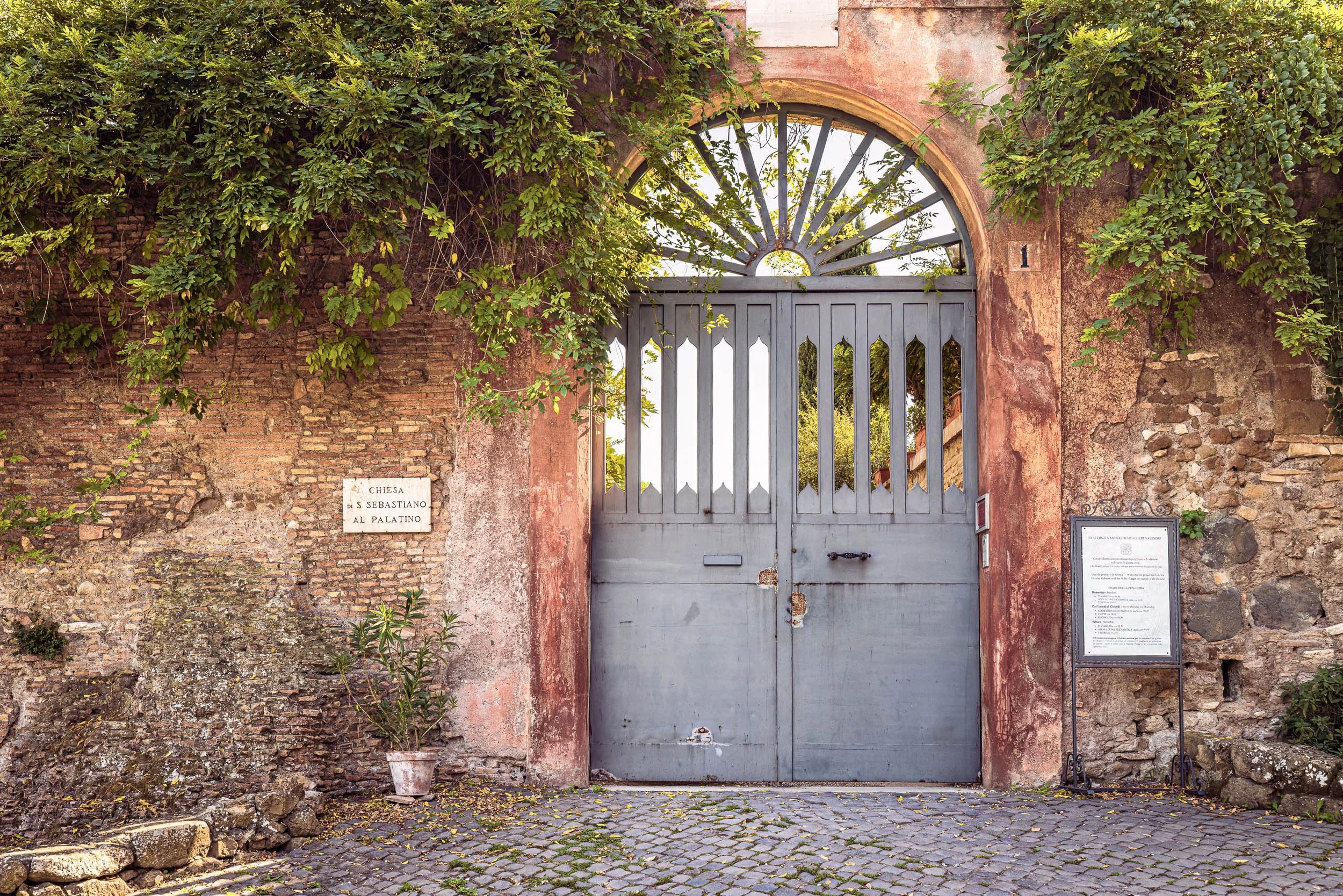
The Gate of San Sebastiano al Palatino is a study of quiet devotion, discovered along the Palatine Hill at the gated entrance to the Chiesa di San Sebastiano al Palatino — a working monastic church tucked behind Rome's more famous ruins. Wisteria and ivy spill from a terracotta wall above a wrought-iron gate, its fan-shaped transom catching the light of the garden beyond. A hand-lettered stone plaque names the church; a posted notice board lists hours of prayer. Nothing about the frame announces itself as a landmark — this is Rome as its residents and religious communities actually use it, not as tourists photograph it.
The composition holds to a disciplined symmetry, the arched gate centered and framed by cascading greenery above, with a terracotta pot anchoring the lower left corner. The eye travels up the cobblestone path to the gate itself, then rises through the fan-shaped ironwork to the light beyond — a quiet sequence of arrival, threshold, and passage. The gate's cool grey-blue tone offers the frame's only counterpoint to the warm ochre wall, holding its own against the surrounding color without disrupting the stillness of the scene.
The work draws on Wim Wenders' patience for doorways and thresholds as subjects in their own right, alongside Josef Sudek's quiet architectural studies of light and enclosure. Rather than spectacle, the photograph offers observation — a private corner of Rome, photographed with the same stillness its subject asks of its visitors.
Design & Styling
The warm terracotta palette, lush greenery, and old-world architectural detail make this piece especially well-suited to Mediterranean and Italian-inspired hospitality interiors — boutique hotels, wine bars, and courtyard-adjacent restaurant spaces. It pairs naturally with aged wood, wrought iron fixtures, and warm stone accents.
Curated Pairings
For continued Roman atmosphere and quiet human presence: pair with Waiting for a Ride.
For a study in golden-hour warmth on ancient stone: complement with Where Light Still Climbs, photographed at the Colosseum.
For shared European texture and light discipline: consider What the Ivy Remembers, from Prague.
Fine Art Presentation
Available as a signed fine art print in ChromaLuxe® Metal (gloss, semi-gloss, or matte), framed paper, and canvas presentation formats. Archival paper is especially recommended for this piece, lending a painterly, traditional quality that suits the old-world subject matter; ChromaLuxe® Metal offers a more contemporary alternative for modern hospitality settings.
Note: Custom and oversized photographic prints are available. Please contact the studio directly to discuss custom framing, matting, or specialized museum glass options.
The Gate of San Sebastiano al Palatino is a study of quiet devotion, discovered along the Palatine Hill at the gated entrance to the Chiesa di San Sebastiano al Palatino — a working monastic church tucked behind Rome's more famous ruins. Wisteria and ivy spill from a terracotta wall above a wrought-iron gate, its fan-shaped transom catching the light of the garden beyond. A hand-lettered stone plaque names the church; a posted notice board lists hours of prayer. Nothing about the frame announces itself as a landmark — this is Rome as its residents and religious communities actually use it, not as tourists photograph it.
The composition holds to a disciplined symmetry, the arched gate centered and framed by cascading greenery above, with a terracotta pot anchoring the lower left corner. The eye travels up the cobblestone path to the gate itself, then rises through the fan-shaped ironwork to the light beyond — a quiet sequence of arrival, threshold, and passage. The gate's cool grey-blue tone offers the frame's only counterpoint to the warm ochre wall, holding its own against the surrounding color without disrupting the stillness of the scene.
The work draws on Wim Wenders' patience for doorways and thresholds as subjects in their own right, alongside Josef Sudek's quiet architectural studies of light and enclosure. Rather than spectacle, the photograph offers observation — a private corner of Rome, photographed with the same stillness its subject asks of its visitors.
Design & Styling
The warm terracotta palette, lush greenery, and old-world architectural detail make this piece especially well-suited to Mediterranean and Italian-inspired hospitality interiors — boutique hotels, wine bars, and courtyard-adjacent restaurant spaces. It pairs naturally with aged wood, wrought iron fixtures, and warm stone accents.
Curated Pairings
For continued Roman atmosphere and quiet human presence: pair with Waiting for a Ride.
For a study in golden-hour warmth on ancient stone: complement with Where Light Still Climbs, photographed at the Colosseum.
For shared European texture and light discipline: consider What the Ivy Remembers, from Prague.
Fine Art Presentation
Available as a signed fine art print in ChromaLuxe® Metal (gloss, semi-gloss, or matte), framed paper, and canvas presentation formats. Archival paper is especially recommended for this piece, lending a painterly, traditional quality that suits the old-world subject matter; ChromaLuxe® Metal offers a more contemporary alternative for modern hospitality settings.
Note: Custom and oversized photographic prints are available. Please contact the studio directly to discuss custom framing, matting, or specialized museum glass options.