
 Image 1 of 1
Corner of Via della Croce
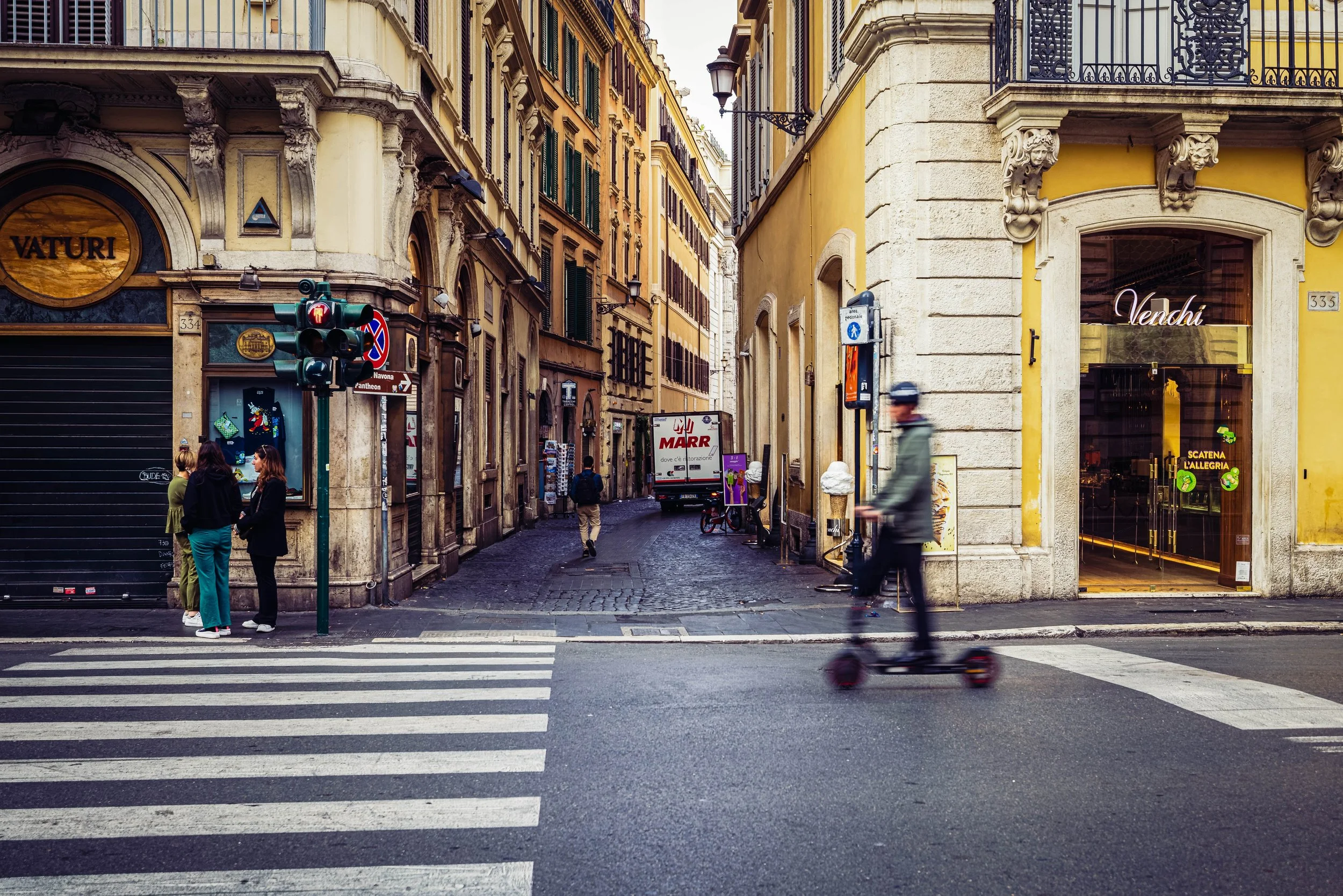
Corner of Via della Croce is a study of layered motion: the ordinary collision of pedestrians, delivery trucks, scooters, and centuries-old architecture that defines a Roman street corner on any given afternoon. Photographed at a busy intersection, with a sign pointing toward Piazza Navona and the Pantheon, the frame stacks depth in bands: a blurred scooter rider crossing the foreground mid-motion, a woman in black waiting at the curb beside the traffic light, and the street receding into warm, hazy distance where a delivery truck idles and a lone walker continues on.
The composition leans into candid layering rather than a single clear subject. Ochre, gold, and cream facades with green shutters, wrought-iron balconies, and an ornate carved corbel rise on both sides of a narrow cobbled street, and a street lamp leans out into the small gap of pale sky. Against them the cool gray asphalt and a broad white zebra crossing sweep into the frame at lower left, and the unresolved blur of the scooter gives the scene a genuine sense of a moment caught mid-motion rather than staged. Small accents keep the eye moving: a red pedestrian signal, a No Parking sign, a gelato cone on the sidewalk, the red lettering on the delivery truck. Nothing here was arranged; the street simply does what streets do, and the photograph trusts that to be enough.
The work draws on the color-street tradition of Saul Leiter: his interest in flattening a scene into layered planes of color and motion rather than isolating a single subject against a clean background. This is Rome as it is actually lived in: commerce, foot traffic, and architecture layered into one unresolved, ordinary moment.
Design & Styling
The warm ochre and gold architecture, the cool gray street, and the candid energy of Corner of Via della Croce suit Italian-themed restaurants, cafés, wine bars, and boutique hospitality spaces looking for authentic street life rather than postcard grandeur. At home it works in studies, dining rooms, and entryways, especially beside warm wood and plaster.
Curated Pairings
To build a cohesive Rome street collection, consider these companion pieces:
For continued candid Roman street energy: Pair with Modern Gladiators, a solitary figure at a busy Roman intersection as traffic sweeps around him in luminous ribbons.
For quiet nocturnal contrast: Complement with Waiting for a Ride, a lone figure in red on the cobblestones outside the Colosseum at night, the same city with the traffic gone.
For shared old-world atmosphere: Consider A Night at the Opera, figures crossing a lantern-lit Roman plaza toward the doors of the theater.
Fine Art Presentation
Available as a signed fine art print on ChromaLuxe® Metal (gloss, semi-gloss, or matte), Glossy Anti-Glare Acrylic (TruLife), canvas, wood, and archival paper (framed or unframed). Framed archival paper is the recommended presentation: its matte surface suits the documentary, editorial feel of a candid street scene and the layered planes of color. ChromaLuxe® Metal is the alternative for the saturated ochre and gold and the crisp architectural detail, and canvas gives a softer, more painterly read.
Note: Custom and oversized photographic prints are available. Please contact the studio directly to discuss custom framing, matting, or specialized museum glass options.
Corner of Via della Croce is a study of layered motion: the ordinary collision of pedestrians, delivery trucks, scooters, and centuries-old architecture that defines a Roman street corner on any given afternoon. Photographed at a busy intersection, with a sign pointing toward Piazza Navona and the Pantheon, the frame stacks depth in bands: a blurred scooter rider crossing the foreground mid-motion, a woman in black waiting at the curb beside the traffic light, and the street receding into warm, hazy distance where a delivery truck idles and a lone walker continues on.
The composition leans into candid layering rather than a single clear subject. Ochre, gold, and cream facades with green shutters, wrought-iron balconies, and an ornate carved corbel rise on both sides of a narrow cobbled street, and a street lamp leans out into the small gap of pale sky. Against them the cool gray asphalt and a broad white zebra crossing sweep into the frame at lower left, and the unresolved blur of the scooter gives the scene a genuine sense of a moment caught mid-motion rather than staged. Small accents keep the eye moving: a red pedestrian signal, a No Parking sign, a gelato cone on the sidewalk, the red lettering on the delivery truck. Nothing here was arranged; the street simply does what streets do, and the photograph trusts that to be enough.
The work draws on the color-street tradition of Saul Leiter: his interest in flattening a scene into layered planes of color and motion rather than isolating a single subject against a clean background. This is Rome as it is actually lived in: commerce, foot traffic, and architecture layered into one unresolved, ordinary moment.
Design & Styling
The warm ochre and gold architecture, the cool gray street, and the candid energy of Corner of Via della Croce suit Italian-themed restaurants, cafés, wine bars, and boutique hospitality spaces looking for authentic street life rather than postcard grandeur. At home it works in studies, dining rooms, and entryways, especially beside warm wood and plaster.
Curated Pairings
To build a cohesive Rome street collection, consider these companion pieces:
For continued candid Roman street energy: Pair with Modern Gladiators, a solitary figure at a busy Roman intersection as traffic sweeps around him in luminous ribbons.
For quiet nocturnal contrast: Complement with Waiting for a Ride, a lone figure in red on the cobblestones outside the Colosseum at night, the same city with the traffic gone.
For shared old-world atmosphere: Consider A Night at the Opera, figures crossing a lantern-lit Roman plaza toward the doors of the theater.
Fine Art Presentation
Available as a signed fine art print on ChromaLuxe® Metal (gloss, semi-gloss, or matte), Glossy Anti-Glare Acrylic (TruLife), canvas, wood, and archival paper (framed or unframed). Framed archival paper is the recommended presentation: its matte surface suits the documentary, editorial feel of a candid street scene and the layered planes of color. ChromaLuxe® Metal is the alternative for the saturated ochre and gold and the crisp architectural detail, and canvas gives a softer, more painterly read.
Note: Custom and oversized photographic prints are available. Please contact the studio directly to discuss custom framing, matting, or specialized museum glass options.