
 Image 1 of 4
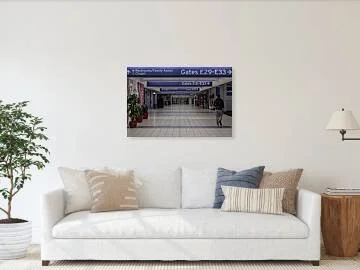 Image 2 of 4
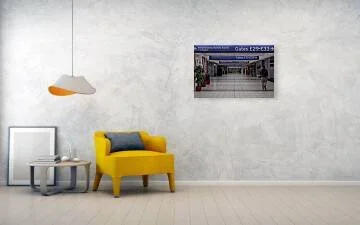 Image 3 of 4
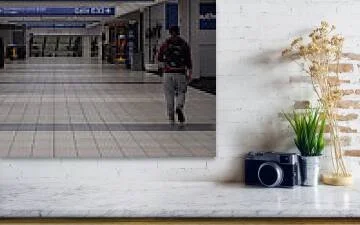 Image 4 of 4
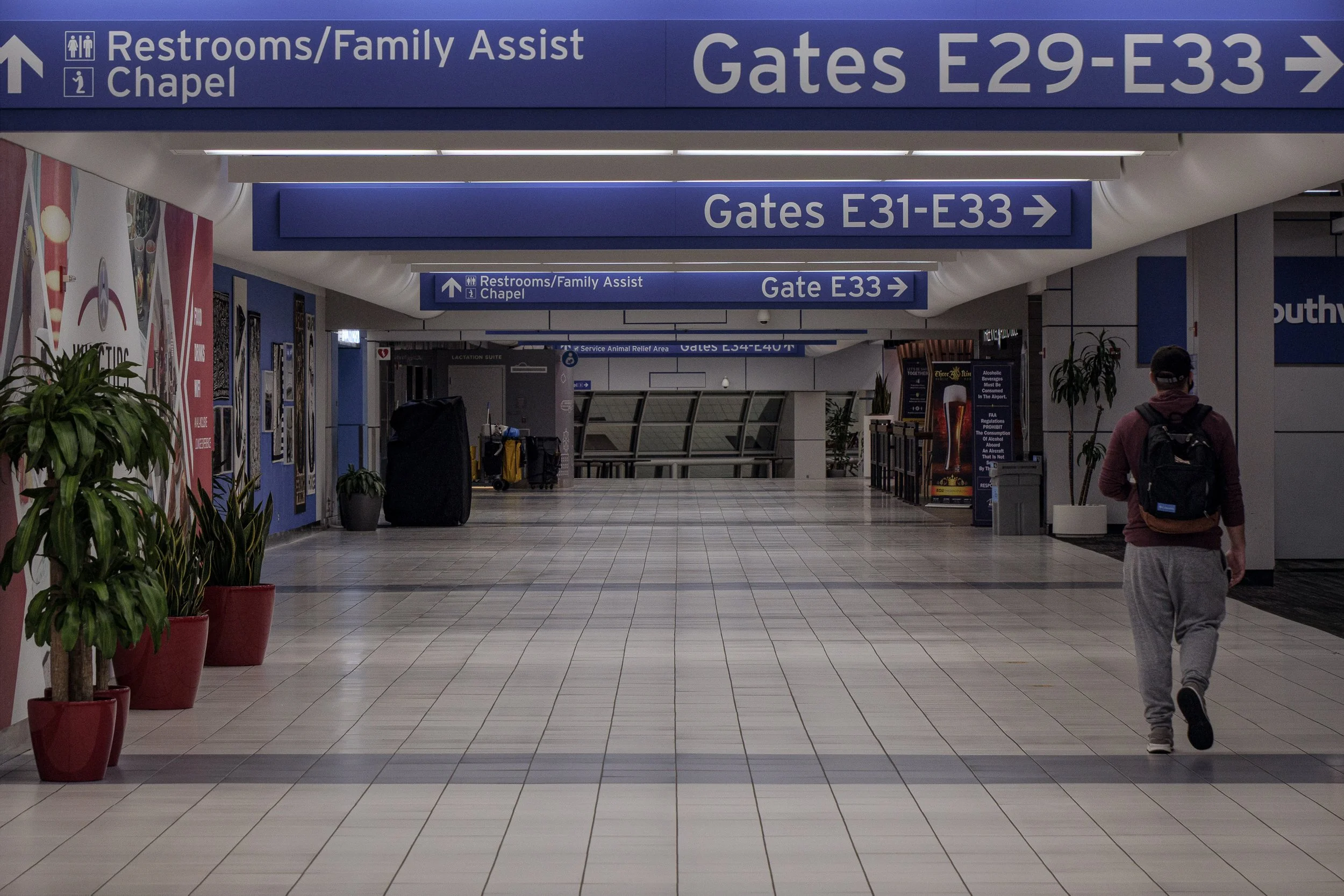
Airports are built almost entirely around anticipation — arriving, departing, waiting, and following signs toward a destination that's always just beyond the current room. Gate E33 captures one anonymous traveler in the middle of that process: a quiet concourse where a lone figure walks beneath a sequence of overhead signs — Gates E29–E33, then E31–E33, and finally E33 alone — each one narrowing the journey as the corridor disappears into the terminal.
The repeating signage and tiled floor build a strong one-point perspective, while the traveler is kept deliberately small within the architecture. Potted plants, storefronts, airport equipment, and the edge of a familiar airline's signage keep the scene grounded in the practical reality of air travel rather than letting it dissolve into pure geometry.
The image sits closer to Wim Wenders' fascination with transient, in-between spaces — the anonymous non-places of travel and passage — than to straightforward airport documentary. There's a secondary echo of Edward Hopper's isolated figures set against dominant architecture: someone caught mid-passage, already leaving one place, not yet arrived at the next.
Design & Styling
With its cool blue signage, neutral tiled floor, strong perspective, and restrained human presence, Gate E33 works especially well in contemporary, modern, industrial, and travel-oriented interiors. Its architectural geometry gives it a structured presence without losing the human story at its center.
The photograph is especially appropriate for offices, transportation or aviation-related spaces, corridors, hospitality environments, and residential interiors built around travel, architecture, or contemporary documentary photography.
Curated Pairings
To create a cohesive gallery wall, consider these companion pieces:
For journeys and movement: Pair with The Long Way West, extending the idea of travel from the controlled architecture of an airport into the openness of the American landscape.
For solitary human presence: Pair with Before the City Wakes, where a lone figure similarly provides the human counterpoint to a strongly structured environment.
For transitional spaces: Pair with Passing Through Prague, continuing the theme of people briefly occupying places designed primarily for movement.
Fine Art Presentation
Available as a signed fine art print on Photo Rag paper (framed or unframed), Chromaluxe Metal, framed canvas, and acrylic presentation. A satin or semi-gloss metal presentation works particularly well with Gate E33, preserving the cool blues of the overhead signs and the repeating geometry of the terminal while holding detail in the subdued interior shadows. For acrylic, TrueVue or low/anti-glare acrylic is recommended to keep the signage crisp without glare washout.
Note: Custom and oversized photographic prints are available. Please contact the studio directly to discuss custom framing, matting, or specialized museum glass options.
Airports are built almost entirely around anticipation — arriving, departing, waiting, and following signs toward a destination that's always just beyond the current room. Gate E33 captures one anonymous traveler in the middle of that process: a quiet concourse where a lone figure walks beneath a sequence of overhead signs — Gates E29–E33, then E31–E33, and finally E33 alone — each one narrowing the journey as the corridor disappears into the terminal.
The repeating signage and tiled floor build a strong one-point perspective, while the traveler is kept deliberately small within the architecture. Potted plants, storefronts, airport equipment, and the edge of a familiar airline's signage keep the scene grounded in the practical reality of air travel rather than letting it dissolve into pure geometry.
The image sits closer to Wim Wenders' fascination with transient, in-between spaces — the anonymous non-places of travel and passage — than to straightforward airport documentary. There's a secondary echo of Edward Hopper's isolated figures set against dominant architecture: someone caught mid-passage, already leaving one place, not yet arrived at the next.
Design & Styling
With its cool blue signage, neutral tiled floor, strong perspective, and restrained human presence, Gate E33 works especially well in contemporary, modern, industrial, and travel-oriented interiors. Its architectural geometry gives it a structured presence without losing the human story at its center.
The photograph is especially appropriate for offices, transportation or aviation-related spaces, corridors, hospitality environments, and residential interiors built around travel, architecture, or contemporary documentary photography.
Curated Pairings
To create a cohesive gallery wall, consider these companion pieces:
For journeys and movement: Pair with The Long Way West, extending the idea of travel from the controlled architecture of an airport into the openness of the American landscape.
For solitary human presence: Pair with Before the City Wakes, where a lone figure similarly provides the human counterpoint to a strongly structured environment.
For transitional spaces: Pair with Passing Through Prague, continuing the theme of people briefly occupying places designed primarily for movement.
Fine Art Presentation
Available as a signed fine art print on Photo Rag paper (framed or unframed), Chromaluxe Metal, framed canvas, and acrylic presentation. A satin or semi-gloss metal presentation works particularly well with Gate E33, preserving the cool blues of the overhead signs and the repeating geometry of the terminal while holding detail in the subdued interior shadows. For acrylic, TrueVue or low/anti-glare acrylic is recommended to keep the signage crisp without glare washout.
Note: Custom and oversized photographic prints are available. Please contact the studio directly to discuss custom framing, matting, or specialized museum glass options.