
 Image 1 of 5
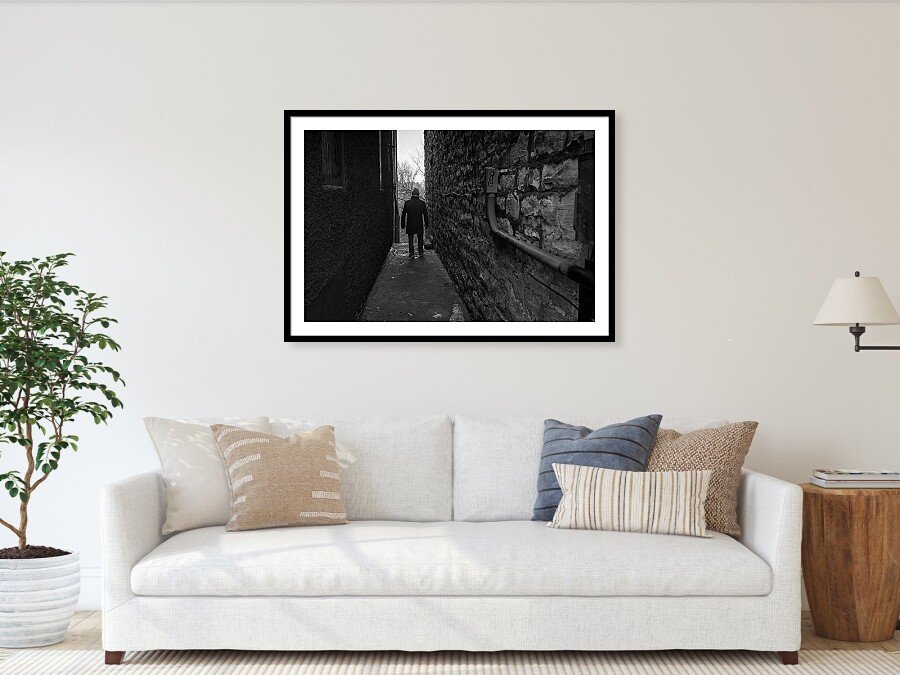 Image 2 of 5
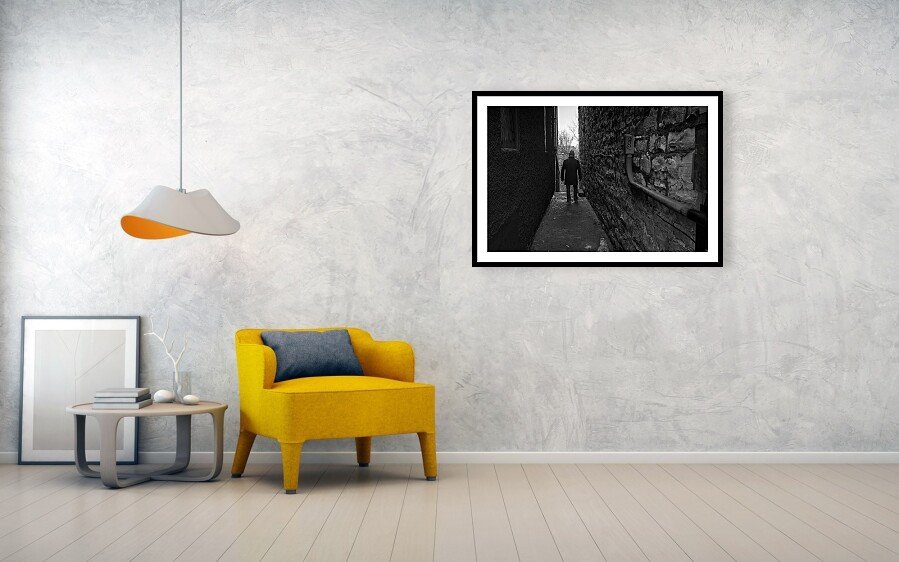 Image 3 of 5
 Image 4 of 5
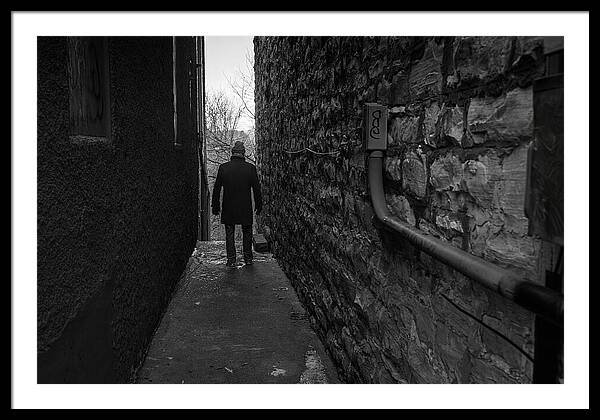 Image 5 of 5
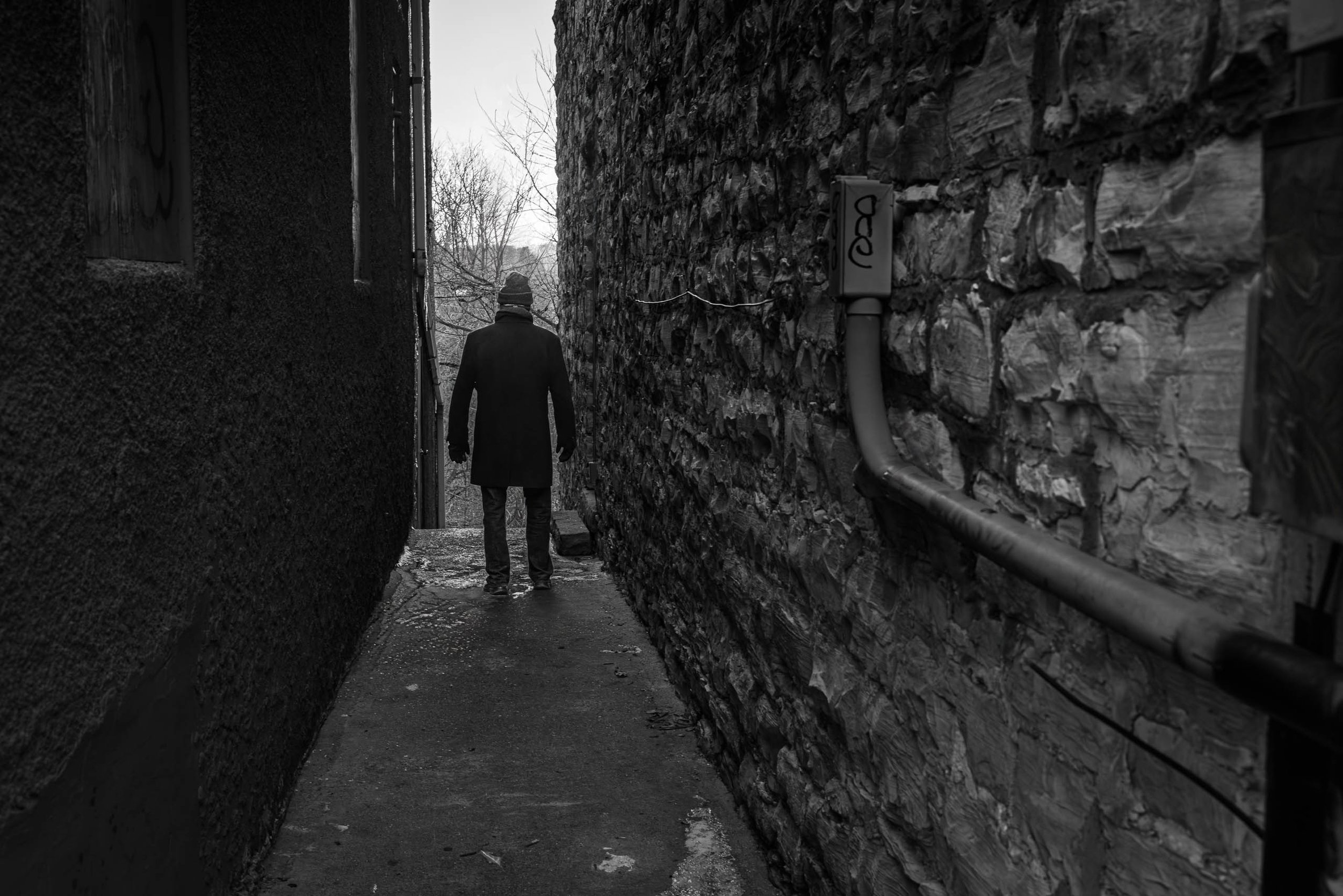
Some passages narrow until all that is left is a choice, and he has not made it. In a stone alley in Eureka Springs, Arkansas, a man in a dark coat and wool cap has stopped with his back to the camera, facing a gap of pale sky. There is ice at his feet, and beyond it a drop of about thirty feet that the frame never shows. He is not sure the next step is a safe one. The Last Dry Step is a black-and-white photograph about the moment of doubt before the ground changes.
The walls do the work. A dark, pebbled wall on the left and rough-cut stone on the right close in from both sides and send the eye down the pavement to the figure, set just left of center against the one bright opening at the end of the alley. His dark coat holds against the pale sky, his hands hang at his sides, and he is still. The pavement around his feet carries the first patches of ice, the only evidence of what he is weighing. Only then does the eye drift right, to a gray junction box with a hand-drawn scrawl and a conduit that bends along the stone, small human traces in a place that is otherwise all texture and shadow. Whether he goes on or turns back is nowhere in the frame.
The photograph follows the tradition of Wim Wenders, whose anonymous figures stand in places that carry the mood for them, and it shares the isolation of Edward Hopper's city figures, where the architecture closes around one person. Nothing is explained and nothing is decided. The ice and the drop live in the title, not the frame, and the viewer supplies the rest, and the doubt.
The Last Dry Step suits hotel corridors and lobbies, restaurants and bars, studios, offices and libraries, where a dark, quiet narrative piece can anchor a wall. In homes the 3:2 format hangs well in a hallway, a stairwell, a den or above a console. It sits comfortably with charcoal, black steel, dark walnut, leather and pale plaster. It is a natural gift for anyone who knows Eureka Springs and the Ozarks, or who has stood at the edge of a decision on a narrow street in winter.
For the same lone figure in a narrow passage: Pair with Waiting for the Morning, a lone walker moving through a narrow cobblestone passage in Prague, the same quiet between close walls, in a rain-soaked color palette instead of black and white.
For the same dark tones and anonymous figure: Pair with Night Watch (Noir), a solitary figure in deep shadow before the lit Colosseum in Rome, the same black-and-white range and unnamed presence at a monumental scale instead of an intimate one.
For the same small figure in a historic setting: Pair with Among the Witnesses, a black-and-white frame where figures are small and the setting shaped by history carries the story, much as the alley does here.
Available as a signed, numbered limited edition print (edition of 15) in Gallery Metal, ChromaLuxe® Metal (Gloss, Semi-Gloss or Matte), TruLife Acrylic, archival paper, canvas, and wood. Archival paper is the strongest choice: this is a dark, low-key frame, and a matte surface keeps the deep blacks free of reflections while holding the grain of the stone and the gradation in the pale sky at the end of the alley. ChromaLuxe® Metal in Matte is the alternative for a crisper, more graphic hang.
Note: Custom and oversized photographic prints are available. Please contact the studio directly to discuss custom framing, matting, or specialized museum glass options.