
 Image 1 of 2
 Image 2 of 2
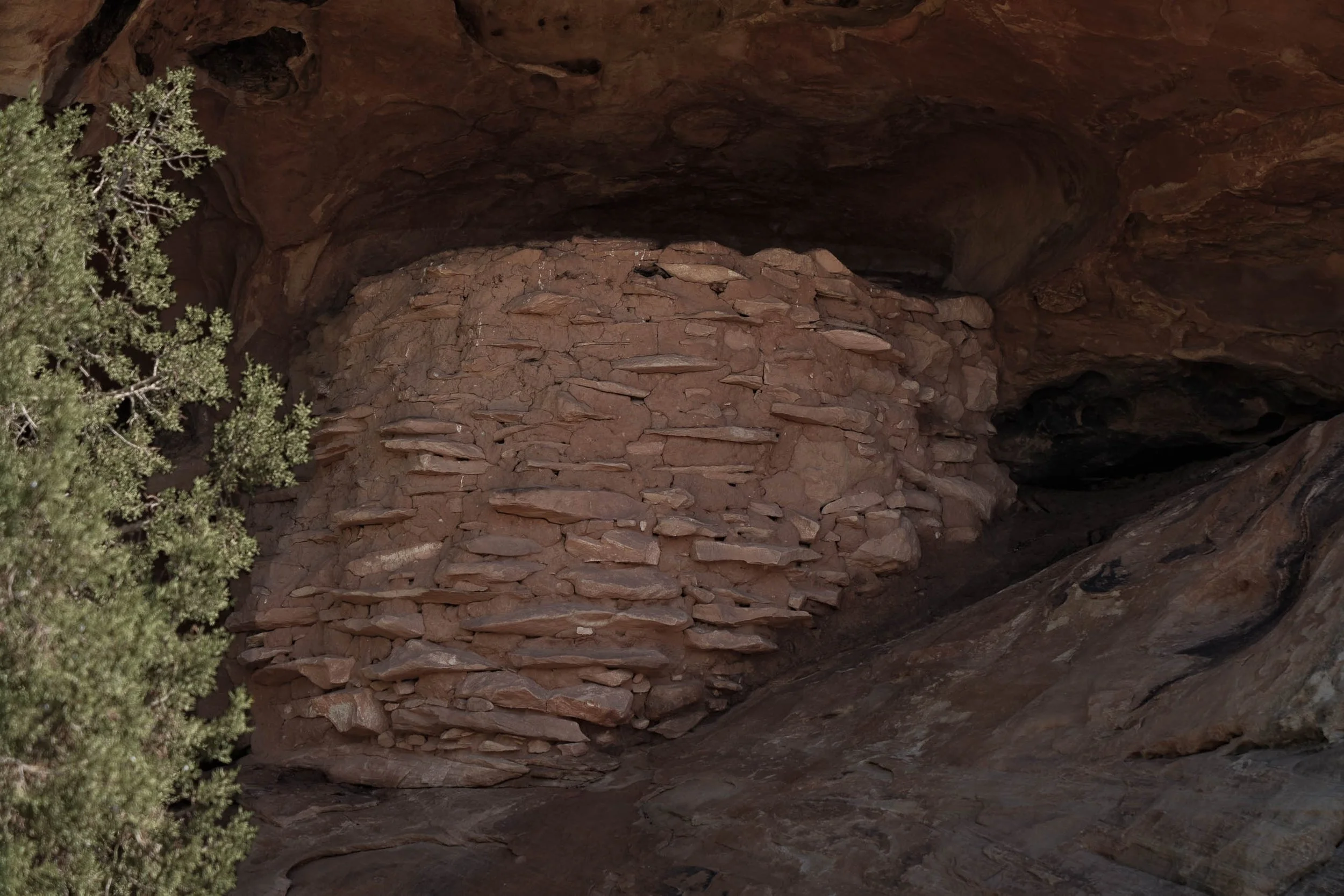
Some of the quietest buildings are the ones nobody planned to be seen. Under the Rim is a hand-built wall of stacked sandstone slabs, tucked into an alcove beneath a red rock overhang in the American Southwest, in warm terracotta and deep umber, and still standing.
The overhang makes the frame. A dark band of rock curves across the top, a darker opening sits at the right, and between them the wall catches a little light, its slabs jutting out in thin horizontal ledges. The eye lands there, travels along the layers from left to right, then drops to the smooth sweep of bare rock at the lower right, which runs back up toward the wall like a ramp. A juniper in soft sage green leans into the left edge and gives the picture its one living note against all that stone.
It looks at a hand-built thing the way Walker Evans did, frontal and unhurried, giving a humble structure the weight of a monument. The warm earth palette and the sense of architecture that grows out of the rock it stands on belong to the Southwest tradition of Paul Strand's photographs of the adobe church at Ranchos de Taos. The photograph does not explain the wall. It leaves it where it is.
Under the Rim suits Southwest lodges, restaurants, hotels, studies, libraries and hallway walls where a piece with real age and texture is wanted. The terracotta and umber sit well beside leather, walnut, plaster, wrought iron and turquoise, and the 3:2 format fits over a bench, a console, a fireplace or a stair landing.
Three companions, each connected in a different way:
For human marks on the same rock: Pair with Before the Alphabet, a panel of petroglyphs in terracotta on dark sandstone. Both pictures show the human hand in the rock, one drawn and one built, in the same warm-on-dark palette.
For another hand-built earthen wall: Pair with Beneath Watchful Wings, the adobe buttresses of St. Francis de Asís Church at Ranchos de Taos under a bright blue sky. The same subject, a Southwest wall built by hand, seen in full sun as a monument where this one sits in shade.
For work in stone that outlasts its makers: Pair with The Stones They Leave Behind, a weathered tombstone in Prague's Jewish Cemetery, covered with stones and offerings left by visitors. A different place and era, but the same idea: people are absent from the frame, and the stone is what remains of them.
Available as a signed fine art print on ChromaLuxe® Metal (Gloss, Semi-Gloss or Matte), TruLife acrylic, archival paper (framed or unframed), canvas and wood. ChromaLuxe® Metal in Matte is the recommendation: it keeps the dark alcove deep and the terracotta slabs clean, without the reflections of a gloss surface. Archival paper, framed, is the quieter alternative, closest to the texture of the clay and stone in the picture.
Note: Custom and oversized photographic prints are available. Please contact the studio directly to discuss custom framing, matting, or specialized museum glass options.