
 Image 1 of 5
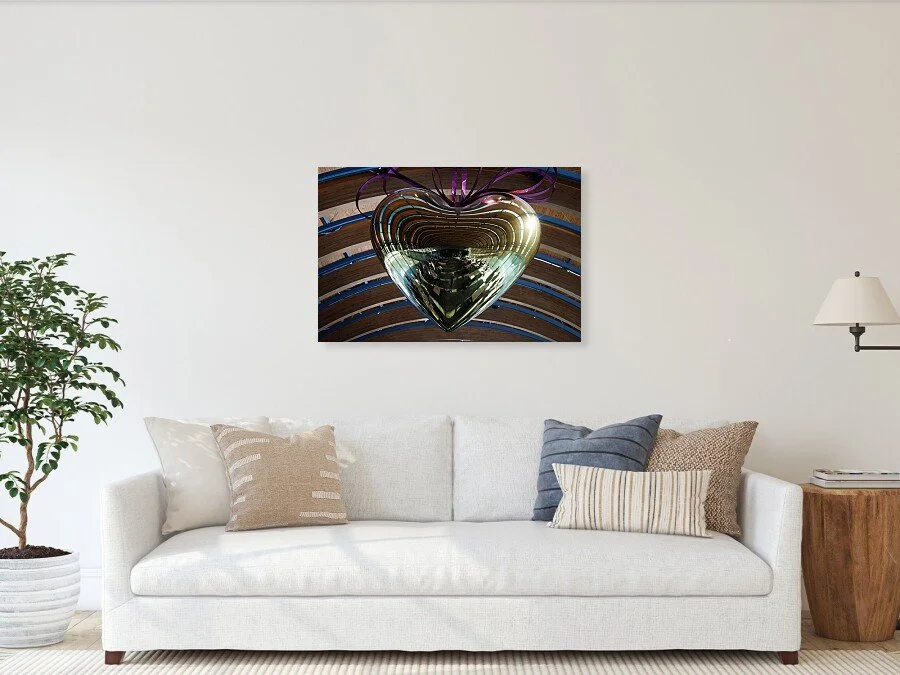 Image 2 of 5
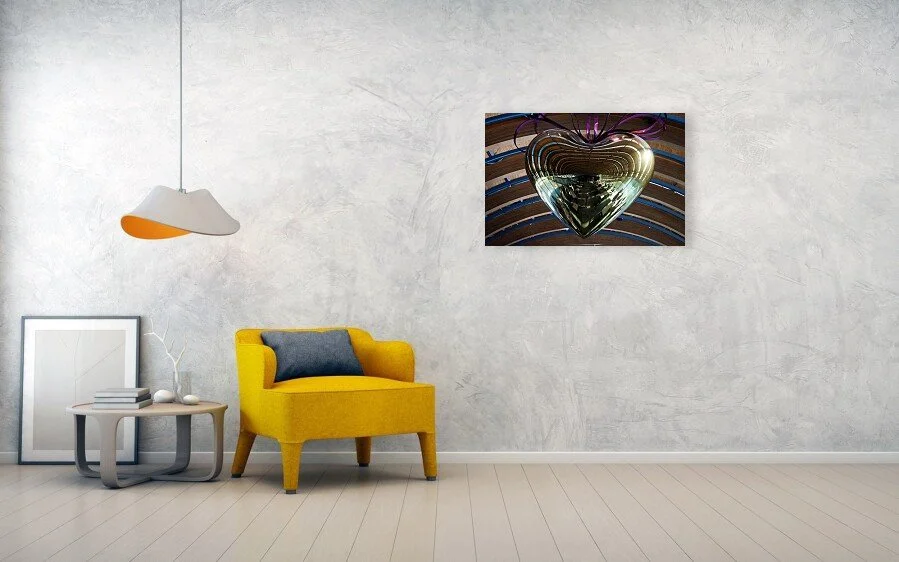 Image 3 of 5
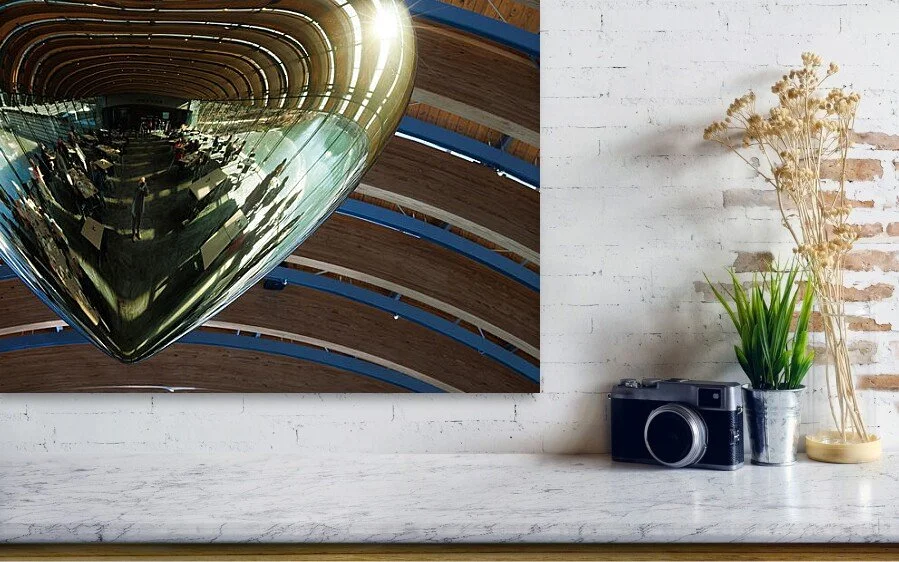 Image 4 of 5
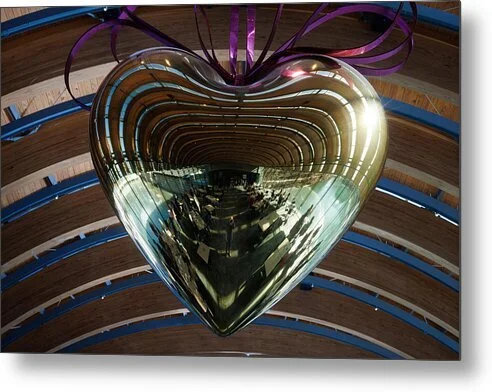 Image 5 of 5
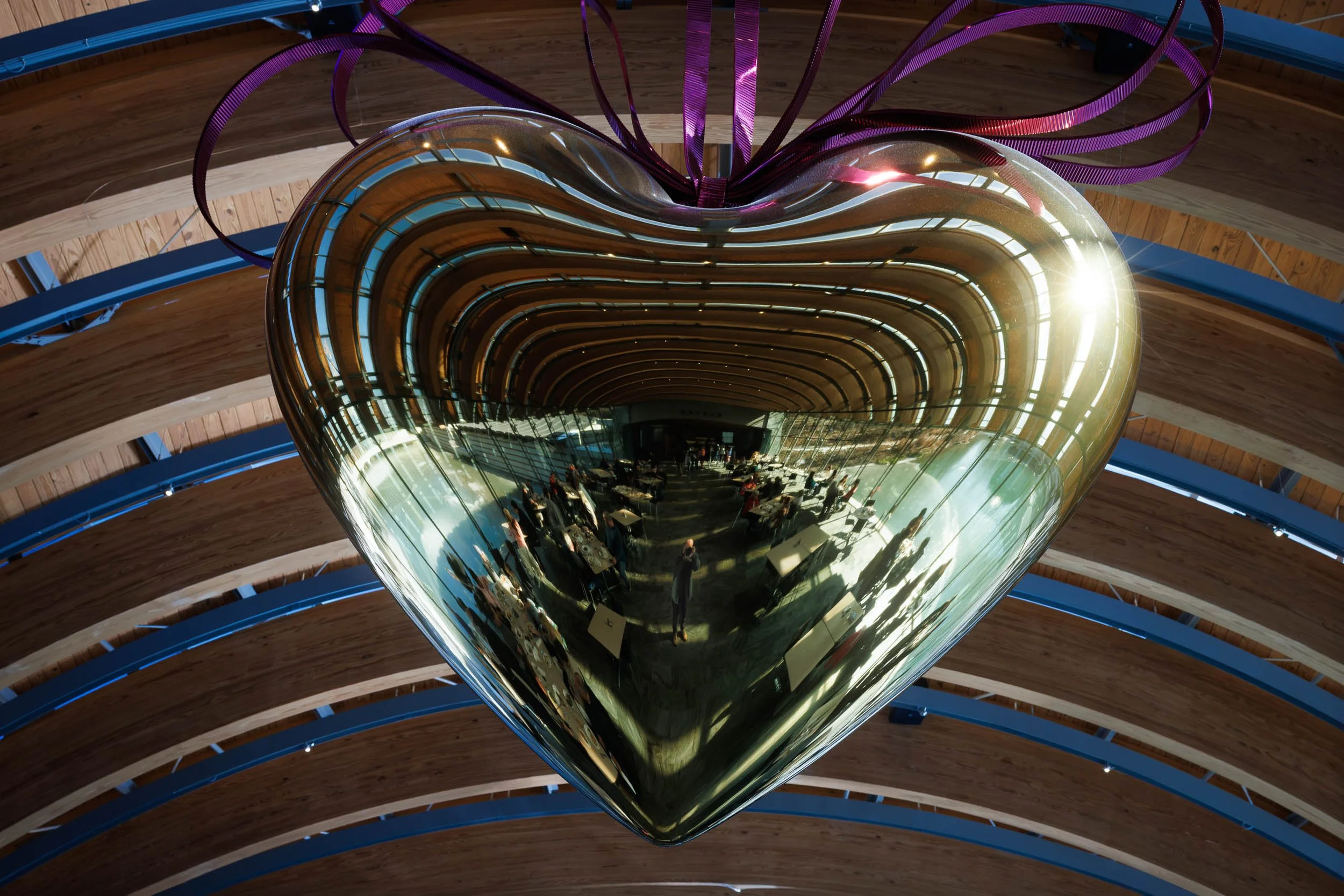
Look closely at a mirror and it shows you the room. What the Heart Reflects hangs a polished heart beneath an arched ceiling of warm wood and steel at Crystal Bridges in Bentonville, Arkansas, made in 2024, and lets its curve hold everything the camera could not otherwise fit: a dining hall, a rib of light, and a small figure with a camera at the bottom of the frame.
The eye goes first to the heart itself, bright and round in the middle of the picture, then up to the magenta ribbon looping out of the top edge, the one saturated color in the frame. From there it follows the arches outward, wood and steel meeting overhead, and drifts to the sunstar at upper right before dropping back into the heart. Only on the second pass does the lower curve give up its small surprise, the photographer standing in the reflection, doing what you are doing now: looking.
The picture owes something to Ernst Haas, in the way one color note does the work that detail usually does, and to Vivian Maier, in the self tucked quietly into a reflection instead of announced.
What the Heart Reflects suits hotel lobbies and lounges, restaurants and wine bars, modern offices, architecture and design studios, and the waiting rooms and corridors of care settings where a warm, quiet focal point is wanted. The wood and steel blue sit well beside oak and walnut, charcoal, cream, brass and white, and the magenta ribbon gives a room one accent to build a palette around. The 3:2 format works over a sofa, a console, a reception desk or a long hall. As an Arkansas image, it is a natural keepsake for anyone with ties to Bentonville or the museum.
Three companions, each connected in a different way:
For a person and a work of art: Pair with Where She Paused, a woman pausing beside a marble bust under the Louvre's glass roof. Both pictures are about a viewer and a made object, one in marble, one in mirror.
For the same museum, seen from the other side: Pair with Spoke and Ring, a ceiling detail at Crystal Bridges in cobalt blue and black. One looks straight up at the structure, the other looks into a mirror beneath it, and the warm wood here against the cool blue there makes a natural pair across a wall.
For the opposite temperament: Pair with Time Between Performances, the Fox Theatre in St. Louis in amber and gray, ornament held sharp and light drifting above. A deliberate contrast: crowded gilded detail beside one clean polished form.
Available as an open edition print in framed or unframed archival paper, ChromaLuxe® Metal (Gloss, Semi-Gloss or Matte), TruLife acrylic, canvas and wood. ChromaLuxe® Metal in Gloss is the recommendation: the polished curve, the sunstar and the magenta ribbon are the luminous parts of this picture, and metal carries that light best. TruLife low-glare acrylic is the alternate where the wall faces a window, and framed archival paper gives a quieter, more graphic reading. Canvas is the least suited, because a canvas weave works against a mirror surface.
Note: This is an open edition print, unsigned and unnumbered, available in the sizes and materials listed above.