
 Image 1 of 1
Approach to Yellowstone
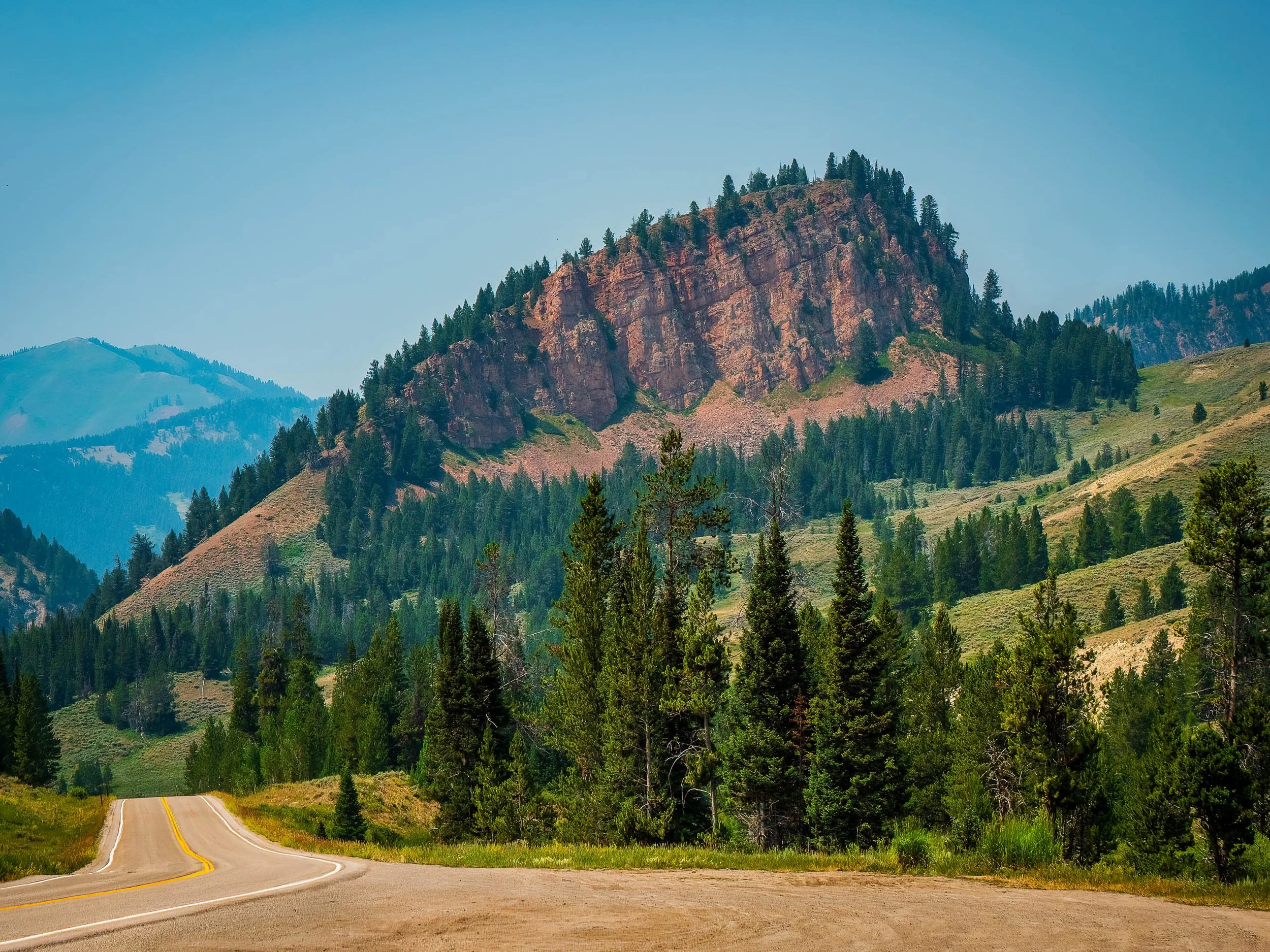
The road curves west, and the country opens up ahead of it — a red-rock sentinel rising from a shoulder of pine and sage, the kind of landmark that tells a traveler they've arrived somewhere worth slowing down for. This is the approach into Yellowstone, captured not at the gate but on the drive in, where the anticipation of the park is already written into the landscape.
The composition leads with the double-yellow line, curving from the lower left and drawing the eye up through a stand of dark conifers before delivering it to the cliff face — sunlit, weathered, ancient against a hazy summer sky. The road doesn't dominate the frame; it simply does its job, offering scale and a sense of forward motion, while the rock formation holds the visual weight as the true subject.
This image sits comfortably in the lineage of the American road photograph — the open highway as both subject and metaphor, in the tradition of Wenders' meditations on landscape and journey. But where that tradition often empties the frame entirely, this piece keeps one foot in classical Western landscape work, closer to Adams in its treatment of geologic form: the cliff face is rendered with real tonal structure, not simply documented.
Design & Styling
This piece works well in spaces built around a sense of journey or destination — a mountain home entryway, a lodge-style living room, or an office for someone whose work or heart lives in the West. The warm rust tones in the rock play well against natural wood interiors, while the cool distant ridgeline and clear sky give it enough range to sit comfortably in a more neutral, contemporary palette as well. Well suited to hospitality settings — lodges, cabins, and mountain-town business interiors — where guests are drawn to a sense of place.
Curated Pairings
To build a wall around the roads, ranges and open country of the American West, consider these companion pieces:
For a tonal counterpoint: Pair with The Long Way Home, a single figure in snow in black-and-white.
For the next range north: Complement with The Notch at Jenny Lake, the gap between Teewinot and the Cathedral Group, framed by pine.
For big-country scale: Add The Bend of Silence, the Bighorn River turning through layered canyon walls on the Wyoming–Montana border.
For a line that leads the eye: Round out the wall with Elliot Barker Trail, where trail, fence and cleared understory converge.
Fine Art Presentation
ChromaLuxe® Metal (gloss, semi-gloss, or matte) in semi-gloss is the strongest choice for this image — it holds the tonal detail in the sky and rock without inviting glare across the frame's large open sky area, while still delivering the luminosity that makes the red rock glow. Framed and unframed paper prints on archival paper offer a softer, more atmospheric alternative, well suited to interiors wanting a quieter, more painterly presentation. TruLife Acrylic adds dimensionality for a more contemporary space.
Note: Custom and oversized photographic prints are available. Please contact the studio directly to discuss custom framing, matting, or specialized museum glass options.
The road curves west, and the country opens up ahead of it — a red-rock sentinel rising from a shoulder of pine and sage, the kind of landmark that tells a traveler they've arrived somewhere worth slowing down for. This is the approach into Yellowstone, captured not at the gate but on the drive in, where the anticipation of the park is already written into the landscape.
The composition leads with the double-yellow line, curving from the lower left and drawing the eye up through a stand of dark conifers before delivering it to the cliff face — sunlit, weathered, ancient against a hazy summer sky. The road doesn't dominate the frame; it simply does its job, offering scale and a sense of forward motion, while the rock formation holds the visual weight as the true subject.
This image sits comfortably in the lineage of the American road photograph — the open highway as both subject and metaphor, in the tradition of Wenders' meditations on landscape and journey. But where that tradition often empties the frame entirely, this piece keeps one foot in classical Western landscape work, closer to Adams in its treatment of geologic form: the cliff face is rendered with real tonal structure, not simply documented.
Design & Styling
This piece works well in spaces built around a sense of journey or destination — a mountain home entryway, a lodge-style living room, or an office for someone whose work or heart lives in the West. The warm rust tones in the rock play well against natural wood interiors, while the cool distant ridgeline and clear sky give it enough range to sit comfortably in a more neutral, contemporary palette as well. Well suited to hospitality settings — lodges, cabins, and mountain-town business interiors — where guests are drawn to a sense of place.
Curated Pairings
To build a wall around the roads, ranges and open country of the American West, consider these companion pieces:
For a tonal counterpoint: Pair with The Long Way Home, a single figure in snow in black-and-white.
For the next range north: Complement with The Notch at Jenny Lake, the gap between Teewinot and the Cathedral Group, framed by pine.
For big-country scale: Add The Bend of Silence, the Bighorn River turning through layered canyon walls on the Wyoming–Montana border.
For a line that leads the eye: Round out the wall with Elliot Barker Trail, where trail, fence and cleared understory converge.
Fine Art Presentation
ChromaLuxe® Metal (gloss, semi-gloss, or matte) in semi-gloss is the strongest choice for this image — it holds the tonal detail in the sky and rock without inviting glare across the frame's large open sky area, while still delivering the luminosity that makes the red rock glow. Framed and unframed paper prints on archival paper offer a softer, more atmospheric alternative, well suited to interiors wanting a quieter, more painterly presentation. TruLife Acrylic adds dimensionality for a more contemporary space.
Note: Custom and oversized photographic prints are available. Please contact the studio directly to discuss custom framing, matting, or specialized museum glass options.