
 Image 1 of 1
Guardian of the Bloom
Guardian of the Bloom:
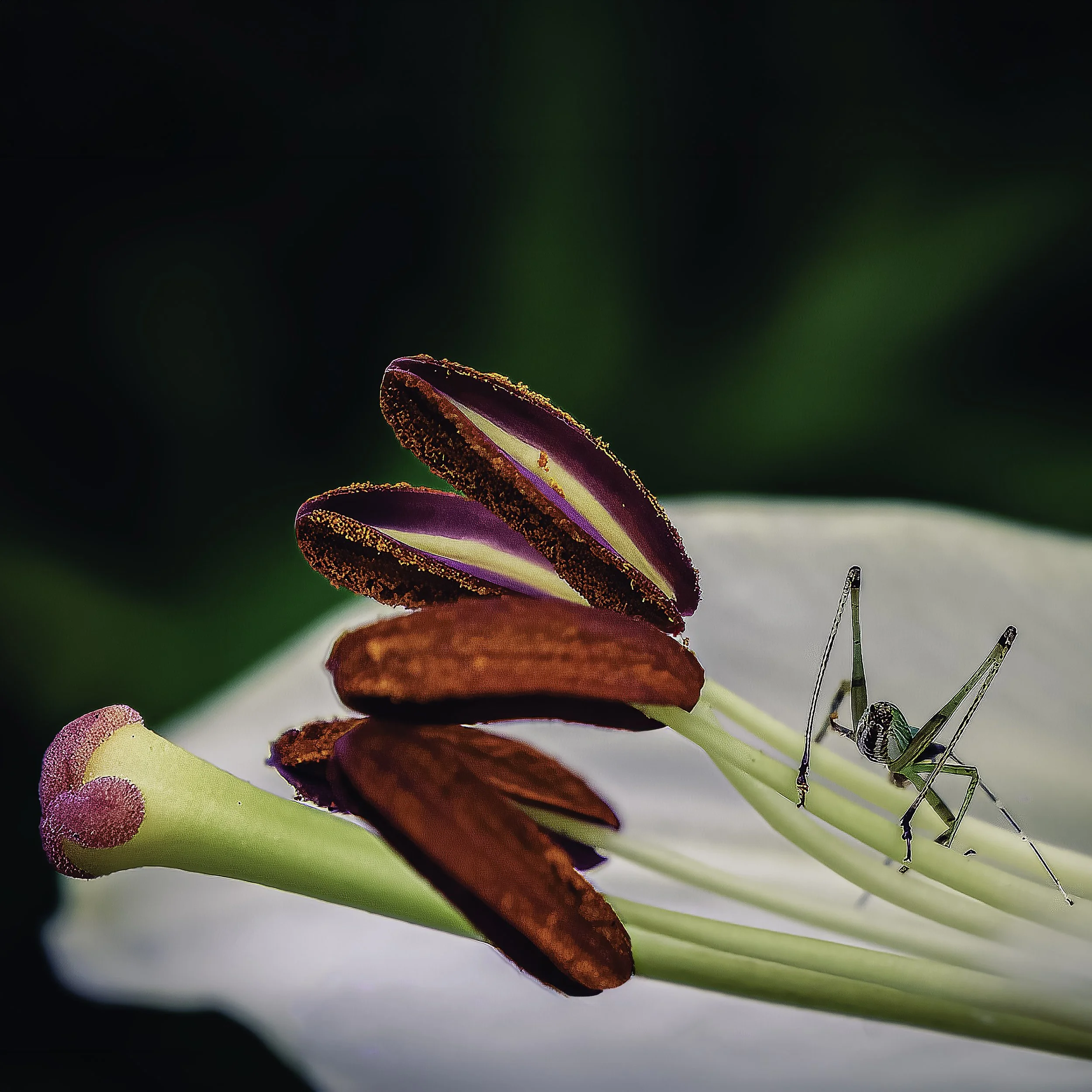
This photograph captures the remarkable architectural beauty hidden within a single flower, and the small dramas that unfold inside it. Photographed at macro scale, the image reveals the intricate reproductive structure of a white lily, its deep crimson anthers curling open to expose bands of pollen-dusted texture, while a young grasshopper pauses among the filaments as if surveying its surroundings. What might otherwise be a purely botanical study becomes something closer to a narrative moment, transforming a familiar garden subject into a scene of quiet tension and discovery. Rather than presenting the flower as a whole, the photograph invites viewers into its inner architecture. The lily's pale, luminous petal dissolves into a soft field of white and green behind the sharply rendered center, creating a visual transition between abstraction and realism. The maroon anthers curve outward like petals of their own, their pollen-flecked surfaces catching the light, while the pink-capped pistil below anchors the composition with quiet symmetry. The grasshopper, caught mid-step along the stamen filaments, introduces an element of life and unpredictability, its slender legs echoing the fine lines of the flower's own architecture. Color plays a central role throughout the image. Deep burgundy and warm ochre tones dominate the flower's core, set against the cool purity of the white petal and the soft, dark green of the blurred background. This contrast allows the anthers to emerge with striking clarity, while the grasshopper's muted greens and grays offer a quiet counterpoint to the flower's saturated palette. The result is a composition that feels both sculptural and alive, revealing the elegance that exists at nature's smallest scales, and the unexpected encounters that occur within it.
Design & Styling
The architecture hidden inside a flower, and a small grasshopper standing guard, make Guardian of the Bloom a natural fit for studies, kitchens, spa and wellness spaces, boutique hospitality, and homes with nature-minded owners. The white and crimson read well against soft neutral walls.
Curated Pairings
To create a cohesive gallery wall around macro botanical detail, consider these companion pieces:
For botanical continuity: Pair with Scarlet Crown, exploring a contrasting floral form while keeping the same emphasis on macro botanical detail.
For color harmony: Complement this piece with After the Heat, extending the warm red and ochre tones found throughout the composition.
For color at landscape scale: Pair with Standing Stone, a red-rock landscape built on the same single, saturated subject, at a very different scale.
Fine Art Presentation
Available as a signed fine art print on ChromaLuxe® Metal (gloss, semi-gloss, or matte), Glossy Anti-Glare Acrylic (TruLife), canvas, wood, and archival paper (framed or unframed). ChromaLuxe® Metal is a strong choice, but Acrylic is the recommended presentation: its luminous depth suits the pollen-dusted texture of the anthers and the soft transitions inside the bloom. Framed archival paper is the alternative for a quieter, more traditional botanical read.
Note: Custom and oversized photographic prints are available. Please contact the studio directly to discuss custom framing, matting, or specialized museum glass options.
Guardian of the Bloom:
This photograph captures the remarkable architectural beauty hidden within a single flower, and the small dramas that unfold inside it. Photographed at macro scale, the image reveals the intricate reproductive structure of a white lily, its deep crimson anthers curling open to expose bands of pollen-dusted texture, while a young grasshopper pauses among the filaments as if surveying its surroundings. What might otherwise be a purely botanical study becomes something closer to a narrative moment, transforming a familiar garden subject into a scene of quiet tension and discovery. Rather than presenting the flower as a whole, the photograph invites viewers into its inner architecture. The lily's pale, luminous petal dissolves into a soft field of white and green behind the sharply rendered center, creating a visual transition between abstraction and realism. The maroon anthers curve outward like petals of their own, their pollen-flecked surfaces catching the light, while the pink-capped pistil below anchors the composition with quiet symmetry. The grasshopper, caught mid-step along the stamen filaments, introduces an element of life and unpredictability, its slender legs echoing the fine lines of the flower's own architecture. Color plays a central role throughout the image. Deep burgundy and warm ochre tones dominate the flower's core, set against the cool purity of the white petal and the soft, dark green of the blurred background. This contrast allows the anthers to emerge with striking clarity, while the grasshopper's muted greens and grays offer a quiet counterpoint to the flower's saturated palette. The result is a composition that feels both sculptural and alive, revealing the elegance that exists at nature's smallest scales, and the unexpected encounters that occur within it.
Design & Styling
The architecture hidden inside a flower, and a small grasshopper standing guard, make Guardian of the Bloom a natural fit for studies, kitchens, spa and wellness spaces, boutique hospitality, and homes with nature-minded owners. The white and crimson read well against soft neutral walls.
Curated Pairings
To create a cohesive gallery wall around macro botanical detail, consider these companion pieces:
For botanical continuity: Pair with Scarlet Crown, exploring a contrasting floral form while keeping the same emphasis on macro botanical detail.
For color harmony: Complement this piece with After the Heat, extending the warm red and ochre tones found throughout the composition.
For color at landscape scale: Pair with Standing Stone, a red-rock landscape built on the same single, saturated subject, at a very different scale.
Fine Art Presentation
Available as a signed fine art print on ChromaLuxe® Metal (gloss, semi-gloss, or matte), Glossy Anti-Glare Acrylic (TruLife), canvas, wood, and archival paper (framed or unframed). ChromaLuxe® Metal is a strong choice, but Acrylic is the recommended presentation: its luminous depth suits the pollen-dusted texture of the anthers and the soft transitions inside the bloom. Framed archival paper is the alternative for a quieter, more traditional botanical read.
Note: Custom and oversized photographic prints are available. Please contact the studio directly to discuss custom framing, matting, or specialized museum glass options.