
 Image 1 of 1
The Painted Storm
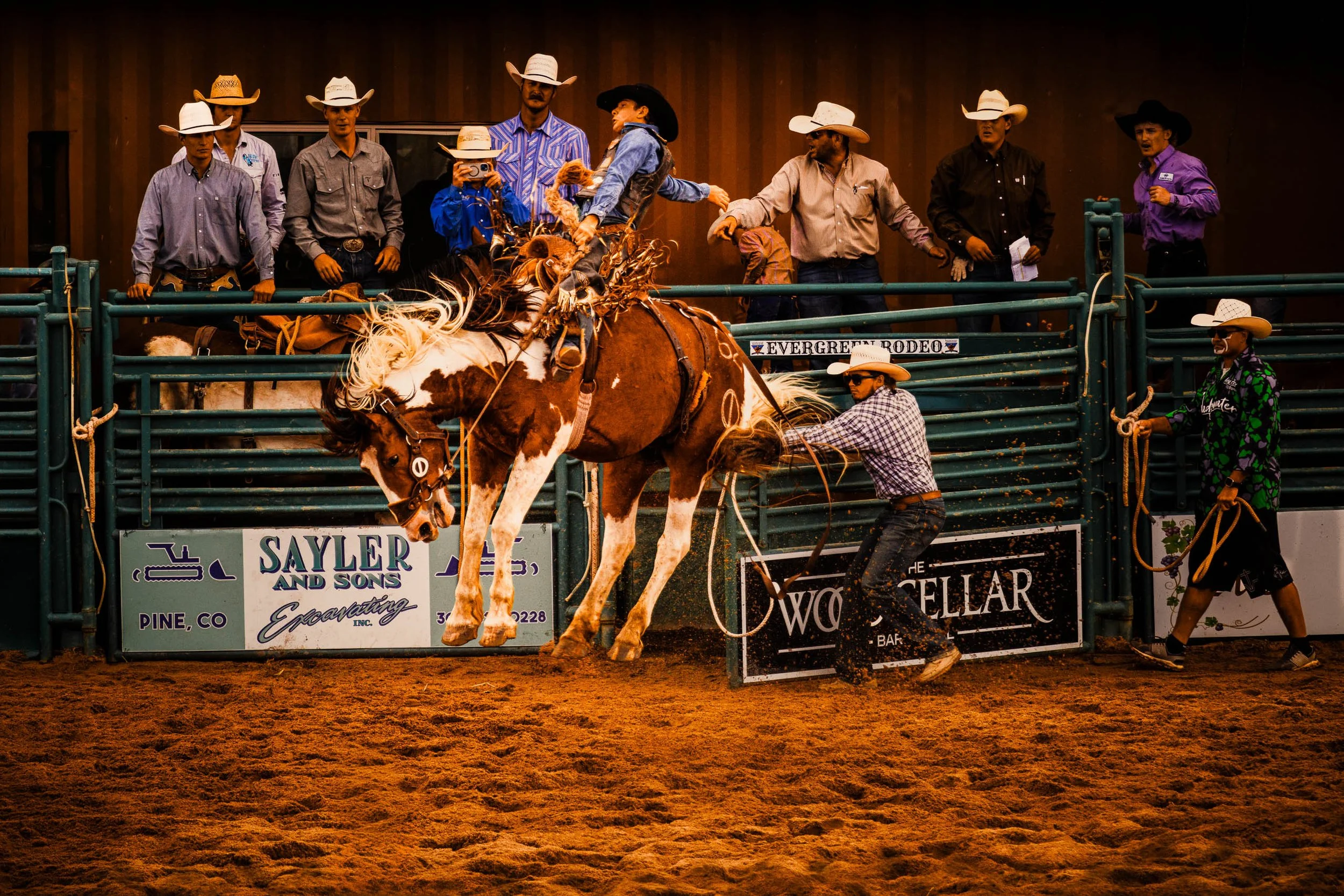
The moment a paint bronc becomes pure force. The Painted Storm arrives with hindquarters driving skyward, mane exploding outward, and the rider locked in position against an animal that has decided the outcome on its own terms. Photographed at the Evergreen Rodeo in the Colorado foothills, it holds horse and rider suspended in a single unrepeatable instant, the Evergreen Rodeo sign in the background, the gate handler braced on the rope, the crowd leaning forward at the rail.
The chestnut-and-white paint horse is the dominant visual force: its coat, animated by the violence of the buck, pulls the eye immediately and holds it, and the flying mane carries the motion through the upper third of the frame. The crowd of cowboys above the rail gives human scale, their reactions ranging from focused intensity to open-mouthed surprise, and warm arena light unifies the chestnut tones, leather gear, and sand into one palette.
Drawing on the kinetic color work of Ernst Haas and the documentary authenticity of Wim Wenders, the image treats rodeo as a living tradition, and the specificity matters: a particular horse, a particular rider, and a particular afternoon at the Evergreen Rodeo, which has run for over a century in the foothills west of Denver.
Design & Styling
With its dramatic contrast, warm chestnut and amber tones, and explosive central subject, The Painted Storm commands attention in mountain homes, ranch properties, sporting lodges, western hospitality spaces, and executive offices. The 3:2 format scales from statement pieces above a fireplace or sofa to mid-size presentations in hallways and guest rooms, reaching full power at 24×36 and above, and its chestnut, sand, leather, and denim palette pairs with reclaimed wood, iron, and aged leather.
Curated Pairings
To build a rodeo wall around The Painted Storm, consider these companion pieces from the same arena:
For a complete Evergreen Rodeo narrative: Pair with Out of the Chute, two horses, two moments, one arena: together they tell the story of the rodeo from gate burst to full ride.
For another paint horse: Complement with Flying Colors, a paint horse clearing the top rail of the chute with straw and mane torn loose, the bareback rider counterbalancing with a free arm thrown wide.
For horse and rider in the air: Pair with Between Sky and Dirt, where horse and rider reach full extension above the arena dirt, both airborne, the outcome still unresolved.
Fine Art Presentation
Available as a signed fine art print on ChromaLuxe® Metal (gloss, semi-gloss, or matte), Glossy Anti-Glare Acrylic (TruLife), canvas, wood, and archival paper (framed or unframed). ChromaLuxe® Metal is the strongest choice: the contrast between the chestnut coat, the white markings, and the dark arena background benefits from metal's luminosity, and the flying mane renders with exceptional sharpness at larger sizes; 24×36 is the recommended primary size. Framed archival paper offers a warmer, more tactile read for traditional and rustic rooms, and canvas or wood adds texture for lodge and ranch settings.
Note: Custom and oversized photographic prints are available. Please contact the studio directly to discuss custom framing, matting, or specialized museum glass options.
The moment a paint bronc becomes pure force. The Painted Storm arrives with hindquarters driving skyward, mane exploding outward, and the rider locked in position against an animal that has decided the outcome on its own terms. Photographed at the Evergreen Rodeo in the Colorado foothills, it holds horse and rider suspended in a single unrepeatable instant, the Evergreen Rodeo sign in the background, the gate handler braced on the rope, the crowd leaning forward at the rail.
The chestnut-and-white paint horse is the dominant visual force: its coat, animated by the violence of the buck, pulls the eye immediately and holds it, and the flying mane carries the motion through the upper third of the frame. The crowd of cowboys above the rail gives human scale, their reactions ranging from focused intensity to open-mouthed surprise, and warm arena light unifies the chestnut tones, leather gear, and sand into one palette.
Drawing on the kinetic color work of Ernst Haas and the documentary authenticity of Wim Wenders, the image treats rodeo as a living tradition, and the specificity matters: a particular horse, a particular rider, and a particular afternoon at the Evergreen Rodeo, which has run for over a century in the foothills west of Denver.
Design & Styling
With its dramatic contrast, warm chestnut and amber tones, and explosive central subject, The Painted Storm commands attention in mountain homes, ranch properties, sporting lodges, western hospitality spaces, and executive offices. The 3:2 format scales from statement pieces above a fireplace or sofa to mid-size presentations in hallways and guest rooms, reaching full power at 24×36 and above, and its chestnut, sand, leather, and denim palette pairs with reclaimed wood, iron, and aged leather.
Curated Pairings
To build a rodeo wall around The Painted Storm, consider these companion pieces from the same arena:
For a complete Evergreen Rodeo narrative: Pair with Out of the Chute, two horses, two moments, one arena: together they tell the story of the rodeo from gate burst to full ride.
For another paint horse: Complement with Flying Colors, a paint horse clearing the top rail of the chute with straw and mane torn loose, the bareback rider counterbalancing with a free arm thrown wide.
For horse and rider in the air: Pair with Between Sky and Dirt, where horse and rider reach full extension above the arena dirt, both airborne, the outcome still unresolved.
Fine Art Presentation
Available as a signed fine art print on ChromaLuxe® Metal (gloss, semi-gloss, or matte), Glossy Anti-Glare Acrylic (TruLife), canvas, wood, and archival paper (framed or unframed). ChromaLuxe® Metal is the strongest choice: the contrast between the chestnut coat, the white markings, and the dark arena background benefits from metal's luminosity, and the flying mane renders with exceptional sharpness at larger sizes; 24×36 is the recommended primary size. Framed archival paper offers a warmer, more tactile read for traditional and rustic rooms, and canvas or wood adds texture for lodge and ranch settings.
Note: Custom and oversized photographic prints are available. Please contact the studio directly to discuss custom framing, matting, or specialized museum glass options.