
 Image 1 of 3
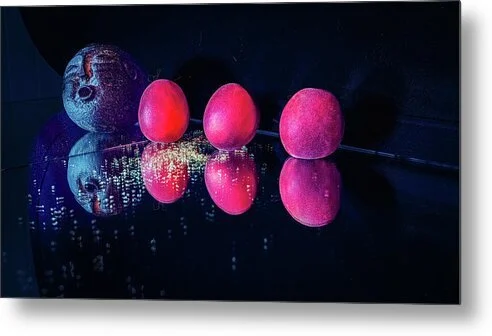 Image 2 of 3
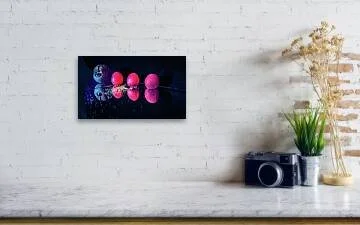 Image 3 of 3
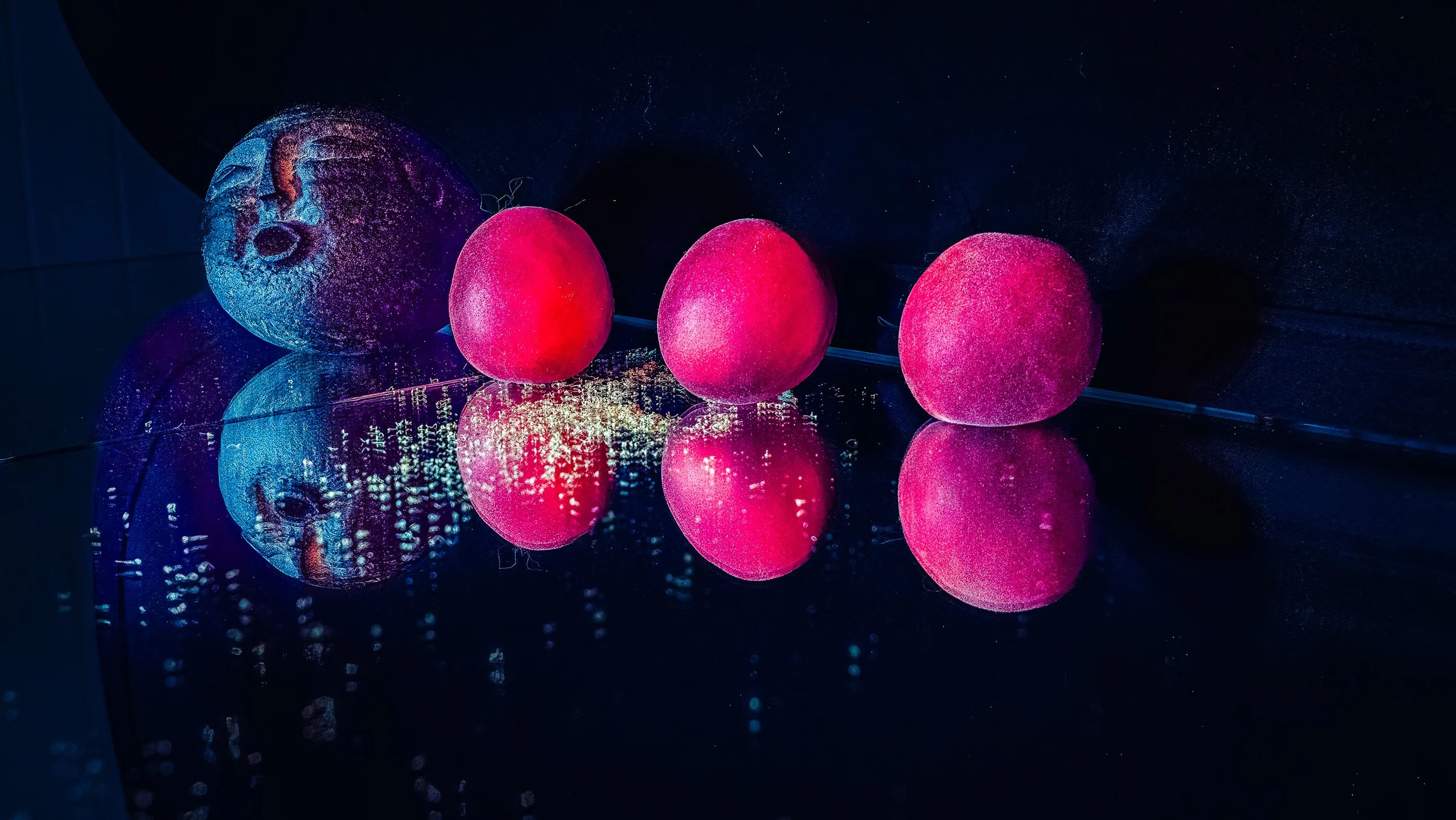
Wind is the unseen hand in this frame — carrying pollen across a dark, reflective surface until it settles at the feet of three apricots, each caught mid-ripening under a warm, theatrical light. Behind them, silent and cool-lit in blue, a weathered stone face watches the whole exchange. It has seen this cycle before. It will see it again.
The composition moves left to right in a loose procession: stone, then fruit, then fruit, then fruit, each form doubled below in a glass-black reflection that turns the pollen scatter into something closer to sediment or starlight than dust. The eye is meant to travel the sequence slowly — this is not an image built for a single glance. The specular highlights on each apricot's skin, the fine grain of pollen caught in reflected light, the carved detail in the stone's eroded face: all of it rewards a second, closer look.
Color does real work here. The stone's cool blue-violet stands in deliberate opposition to the apricots' warm red, a chiaroscuro built the way the Dutch masters built theirs — Kalf, Zurbarán — single hard light, dark ground, glossy surfaces catching what little light there is. The pollen is the picture's quiet argument: proof that what looks fixed and permanent (the stone) and what looks fleeting and perishable (the fruit) are both, in their own way, products of the same wind.
Design & Styling
This piece anchors a room the way a strong still life should — with stillness, not spectacle. It reads beautifully in a formal dining room paired with dark wood and low, warm lighting; in a chef's kitchen or wine cellar where the food-adjacent subject matter feels intentional rather than decorative; or in a moody study or reading room where its slow-reveal quality has room to work. The deep black ground makes it a strong match for contemporary interiors with black or dark bronze fixtures, and the warm/cool color split gives a designer real flexibility to key off either half of the palette depending on the room.
Curated Pairings
For the companion piece — "Blowing Foul", a still life built on the same stone, paired here with a single weathered baseball rather than ripening fruit — permanence set against a different kind of wind.
For fruit and ripening continuity — "Before the Crush", a study of Chianti grapes at the edge of harvest, sharing this piece's interest in fruit as a marker of time passing.
For still-life tradition — "Still Life for Grandmother", another dark-ground still life working in the same quiet, close-looking register.
Fine Art Presentation
This image is available as a fine art print on archival paper or the new Canson BFK Rives fine art paper for a soft, painterly surface well suited to the piece's Dutch still-life quality; as ChromaLuxe® Metal (gloss, semi-gloss, or matte) print for a sleek, high-color presentation that intensifies the warm/cool contrast; or face-mounted on TruLife Acrylic for exceptional depth and a glass-like surface that echoes the reflective black ground in the image itself. Framed and unframed paper options are available on request.
Note: Custom and oversized photographic prints are available. Please contact the studio directly to discuss custom framing, matting, or specialized museum glass options.
Wind is the unseen hand in this frame — carrying pollen across a dark, reflective surface until it settles at the feet of three apricots, each caught mid-ripening under a warm, theatrical light. Behind them, silent and cool-lit in blue, a weathered stone face watches the whole exchange. It has seen this cycle before. It will see it again.
The composition moves left to right in a loose procession: stone, then fruit, then fruit, then fruit, each form doubled below in a glass-black reflection that turns the pollen scatter into something closer to sediment or starlight than dust. The eye is meant to travel the sequence slowly — this is not an image built for a single glance. The specular highlights on each apricot's skin, the fine grain of pollen caught in reflected light, the carved detail in the stone's eroded face: all of it rewards a second, closer look.
Color does real work here. The stone's cool blue-violet stands in deliberate opposition to the apricots' warm red, a chiaroscuro built the way the Dutch masters built theirs — Kalf, Zurbarán — single hard light, dark ground, glossy surfaces catching what little light there is. The pollen is the picture's quiet argument: proof that what looks fixed and permanent (the stone) and what looks fleeting and perishable (the fruit) are both, in their own way, products of the same wind.
Design & Styling
This piece anchors a room the way a strong still life should — with stillness, not spectacle. It reads beautifully in a formal dining room paired with dark wood and low, warm lighting; in a chef's kitchen or wine cellar where the food-adjacent subject matter feels intentional rather than decorative; or in a moody study or reading room where its slow-reveal quality has room to work. The deep black ground makes it a strong match for contemporary interiors with black or dark bronze fixtures, and the warm/cool color split gives a designer real flexibility to key off either half of the palette depending on the room.
Curated Pairings
For the companion piece — "Blowing Foul", a still life built on the same stone, paired here with a single weathered baseball rather than ripening fruit — permanence set against a different kind of wind.
For fruit and ripening continuity — "Before the Crush", a study of Chianti grapes at the edge of harvest, sharing this piece's interest in fruit as a marker of time passing.
For still-life tradition — "Still Life for Grandmother", another dark-ground still life working in the same quiet, close-looking register.
Fine Art Presentation
This image is available as a fine art print on archival paper or the new Canson BFK Rives fine art paper for a soft, painterly surface well suited to the piece's Dutch still-life quality; as ChromaLuxe® Metal (gloss, semi-gloss, or matte) print for a sleek, high-color presentation that intensifies the warm/cool contrast; or face-mounted on TruLife Acrylic for exceptional depth and a glass-like surface that echoes the reflective black ground in the image itself. Framed and unframed paper options are available on request.
Note: Custom and oversized photographic prints are available. Please contact the studio directly to discuss custom framing, matting, or specialized museum glass options.