
Roads Through the World
A Closer Look
Explore the finer details of each photograph by hovering over an image to reveal subtle focus and texture, or click to expand the work into a distraction-free viewing environment. This immersive view allows each study of Roads around the World to be experienced at its full scale and proportion.
Search for a specific photograph, series, or browse the curated collections. Looking for a particular format? Search by Square or 1:1, Landscape or 3:2, or Panorama or 16:9.
Roads Through the World: Journeys Across the West
Roads invite us forward. They connect landscapes, cities, cultures, and histories, but they also connect moments of curiosity, discovery, and possibility.
The photographs in this collection explore the roads, pathways, bridges, and routes that carry us through the world, revealing not only where we travel, but how we experience the journey itself.
Created across North America and Europe, these images follow highways disappearing into distant horizons, winding roads through mountains and deserts, quiet streets in historic cities, and pathways shaped by generations of travelers. Some photographs celebrate the vastness of the landscape, while others focus on the smaller moments found along the way. Together they reflect a fascination with movement, direction, and the enduring human desire to explore what lies beyond the next bend.
Weather, light, and atmosphere often play a central role. Morning fog, gathering storms, evening light, and changing seasons transform familiar routes into places of wonder and reflection. Rather than documenting destinations alone, these photographs emphasize the experience of travel itself—the anticipation, uncertainty, and discovery that accompany every journey.
Influenced by the cinematic landscapes of Wim Wenders, the color sensibilities of Ernst Haas, and the tradition of American road photography, these images explore themes of freedom, possibility, solitude, and connection. They are photographs about movement, but they are equally about the landscapes, cultures, and stories encountered along the way.
Designed for collectors, healthcare environments, hospitality spaces, offices, and residential interiors, these photographs bring a sense of openness, adventure, and visual depth while inviting viewers to imagine journeys of their own.

“The journey, not the arrival, matters.”
The Long Way West is a study of distance, anticipation, and the enduring pull of the American horizon. Photographed along the highway approaching Monument Valley, the image follows a ribbon of road as it stretches across the high desert toward one of the most iconic landscapes in the American West. Far in the distance, the sandstone buttes rise from the desert floor like ancient landmarks, providing both destination and promise.
The panoramic composition emphasizes the immense scale of the landscape and the experience of traveling through it. The highway becomes the visual anchor, guiding the eye through layers of open desert, distant mesas, and expansive sky. Rather than focusing solely on Monument Valley itself, the photograph celebrates the approach—the gradual revelation of place that unfolds mile by mile across the landscape. The result is an image that captures not only geography, but the emotional experience of moving through vast spaces where distance becomes part of the journey.
Drawing inspiration from the cinematic road imagery of Wim Wenders, the luminous color sensibilities of Ernst Haas, and the grand Western landscapes of Ansel Adams, The Long Way West explores themes of exploration, freedom, and discovery. The photograph reflects a uniquely American experience: the feeling of seeing a distant destination emerge slowly from the horizon while the open road continues onward.
Design & Styling
The long horizon and open highway of The Long Way West give a wide wall a sense of adventure for offices, lobbies, hospitality spaces, and Western homes. The panoramic format suits a long wall over a sofa or a desk.
Curated Pairings
To create a cohesive display around the road toward Monument Valley, consider these companion pieces:
For a complete road narrative: Pair with Beyond the Next Bend, with Before the Road Disappears, a visual progression through the landscapes of the American West.
For a Monument Valley collection: Complement with Where the Valley Beckons, with Where the Desert Meets Night, linking the approach to the landscape with its iconic forms and changing light.
For exploration and distance: Pair with Before the Desert Opens, emphasizing the anticipation and discovery that define travel through the Southwest.
Fine Art Presentation
Available as a signed fine art print on ChromaLuxe® Metal (gloss, semi-gloss, or matte), Glossy Anti-Glare Acrylic (TruLife), canvas, wood, and archival paper (framed or unframed). ChromaLuxe® Metal is the recommended presentation: the panoramic composition suits larger sizes, and metal holds the sky and the fine road detail. Acrylic is the alternative for extra depth.
Note: Custom and oversized photographic prints are available. Please contact the studio directly to discuss custom framing, matting, or specialized museum glass options.
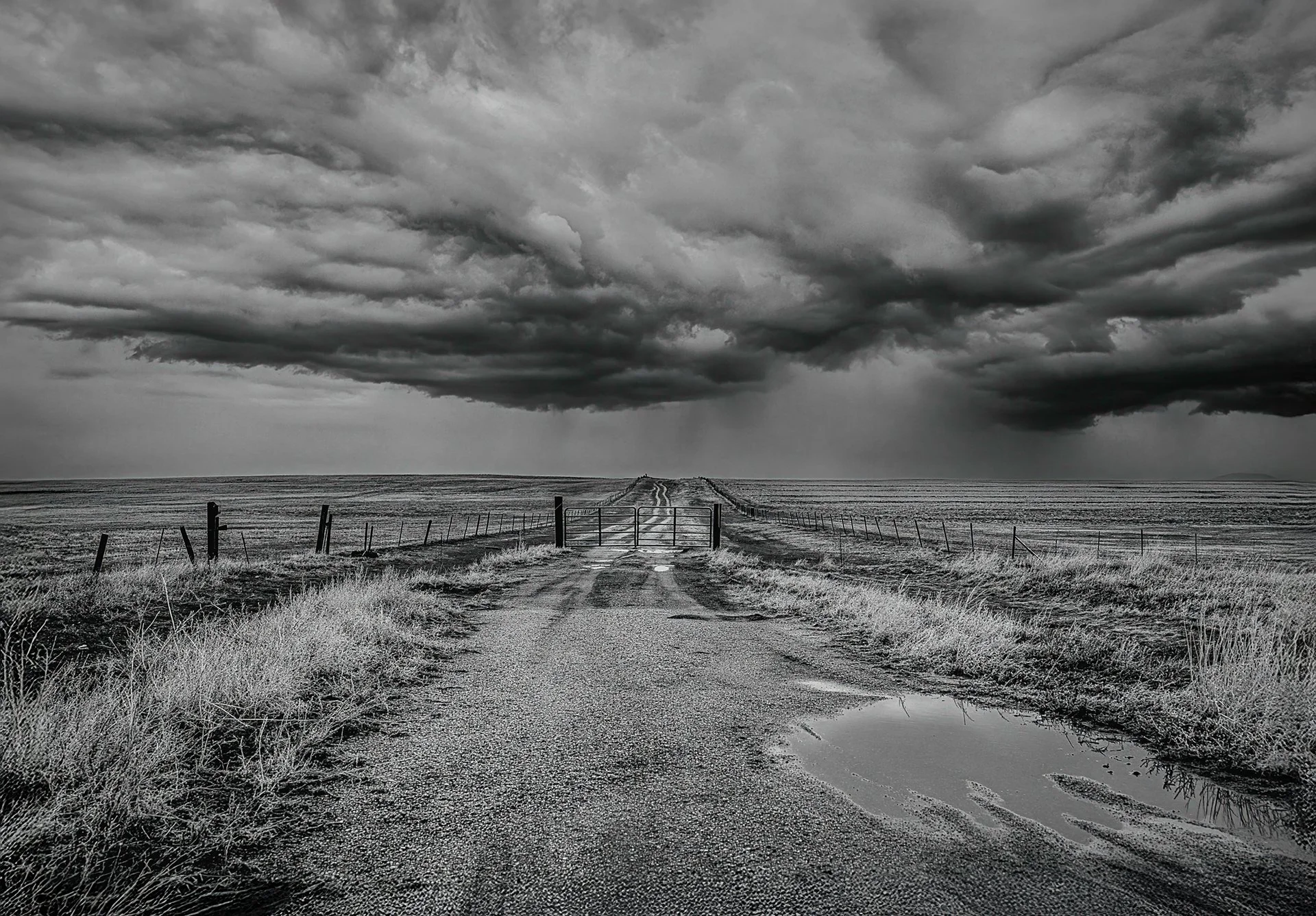
Some roads lead straight into weather. Storm Gate is a study of anticipation, endurance, and the immense scale of the American landscape. Photographed on the Colorado prairie, the image follows a long frozen road as it disappears toward a gathering storm. Winter grasses line the roadway and icy puddles reflect the sky, creating a visual path that draws the eye toward the dark horizon and the approaching weather beyond.
Presented in monochrome, the photograph emphasizes form, texture, and atmosphere rather than color. The frozen road, the subtle detail in the grasses, and the dramatic structure of the storm combine into a landscape that feels both timeless and immediate, caught between stillness and movement in the quiet before weather transforms the scene.
Drawing inspiration from the formal precision of Ansel Adams, the expansive vision of the American West, and the contemplative minimalism of Michael Kenna, Storm Gate explores resilience, uncertainty, and the enduring relationship between land, weather, and time.
Design & Styling
With its dramatic sky, strong leading lines, and timeless monochrome, Storm Gate brings strength and depth to executive offices, mountain homes, hospitality lounges, and contemporary interiors where perseverance, exploration, and the American landscape are valued. Its combination of scale and simplicity makes a powerful focal point without overwhelming a room.
Curated Pairings
To build a wall around weather, distance, and the American road, consider these companion pieces:
For a complementary landscape statement: Pair with Where the Sky Breaks, another Western sky as the subject, here a meteor crossing the night above Turret Arch instead of a gathering storm.
For thematic harmony: Complement the journey suggested in Storm Gate with The Long Way West, continuing the exploration of roads, distance, and the landscapes that shape the American experience.
For the road in sunlight: Pair with The Road Beneath the Mesa, a Western highway curving through a working valley beneath a towering sandstone mesa, the road again in light instead of storm.
Fine Art Presentation
Available as a signed fine art print on ChromaLuxe® Metal (gloss, semi-gloss, or matte), Glossy Anti-Glare Acrylic (TruLife), canvas, wood, and archival paper (framed or unframed). Framed archival paper is the recommended presentation: its matte surface holds the subtle tonal gradations of the storm structure and the frozen road in the tradition of Adams and Kenna. ChromaLuxe® Metal is the alternative for deeper blacks and a more luminous sky at large sizes.
Note: Custom and oversized photographic prints are available. Please contact the studio directly to discuss custom framing, matting, or specialized museum glass options.
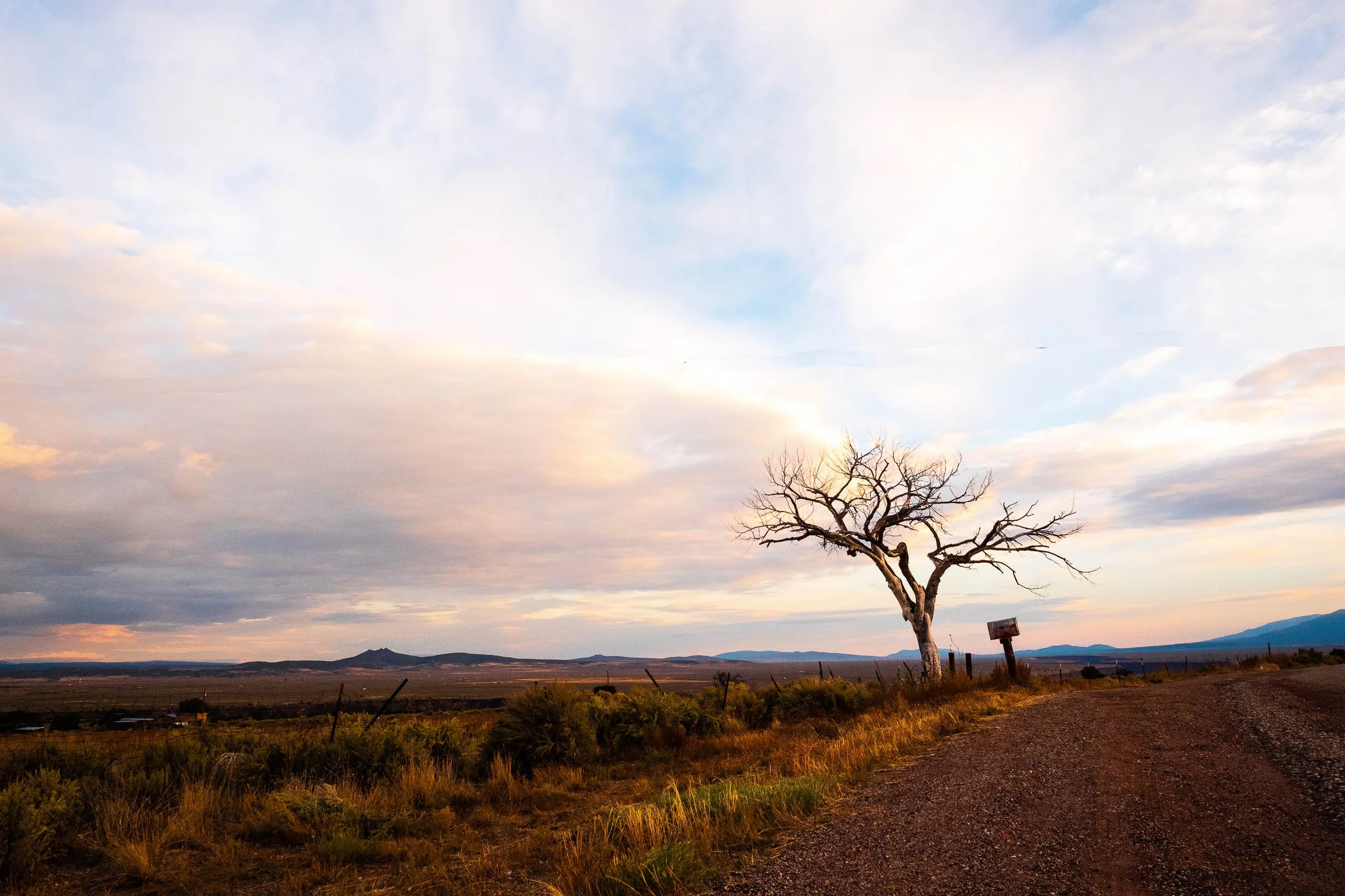
Some landmarks become memories while we are still driving past them. The Last Goodbye is a reflection on place and the landmarks that quietly become part of our lives. Photographed along a rural road near Taos, New Mexico, it portrays a solitary cottonwood beneath an expansive Southwestern sky, the tree locals called the Welcome Tree or the Hello-Goodbye Tree, which greeted travelers arriving in the valley and accompanied them as they left.
The composition is deceptively simple: a narrow road curves gently through open grassland toward a lone tree framed against drifting clouds and distant mountains. Space, restraint, and atmosphere let the tree become both subject and symbol, while the road invites the eye forward and the immense sky reinforces the openness of the American West.
Since the photograph was made, the tree has fallen in a period of severe winds, turning a landscape into a record of something that no longer exists in the same form. The image now preserves not only the tree but the experience of meeting it, a sign of arrival, departure, and home for generations of residents and travelers. It draws on the quiet observational traditions of Wim Wenders and the sense of place found throughout the American landscape.
Design & Styling
With its restrained palette, expansive sky, and contemplative atmosphere, The Last Goodbye suits contemporary residences, mountain homes, executive offices, hospitality spaces, and rooms centered on calm, reflection, and connection to place. Its minimalist composition works as a statement piece or as a quiet anchor within a larger collection, and it carries particular meaning for anyone who knew the tree.
Curated Pairings
For a cohesive gallery wall, consider these companion pieces:
For a meditation on memory and place: Pair with Where the Road Pauses, continuing the story of the landscape and the roads that connect us to it.
For themes of endurance and survival: Complement this piece with Hanging On, Creede, Colorado, creating a dialogue about resilience, time, and what remains.
For a broader Americana narrative: Pair with Cottonwoods and Chrome, exploring the relationship between landscape, memory, and the evolving American West.
Fine Art Presentation
Available as a signed fine art print on ChromaLuxe® Metal (gloss, semi-gloss, or matte), Glossy Anti-Glare Acrylic (TruLife), canvas, wood, and archival paper (framed or unframed). The minimalist composition, expansive sky, and subtle tonal transitions suit larger presentations. Framed archival paper emphasizes the photograph's contemplative character, while semi-gloss ChromaLuxe® Metal enhances the balance between sky, landscape, and subject, and wood offers a natural presentation that reinforces the photograph's connection to place and memory. Recommended: 24×36 framed archival paper, 24×36 or 30×45 metal, or a 48×32 wood print. Most images are available up to 40×60 inches, with select wood prints up to 48×32 inches.
Note: Custom and oversized photographic prints are available. Please contact the studio directly to discuss custom framing, matting, or specialized museum glass options.
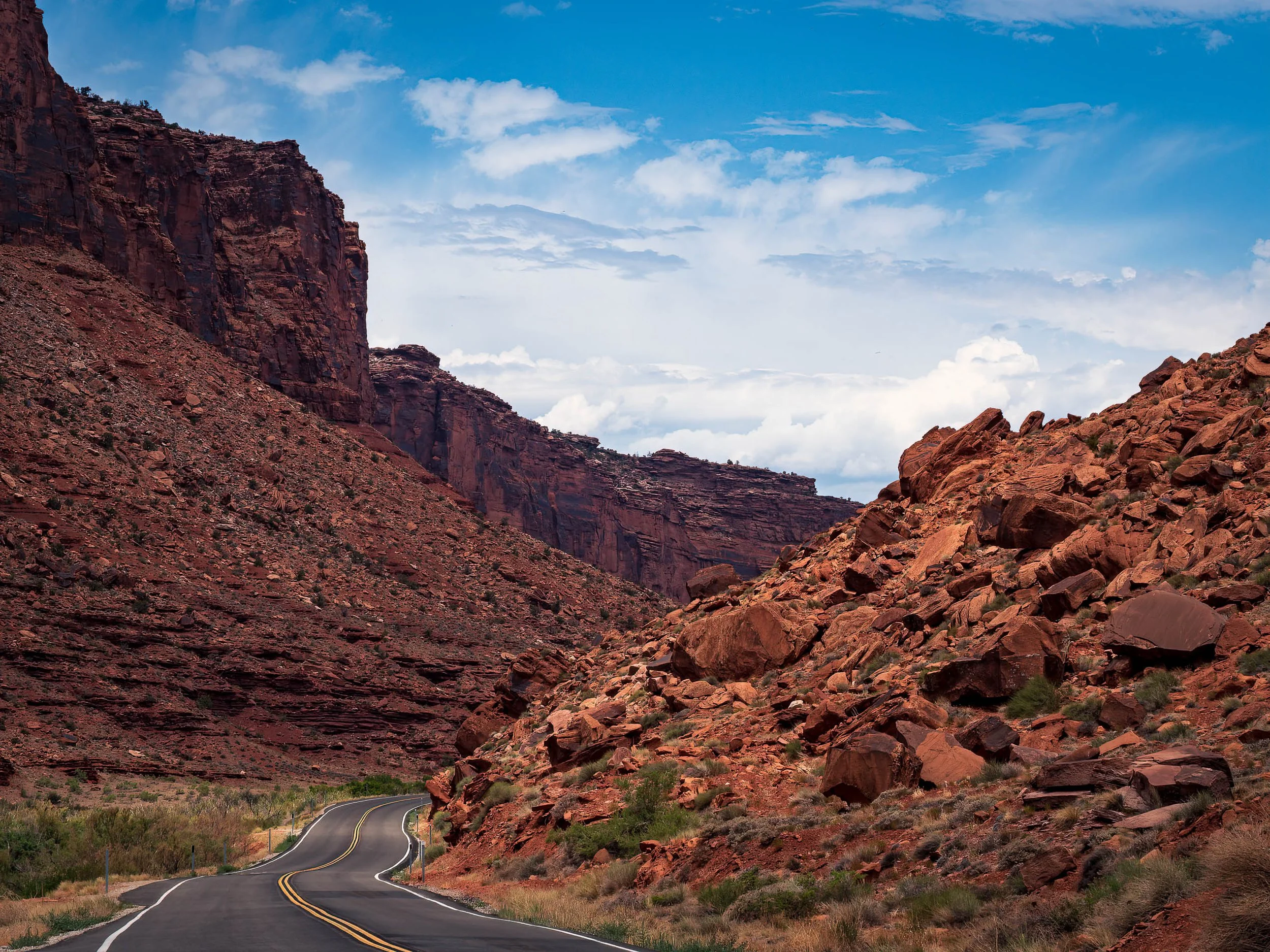
Between Walls of Stone is a study of passage, scale, and the transformative power of landscape. Photographed within the canyon country of the American Southwest, the image follows a winding road as it disappears between towering walls of red sandstone and into a landscape hidden beyond view. Surrounded by immense geological formations shaped over millions of years, the roadway becomes a slender thread connecting human movement with the vastness of deep time.
The composition is built upon contrast and immersion. Massive canyon walls rise from both sides of the frame, their weathered surfaces revealing layers of ancient sediment, fractured cliffs, and scattered boulders. Between them, the road bends gently through the canyon floor, guiding the eye toward a destination that remains unseen. The landscape feels both expansive and enclosed, creating a tension between openness and confinement that draws viewers deeper into the scene.
Rather than presenting a specific landmark, the photograph focuses on the experience of moving through the landscape itself. The canyon becomes a place of transition where every bend suggests a new discovery waiting just ahead. The road invites exploration, while the surrounding stone speaks to permanence, endurance, and the immense scale of geological time.
Drawing inspiration from the cinematic road imagery of Wim Wenders, the atmospheric color traditions of Ernst Haas, and the structural landscape compositions of Ansel Adams, Between Walls of Stone explores themes of journey, discovery, and the relationship between people and the landscapes they traverse. The result is a photograph that encourages viewers to imagine themselves within the scene, following the road toward whatever lies beyond the next turn.
Design & Styling
The red walls and winding road of Between Walls of Stone bring warmth, scale, and movement to executive offices, hospitality spaces, and Southwestern homes. It suits large walls.
Curated Pairings
To create a cohesive display around the Southwest road, consider these companion pieces:
For a Southwest road narrative: Pair with Where the Canyon Waits, with The Long Way West, a visual progression from open highway to canyon passage.
For travel and discovery: Complement with Before the Road Disappears, with Where the Valley Beckons, linking themes of anticipation, movement, and distant destinations.
For canyon country and desert: Pair with Before the Desert Opens, exploring the diverse landscapes of canyon country and the desert beyond.
Fine Art Presentation
Available as a signed fine art print on ChromaLuxe® Metal (gloss, semi-gloss, or matte), Glossy Anti-Glare Acrylic (TruLife), canvas, wood, and archival paper (framed or unframed). ChromaLuxe® Metal is the recommended presentation: it emphasizes the rich red sandstone and the geological texture, and the scale suits larger sizes. Acrylic is the alternative for extra depth.
Note: Custom and oversized photographic prints are available. Please contact the studio directly to discuss custom framing, matting, or specialized museum glass options.
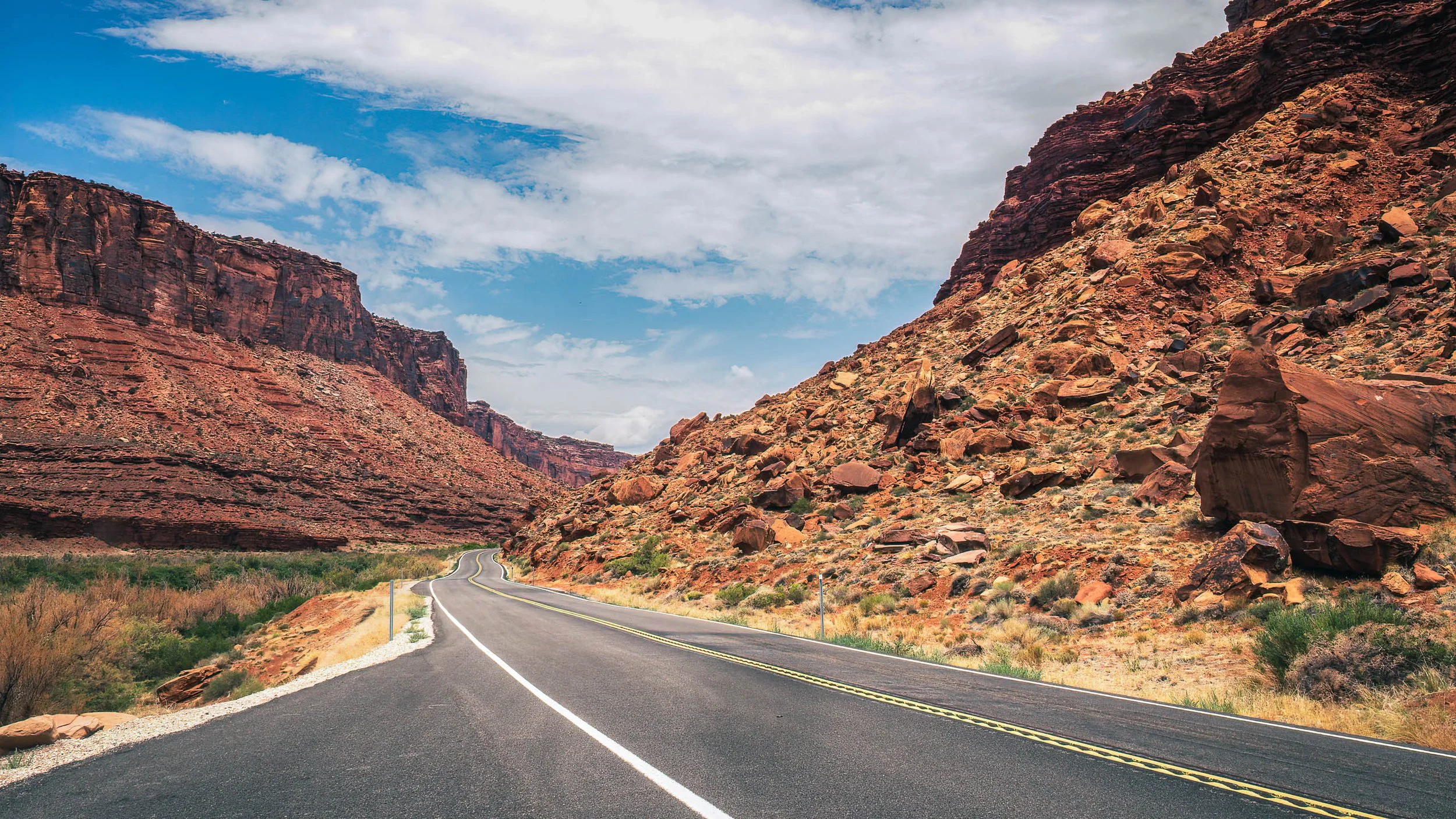
Where the Canyon Waits is a study of anticipation, passage, and the enduring invitation of the open road. Photographed along a winding highway in the canyon country of the American Southwest, the image follows a ribbon of pavement as it disappears between towering walls of red stone. The road becomes both a physical pathway and a symbolic journey, guiding viewers toward a destination that remains hidden beyond the bend.
The composition is built around movement and discovery. The roadway enters the frame in the foreground before curving gently into the canyon, drawing the eye deeper into the landscape. Massive sandstone walls rise on either side, their weathered surfaces revealing layers of geological time. The contrast between the smooth line of the highway and the rugged textures of the canyon creates a visual dialogue between human passage and the enduring forces that shaped the land long before the road arrived.
Rather than focusing on a specific landmark, the photograph explores the experience of entering a landscape. The destination remains unseen, allowing the viewer to imagine what lies beyond the visible horizon. The image celebrates a moment familiar to travelers throughout the American West: the feeling of being drawn forward by curiosity, possibility, and the promise of discovery waiting just beyond the next turn.
Drawing inspiration from the cinematic road imagery of Wim Wenders, the atmospheric color sensibilities of Ernst Haas, and the formal landscape traditions of Ansel Adams, Where the Canyon Waits explores themes of exploration, distance, and the relationship between journey and place. The result is a photograph that invites viewers to become participants in the scene rather than simply observers of it.
Design & Styling
The winding pavement between red stone walls brings warmth and anticipation to offices, hospitality lobbies, and Southwestern homes. It suits large formats.
Curated Pairings
To create a cohesive display around the canyon road, consider these companion pieces:
For a road narrative: Pair with The Long Way West (Panorama), with Before the Road Disappears, a journey through some of the most iconic landscapes of the American West.
For a Southwest collection: Complement with Where the Valley Beckons, with Before the Desert Opens, linking travel, anticipation, and discovery.
For landscape and distance: Pair with Where the Morning Waited, Monument Valley after rain in first light, with Enduring Silence as a quiet companion.
Fine Art Presentation
Available as a signed fine art print on ChromaLuxe® Metal (gloss, semi-gloss, or matte), Glossy Anti-Glare Acrylic (TruLife), canvas, wood, and archival paper (framed or unframed). ChromaLuxe® Metal is the recommended presentation: it holds the rich sandstone color and the canyon textures. Acrylic is the alternative for extra depth.
Note: Custom and oversized photographic prints are available. Please contact the studio directly to discuss custom framing, matting, or specialized museum glass options.
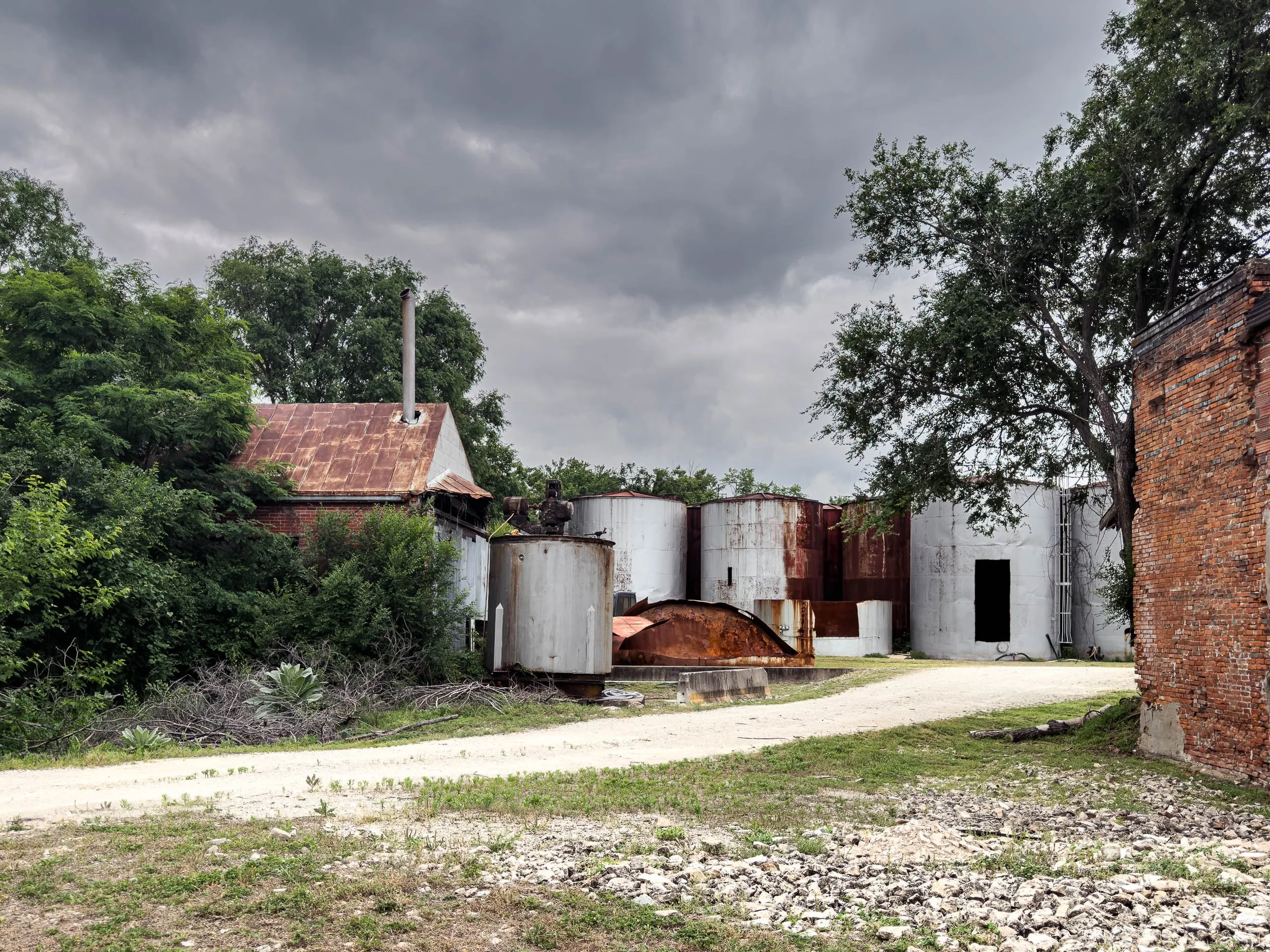
Before the Storm Breaks is a study of weather, industry, and the quiet persistence of place. Photographed in New Haven, Missouri, the image follows a pale gravel road as it bends through rusted tanks, weathered brick, overgrown vegetation, and gathering storm clouds. The scene feels suspended between use and abandonment, where human structures remain present but are slowly being marked by time, weather, and the surrounding landscape.
The composition uses the foreground rocks and road to guide the eye into the image, creating a subtle movement from the ground plane toward the rusted industrial forms and finally into the heavy sky above. Rust, brick, gravel, foliage, and cloud all contribute to the atmosphere, giving the photograph a layered sense of texture and quiet tension. Rather than presenting the site as ruin, the image treats it as a place shaped by work, weather, and memory.
Drawing on the atmospheric color sensibility of Ernst Haas and the quiet, place-based observation of Wim Wenders, Before the Storm Breaks explores the visual poetry of overlooked industrial spaces. The photograph is not about spectacle. It is about the charged stillness before rain, the muted beauty of weathered materials, and the way ordinary places can carry emotional weight when seen with patience.
Design & Styling
A pale road bending through rusted tanks and gathering clouds gives Before the Storm Breaks a moody, industrial drama for lofts, studios, offices, and dens. Its rust and storm gray sit well with concrete, brick, and steel.
Curated Pairings
To create a cohesive gallery wall around industrial weather, consider these companion pieces:
For industrial abstraction: Pair with Steel Wave, connecting rust, reflection, and weathered form.
For structure, time, and restraint: Complement with Reflections of Glass and Stone, a built-environment grouping centered on structure, time, and visual restraint.
For the same town: Pair with Iron Cathedral - New Haven, Missouri, New Haven, Missouri's rusted tanks in saturated color.
Fine Art Presentation
Available as a signed fine art print on ChromaLuxe® Metal (gloss, semi-gloss, or matte), Glossy Anti-Glare Acrylic (TruLife), canvas, wood, and archival paper (framed or unframed). ChromaLuxe® Metal is the recommended presentation: it holds the rust tones, the storm-cloud detail, and the crisp lines of the road. Framed archival paper is the alternative for a more subdued, documentary read.
Note: Custom and oversized photographic prints are available. Please contact the studio directly to discuss custom framing, matting, or specialized museum glass options.
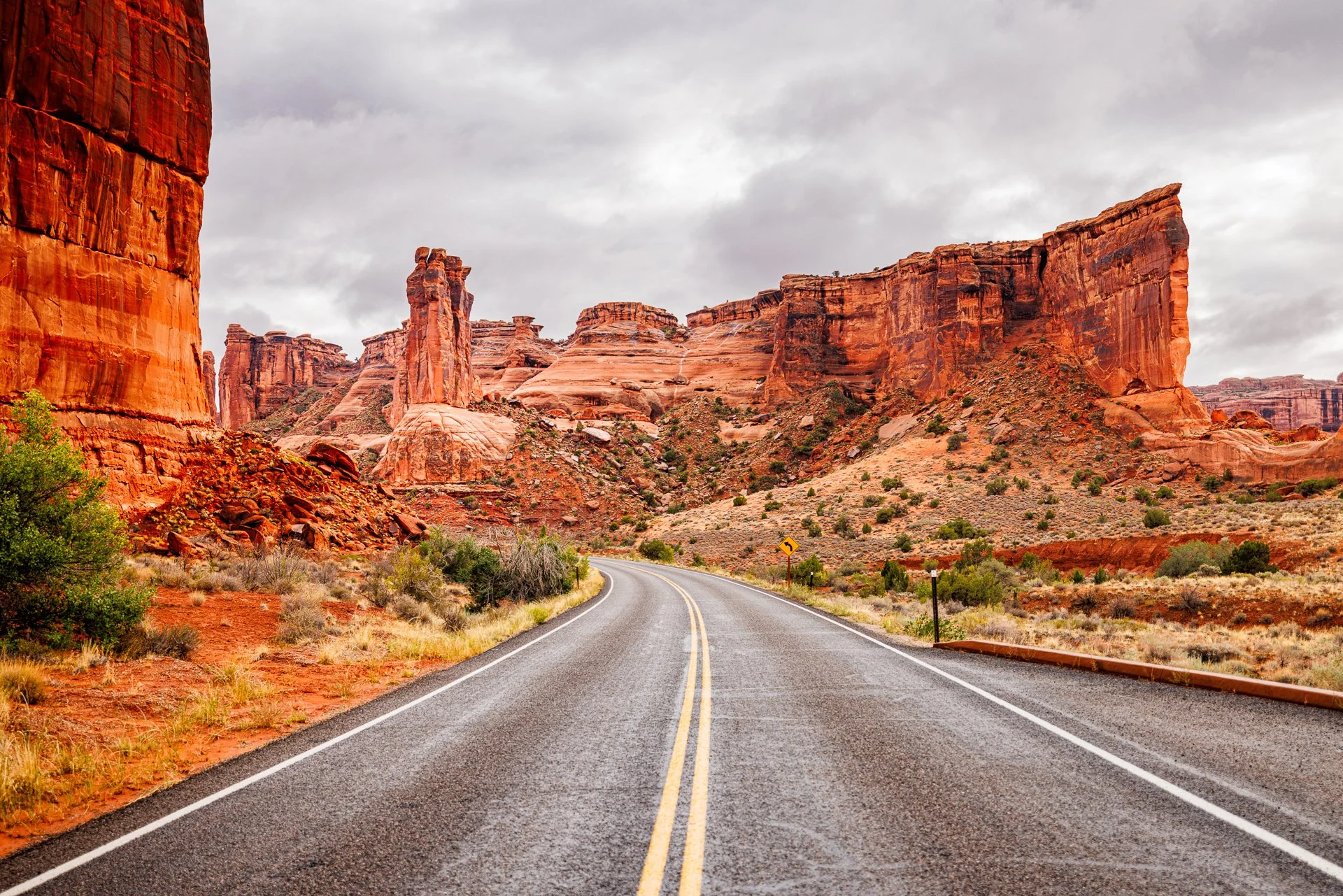
Into the Canyon is a study of discovery, anticipation, and the invitation of the open road. Photographed at the entrance to Arches National Park in Utah, the image follows a winding roadway as it disappears into towering sandstone formations and the vast landscape beyond. The road becomes both a physical path and a symbolic journey, drawing the viewer into one of the most remarkable landscapes of the American Southwest.
The composition balances the graceful curve of the roadway against the sculptural forms of the canyon walls, creating a sense of movement and exploration. Light and shadow reveal the rich textures of the sandstone while emphasizing the immense scale of the landscape. Rather than focusing on a single destination, the photograph celebrates the experience of entering a place where geology, time, and distance shape every view.
Drawing inspiration from the luminous color sensibilities of Ernst Haas, the formal structure of Ansel Adams, and the cinematic road imagery of Wim Wenders, Into the Canyon explores themes of adventure, possibility, and the enduring connection between travel and landscape. The result is a photograph that invites viewers to imagine the journey ahead and the discoveries waiting beyond the next bend.
Design & Styling
The winding road into towering sandstone in Into the Canyon brings energy and a spirit of exploration to offices, hospitality spaces, and Southwestern homes. Its warm tones suit natural materials.
Curated Pairings
To create a cohesive display around the road into Arches, consider these companion pieces:
For a Southwest statement: Pair with Where the Road Pauses, continuing the visual theme of roads, travel, and the vast landscapes of the American West.
For the destination: Complement with The First Aperture (Panorama), linking the experience of entering Arches National Park with one of its most iconic destinations.
For another road into canyon country: Pair with Between Walls of Stone, a winding road disappearing between towering red sandstone walls.
Fine Art Presentation
Available as a signed fine art print on ChromaLuxe® Metal (gloss, semi-gloss, or matte), Glossy Anti-Glare Acrylic (TruLife), canvas, wood, and archival paper (framed or unframed). ChromaLuxe® Metal is the recommended presentation: it holds the rich sandstone color, the canyon texture, and the expansive sky. Acrylic is the alternative for extra depth.
Note: Custom and oversized photographic prints are available. Please contact the studio directly to discuss custom framing, matting, or specialized museum glass options.
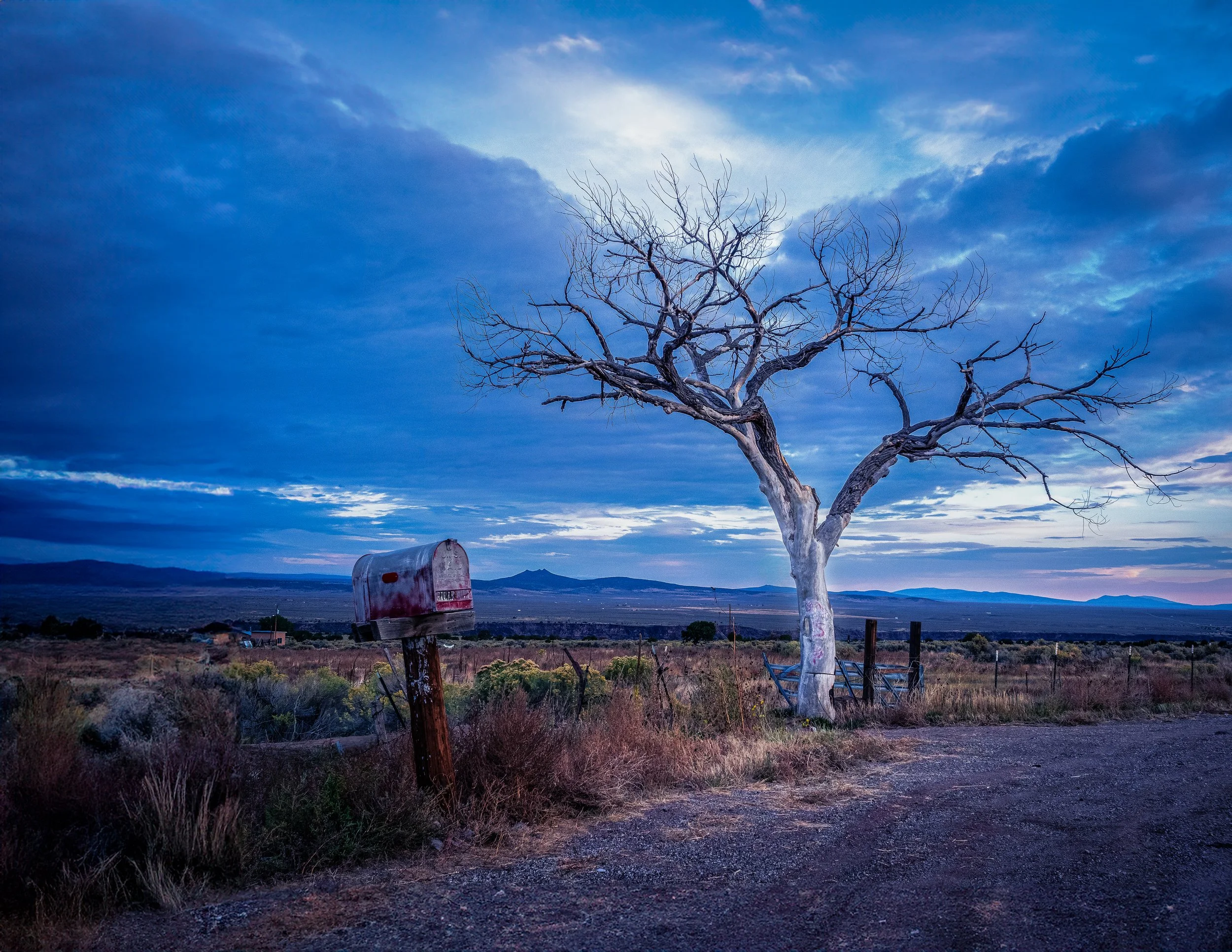
Some trees become the place. Where the Road Pauses is a study of place, memory, and the landmarks that quietly become part of our lives. Photographed near Taos, New Mexico, the image centers on the locally beloved Hello Goodbye Tree, a solitary cottonwood that has greeted travelers entering and leaving the region for generations. Standing beside the road against the vast New Mexico landscape, it serves as both waypoint and symbol, marking the threshold between arrival and departure.
The composition balances the enduring presence of the tree against the openness of the surrounding landscape, emphasizing both its isolation and its significance. Roads pass by, seasons change, and travelers come and go, yet the tree remains — the quiet poetry of a familiar landmark woven into personal and collective memory.
Drawing inspiration from the luminous color sensibilities of Ernst Haas, the contemplative landscapes of Andrew Wyeth, and the cinematic sense of place in the work of Wim Wenders, the image explores belonging, transition, and the emotional connections people form with the landscapes they return to again and again.
Design & Styling
With its open sky, solitary tree, and sense of quiet permanence, Where the Road Pauses brings warmth and a strong sense of place to Southwestern interiors, mountain homes, hospitality spaces, and residences where home, travel, and belonging matter. Its balance of simplicity and symbolism makes a timeless focal point, and a natural gift for anyone connected to Taos.
Curated Pairings
To build a wall around place, travel, and transition, consider these companion pieces:
For a complementary New Mexico statement: Pair with Enduring Silence, to explore two iconic landmarks of the Southwest, each expressing a different sense of permanence and place.
For thematic harmony: Complement the themes of travel and transition with Into the Canyon, creating a visual conversation about roads, journeys, and the landscapes that shape them.
For the same tree, later: Pair with The Last Goodbye, the same cottonwood photographed near Taos before the winds brought it down.
Fine Art Presentation
Available as a signed fine art print on ChromaLuxe® Metal (gloss, semi-gloss, or matte), Glossy Anti-Glare Acrylic (TruLife), canvas, wood, and archival paper (framed or unframed). Canvas is the recommended presentation: its warmth and texture suit the Southwestern palette and the roadside Americana of the subject. ChromaLuxe® Metal is the alternative for the richest color in the sky and landscape, and wood suits an organic subject like a lone tree, where the grain of the print echoes the trunk.
Note: Custom and oversized photographic prints are available. Please contact the studio directly to discuss custom framing, matting, or specialized museum glass options.
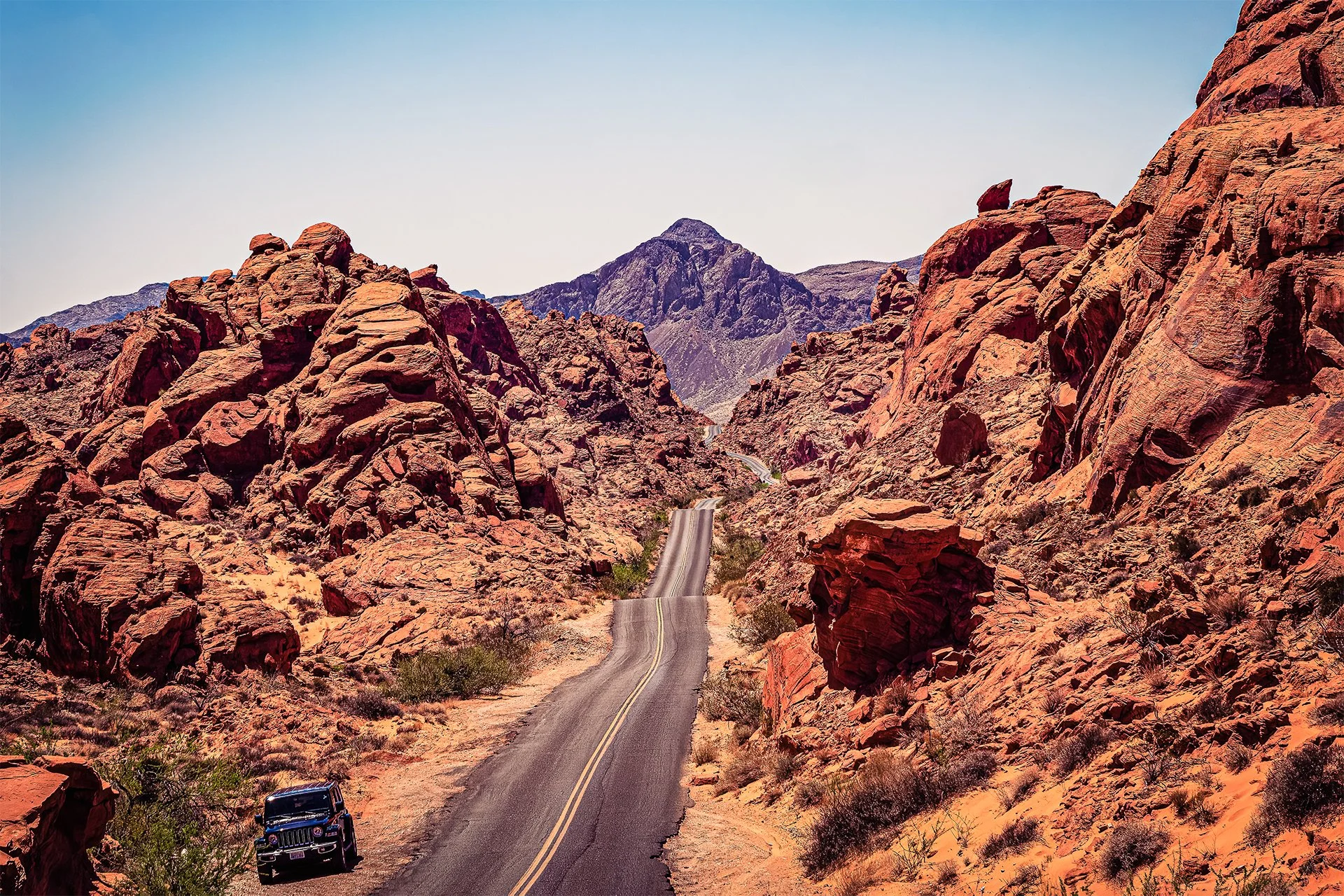
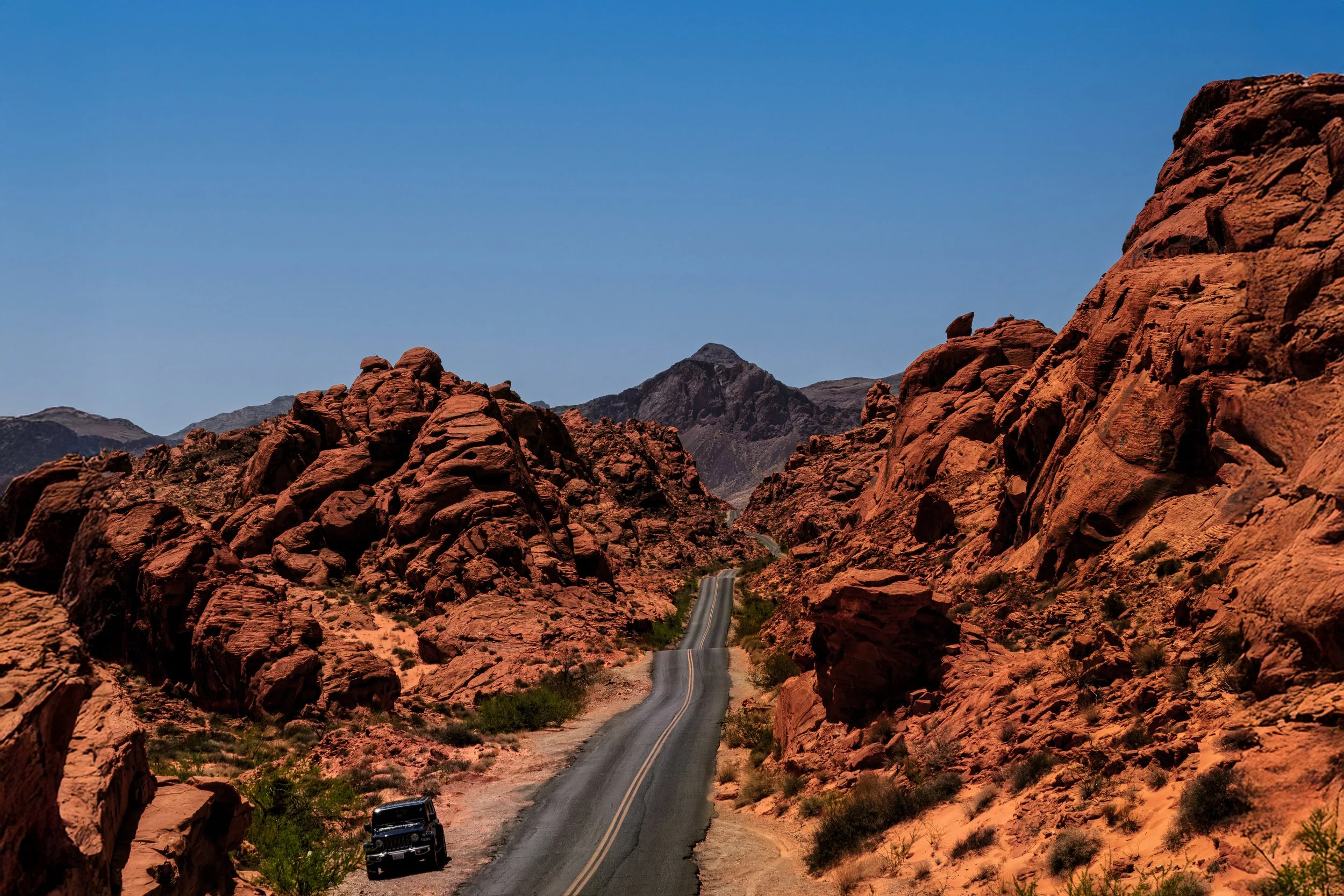
Valley of Fire is a study of exploration, scale, and the enduring relationship between people and the landscape. Photographed in Nevada's Valley of Fire State Park during the final hours of afternoon light, the image captures a lone Jeep moving through a landscape shaped by millions of years of geological forces. Warm sunlight ignites the sandstone formations, revealing layers of color, texture, and form that have made this one of the American Southwest's most extraordinary destinations.
The small vehicle provides a human element within an immense environment, emphasizing both the grandeur of the landscape and the spirit of discovery that draws travelers into remote places. The contrast between the rugged terrain and the solitary Jeep creates a visual narrative about exploration, curiosity, and the desire to experience landscapes larger than ourselves.
Drawing inspiration from the luminous color sensibilities of Ernst Haas, the compositional discipline of Ansel Adams, and the cinematic road imagery of Wim Wenders, Valley of Fire explores themes of adventure, scale, and the timeless allure of the American West. Rather than simply documenting a location, the photograph celebrates the experience of moving through a landscape where light, stone, and distance combine to create something extraordinary.
The result is a photograph that invites viewers to imagine themselves on the journey, surrounded by the colors, textures, and vast horizons of the Southwest desert.
Design & Styling
The lone Jeep in the rich red sandstone of Valley of Fire, Jeep gives a wall warmth and a spirit of exploration for offices, dens, hospitality spaces, and Southwestern homes.
Curated Pairings
To create a cohesive display around Southwest exploration, consider these companion pieces:
For a Southwest statement: Pair with Enduring Silence, contrasting the stillness of Shiprock with the dynamic spirit of exploration in Valley of Fire.
For thematic harmony: Complement with Into the Canyon, a visual conversation about roads, discovery, and the landscapes of the American Southwest.
For the approach: Pair with Before the Desert Opens, a remote road approaching Moab, the same feeling of arrival.
Fine Art Presentation
Available as a signed fine art print on ChromaLuxe® Metal (gloss, semi-gloss, or matte), Glossy Anti-Glare Acrylic (TruLife), canvas, wood, and archival paper (framed or unframed). ChromaLuxe® Metal is the recommended presentation: it holds the vibrant sandstone color, the dramatic texture, and the luminous late light. Acrylic is the alternative for extra depth.
Note: Custom and oversized photographic prints are available. Please contact the studio directly to discuss custom framing, matting, or specialized museum glass options.
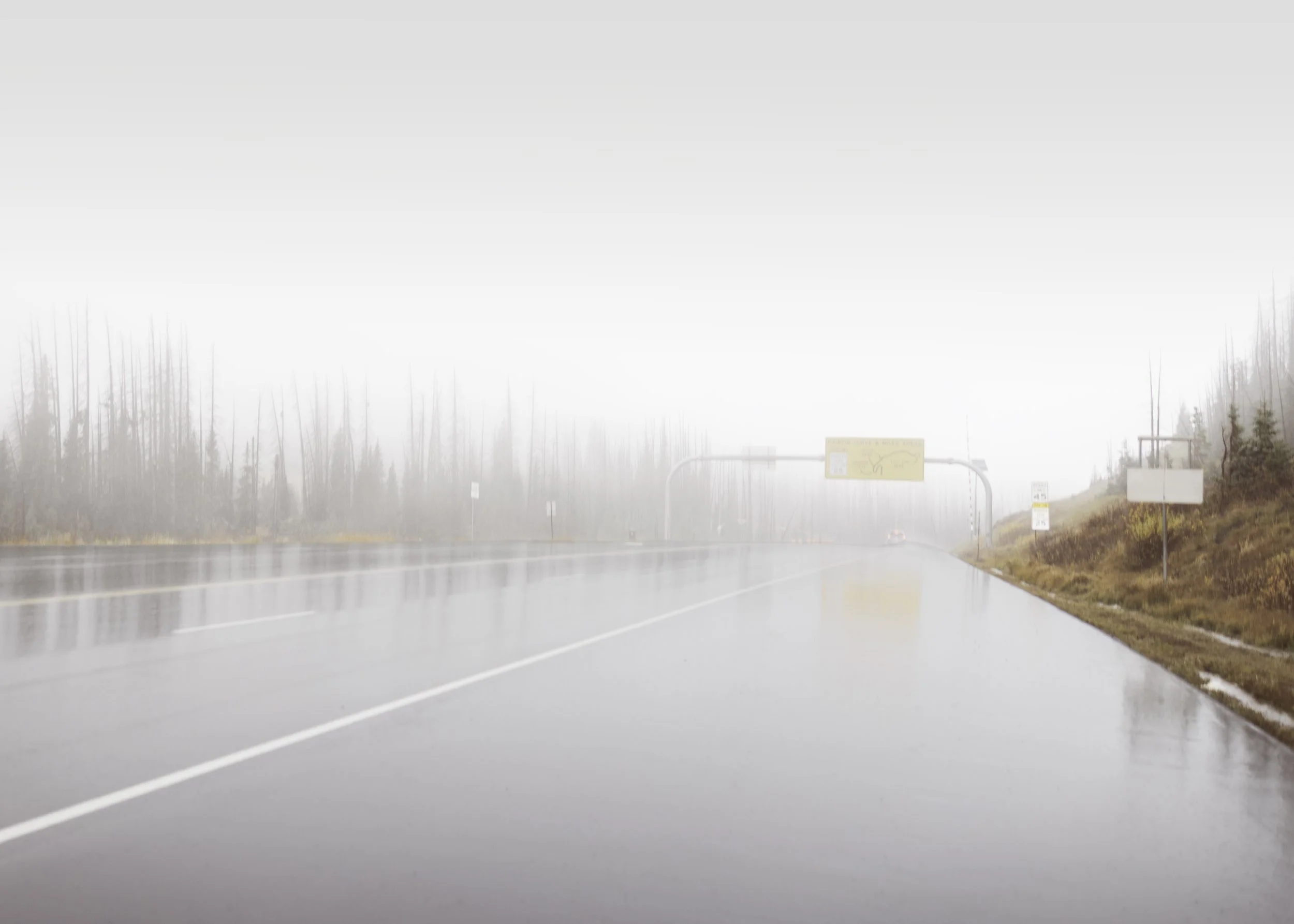
Before the Road Disappears is a study of uncertainty, solitude, and the quiet power of the landscape. Photographed at Wolf Creek Pass in Colorado during a day of low clouds, fog, and fresh snow, the image follows a mountain road as it gradually vanishes into a world of white. The familiar certainty of the roadway gives way to mystery, inviting viewers to imagine what lies beyond the veil of weather and distance.
The photograph embraces the subtle beauty of winter conditions often overlooked in favor of dramatic vistas. Snow softens the landscape, fog dissolves the horizon, and the road becomes a visual metaphor for journeys whose destinations remain unknown. Rather than revealing the landscape in its entirety, the image celebrates what is hidden, allowing atmosphere and suggestion to carry the emotional weight of the scene.
Drawing inspiration from the contemplative minimalism of Hiroshi Sugimoto, the atmospheric landscapes of Michael Kenna, and the quiet emotional resonance of Andrew Wyeth, Before the Road Disappears explores themes of possibility, reflection, and the spaces between certainty and mystery. The restrained palette and simplified forms encourage a slower way of seeing, inviting viewers to engage with the image through feeling as much as observation.
The result is a photograph that speaks to both the physical experience of travel and the broader human experience of moving forward without always knowing what lies ahead.
Design & Styling
With its soft tonal palette, minimalist composition, and atmospheric mood, Before the Road Disappears brings calm, depth, and reflection to a space. The photograph works particularly well in healthcare environments, executive offices, hospitality settings, mountain homes, and contemporary interiors where serenity and visual restraint are valued. Its subtle tones and emotional openness allow it to complement a wide range of architectural styles.
Curated Pairings
To build a wall around weather, stillness, and the road as a journey, consider these companion pieces:
For a complementary atmospheric landscape: Pair with Storm Gate, exploring two very different expressions of weather, uncertainty, and the road as a metaphor for journey.
For thematic harmony: Complement with Where Winter Waited, creating a visual conversation about winter, stillness, and the transformative power of atmosphere.
For the road, made visible: Pair with Curve at Elliot Barker, a silver sedan curling through an S-curve at dusk beneath the Sangre de Cristo Mountains — another mountain road at the edge of weather and light, with the traveler in view.
Fine Art Presentation
Available as a signed fine art print on ChromaLuxe® Metal (gloss, semi-gloss, or matte), Glossy Anti-Glare Acrylic (TruLife), canvas, wood, and archival paper (framed or unframed). Framed archival paper is the recommended presentation: its matte surface keeps the soft tonal gradations of fog and snow smooth and suits the quiet minimalism of Sugimoto and Kenna. ChromaLuxe® Metal is the alternative for a crisper, more luminous white, and canvas adds a softer, more painterly veil.
Note: Custom and oversized photographic prints are available. Please contact the studio directly to discuss custom framing, matting, or specialized museum glass options.
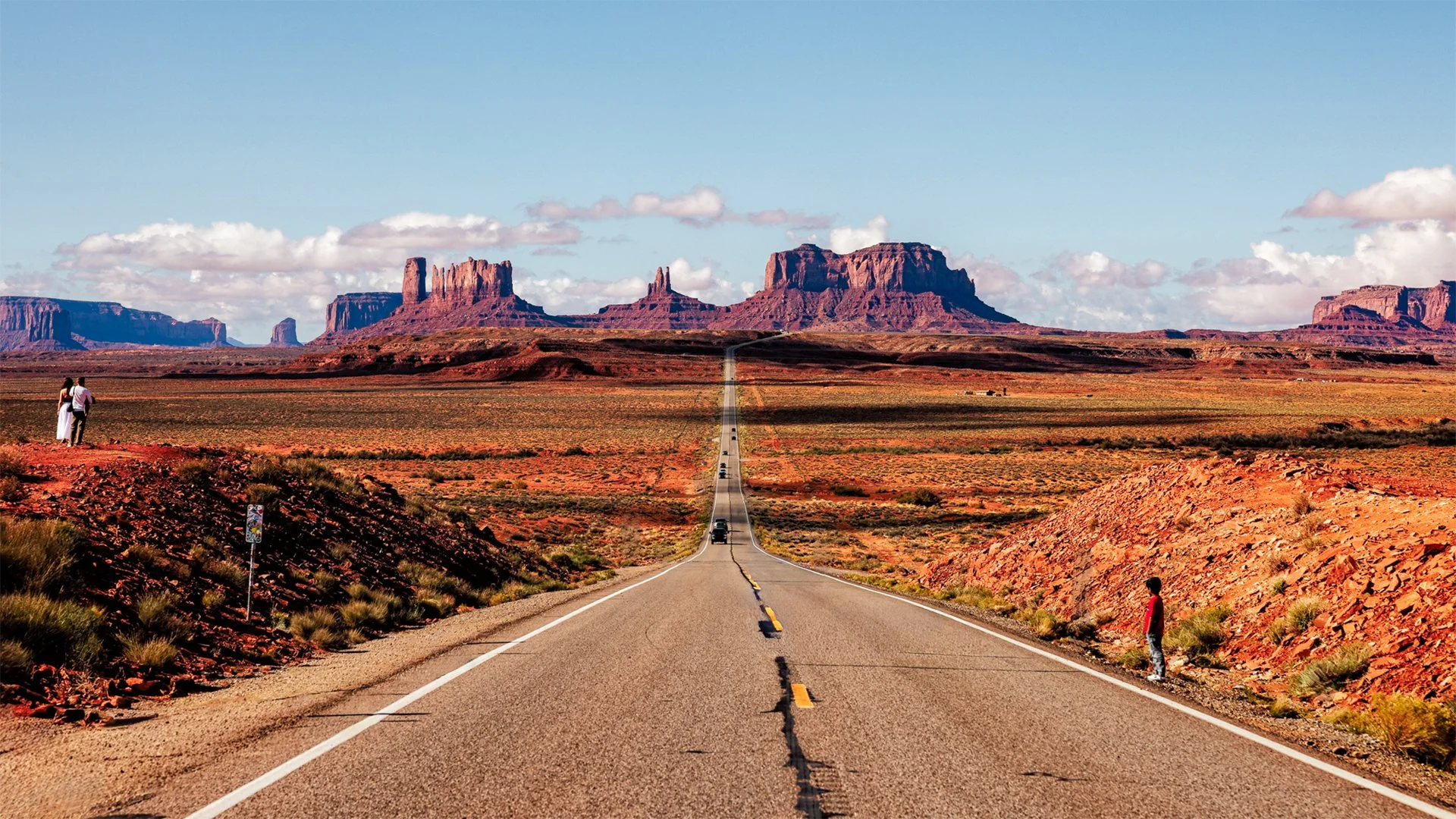
The Long Way West is a study of distance, possibility, and the enduring allure of the open road. Photographed along U.S. Highway 163 approaching Monument Valley, the image captures one of the most recognizable road scenes in the American West. The highway stretches toward the distant sandstone buttes while scattered clouds drift across the desert sky, creating a landscape that feels both immense and inviting.
For generations, this road has symbolized adventure, discovery, and the promise of horizons yet unseen. The composition uses the strong leading lines of the highway to draw the viewer deep into the landscape, where the monumental formations of Monument Valley rise from the desert floor. The scene balances movement and stillness, inviting viewers to imagine themselves traveling toward one of the Southwest's most iconic destinations.
Drawing inspiration from the cinematic landscapes of Wim Wenders, the luminous color sensibilities of Ernst Haas, and the formal clarity of Ansel Adams, The Long Way West explores themes of journey, freedom, and the powerful relationship between road and landscape. Rather than focusing solely on the destination, the photograph celebrates the experience of travel itself and the enduring fascination of the American road.
The result is a photograph that captures both a specific place and a universal feeling—the anticipation that accompanies every journey into the unknown.
Short Description
The iconic highway leading into Monument Valley captures the timeless spirit of exploration, distance, and the American West.
Design & Styling
The highway leading toward Monument Valley's distant buttes gives a wall energy and optimism for offices, hospitality spaces, and Southwestern homes. Its classic Southwestern sky suits large formats.
Curated Pairings
To create a cohesive display around the road to Monument Valley, consider these companion pieces:
For a Southwest statement: Pair with Where the Road Pauses, contrasting the iconic highway of Monument Valley with the beloved roadside landmark near Taos, New Mexico.
For thematic harmony: Complement with Into the Canyon, a visual conversation about roads, discovery, and the landscapes that define the American Southwest.
For the panoramic version: Pair with The Long Way West (Panorama), the same highway in a wide panoramic format.
Fine Art Presentation
Available as a signed fine art print on ChromaLuxe® Metal (gloss, semi-gloss, or matte), Glossy Anti-Glare Acrylic (TruLife), canvas, wood, and archival paper (framed or unframed). ChromaLuxe® Metal is the recommended presentation: it holds the desert color, the dramatic clouds, and the sweep of the road. Acrylic is the alternative for extra depth.
Note: Custom and oversized photographic prints are available. Please contact the studio directly to discuss custom framing, matting, or specialized museum glass options.
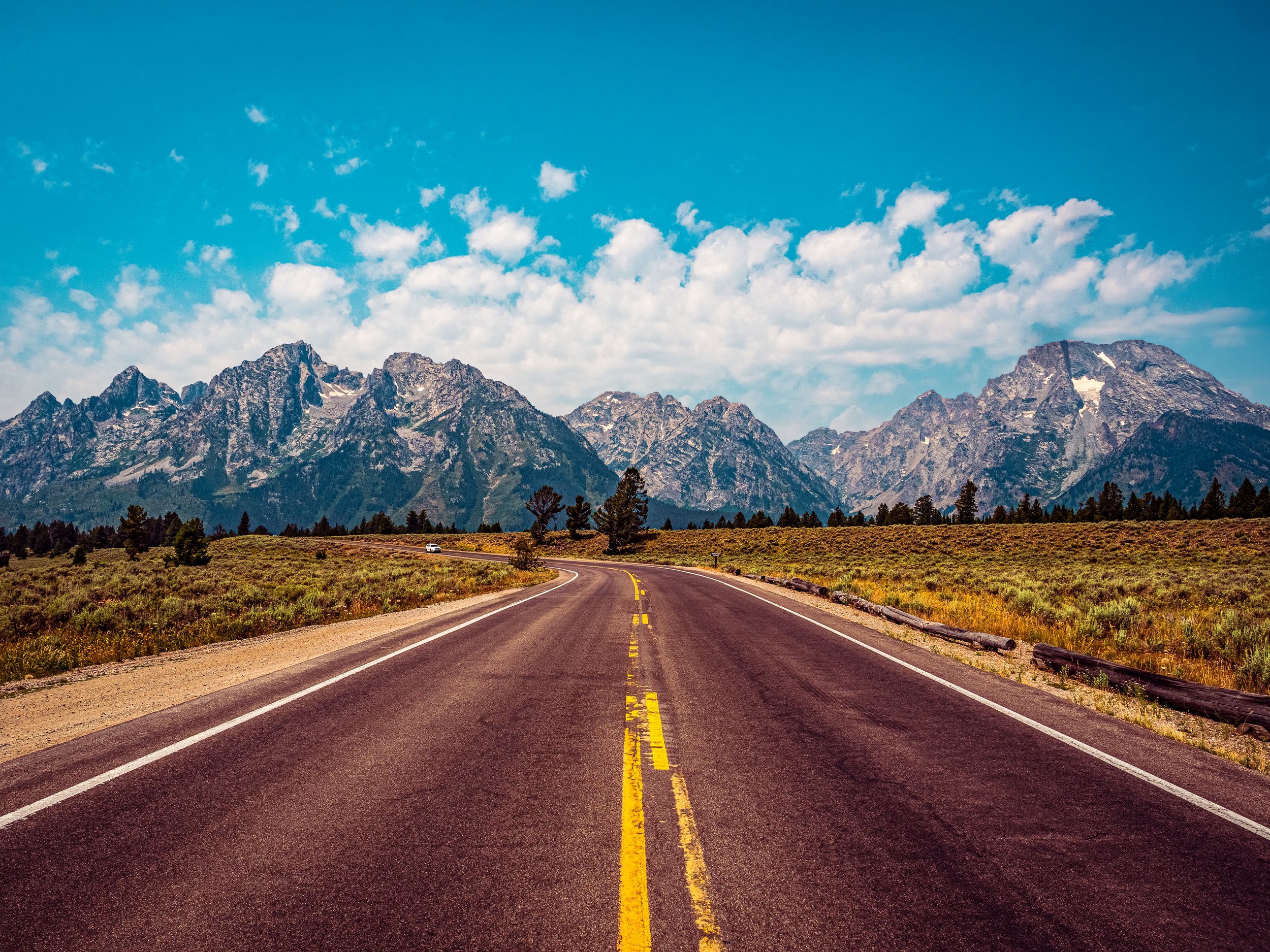
Where the Valley Beckons is a study of invitation, scale, and the enduring promise of the open landscape. Photographed in Grand Teton National Park, Wyoming, the image follows a highway as it leads toward the dramatic peaks of the Teton Range. The road becomes a visual pathway into the valley, drawing the eye toward mountains that have inspired travelers, artists, and explorers for generations.
The composition balances the strong geometry of the roadway against the natural grandeur of the Tetons. The distant mountains rise beyond the valley floor with a commanding presence, while the road offers a sense of movement and possibility. Together they create a landscape that feels both expansive and deeply personal, inviting viewers to imagine themselves traveling toward the horizon.
Drawing inspiration from the luminous color sensibilities of Ernst Haas, the formal structure of Ansel Adams, and the cinematic road imagery of Wim Wenders, Where the Valley Beckons explores themes of journey, discovery, and the powerful connection between landscape and imagination. The photograph celebrates not only a destination, but the anticipation that comes from seeing a remarkable place emerge in the distance.
The result is a photograph that captures both the grandeur of the American West and the timeless feeling of being called toward something beyond the next mile.
Short Description
A highway leads toward the majestic Teton Range in Wyoming, capturing the spirit of exploration, possibility, and the enduring beauty of the American West.
Design & Styling
The highway leading toward the Teton peaks in Where the Valley Beckons brings depth and optimism to offices, hospitality spaces, lodges, and mountain homes. It suits large walls.
Curated Pairings
To create a cohesive display around the Grand Tetons and the open road, consider these companion pieces:
For a complementary Teton landscape: Pair with Between Us, the Field, two distinct expressions of the Grand Teton landscape, one intimate and one expansive.
For thematic harmony: Complement with The Long Way West 3:2, a visual conversation between two of the most iconic roads in the American West.
For the open road: Pair with Beyond the Next Bend, a highway toward distant mesas and an expansive horizon.
Fine Art Presentation
Available as a signed fine art print on ChromaLuxe® Metal (gloss, semi-gloss, or matte), Glossy Anti-Glare Acrylic (TruLife), canvas, wood, and archival paper (framed or unframed). ChromaLuxe® Metal is the recommended presentation: it holds the mountain detail, the expansive sky, and the depth of the landscape. Acrylic is the alternative for extra depth.
Note: Custom and oversized photographic prints are available. Please contact the studio directly to discuss custom framing, matting, or specialized museum glass options.
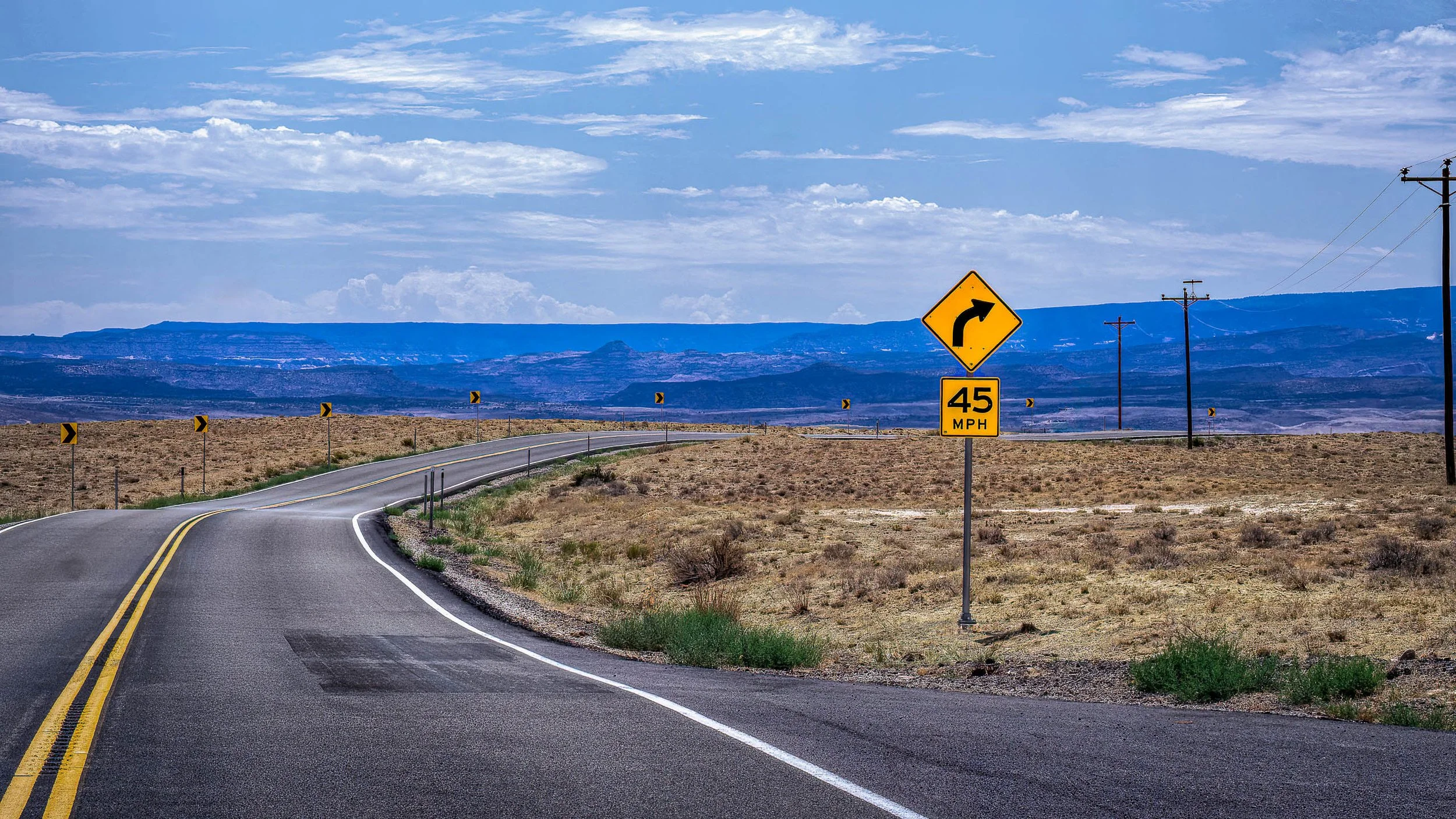
Beyond the Next Bend is a study of anticipation, distance, and the enduring promise of the open road. Photographed in the high desert of the American West, the image follows a winding highway as it disappears toward distant mesas and an expansive horizon. A solitary curve sign stands beside the roadway, quietly signaling a change in direction while inviting viewers to imagine what lies beyond the visible landscape.
The composition is built around movement and discovery. The sweeping line of the road enters the frame in the foreground before bending toward a destination that remains hidden from view. Repeating curve markers echo the road's progression through the landscape, while layers of distant ridges and open sky create a powerful sense of scale. Rather than documenting a specific location, the photograph explores the universal experience of travel—the moment when the journey ahead becomes more compelling than the place left behind.
Drawing inspiration from the cinematic road imagery of Wim Wenders, the atmospheric color traditions of Ernst Haas, and the expansive landscapes of the American West, Beyond the Next Bend reflects themes of exploration, possibility, and curiosity. The image celebrates the simple but enduring question that accompanies every journey: what waits just beyond the horizon?
Design & Styling
The winding highway and the lone curve sign of Beyond the Next Bend bring expansion and anticipation to executive offices, hospitality lobbies, and homes with room for a big wall. It suits large formats.
Curated Pairings
To create a cohesive display around the open road, consider these companion pieces:
For a compelling road narrative: Pair with The Long Way West (Panorama), with Before the Road Disappears, a visual progression across the landscapes of the American West.
For a journey through the West: Combine with Before the Desert Opens, with Where the Valley Beckons, linking anticipation, movement, and distant destinations.
For travel and discovery: Pair with Storm Gate, linking weather, distance, and the experience of moving through the landscape.
Fine Art Presentation
Available as a signed fine art print on ChromaLuxe® Metal (gloss, semi-gloss, or matte), Glossy Anti-Glare Acrylic (TruLife), canvas, wood, and archival paper (framed or unframed). ChromaLuxe® Metal is the recommended presentation: it holds the expansive sky, the subtle desert tones, and the depth of the landscape. Acrylic is the alternative for extra depth.
Note: Custom and oversized photographic prints are available. Please contact the studio directly to discuss custom framing, matting, or specialized museum glass options.
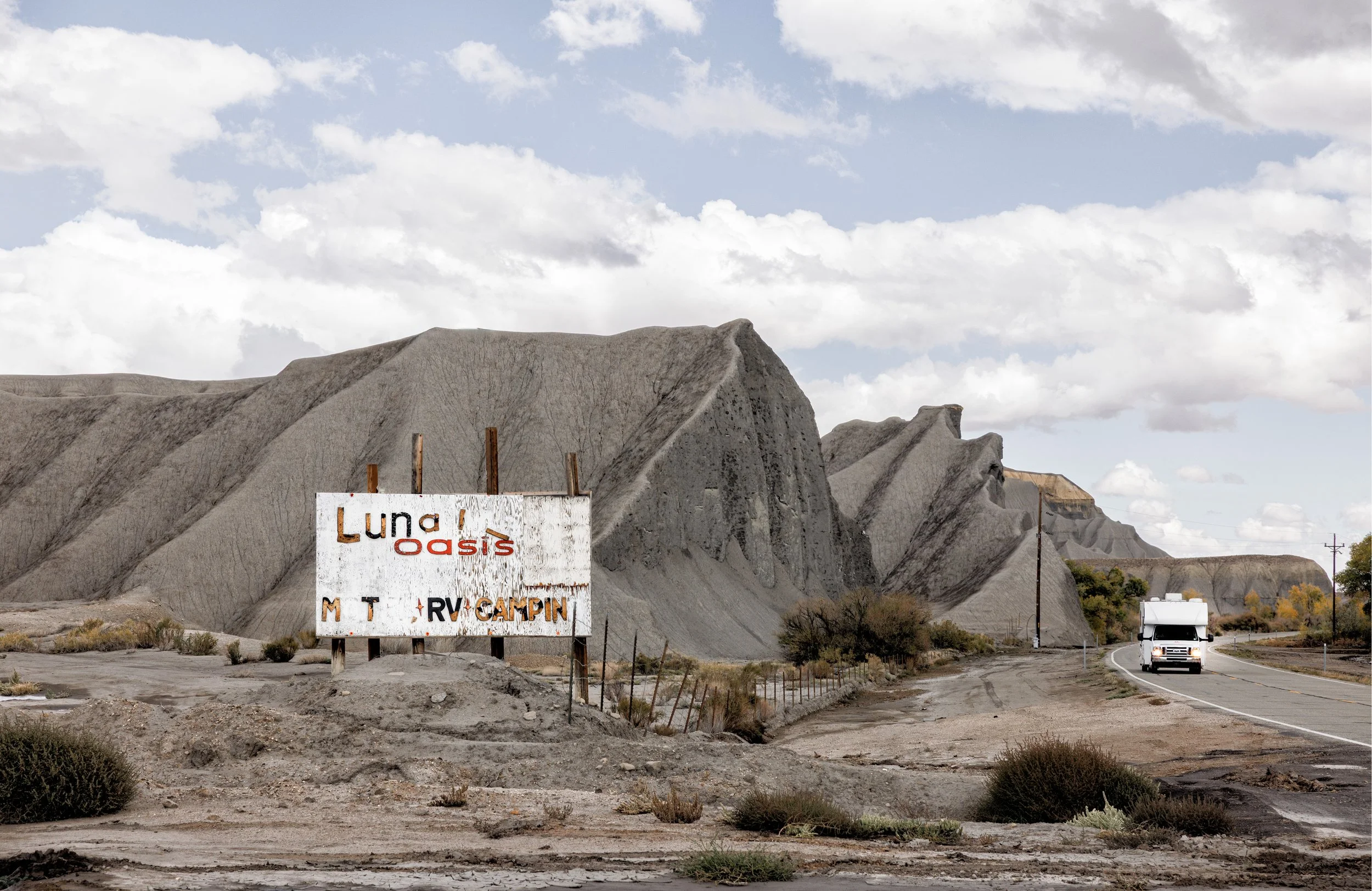
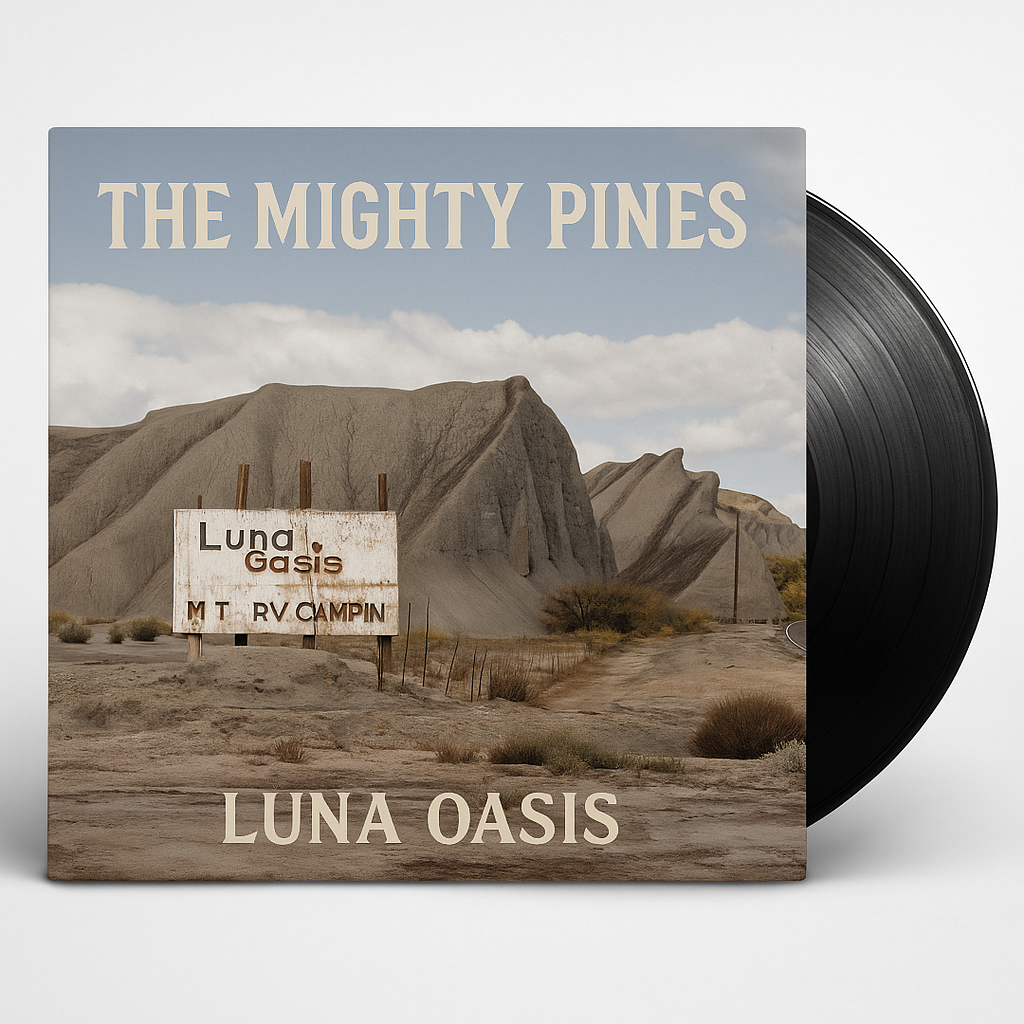
Originally Luna Oasis was a proposed album cover for The Mighty Pines, sadly, they haven’t yet used it, yet. You can purchase the original image!
Luna Oasis is a study of passage, memory, and the traces people leave behind in the landscape. Photographed near Capitol Reef National Park, Utah, the image captures a fleeting moment as a camper travels along a quiet desert road past the weathered sign of the former Luna Oasis campground. The scene combines movement and stillness, present and past, creating a narrative that feels distinctly Western and deeply American.
The abandoned sign stands as a remnant of another era, while the passing camper suggests the continuing rhythm of travel through the desert Southwest. Together, they create a visual conversation between what remains and what moves on. Drawing inspiration from the cinematic road imagery of Wim Wenders and the color sensibilities of Ernst Haas, Luna Oasis explores themes of discovery, impermanence, and the enduring allure of the open road.
Rather than focusing solely on landscape, the photograph embraces the human presence woven into the Southwest. The image invites viewers to imagine the travelers who once stopped here, the stories carried across these roads, and the quiet beauty found in places that persist long after their original purpose has faded.
Design & Styling
With its warm desert palette, narrative content, and sense of movement, Luna Oasis is particularly well suited for hospitality environments, travel-inspired interiors, executive offices, residential spaces, and collectors drawn to Americana and road-trip imagery. The photograph adds character and story while maintaining a strong connection to place and landscape.
Curated Pairings
To create a cohesive gallery wall, consider these three Southwestern companions that share themes of travel, distance, and discovery:
For a complementary focal point: Pair with The Long Way West to continue the visual narrative of journeys through the vast landscapes of the American Southwest.
For tonal harmony: Complement the roadside atmosphere of this piece with Into the Canyon, which similarly explores the relationship between road, landscape, and destination.
For another vehicle in the desert: Pair with Valley of Fire, Jeep, a lone Jeep moving through sandstone in the last hours of afternoon light.
Fine Art Presentation
Available as a signed fine art print in ChromaLuxe® Metal (gloss, semi-gloss, or matte), framed paper, framed canvas, and acrylic presentation formats. For this image, ChromaLuxe® Metal is highly recommended, preserving the rich desert colors and maintaining excellent detail throughout the scene. Framed fine art paper is also an excellent choice, emphasizing the photograph's documentary and cinematic qualities.
Note: Custom and oversized photographic prints are available. Please contact the studio directly to discuss custom framing, matting, or specialized museum glass options.
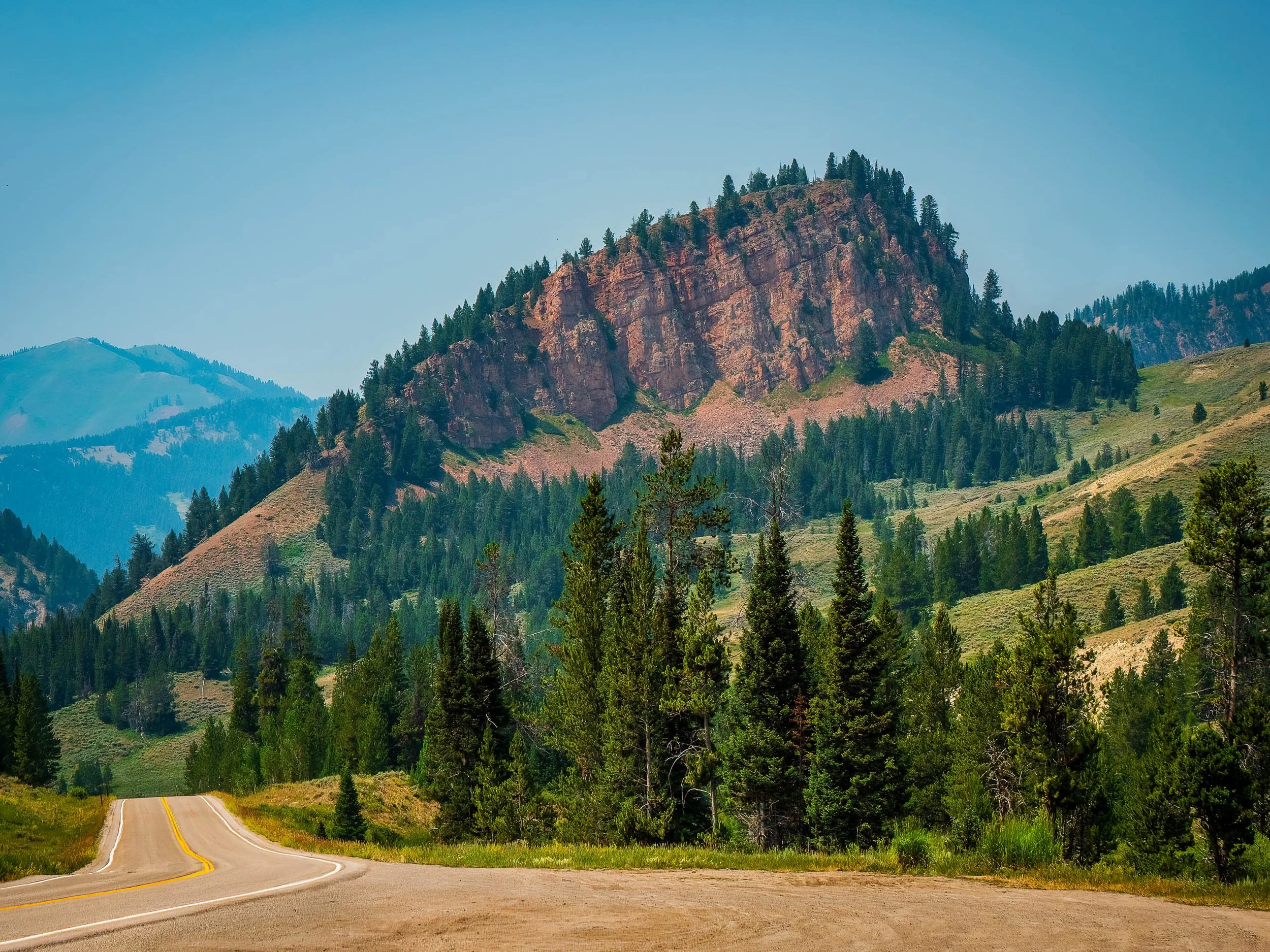
The road curves west, and the country opens up ahead of it — a red-rock sentinel rising from a shoulder of pine and sage, the kind of landmark that tells a traveler they've arrived somewhere worth slowing down for. This is the approach into Yellowstone, captured not at the gate but on the drive in, where the anticipation of the park is already written into the landscape.
The composition leads with the double-yellow line, curving from the lower left and drawing the eye up through a stand of dark conifers before delivering it to the cliff face — sunlit, weathered, ancient against a hazy summer sky. The road doesn't dominate the frame; it simply does its job, offering scale and a sense of forward motion, while the rock formation holds the visual weight as the true subject.
This image sits comfortably in the lineage of the American road photograph — the open highway as both subject and metaphor, in the tradition of Wenders' meditations on landscape and journey. But where that tradition often empties the frame entirely, this piece keeps one foot in classical Western landscape work, closer to Adams in its treatment of geologic form: the cliff face is rendered with real tonal structure, not simply documented.
Design & Styling
This piece works well in spaces built around a sense of journey or destination — a mountain home entryway, a lodge-style living room, or an office for someone whose work or heart lives in the West. The warm rust tones in the rock play well against natural wood interiors, while the cool distant ridgeline and clear sky give it enough range to sit comfortably in a more neutral, contemporary palette as well. Well suited to hospitality settings — lodges, cabins, and mountain-town business interiors — where guests are drawn to a sense of place.
Curated Pairings
To build a wall around the roads, ranges and open country of the American West, consider these companion pieces:
For a tonal counterpoint: Pair with The Long Way Home, a single figure in snow in black-and-white.
For the next range north: Complement with The Notch at Jenny Lake, the gap between Teewinot and the Cathedral Group, framed by pine.
For big-country scale: Add The Bend of Silence, the Bighorn River turning through layered canyon walls on the Wyoming–Montana border.
For a line that leads the eye: Round out the wall with Elliot Barker Trail, where trail, fence and cleared understory converge.
Fine Art Presentation
ChromaLuxe® Metal (gloss, semi-gloss, or matte) in semi-gloss is the strongest choice for this image — it holds the tonal detail in the sky and rock without inviting glare across the frame's large open sky area, while still delivering the luminosity that makes the red rock glow. Framed and unframed paper prints on archival paper offer a softer, more atmospheric alternative, well suited to interiors wanting a quieter, more painterly presentation. TruLife Acrylic adds dimensionality for a more contemporary space.
Note: Custom and oversized photographic prints are available. Please contact the studio directly to discuss custom framing, matting, or specialized museum glass options.
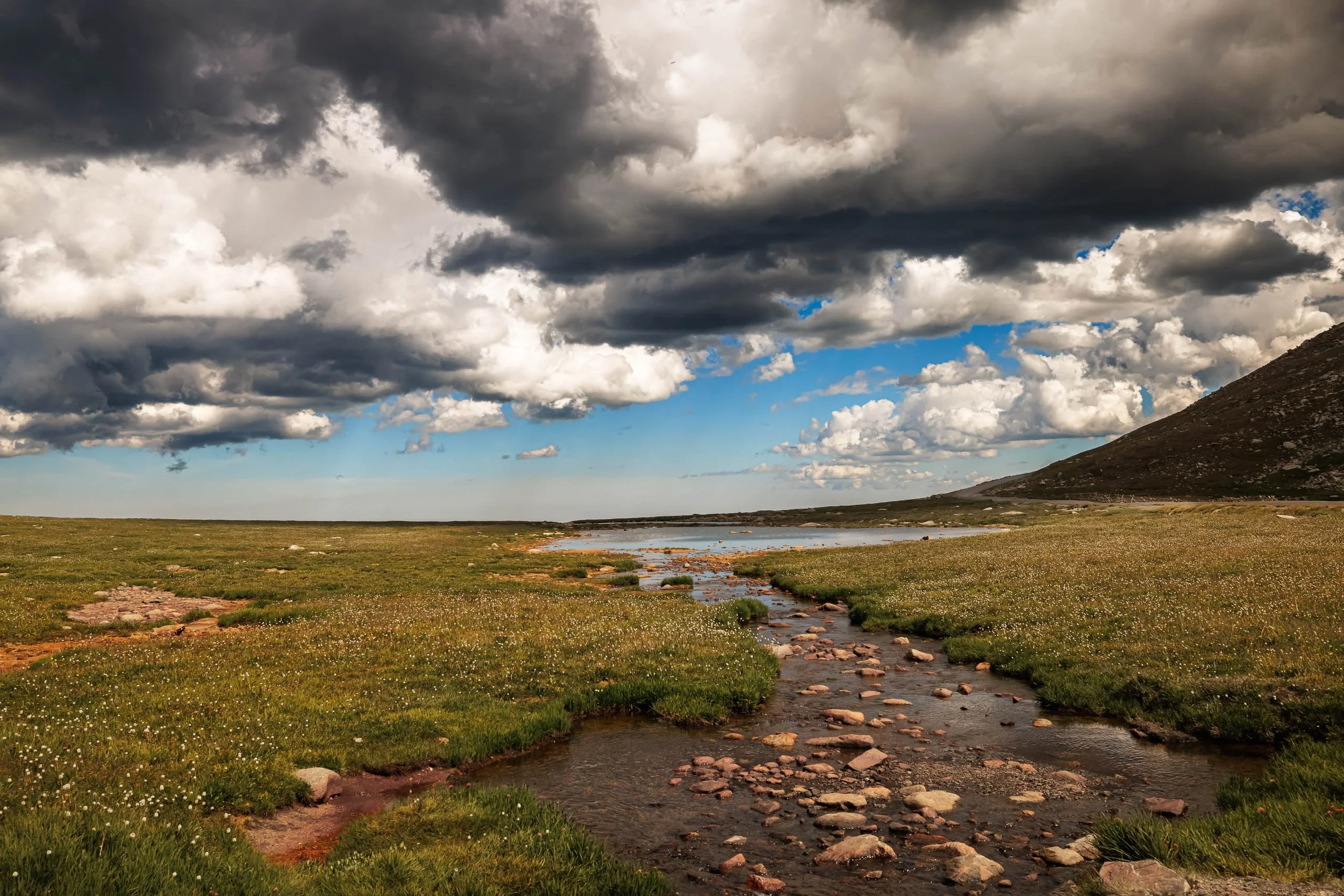
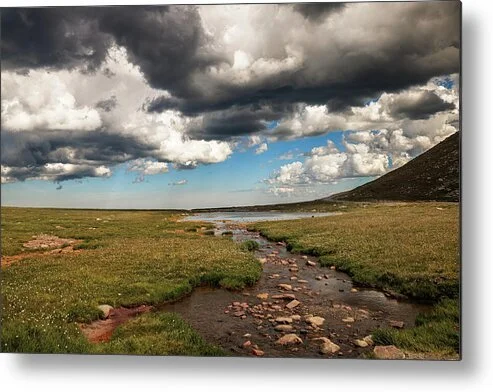
Every hiker above treeline knows the moment the sky changes its mind. When the Weather Turns holds that moment on the high tundra of Mount Blue Sky, Colorado, near 13,000 feet, where a dark storm front builds over a pale mountain lake and the light along the ground has not yet gone.
A rust-stained stream enters at the lower right and winds through the foreground rocks toward the lake, and the eye follows it before it climbs into the clouds. The storm presses down from the upper left, heavy and slate-dark, while white cumulus and a cut of clean blue hold the middle of the frame. Warm side light still lies on the tundra, and pinpoint white flowers speckle the grass. On the right-hand slope, a thin pale line is the highway that climbs toward the summit, the one human mark in the picture and easy to miss until the second look.
This is weather photography in the clearing-storm tradition of Ansel Adams, with some of the warm, close palette of Eliot Porter. It is for people who have stood where the ground is soft, the air is thin, and the forecast has just stopped being a suggestion.
Design & Styling
The dark upper third and warm lower field suit a mountain lodge lobby, a ski-town restaurant or a resort suite, and design-forward homes with walnut, stone or leather. It also fits a hiker's study or a cabin great room, where the view is one the owner has earned. A horizontal print works above a long console, fireplace or sofa.
Curated Pairings
For shared concept: Pair with A Shadow's Passing, where a passing cloud drags its shadow across a Colorado alpine meadow. Both show weather moving over high ground, one at the moment of arrival and one in passing.
For shared place type: Pair with Where the Lake Curves, a Colorado high-country lake whose shoreline curve leads the eye the way the stream does here. The lake is still and clear, where this storm is not.
For shared subject: Pair with Luna Oasis, another western road crossing open landscape with one small human trace, here a desert road and a vanished campground sign.
For deliberate contrast: Pair with The Shape of Distance, a procession of clouds over the eastern Colorado plains with no drama in the weather at all. It is the quiet counterpart to a mountain sky in motion.
Fine Art Presentation
Available as a signed, numbered limited edition print (edition of 15) in Gallery Metal, ChromaLuxe® Metal (Gloss, Semi-Gloss and Matte), TruLife Acrylic, archival paper, canvas and wood. ChromaLuxe® Metal is the first recommendation, since it keeps the contrast between the slate-dark cloud base and the clean blue crisp and gives the warm tundra real saturation. TruLife (Low-Glare) Acrylic adds depth to the dark cloud mass. Archival paper, framed, suits a more traditional presentation of the storm's tonal range.
Note: Custom and oversized photographic prints are available. Please contact the studio directly to discuss custom framing, matting, or specialized museum glass options.
Roads Through the West
Roads Through the West
Filters

No results found
No results match your search. Try removing a few filters.
Have Questions?
To accommodate grand residential or corporate spaces, larger scale photographic prints and custom dimensions are available upon request.
For collectors seeking ready-to-hang presentations, we welcome the opportunity to collaborate on custom framing, museum-quality matting, and specialized glass selections tailored to your unique aesthetic.
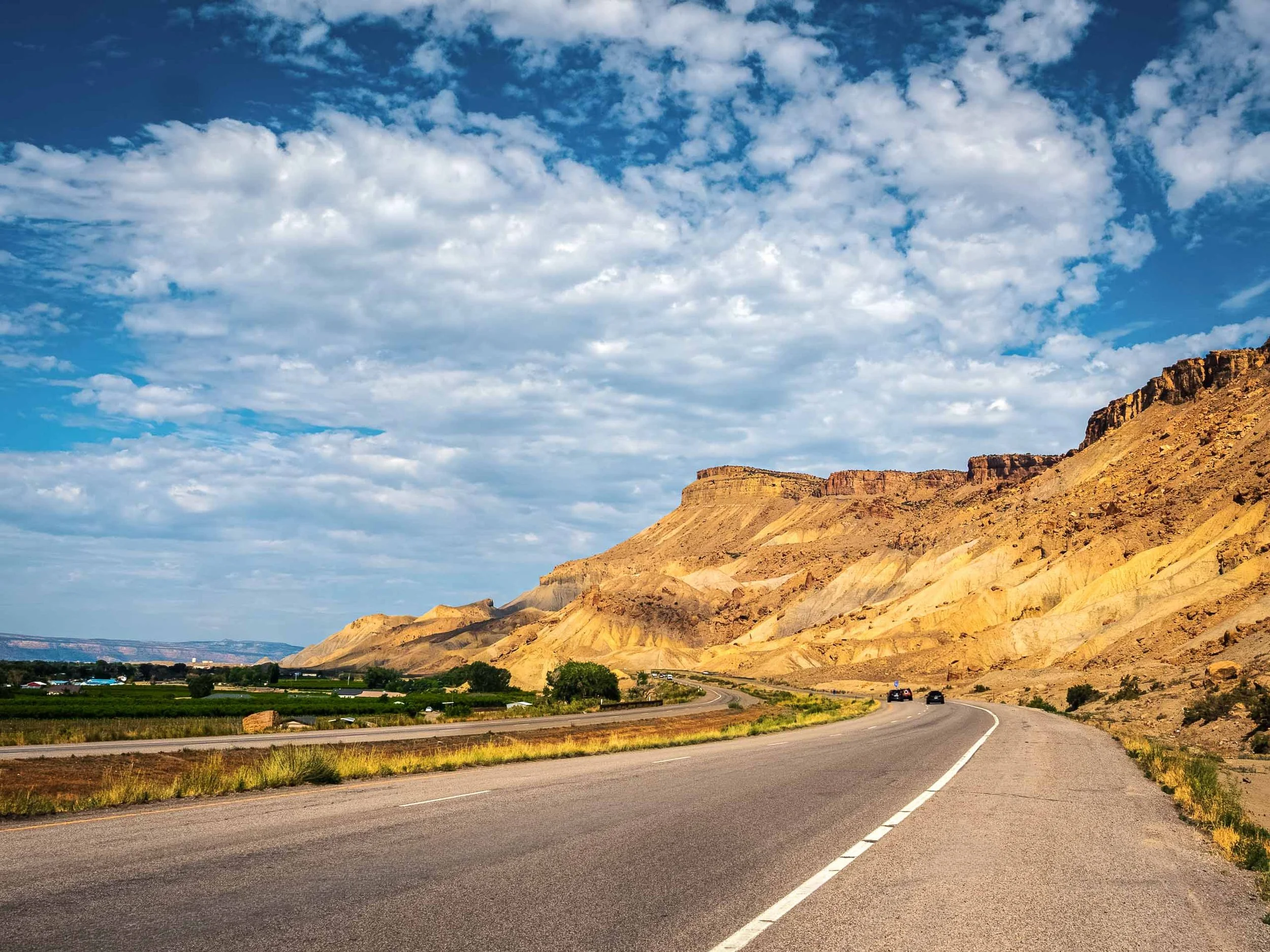
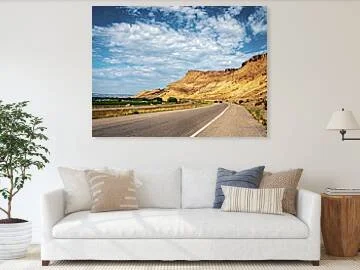
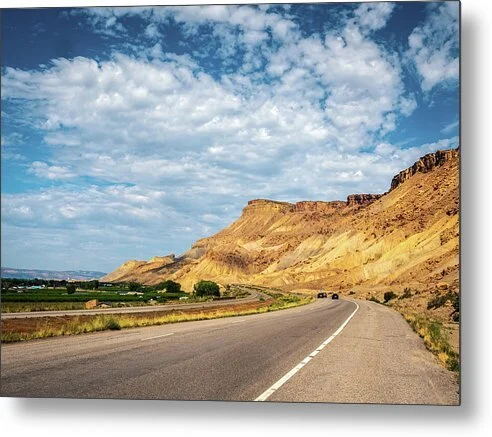
A Western highway curves through a working valley, green orchards and farmland stretched out to the left, a towering sandstone mesa rising abruptly on the right. Two cars move ahead on the road, small against the scale of the formation looming over them — a quiet reminder of how casually the American West's most dramatic geology sits alongside everyday travel.
The composition leans fully into the road as leading line: dashed white center markings and a solid yellow edge line both pull the eye forward and right, directly toward the mesa's layered, sun-struck face. A wide, cloud-filled sky takes up more than half the frame, giving the whole scene room to breathe and letting the formation's scale register fully against it. This is classic American road photography — the journey and the destination held in the same frame, without needing to choose between them.
Design & Styling
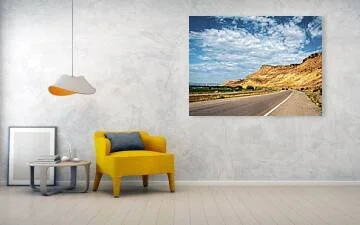
The warm sandstone tones and wide, dynamic sky make this piece a strong fit for offices, travel-themed spaces, and any interior where a sense of open road and Western landscape belongs. It reads well at large scale, where the mesa's scale and the highway's sweep both have room to register.
Curated Pairings
For direct collection continuity — "The Long Way West", another highway-and-iconic-formation composition in the same collection.
For curving road continuity — "Beyond the Next Bend", sharing this piece's interest in a curving highway pulling the eye toward the landscape ahead.
For red rock and road continuity — "Approach to Yellowstone", another road composition set against dramatic red rock cliffs.
Fine Art Presentation
Given the wide dynamic range between the bright sky and the sunlit mesa face, this piece is especially well suited to ChromaLuxe® Metal (gloss, semi-gloss, or matte) print, which will hold the tonal separation cleanly, or an archival paper print for a softer, more traditional landscape presentation. Framed and unframed options available on request.