
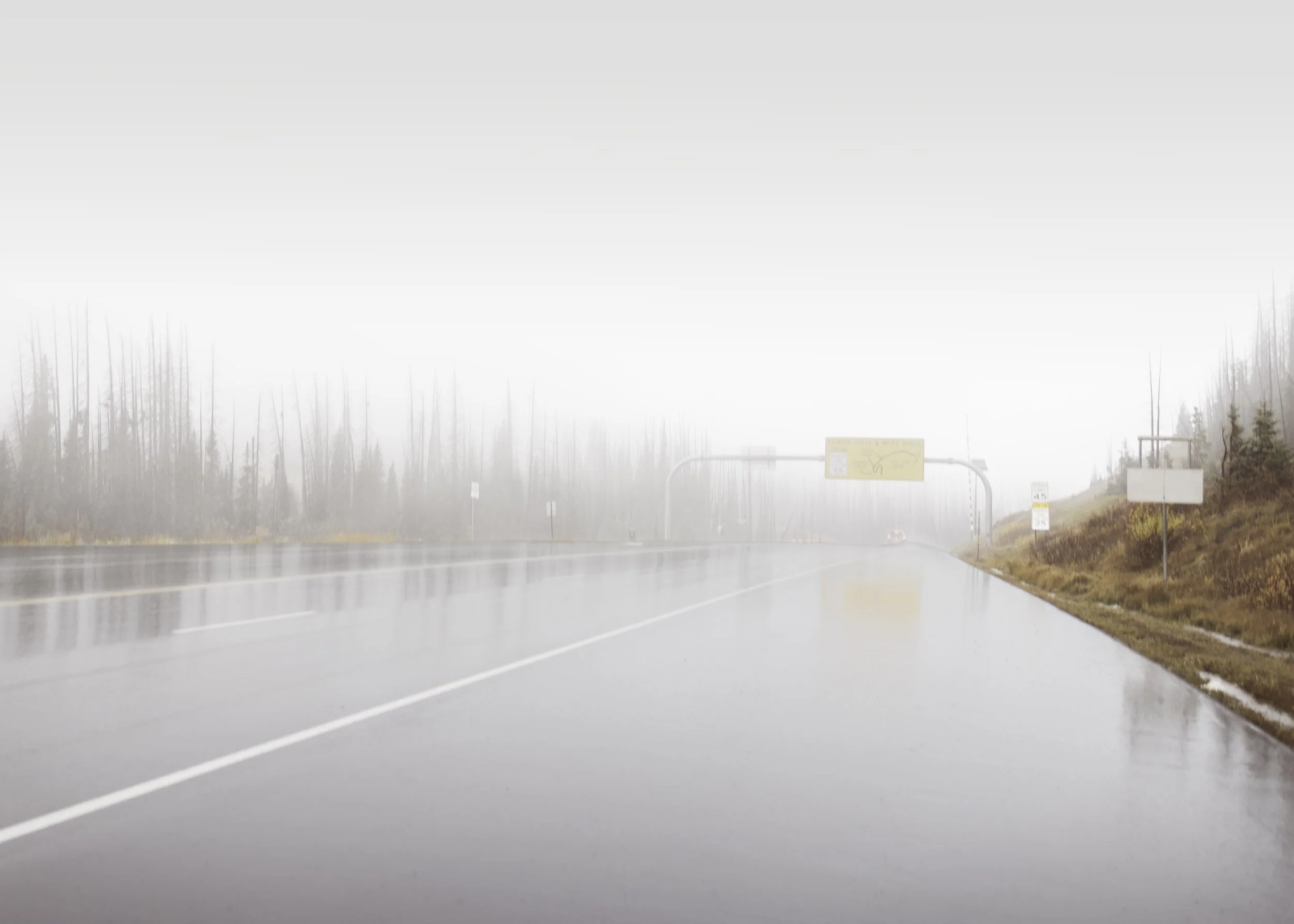
Shadows & Silence
Shadows & Silence: Monochrome Landscape & Urban Photography
Some photographs are less about what is seen and more about what is felt.
The images in this collection explore quiet places, subdued light, and moments of stillness where atmosphere becomes the subject.
They are photographs shaped by shadow, weather, solitude, and the subtle emotional character of a scene.
A Closer Look
Explore the finer details of each photograph by hovering over an image to reveal subtle focus and texture, or click to expand the work into a distraction-free viewing environment. This immersive view allows each study of Shadows & Silence to be experienced at its full scale and proportion.
Search for a specific photograph, series, or browse the curated collections. Looking for a particular format? Search by Square or 1:1, Landscape or 3:2, or Panorama or 16:9.
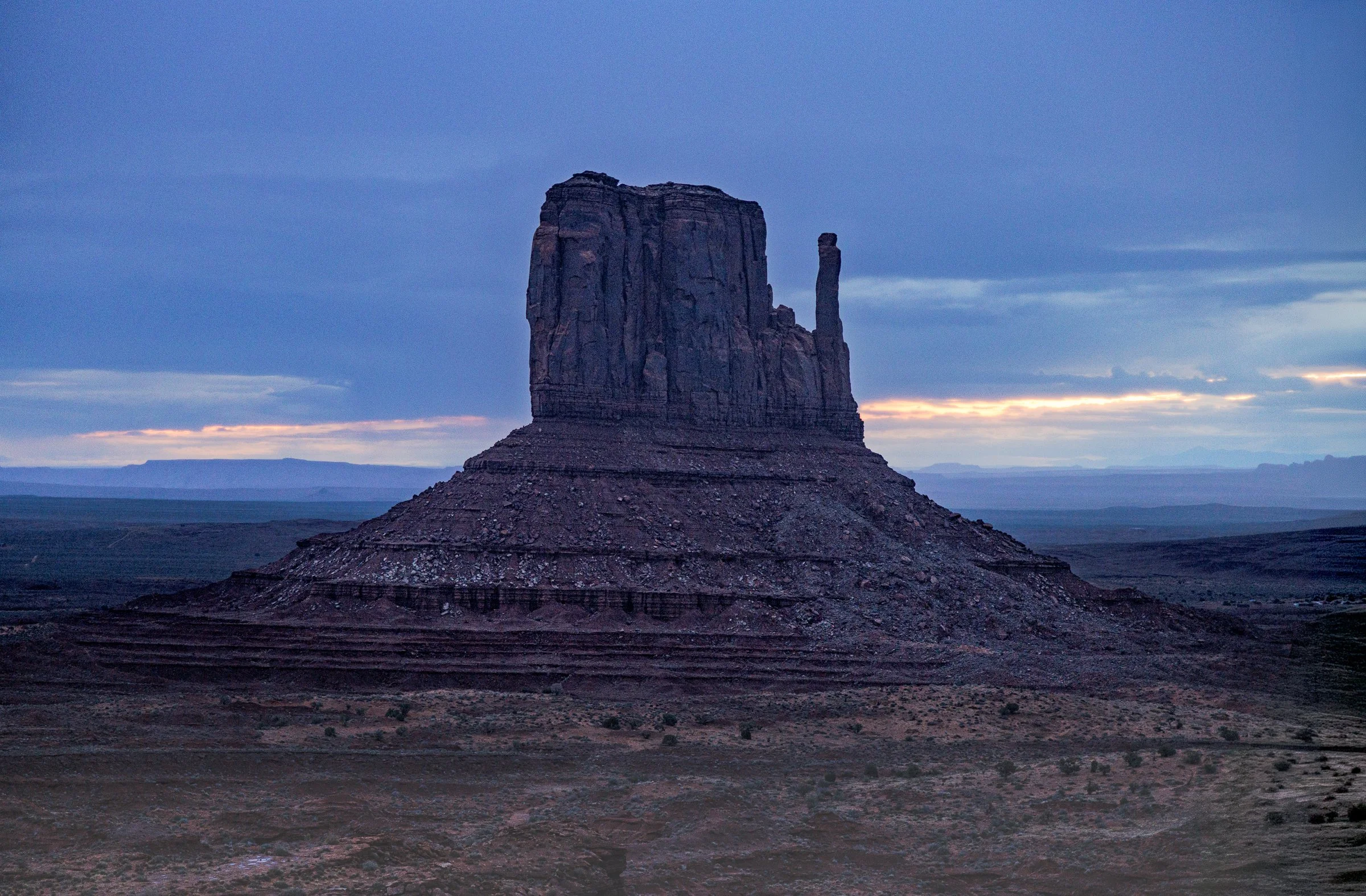
“The quieter you become, the more you are able to hear.”
Created in landscapes, historic sites, churches, cemeteries, rural roads, and urban environments across North America and Europe, these images focus on the spaces between activity and absence. Empty rooms, weathered structures, fading light, quiet roads, and solitary forms become opportunities to explore memory, contemplation, and the passage of time. Rather than seeking dramatic events, the photographs embrace restraint, inviting viewers to slow down and engage with the quieter details that often go unnoticed.
Light plays a central role throughout the collection. Early morning fog, overcast skies, twilight, snowfall, and deep shadows shape the emotional tone of each image. The resulting photographs often occupy the space between documentary observation and personal interpretation, where atmosphere carries as much meaning as the subject itself.
Influenced by the quiet realism of Andrew Wyeth, the contemplative landscapes of Michael Kenna, and the cinematic solitude found in the work of Wim Wenders, these photographs explore themes of memory, absence, resilience, and reflection. They are images about places, but they are equally about the emotions those places evoke.
Designed for collectors, healthcare environments, hospitality spaces, offices, and residential interiors, these photographs bring a sense of calm, introspection, and visual stillness while encouraging viewers to pause and linger within the scene.
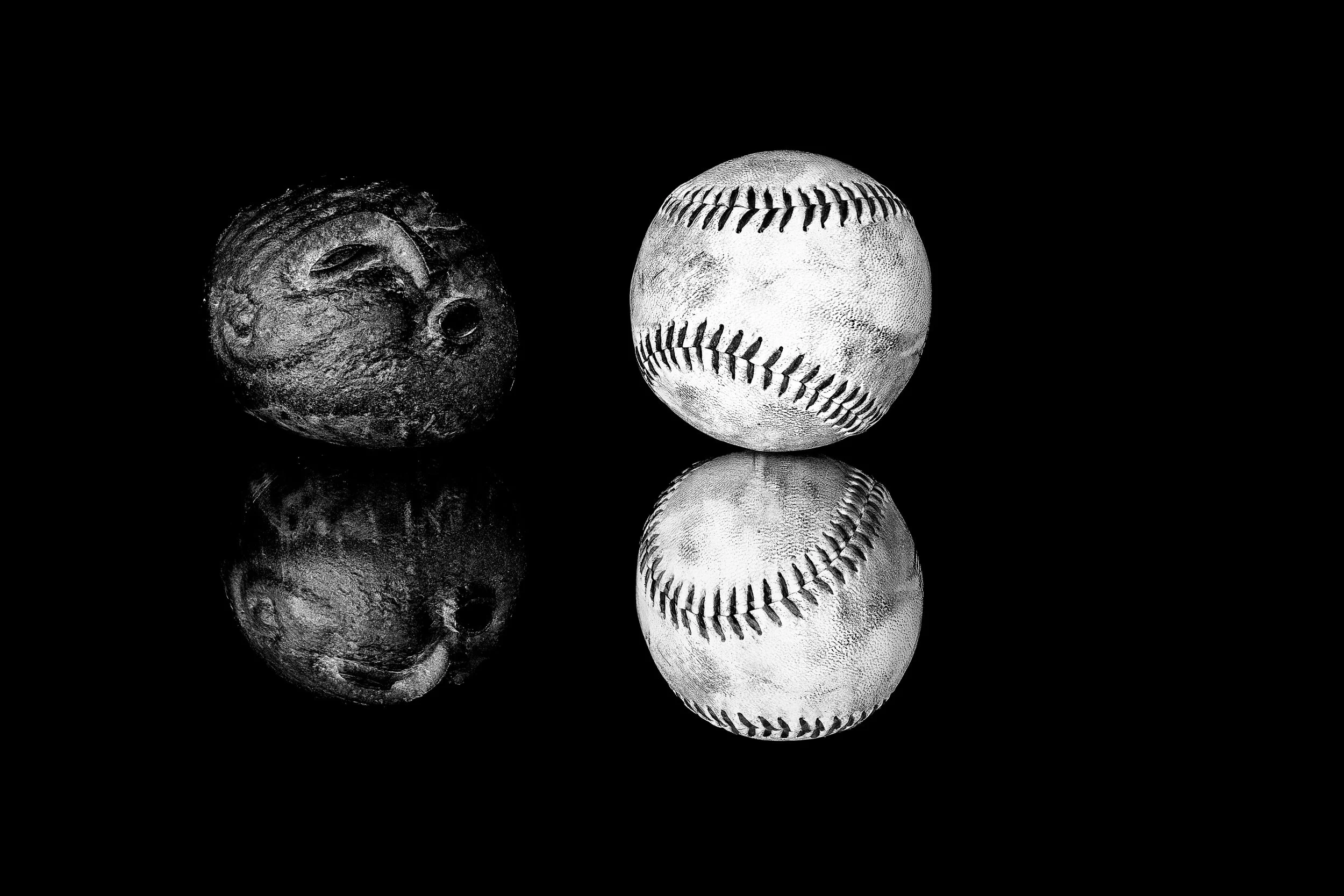
Blowing Foul is a playful study of gesture, illusion, and one of baseball's most enduring bits of visual folklore. A weathered carved stone faces a worn baseball across a field of black, its open mouth appearing to send an invisible breath toward the ball. Beneath them, both objects are repeated in reflection, transforming a simple still life into a small theatrical encounter.
The composition depends on contrast. The baseball is immediately recognizable—bright, familiar, and marked by years of use—while the dark stone initially remains more mysterious. Its carved features gradually resolve into a face caught in the act of blowing. The space between the two objects becomes an active part of the photograph: an empty interval in which the imagined breath, and the joke itself, takes place.
For those who know baseball history, the gesture carries another association: the wonderfully human impulse of a player trying to coax a rolling baseball across the foul line with his breath. For everyone else, the image can simply operate as an improbable conversation between two objects. By withholding explanation, Blowing Foul allows humor to emerge through recognition rather than illustration.
The black-and-white treatment strips the scene of unnecessary information and emphasizes surface, age, shape, and gesture. The polished reflection introduces symmetry without becoming perfect, retaining the physical character of the photographed objects and the surface on which they were placed. The result sits somewhere between still life, visual pun, and photographic theater.
Design & Styling
With its deep black field, sculptural forms, and restrained monochrome palette, Blowing Foul works particularly well in contemporary interiors, offices, studies, game rooms, sports-oriented spaces, restaurants, and hospitality environments. Its graphic simplicity allows it to hold a wall from a distance, while the textures of the stone, baseball, and their reflections reward closer viewing.
The photograph offers something unusual for sports-related artwork: its connection to baseball is unmistakable without depending on a stadium, player, team, or piece of memorabilia. That makes it equally appropriate for a serious contemporary interior and for a collector with a personal connection to the game.
Curated Pairings
To build a monochrome wall around objects, gesture, and quiet humor, consider these companion pieces:
For deadpan humor: Pair with No Parking, two barn swallows unbothered on a No Parking sign — another photograph whose joke depends on recognition.
For objects that suggest people: Complement with The Silent Assembly (Monochrome), weathered trunks that gather like a silent congregation — human presence implied without a person in the frame.
For monochrome structure and negative space: Pair with Storm Gate, a frozen road disappearing toward a storm — the same restrained tonal language at landscape scale.
Fine Art Presentation
Available as a signed fine art print on ChromaLuxe® Metal (gloss, semi-gloss, or matte), Glossy Anti-Glare Acrylic (TruLife), canvas, wood, and archival paper (framed or unframed). Framed archival paper is the recommended presentation: its matte surface preserves the deep blacks and the tactile detail of the stone, the baseball, and their reflections. ChromaLuxe® Metal is the alternative for a sharper, more graphic read, and a larger presentation strengthens the photograph considerably.
Note: Custom and oversized photographic prints are available. Please contact the studio directly to discuss custom framing, matting, or specialized museum glass options.
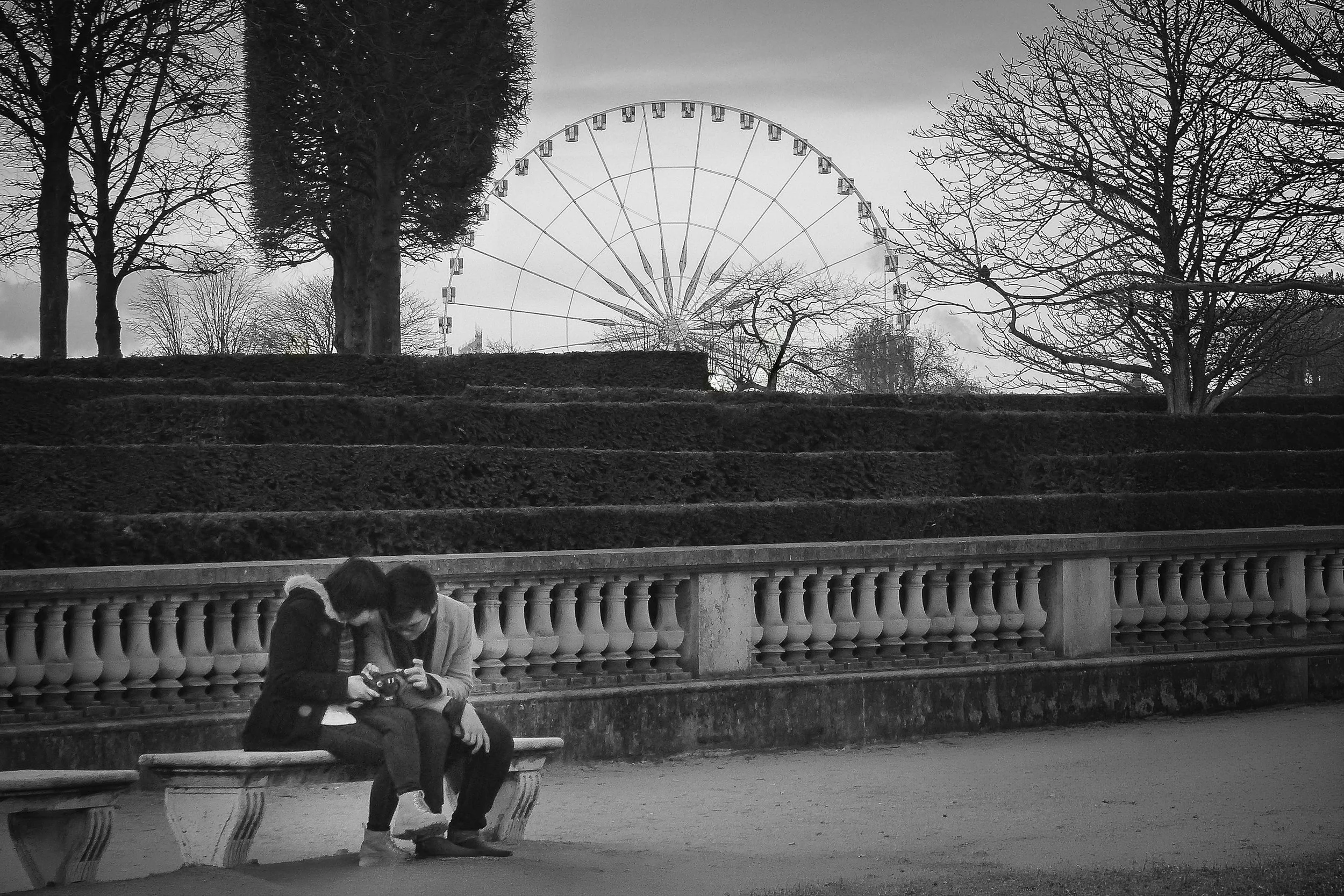
Between Frames finds a couple on a stone bench in the Tuileries Garden, heads bowed together over a camera, absorbed in a single photograph while the Roue de Paris turns slowly behind them — its arc caught precisely in the gap between two bare winter trees. Around them, the garden's terraced hedges and worn stone balustrade hold the quiet architecture of a formal French garden; above, the wheel offers the one piece of movement in an otherwise still frame.
The moment is small and private — two people, one photograph, nothing more — set against a piece of Parisian spectacle that neither of them is looking at. Rendered in black and white, the couple is drawn forward from the frame through careful tonal separation: the hedges recede into deep, quiet shadow, while the two figures hold real light and texture, unmistakably the center of the image despite occupying only a fraction of it.
The picture is quietly self-referential: a couple absorbed in a photograph, seen by a photographer doing the same thing, with a wheel turning slowly behind them. It belongs to the long tradition of street photography that finds its subject in the attention people give to one another.
Design & Styling
With its quiet monochrome palette and intimate human presence, Between Frames suits contemplative interiors, offices, and hospitality spaces seeking a documentary register — a piece that rewards a second look rather than announcing itself.
Curated Pairings
To build a wall around European travel and candid human presence, consider these companion pieces:
For a shared location and mood: Pair with Reading in the Rain, another candid black-and-white study from the same Paris trip.
For a shared narrative thread: Complement with Passing Through Prague, continuing the exploration of quiet human presence within European architecture.
For a shared candid register: Round out the wall with Night Watch at the Colosseum (Monotone), another European landmark caught in its own particular light.
Fine Art Presentation
Available as a signed fine art print on ChromaLuxe® Metal (gloss, semi-gloss, or matte), Glossy Anti-Glare Acrylic (TruLife), canvas, wood, and archival paper (framed or unframed). Framed archival paper is the recommended presentation: its matte, silvery surface carries the full tonal range from the deep hedge shadow to the couple's lifted, textured clothing and suits a documentary Paris scene. ChromaLuxe® Metal is the alternative for deeper blacks and crisper detail in the stone balustrade and the wheel.
Note: Custom and oversized photographic prints are available. Please contact the studio directly to discuss custom framing, matting, or specialized museum glass options.
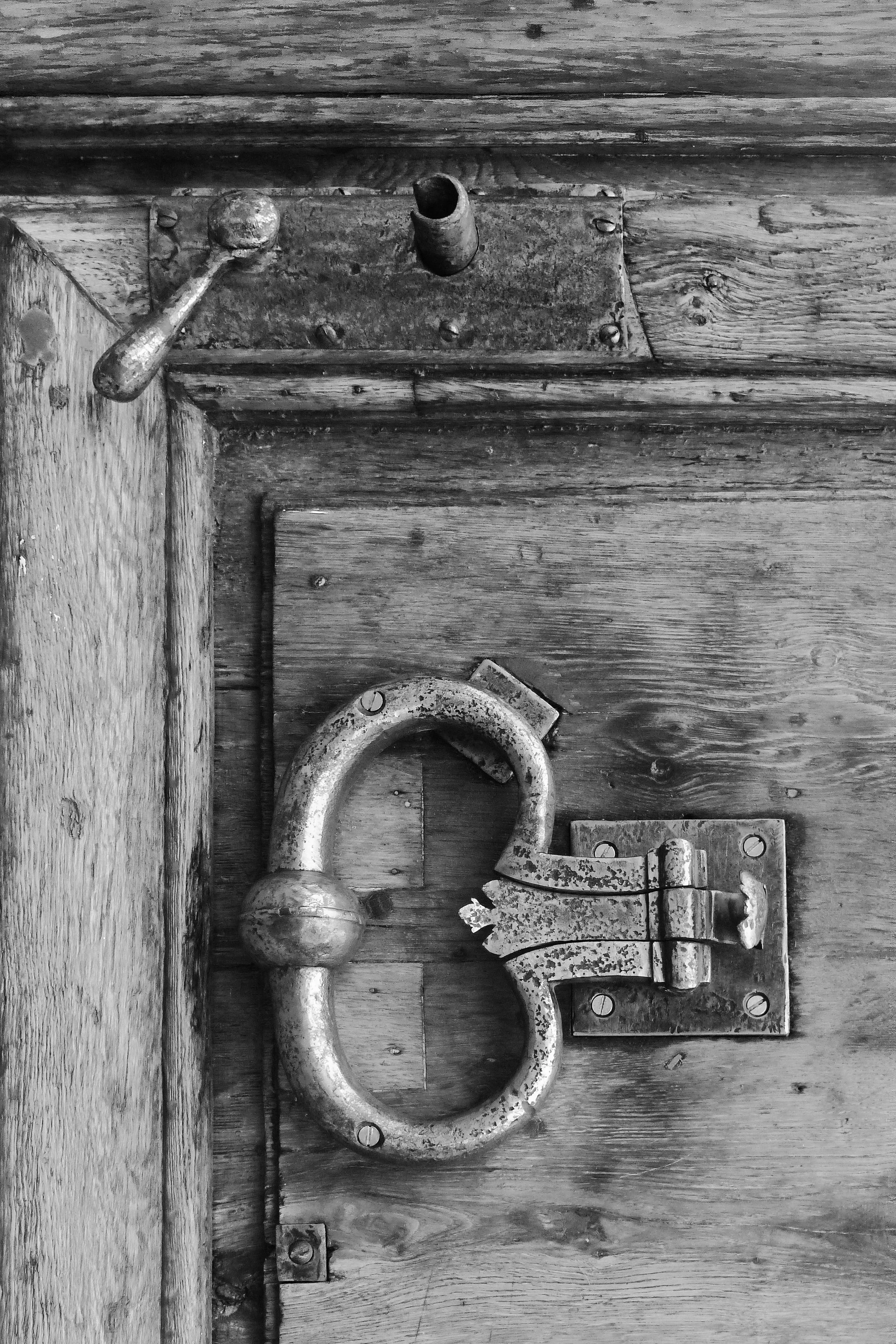
What the Door Remembers looks closely at the hardware of an aged wooden cabinet door in Paris — an ornate ring-pull knocker below, a separate iron latch mechanism above — stripped to black and white to let pure tone and texture carry the composition. Rather than documenting the door as a whole, the photograph isolates this quiet corner of use and wear, where decades of hands and weather have left their mark.
Without color to separate the materials, the image relies on tonal contrast: the polished metal of the ring-pull catches light and reads distinctly brighter than the surrounding wood grain, while the secondary latch mechanism sits quieter in the frame, subordinate to the main form. A vertical composition follows the door's own structure, connecting the two hardware pieces along a single line of sight.
Drawing directly on the black-and-white object studies of Josef Sudek, the image treats old hardware not as documentation but as a quiet meditation on time, use, and the particular beauty of things worn rather than new — rendered here in the medium Sudek himself worked in most.
Design & Styling
With its restrained black-and-white palette and quiet, textural presence, What the Door Remembers works well in studies, libraries, and contemplative interiors — as well as healthcare and hospitality spaces seeking a dignified, non-jarring black-and-white piece.
Curated Pairings
To build a wall around texture, patina, and quiet detail, consider these companion pieces:
For the same subject, a different register: Pair with What the Door Remembers (Color), the color treatment of the same hardware.
For a shared black-and-white register: Complement with Rock with Wings – Tsé Bitʼaʼí, another black-and-white study built on tonal contrast and restraint.
For the same Paris trip: Pair with Between Frames, a Tuileries Garden couple in black and white, where quiet tonal separation does the same work on people.
Fine Art Presentation
Available as a signed fine art print on ChromaLuxe® Metal (gloss, semi-gloss, or matte), Glossy Anti-Glare Acrylic (TruLife), canvas, wood, and archival paper (framed or unframed). Framed archival paper is the recommended presentation: its matte, silvery surface suits a Sudek-style object study and preserves the full tonal range in the wood grain and metal patina. ChromaLuxe® Metal is the alternative for brighter highlights on the polished ring-pull.
Note: Custom and oversized photographic prints are available. Please contact the studio directly to discuss custom framing, matting, or specialized museum glass options.

Within the Nave finds a single figure at prayer inside the Cathedral Basilica of Saint Louis, rendered in silhouette against the vast, dim architecture surrounding her. The Basilica holds one of the largest mosaic collections in the Western Hemisphere, but this photograph turns away from that spectacle — the mosaics recede into shadow and texture rather than announcing themselves, leaving the frame to the quiet fact of a person, alone, in a space built for exactly this kind of stillness.
The monochrome treatment strips the scene to its essential structure: light falling from somewhere unseen, the architecture's weight and scale, and one small human presence held within it. It's a composition built on contrast and restraint rather than detail — the nave's soaring space measured against a single kneeling figure, and the silence that seems to gather around her.
Drawing on the atmospheric interiors of Josef Sudek and the quiet documentary humanity of Wim Wenders, the image treats sacred architecture not as a subject to be catalogued but as a space to be felt — the kind of photograph that rewards the same unhurried attention its subject is giving to her own prayer.
Design & Styling
With its deep monochrome palette and contemplative subject, Within the Nave works well in spaces seeking a quiet, dignified presence — private studies, meditation and wellness spaces, and healthcare or hospice environments where a moment of stillness carries real weight. It also suits collectors drawn to architectural photography with a human, emotional center rather than pure documentation.
Curated Pairings
To build a wall around quiet architecture and human presence, consider these companion pieces:
For a shared location: Pair with Sanctuary of Light, photographed in the same Cathedral Basilica of Saint Louis, offering a brighter counterpoint to this piece's shadow and silhouette.
For a shared theme: Complement with Transfiguration, another sacred-architecture study built around quiet human presence within a place of worship.
For tonal harmony: Round out the wall with The Bartender's Measure (Monochrome), continuing the same restrained black-and-white register and quiet study of a solitary figure.
Fine Art Presentation
Available as a signed fine art print on ChromaLuxe® Metal (gloss, semi-gloss, or matte), Glossy Anti-Glare Acrylic (TruLife), canvas, wood, and archival paper (framed or unframed). Framed archival paper is the recommended presentation: its quiet matte surface suits a sacred silhouette and the fine tonal gradation across the architecture. ChromaLuxe® Metal is the alternative for depth in the shadows.
Note: Custom and oversized photographic prints are available. Please contact the studio directly to discuss custom framing, matting, or specialized museum glass options.

Sentinel of the Plain is a study in isolation and scale — a single sandstone formation rising alone from an otherwise flat desert floor, its beehive silhouette set against a sky rendered nearly black at its zenith. Photographed in classic monochrome, using a red-filter technique in the tradition of Ansel Adams, the image separates the warm sandstone from the sky with dramatic clarity, allowing the formation's sculptural, layered strata to emerge in full relief.
The composition is deliberately spare: a lone cloud drifts to the left, a distant mountain range anchors the horizon, and a band of sagebrush stretches across the foreground — but the formation itself commands the frame, its stepped, tiered profile reading almost as an architectural structure rather than a natural one. The darkened sky, opening gradually toward the horizon, reinforces the sense of a single monumental presence standing watch over an empty plain.
Where much of the surrounding landscape work in this collection features human figures for scale, Sentinel of the Plain stands alone — a study in solitude and permanence, the formation's watchful, upright stance giving the piece its name.
Design & Styling
With its bold graphic silhouette and dramatic tonal range, Sentinel of the Plain works well as a statement piece in living rooms, offices, and lobbies — spaces that can hold a strong contrast anchor. The deep sky treatment gives it more presence than a softer, high-key print, making it a better fit for common areas and corporate/hospitality settings than for spaces calling for a calming, low-contrast palette.
Curated Pairings
To build a cohesive Southwest monochrome grouping, consider these companion pieces:
For tonal harmony: Pair with Between Stone and Silence, continuing the same dramatic red-filter sky treatment in a Turret Arch composition.
For thematic echo: Complement with The Last Sentinel, extending the solitary-formation, watchful-presence theme into a Monument Valley dawn setting.
For a second monolith: Pair with Shadows of the Monolith, the volcanic plume near Shiprock, New Mexico, in the same sharp monochrome contrast — another single monumental presence in a vast landscape.
Fine Art Presentation
Available as a signed fine art print on ChromaLuxe® Metal (gloss, semi-gloss, or matte), Glossy Anti-Glare Acrylic (TruLife), canvas, wood, and archival paper (framed or unframed). ChromaLuxe® Metal is the recommended presentation: it holds the deep, graduated sky cleanly without banding at large sizes and separates the warm sandstone from the dark sky. Framed archival paper is the classic alternative, closest to the silver-gelatin prints of the Adams tradition, for a study or library.
Note: Custom and oversized photographic prints are available. Please contact the studio directly to discuss custom framing, matting, or specialized museum glass options.
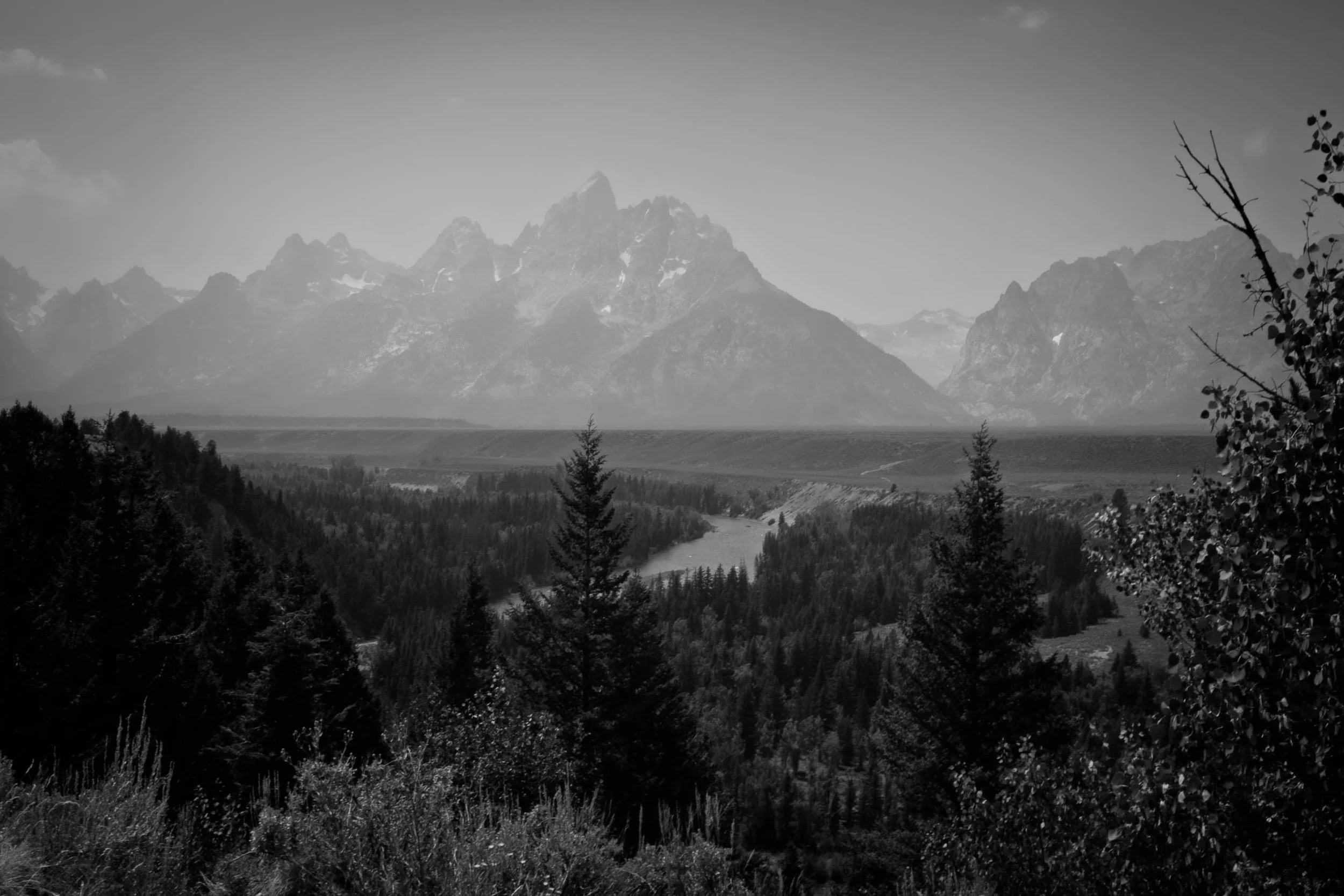
Where the Smoke Settles was photographed from the Snake River Overlook in Grand Teton National Park — the same vantage that produced one of the most recognized compositions in American landscape photography. Here, though, the peaks rise through genuine wildfire haze, smoke carried in from distant fires in the Lake Tahoe basin, softening the granite ridgelines into something more atmospheric than crisp. Rather than remove that haze, the image works within it — recovering texture and tonal separation in the mountains without erasing the honest record of what the air actually looked like that day.
The composition follows the Snake River as it curves through a dense valley of lodgepole pine, leading the eye directly toward the peaks rising above the haze-flattened horizon. A single bare-branched tree frames the right edge of the frame, its stark silhouette a quiet counterpoint to the layered pines below. The foreground carries the image's real tonal weight — rich, deep blacks in the timber — while the mountains and sky settle into a softer, smoke-muted register, the two zones in quiet conversation with each other.
Printed in black and white using a red-filter conversion technique in the tradition of Ansel Adams, the piece reflects on how the same iconic view changes character depending on the day — not always crisp and dramatic, sometimes soft, hazy, and quietly altered by forces far beyond the frame.
Design & Styling
With its gentle tonal range and classic mountain-and-river composition, Where the Smoke Settles works well in a wide range of settings — living rooms, offices, waiting areas, and healthcare or senior-living environments seeking a calming, universally appealing nature subject. Its muted contrast makes it a softer presence than more dramatic black and white work, suited to spaces wanting quiet rather than bold visual statement.
Curated Pairings
To build a cohesive grouping, consider these companion pieces:
For place continuity: Pair with Between Us, the Field, photographed at Mormon Row in Grand Teton National Park during the same wildfire smoke season.
For thematic echo: Complement with Between Weather and Silence, extending the mountains-under-atmosphere theme into a Colorado setting.
Fine Art Presentation
Available as a signed fine art print in ChromaLuxe® Metal (gloss, semi-gloss, or matte), acrylic, canvas, and paper presentation formats, from 12×8 up to 36×24. Given the soft, even tonal range throughout, ChromaLuxe® Metal or archival paper both render this piece well — neither substrate's characteristic contrast boost works against the image's intentionally gentle character.
Note: Custom and oversized photographic prints are available. Please contact the studio directly to discuss custom framing, matting, or specialized museum glass options.
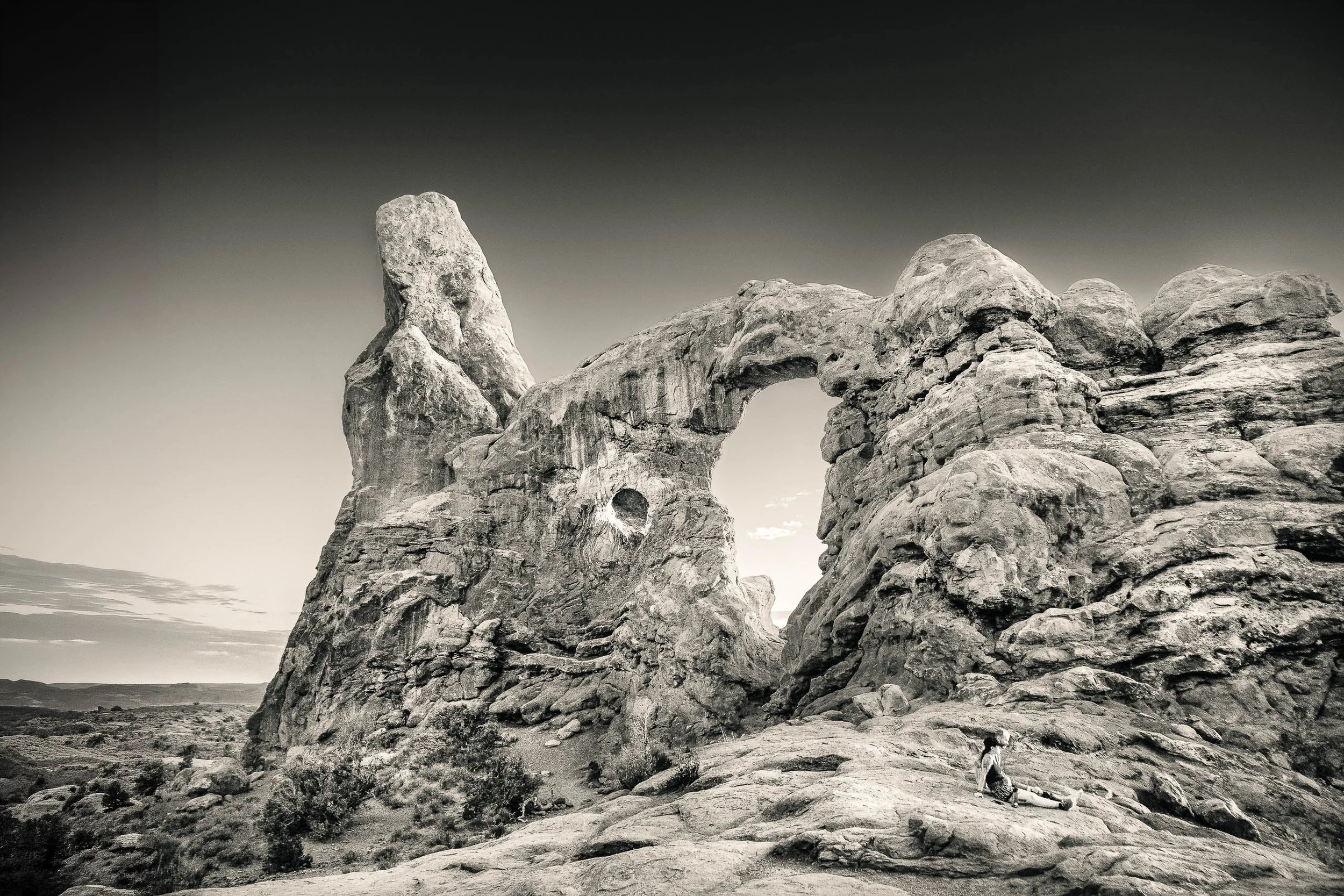
The Measure of Stone explores the relationship between human presence and geological time. Photographed in Arches National Park, Utah, at sunset, the image captures a couple resting beneath a monumental sandstone formation shaped by millions of years of erosion, watching the day's last light fade over the desert below. The vast scale of the landscape immediately dwarfs the individuals, yet their presence becomes essential to the photograph's meaning. Drawing inspiration from the monumental landscapes of Ansel Adams and the contemplative sense of place found in the work of Wim Wenders, the image reflects on perspective, permanence, and the quiet act of observation.
Rather than presenting the arch as a purely scenic landmark, the composition emphasizes the dialogue between the human figures and the surrounding stone. The sweeping arc of the formation stretches across the frame, connecting two massive rock structures while creating a visual bridge through the image. The seated couple occupies only a small portion of the composition, watching the sunset in quiet stillness, yet immediately becomes a focal point, providing both scale and narrative. Rendered in monochrome, the photograph emphasizes texture, shape, and light, allowing the intricate surfaces of the sandstone to emerge with sculptural clarity. The darkened sky further separates the formation from its surroundings, reinforcing its monumental presence.
The photograph is ultimately a meditation on humility and wonder. The weathered sandstone records millions of years of geological change, while the figures represent a fleeting moment of human experience — a single sunset among countless others the stone has witnessed. Together they create a visual reminder of our place within a much larger story.
Design & Styling
With its monumental stone, small human figures, and deep monochrome tonality, The Measure of Stone suits executive offices, libraries, desert and mountain homes, and hospitality spaces that want scale and quiet perspective. The darkened sky and sculptural sandstone hold a wall from across a room, while the seated couple gives the viewer a human way in.
Curated Pairings
To build a cohesive Arches and Southwest grouping, consider these companion pieces:
For place continuity: Pair with At the Edge of Wonder, photographed at the same location and continuing the same monumental-scale study.
For thematic echo: Complement with A Gentle Lesson, extending the human-figure-against-landscape narrative in a different western setting.
For the scale of a figure in a landscape: Pair with The Long Way Home, a single figure moving between two frost-rimed pines, where the ratio between walker and trees is the whole picture.
Fine Art Presentation
Available as a signed fine art print on ChromaLuxe® Metal (gloss, semi-gloss, or matte), Glossy Anti-Glare Acrylic (TruLife), canvas, wood, and archival paper (framed or unframed). ChromaLuxe® Metal is the recommended presentation: it holds the tonal separation between the darkened sky and the sculptural sandstone. Framed archival paper is the classic alternative for the monochrome, with a matte surface suited to a study or library.
Note: Custom and oversized photographic prints are available. Please contact the studio directly to discuss custom framing, matting, or specialized museum glass options.
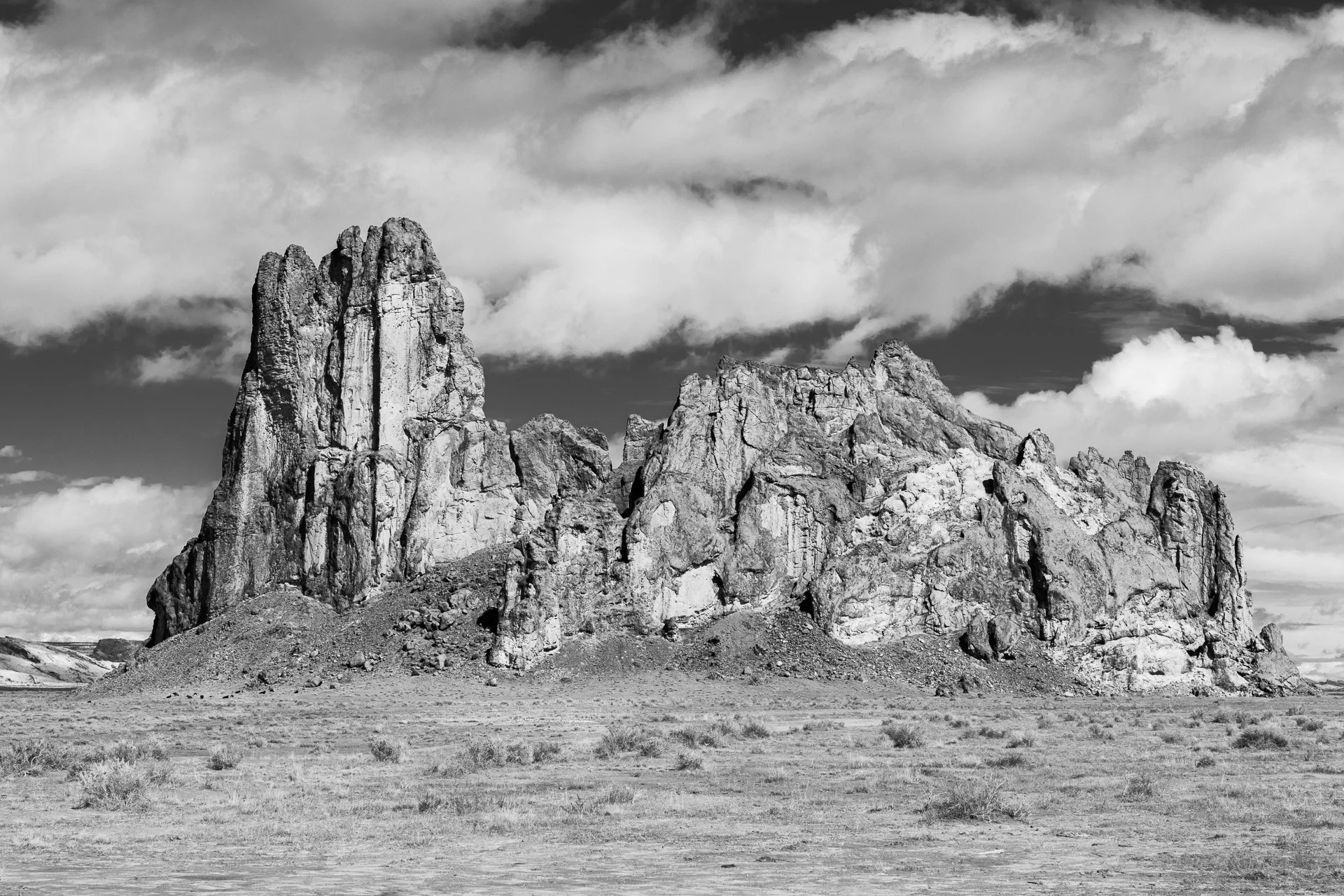
Shadows of the Monolith is a powerful, deeply atmospheric exploration of geological grandeur, sharp contrast, and ancient desert stillness. Capturing the towering volcanic plume of near Shiprock, New Mexico—rising dramatically near the Kayenta borderlands—this monochrome composition forces a profound study of light and negative space. Heavily influenced by the legendary high-contrast environmental scales of Ansel Adams and the isolated, melancholic rural realism of Andrew Wyeth, the image masterfully transforms raw, sun-baked sandstone ridges and ink-like desert shadows into a timeless visual meditation on permanence and silent endurance.
Shiprock is the eroded volcanic core of an ancient volcano, rising roughly fifteen hundred feet above the high desert plain, and it is sacred to the Navajo Nation. In monochrome its shape reads as pure structure, and the shadows take on the weight of stone.
Design & Styling
The commanding form and deep blacks of Shadows of the Monolith make a bold anchor for modern Western interiors, executive suites, and lodges. Its tonal range suits plain, pale walls.
Curated Pairings
To build a cohesive monochrome or desert wall, consider these companion pieces:
For graphic ridges: Pair with The Shape of Silence (Monotone), another stark monochrome landscape of graphic ridges and deep shadow.
For celestial pattern: Complement with The Day the Sky Stood Still, the stark celestial pattern of a total solar eclipse, in the same monochrome register.
For the same rock in color: Pair with Enduring Silence, Shiprock in cool blue-violet tones with a reflection in the foreground.
Fine Art Presentation
Available as a signed fine art print on ChromaLuxe® Metal (gloss, semi-gloss, or matte), Glossy Anti-Glare Acrylic (TruLife), canvas, wood, and archival paper (framed or unframed). ChromaLuxe® Metal is the recommended presentation: it maximizes the deep blacks and the rich tonal gradients of the monolith. Framed archival paper is the alternative for a more classic, darkroom-print reading.
Note: Custom and oversized photographic prints are available. Please contact the studio directly to discuss custom framing, matting, or specialized museum glass options.
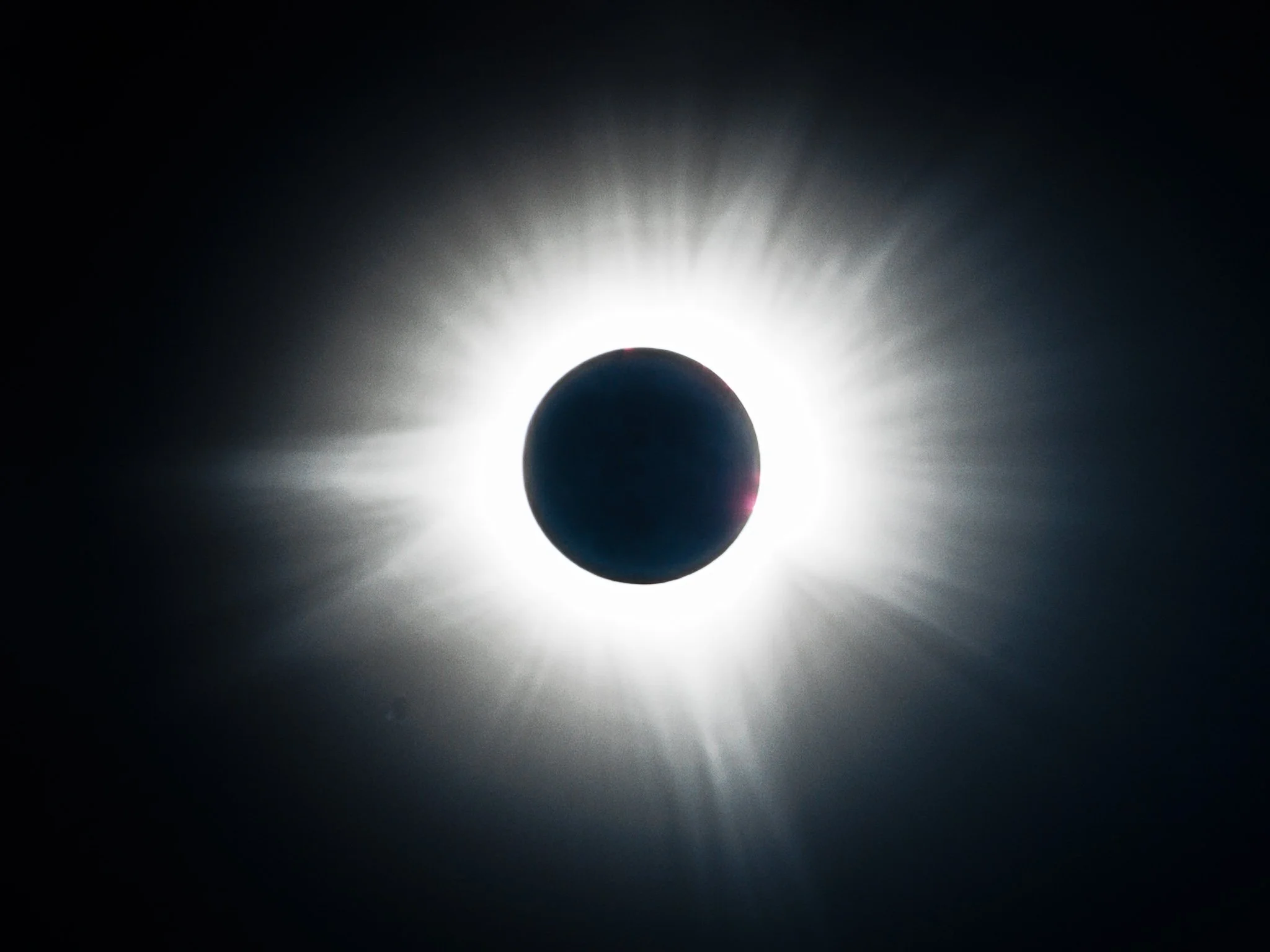
The Day the Sky Stood Still is a striking, deeply atmospheric study of celestial alignment, negative space, and transient light. Capturing the breathtaking totality of a solar eclipse, this monochrome composition frames the jet-black disk of the moon perfectly ringed by the explosive, delicate tendrils of the sun's solar corona. Drawing direct stylistic influence from the razor-sharp contrast and epic environmental scales of Ansel Adams, the image transforms a fleeting astronomical phenomenon into a timeless, minimalist visual meditation on cosmic structure, shadow, and quiet grandeur.
Totality lasts only a few minutes at most, and the corona, the sun's outer atmosphere, is visible only when the moon fully covers the disk. The photograph holds that brief window still, and the silence around it is part of what it is about.
Design & Styling
The jet-black disk and silver crown of The Day the Sky Stood Still make a powerful, modern anchor for living rooms, minimalist offices, and studies. It suits plain walls.
Curated Pairings
To build a cohesive monochrome wall, consider these companion pieces:
For graphic ridges: Pair with The Shape of Silence (Monotone), whose razor-sharp dune ridges and ink-black shadows share the same stark tonal range.
For intimate organic texture: Complement with Center of Grace, bringing the same high-contrast drama down to close range.
For the same phenomenon: Pair with Eclipse Sequence: Totality, four moments of a total solar eclipse from partial crescent to totality.
Fine Art Presentation
Available as a signed fine art print on ChromaLuxe® Metal (gloss, semi-gloss, or matte), Glossy Anti-Glare Acrylic (TruLife), canvas, wood, and archival paper (framed or unframed). ChromaLuxe® Metal is the recommended presentation: it holds the ink-like black and the luminous crown. Acrylic is the alternative for extra depth.
Note: Custom and oversized photographic prints are available. Please contact the studio directly to discuss custom framing, matting, or specialized museum glass options.
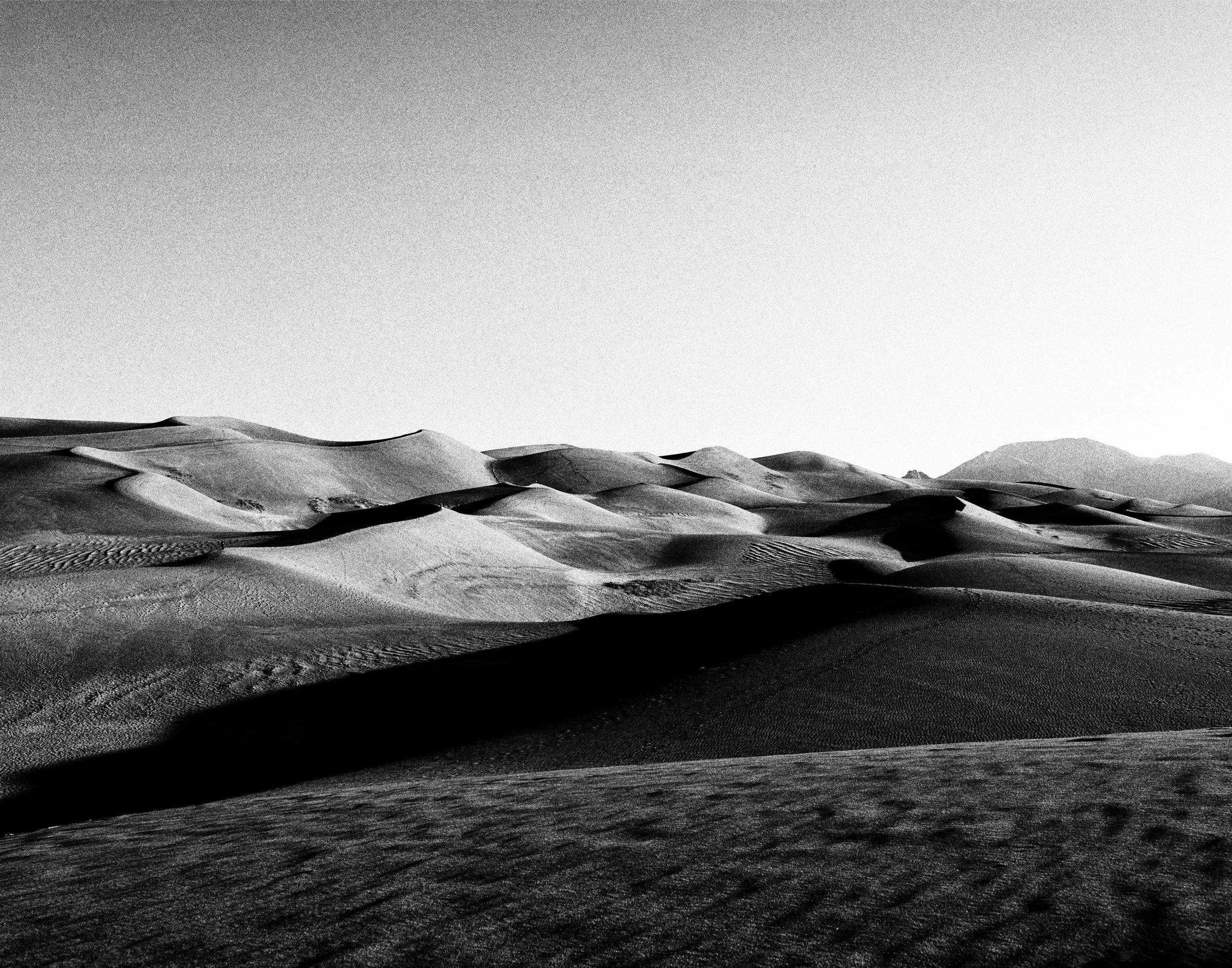
The Shape of Silence (Monotone) is a stark, deeply contemplative exploration of organic geometry, light, and desert minimalism. Capturing the razor-sharp ridges, sweeping wind-sculpted contours, and ink-like shadows of Great Sand Dunes National Park, this monochrome composition focuses on a profound sense of isolation and environmental scale. Heavily influenced by the legendary high-contrast structural landscapes of Ansel Adams and the quiet, emotionally charged realism of Andrew Wyeth, the image masterfully transforms shifting desert sands into a timeless, abstract visual meditation on form, permanence, and silence.
Great Sand Dunes National Park, in Colorado's San Luis Valley, holds the tallest dunes in North America. In monochrome their ridges read as pure line, and the shadows on the leeward faces give the sand a sculptural weight.
Design & Styling
The razor-sharp ridges and ink-like shadows of The Shape of Silence (Monotone) make a sophisticated anchor for contemporary living spaces, professional offices, and studies. Its clean lines suit minimalist walls.
Curated Pairings
This is one of four treatments of the same Great Sand Dunes capture — consider displaying it alongside its companions:
The same dunes, in form: Pair with Sculpted in Silence, the same dunes reduced to pure abstract form in the register of Edward Weston.
The same dunes, held still: Complement with The Weight of Sand, a muted, restrained treatment in the register of Andrew Wyeth.
The same dunes, in motion: Complete the set with Where Light Runs Wild, the same capture rendered in a warm, kinetic Ernst Haas register.
Fine Art Presentation
Available as a signed fine art print on ChromaLuxe® Metal (gloss, semi-gloss, or matte), Glossy Anti-Glare Acrylic (TruLife), canvas, wood, and archival paper (framed or unframed). ChromaLuxe® Metal is the recommended presentation: it elevates the sharp ridges and the ink-like shadows of the dunes. Framed archival paper is the alternative for a classic, tactile read.
Note: Custom and oversized photographic prints are available. Please contact the studio directly to discuss custom framing, matting, or specialized museum glass options.
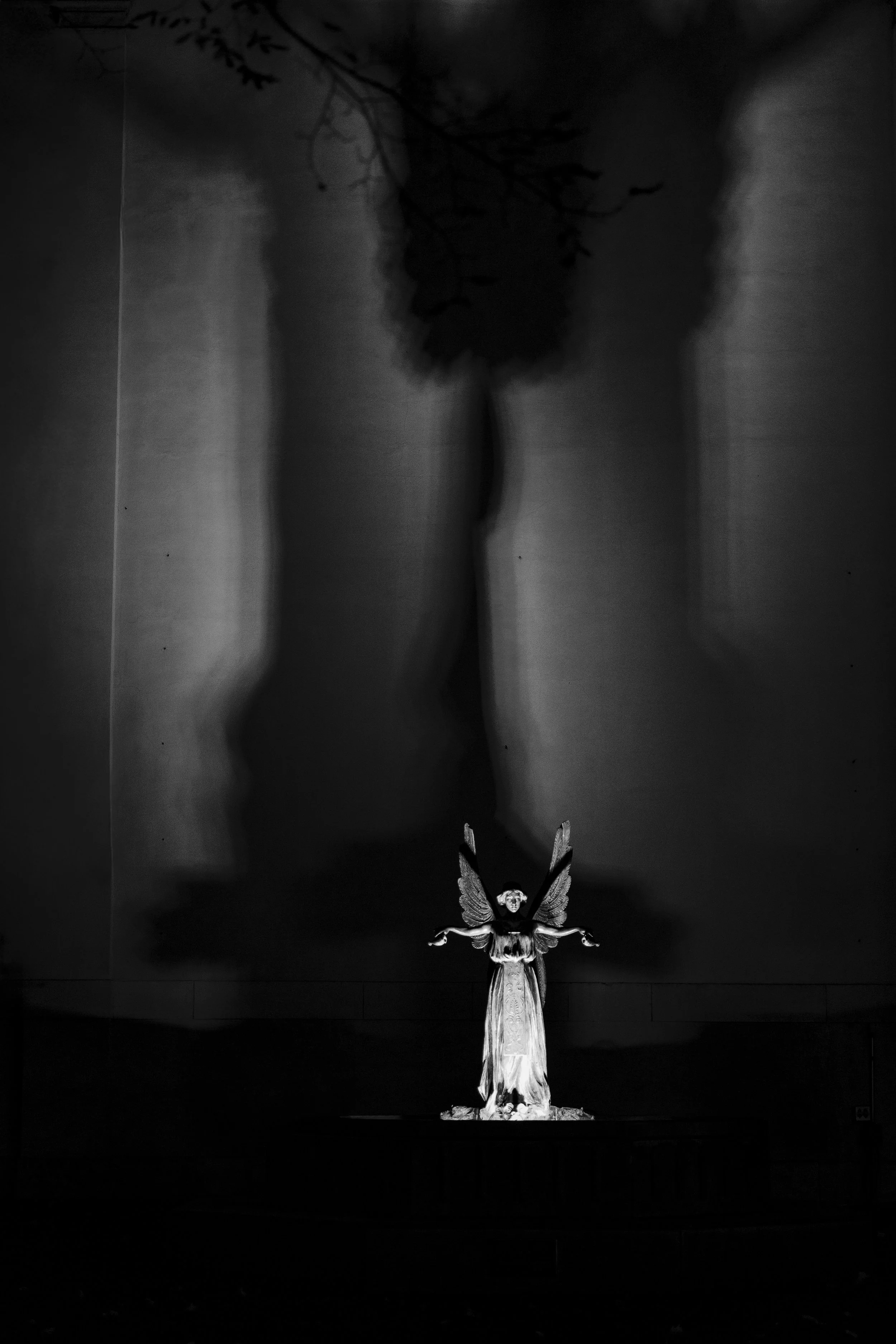
Some figures keep watch long after everyone else has gone. The Long Watch finds a winged statue alone in a single pool of light at night in the Missouri Botanical Garden in St. Louis, her arms extended, while a vast pale wall rises behind her into darkness.
The statue is the only bright, sharply defined thing in the frame, so the eye lands on her at once. From there it climbs the soft bands of light on the wall and follows a long dark shadow that descends toward her, a trunk-like column crowned by the shadow of a tree canopy and its branches at the top of the frame. That shadow dwarfs the figure, so a small, luminous watcher stands beneath a much larger presence that seems to watch back.
Nearly everything else is shadow: deep blacks at the base, soft gray gradients across the wall, and one hard-edged highlight on the wings and folds of the statue. The psychological stillness of a single lit figure in a vast, dark space belongs to Edward Hopper's world of light and isolation, translated to night. It is quietly unsettling, the kind of stillness that makes you wonder whether the figure moves when no one is looking.
Design & Styling
With its deep blacks, cinematic drama, and single point of light, The Long Watch suits moody, gallery-style interiors: collectors' libraries and studies, boutique hotel lounges, cocktail bars, restaurants, and gothic or loft-style residences. On a deep charcoal or plaster wall, the black surround merges with the room and the figure appears to float. For anyone who knows the Missouri Botanical Garden by day, it is a quiet, uncanny view of a familiar place after dark.
Curated Pairings
For a highly cohesive, storytelling layout across a larger wall, consider these companion pieces:
For a shared vigil: Pair with Within the Nave, a single figure at prayer in silhouette against the vast, dim architecture of the Cathedral Basilica — another small human presence held in a large dark space.
For quiet endurance: Complement with Where the Homestead Waits, an abandoned homestead near Lowland, Colorado — the same patient waiting, moved into daylight and open country.
For the same garden after dark: Pair with As the Glow Ends, the Climatron at the Missouri Botanical Garden after dark — the same place and hour, in architecture instead of statuary.
Fine Art Presentation
Available as a signed fine art print on ChromaLuxe® Metal (gloss, semi-gloss, or matte), Glossy Anti-Glare Acrylic (TruLife), canvas, wood, and archival paper (framed or unframed). Acrylic is the recommended presentation: its depth makes the statue seem to glow out of the darkness, and the anti-glare surface keeps the near-black areas from reflecting the room. Framed archival paper is the quieter alternative, closest to a traditional darkroom print, with a matte surface that keeps the wall's soft gradients smooth in a brightly lit space.
Note: Custom and oversized photographic prints are available. Please contact the studio directly to discuss custom framing, matting, or specialized museum glass options.
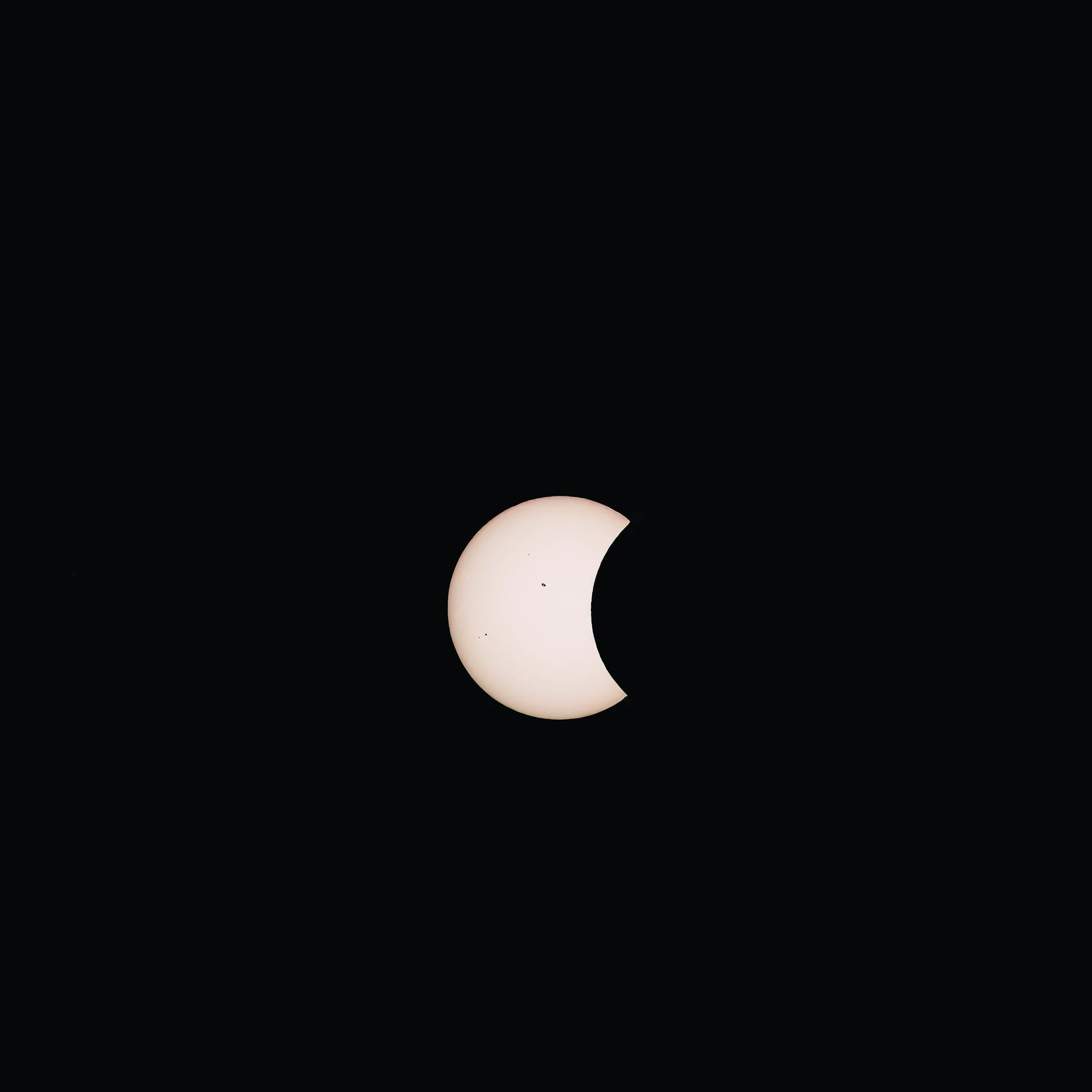
Eclipse Sequence: Four Moments of Totality is a visual meditation on anticipation, transformation, and wonder. Created during the total solar eclipse of April 8, 2024, the series follows the progression of the event through four distinct phases: the partial crescent, Bailey's Beads and chromosphere, the Diamond Ring effect, and totality itself. Presented together as a unified body of work, the photographs transform a fleeting astronomical phenomenon into a narrative about light, time, and our place beneath the sky.
The sequence begins with a simple crescent sun suspended within a field of deep black. Elegant and minimal, the first image introduces the celestial mechanics that will unfold over the next several minutes. The second image reveals Bailey's Beads and the solar chromosphere, where brilliant crimson prominences emerge along the edge of the moon while the final rays of sunlight shine through valleys on the lunar surface. The event reaches its dramatic climax with the Diamond Ring effect, one of the rarest and most celebrated moments of totality. The final image reveals the solar corona, the sun's outer atmosphere extending into space in delicate structures normally hidden by the brilliance of daylight.
While each image stands on its own, the true subject of the series is the progression itself. Together the photographs mirror the emotional experience of witnessing an eclipse: anticipation gives way to astonishment, drama yields to stillness, and an event lasting only minutes becomes a memory that remains for years. Rather than presenting a single iconic eclipse photograph, the collection preserves the unfolding experience of totality and the remarkable transition from ordinary daylight to one of nature's most extraordinary spectacles.
The square format and minimalist presentation emphasize the geometry of the eclipse while allowing each phase to function as part of a larger visual story. Viewed together, the images become a contemporary study of light, transformation, and discovery that appeals equally to lovers of astronomy, science, and fine art photography.
Design & Styling
With its minimalist palette, striking geometry, and universal subject matter, Eclipse Sequence works exceptionally well in contemporary residential interiors, corporate offices, healthcare environments, educational institutions, science and technology organizations, observatories, and modern hospitality spaces.
The deep blacks and luminous solar forms create a sophisticated visual statement while remaining accessible to a broad audience. The series functions equally well as a focal point in a modern setting or as part of a larger collection exploring nature, science, and the passage of time.
Curated Pairings
Eclipse Sequence pairs particularly well with:
Together these works explore themes of light, atmosphere, wonder, and humanity's relationship to the natural world.
Fine Art Presentation
Available as a coordinated four-piece sequence or as individual images.
Recommended presentation:
Four 12×12 ChromaLuxe® Metal Prints (gloss, semi-gloss, or matte; gloss recommended)
Displayed vertically as a timeline or in a 2×2 grid
Float-mounted for a contemporary presentation
The glossy metal finish enhances the deep blacks, luminous corona, and brilliant solar details while creating a modern presentation appropriate for both residential and commercial environments.
Each individual component can be purchased, contact the studio for pricing.
Note: Custom and oversized photographic prints are available. Please contact the studio directly to discuss custom framing, matting, or specialized museum glass options.
Western Silence
Western Silence
Filters
No results found
No results match your search. Try removing a few filters.
Have Questions?
To accommodate grand residential or corporate spaces, larger scale photographic prints and custom dimensions are available upon request.
For collectors seeking ready-to-hang presentations, we welcome the opportunity to collaborate on custom framing, museum-quality matting, and specialized glass selections tailored to your unique aesthetic.
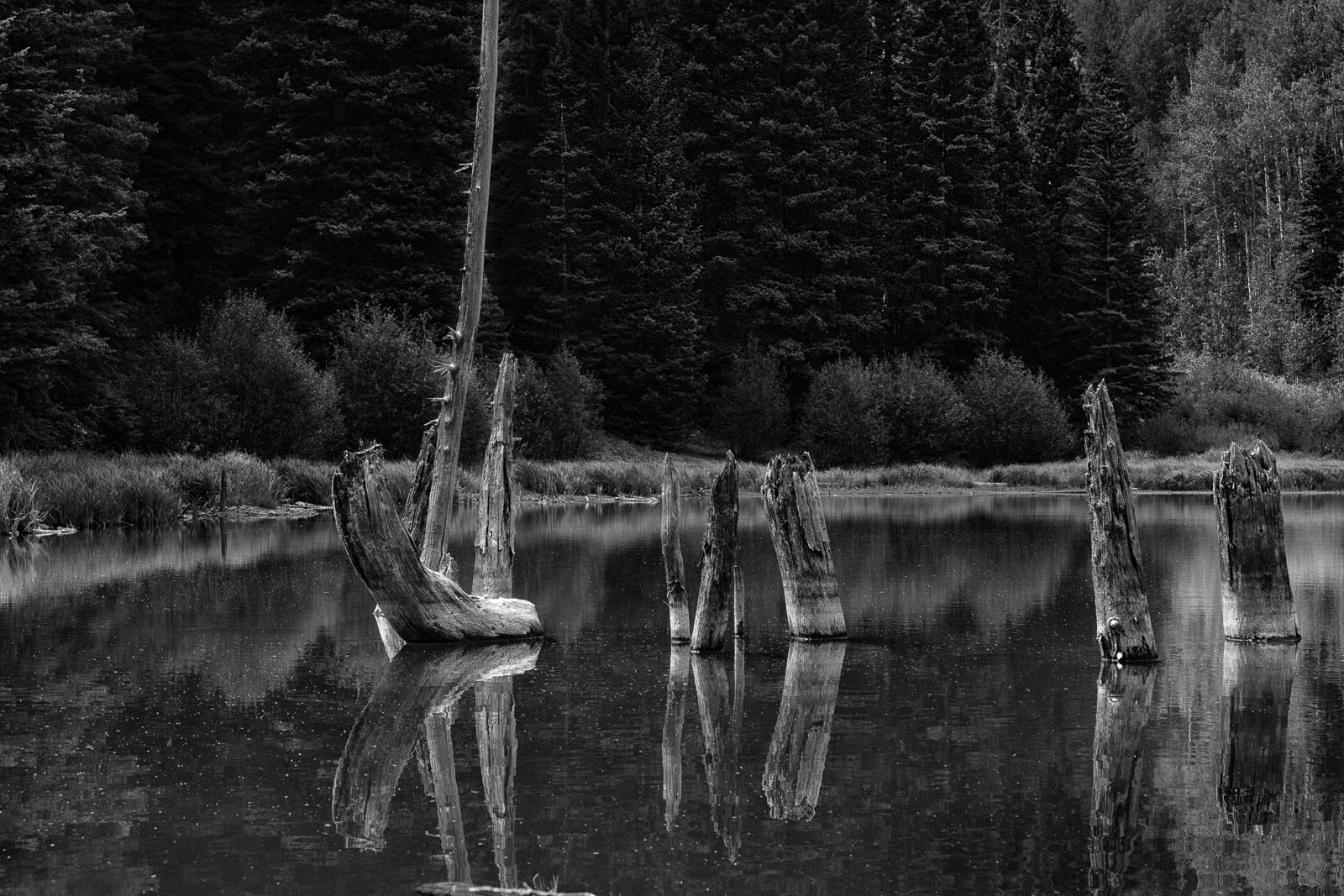
The Silent Assembly is a study of time, transformation, and the strange presence created by what remains. Rising from the still water of a mountain pond, weathered trunks and broken remnants of trees stand separated from the surrounding forest, stripped of branches and foliage and reduced to elemental forms — wood, water, light, and reflection.
The composition is built around repetition and individuality. Some remnants stand upright and narrow, others lean or twist, and one large fractured trunk reaches upward from the water like a figure caught in motion. Their reflections extend the forms below the surface, creating a second assembly that is less substantial and more transient than the one above. A dark wall of trees behind the pond isolates the weathered forms, while the quiet water lets each one occupy its own space.
In black and white the landscape becomes sculptural: texture, shape, luminosity, and negative space determine how the scene is read. There is an unavoidable suggestion of human presence despite the absence of people. The trunks seem to gather, face one another, and stand in the water like members of a silent congregation — the point at which remnants of the natural world begin to suggest figures, monuments, or witnesses to a landscape changing around them.
Design & Styling
With its deep blacks, silver-gray water, organic forms, and restrained monochrome palette, The Silent Assembly brings a contemplative, sculptural presence to contemporary and transitional residences, mountain homes, executive offices, hospitality spaces, libraries, and quiet rooms. Its horizontal format is effective above a sofa, credenza, bed, or conference-room console; from a distance it reads as a strong arrangement of dark and light vertical forms, and closer up the weathered wood and reflections emerge.
Curated Pairings
To build a wall around silence, permanence, and what remains, consider these companion pieces:
For silence and permanence: Pair with Enduring Silence, where water, reflection, and isolation also set enduring forms against an atmosphere that is constantly changing.
For monochrome landscape: Complement with Storm Gate, which shares a restrained tonal language while contrasting the constructed geometry of road and gate with the irregular organic forms of water and wood.
For what remains: Pair with The Long Goodbye (Panorama), where remnants, implied human presence, and the passage of time carry the landscape.
Fine Art Presentation
Available as a signed fine art print on ChromaLuxe® Metal (gloss, semi-gloss, or matte), Glossy Anti-Glare Acrylic (TruLife), canvas, wood, and archival paper (framed or unframed). Framed archival paper is the recommended presentation: a quieter, more traditional monochrome with strong reproduction of the weathered textures and middle-gray transitions. ChromaLuxe® Metal is the alternative for the deep tonal range and sculptural forms; larger sizes let each trunk and its reflection stand on its own.