
Midwest Quiet
A Closer Look
Explore the finer details of each photograph by hovering over an image to reveal subtle focus and texture, or click to expand the work into a distraction-free viewing environment. This immersive view allows each study of Midwest Silence to be experienced at its full scale and proportion.
Search for a specific photograph, series, or browse the curated collections. Looking for a particular format? Search by Square or 1:1, Landscape or 3:2, or Panorama or 16:9.
Midwest Quiet: Contemplative Landscape Photography
The Midwest is often defined by openness—broad skies, long horizons, winding rivers, quiet roads, and landscapes shaped as much by weather as by geography.
The photographs in this collection explore those quieter places, focusing on moments of stillness, reflection, and the enduring relationship between people and the land.
Created throughout Missouri, Kansas, Colorado, and neighboring regions, these images celebrate the character of landscapes that are frequently overlooked. Country roads disappear into distant horizons. Rivers reflect changing skies. Fields, farms, trees, and small towns become studies in light, atmosphere, and season. Rather than seeking dramatic spectacle, the photographs embrace subtle beauty and the emotional resonance found in ordinary places.
Weather often plays a central role. Morning fog, approaching storms, snowfall, changing seasons, and the final light of day transform familiar scenes into moments of quiet discovery. These photographs reflect an appreciation for patience and observation, revealing how a landscape can change from one hour to the next while remaining deeply connected to its history and sense of place.
Influenced by the regional storytelling of Andrew Wyeth, the atmospheric color of Ernst Haas, and the landscape traditions of the American Midwest, these images explore themes of memory, solitude, resilience, and belonging. They are photographs about place, but also about the experiences and emotions that certain places continue to evoke.
Designed for collectors, healthcare environments, hospitality spaces, offices, and residential interiors, these photographs bring a sense of calm, openness, and connection to the natural world while celebrating the enduring beauty of the American heartland.
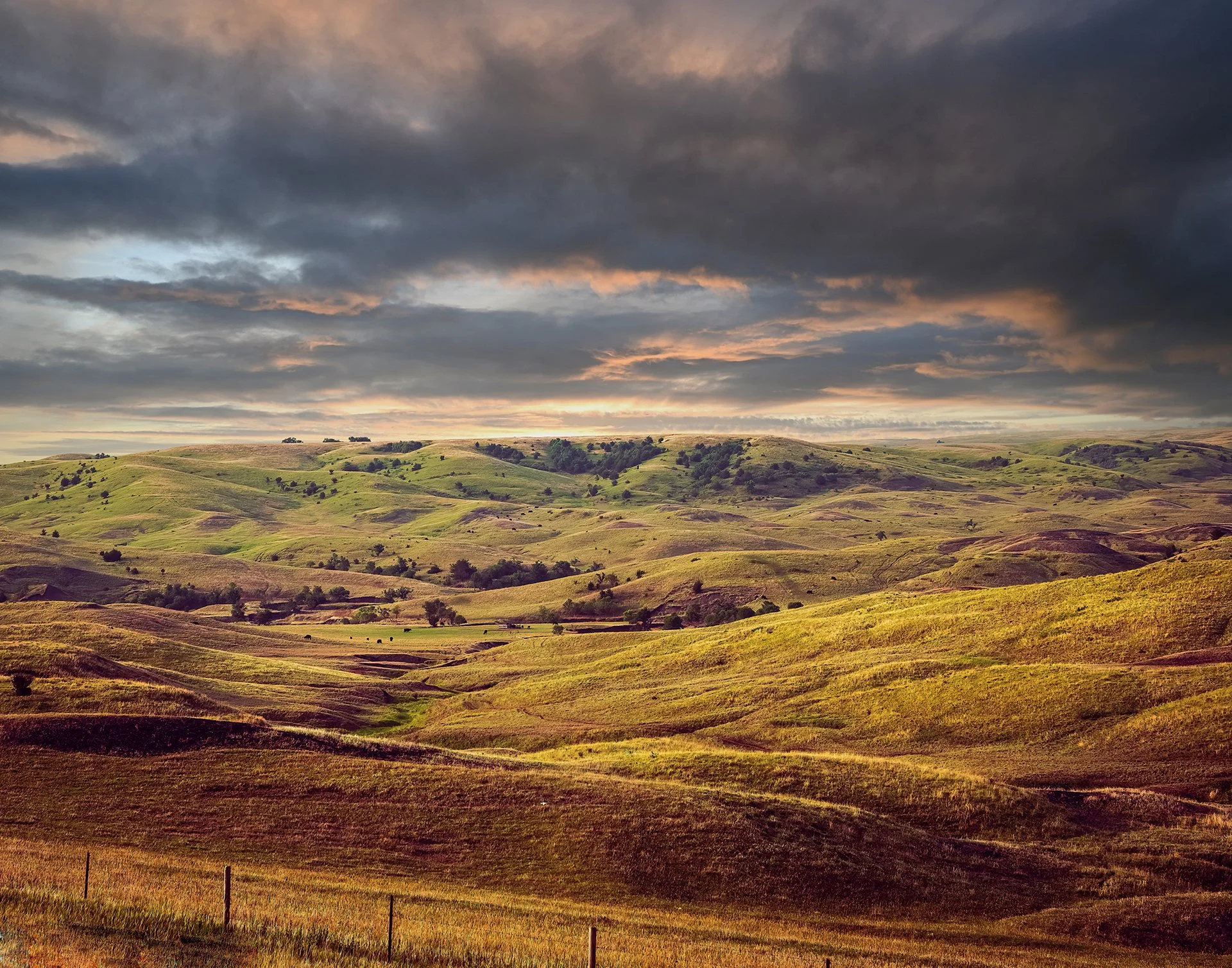
“Anybody can love the mountains, but it takes a soul to love the prairie.”
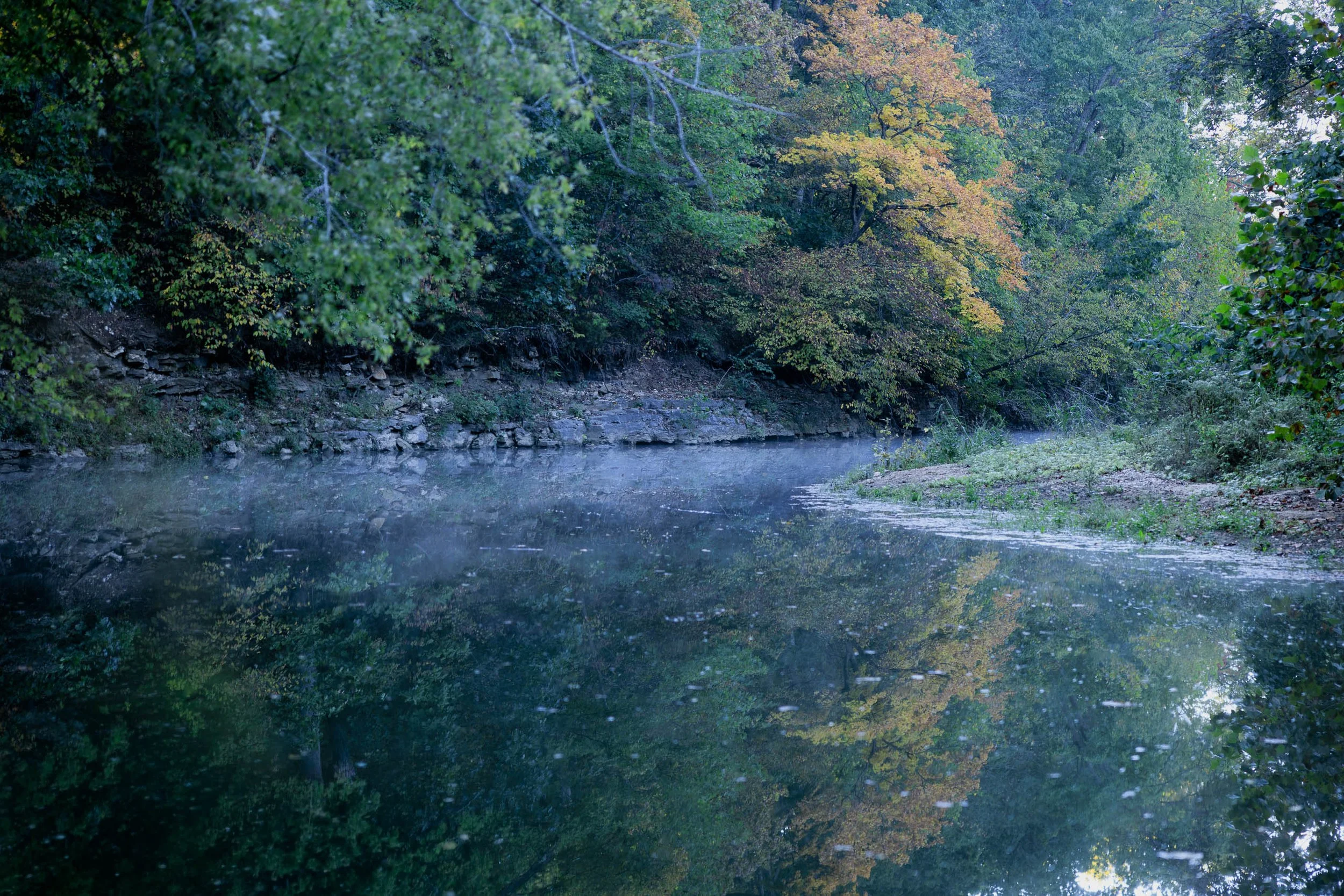
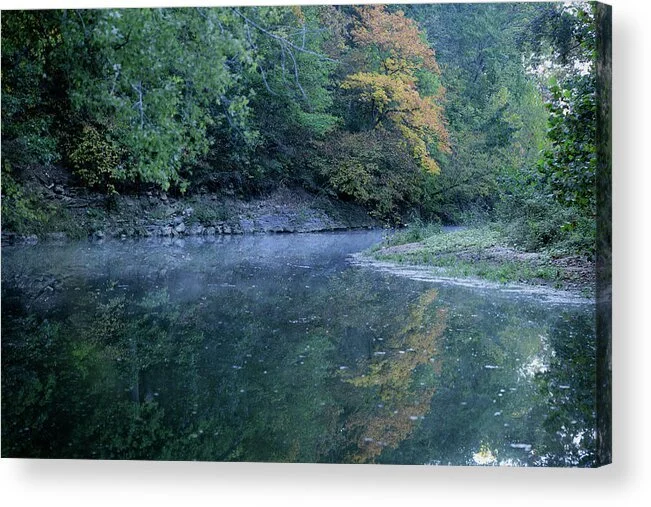
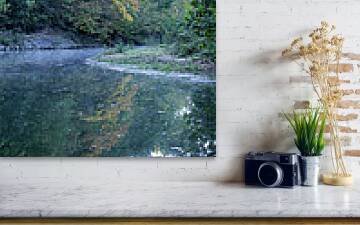
Autumn arrives quietly on the water first. Before the Mist Lifts holds a single turning maple, amber against forest green, and its reflection in the still surface of Peruque Creek at Quail Ridge Park in Wentzville, Missouri, while a thin band of mist still lies along the far limestone bank.
The creek enters from the right and bends left along the bank, and the eye follows it before settling on the maple and the long amber column of its reflection below. Floating specks of leaf and pollen on the dark water break the surface into small points of light. The scene has no drama in it. The light is soft, the water is nearly black, and the maple is the one warm thing in the frame.
This is quiet, atmosphere-first landscape photography in the tonalist tradition, with some of the muted autumn palette of Andrew Wyeth. It asks for slow looking and rewards it.
Design & Styling
The cool, restrained palette and calm subject suit healthcare waiting rooms and corridors, senior-living interiors, hospitality lobbies and guest rooms, and design-forward homes with warm neutrals, walnut or leather. As a Missouri image, it is a natural gift or keepsake for anyone with ties to St. Louis and St. Charles County.
Curated Pairings
For shared subject: Pair with Where the Water Runs Clear, another backcountry creek, here in summer amber and green in Yellowstone.
For shared formal treatment: Pair with Where the Lake Curves, which holds still on a clear surface in the same way and follows the curve of a shoreline.
For shared place and hour: Pair with Dawn at the Meramec River, also Missouri water at first light, in cooler tones.
For shared idea: Pair with Where the Water Waited, where still water holds the surrounding forest and the last of the light.
Fine Art Presentation
Available as a signed, numbered limited edition print (edition of 15) in Gallery Metal, ChromaLuxe® Metal, TruLife Acrylic, archival paper, canvas, and wood. TruLife (Low-Glare) Acrylic is the first recommendation, since it deepens the dark water and gives the mist and the amber reflection real luminosity. Archival paper, framed, suits the soft tonal transitions in a more traditional presentation. ChromaLuxe® Metal is a crisp, cooler alternate.
Note: Custom and oversized photographic prints are available. Please contact the studio directly to discuss custom framing, matting, or specialized museum glass options.
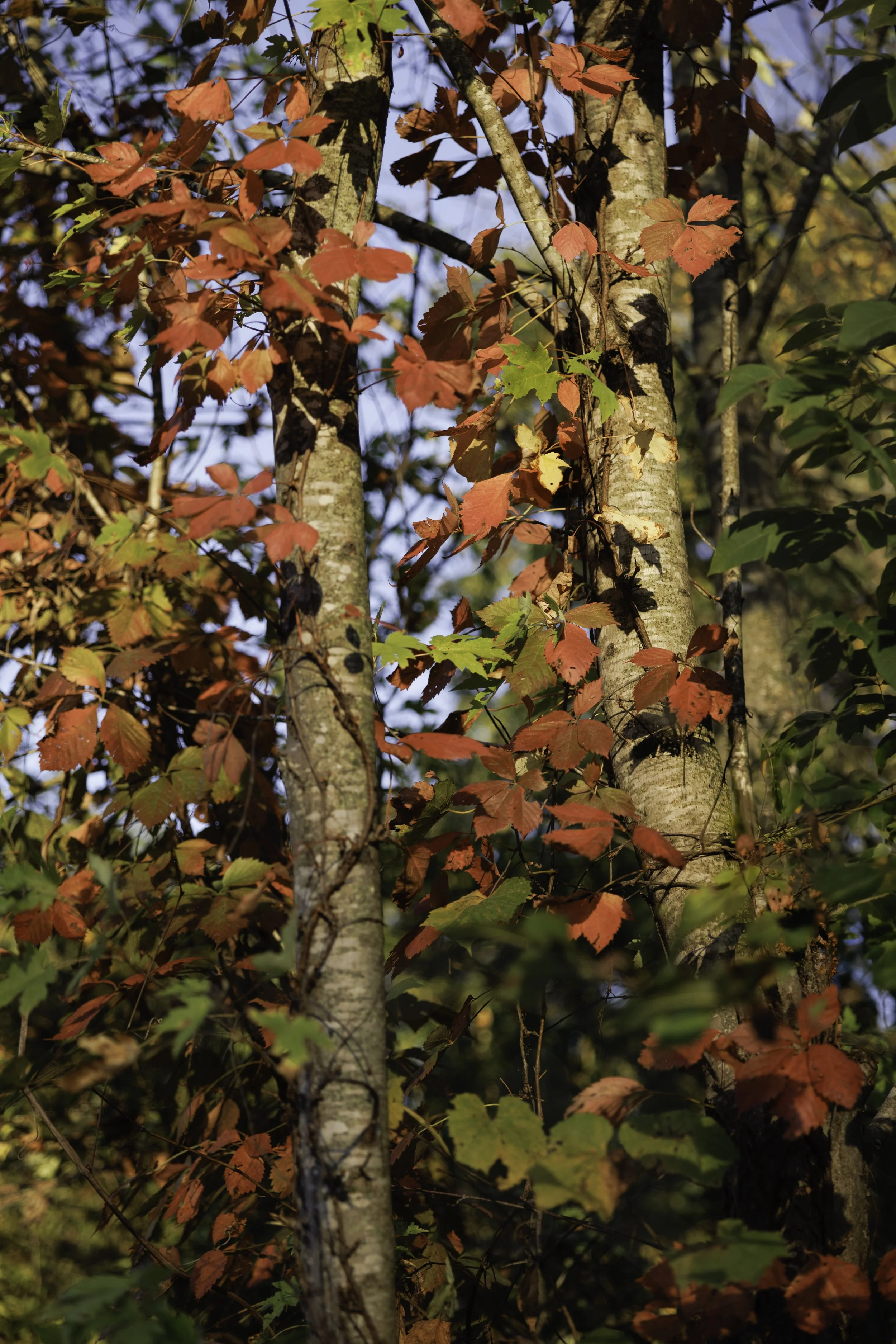
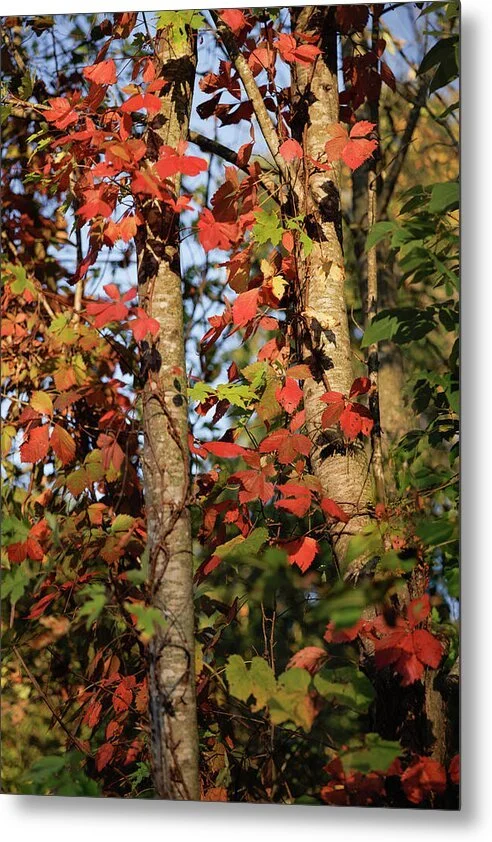
Autumn rarely arrives all at once. It climbs. Where the Red Climbs follows Virginia creeper in rust-orange and forest green as it winds up two pale trunks at Quail Ridge Park in Wentzville, Missouri, turning first in a wood that is still mostly green.
The vine spirals up the left trunk, crosses the center, and then runs as a diagonal of backlit red leaves toward the second trunk, where low sun catches the bark. Small gaps of blue sky open between the leaves, and the dark woods behind them make each leaf glow. The eye follows the climb rather than landing on one leaf, and finds a new leaf each time it looks.
This is close, color-forward woodland photography in the lineage of Eliot Porter and Ernst Haas, attentive to how light moves through a small piece of forest. It does not announce a subject. It rewards looking.
Design & Styling
The warm, restrained palette suits hospitality guest rooms and lobbies, healthcare and senior-living corridors and waiting rooms where a calm nature image is preferred, and design-forward homes with walnut, leather or warm-neutral walls. As a Missouri image, it is a natural gift or keepsake for anyone with ties to St. Louis and the surrounding woods.
Curated Pairings
For shared subject, in black and white: Pair with What the Bark Remembers, where a single pale trunk is lit against dark woods, the same device in monochrome.
For shared vertical rhythm: Pair with Aspen Curtain, which renders pale trunks as streaks of light and motion where this image holds them sharp.
For shared place: Pair with Held by the River, a quieter Missouri landscape that rewards the same slow looking.
For shared light: Pair with Where Morning Lingers, a close study of foliage glowing in low backlight.
Fine Art Presentation
Available as a signed, numbered limited edition print (edition of 15) in Gallery Metal, ChromaLuxe® Metal, TruLife Acrylic, archival paper, canvas, and wood. ChromaLuxe® Metal is the first recommendation: its saturation and clarity hold the rust-orange against the deep green and keep the bark texture crisp. TruLife (Low-Glare) Acrylic is a strong alternate that deepens the glow of the backlit leaves. Archival paper, framed, gives a quieter, more traditional look.
Note: Custom and oversized photographic prints are available. Please contact the studio directly to discuss custom framing, matting, or specialized museum glass options.
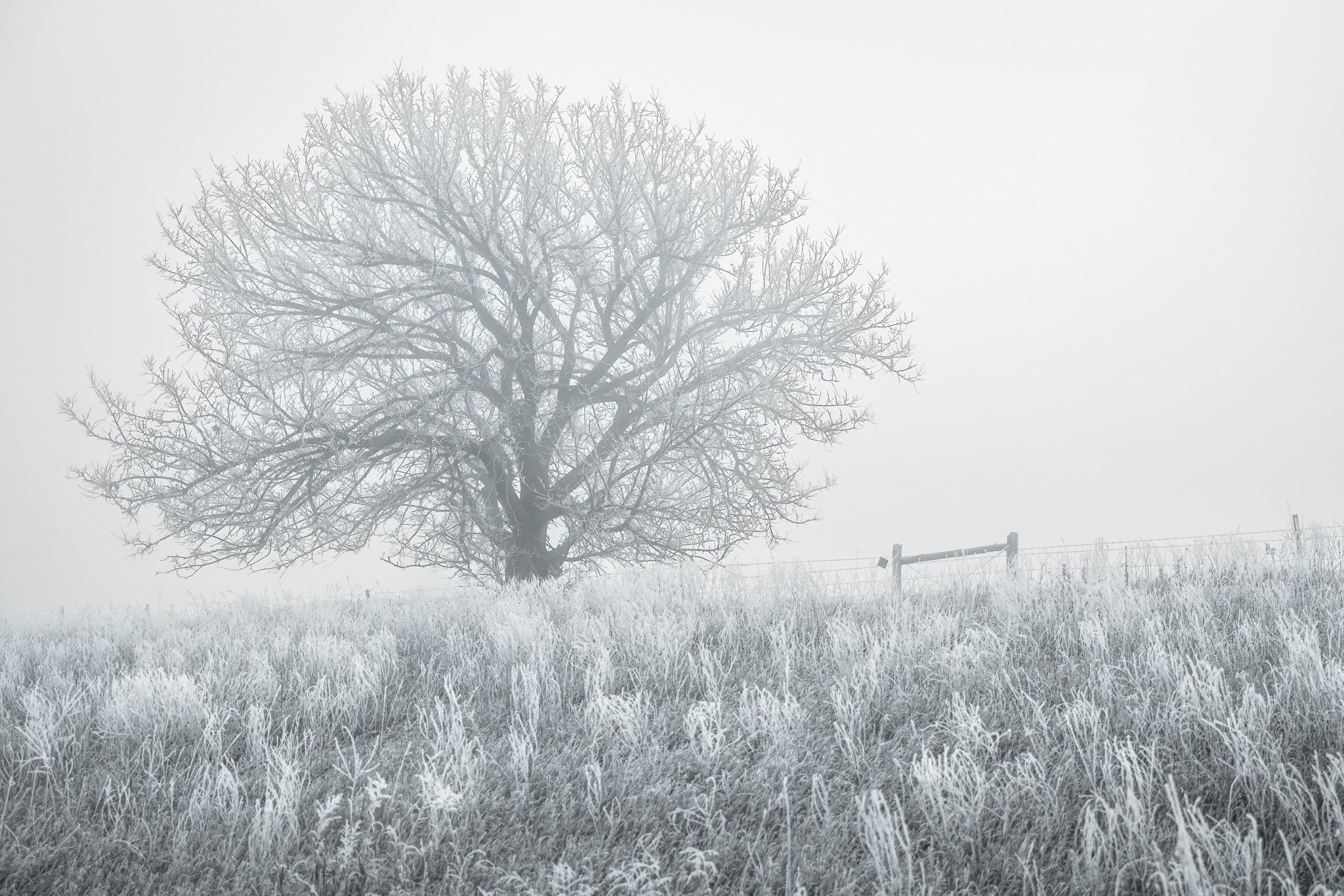
Hoarfrost, Kansas is a winter photograph about what remains when the horizon disappears: a single tree, every branch coated in hoarfrost, standing in ice fog so thick the Kansas prairie dissolves into cream around it. Made near Salina in January 2024.
The crown fills the left of the frame in fine, branching detail, each twig outlined in frost. The eye enters there, follows the trunk down to the frozen grass, then runs along the wire fence to a weathered brace post on the right, where a small dark tag hangs from the wire and frosted plants stand in front of the post, details easy to miss on a first look. Nothing in the image announces itself. The tree and the fence have to be found, one after the other, in the pale space between them.
The photograph carries the restraint of Andrew Wyeth's rural winter studies, where a fence line or a field says as much as a figure, and the quiet tonal discipline of the monochrome landscape tradition. Ice fog leaves hoarfrost on everything it touches, and the cool-neutral tone lets that frost read as frost, silver and crisp, while the fog stays clean and soft.
Design & Styling
With its pale, cool-neutral palette and calm horizontal composition, Hoarfrost, Kansas suits bedrooms and reading rooms, spa and wellness interiors, lodge and boutique hotel corridors, and offices where a quiet, light-filled wall is wanted. It reads best on a wall with some breathing room, over a console or a headboard, where the soft tones can stay the subject. It is also a natural fit for Midwest homes and for anyone with ties to the Kansas prairie.
Curated Pairings
For shared place: Pair with Stillness Over Flint Hills, also made on the Kansas prairie, where layered clouds and open horizon give the same quiet register in a different season and light.
For shared concept: Complement with The Long Goodbye, which also gives a single bare tree the whole frame, set against a sunset sky where this one stands in white fog, a deliberate contrast of warm color and pale stillness.
For shared formal treatment: Pair with Between Us, the Field, where mist veils the distance and a lone farmstead holds the middle of the frame in the same muted, Wyeth-inflected register.
For shared motif: Complement with What the Tree Kept, a quiet study of a tree and a weathered iron fence, where the fence has become part of the tree over time; here the frozen fence line stands beside the tree, a different answer to how the two share a place.
Fine Art Presentation
Available as a signed, numbered limited edition print (edition of 15) in ChromaLuxe® Metal, TruLife Acrylic, archival paper, canvas, and wood presentation formats. Because the sky is nearly paper white, the image can lose its edge on a white wall, so framed archival paper with a warm white mat is the strongest presentation: the mat holds the border and the paper's matte surface keeps the frost texture soft. Canvas suits the diffuse, fog-softened tones as an alternative. On ChromaLuxe® Metal, a matte or semi-gloss finish is recommended over gloss so reflections do not compete with the pale tonal gradations.
Note: Custom and oversized photographic prints are available. Please contact the studio directly to discuss custom framing, matting, or specialized museum glass options.

What the Tree Kept is a quiet study of time, endurance, and the unexpected ways nature absorbs the traces of human activity. Photographed in a residential neighborhood, the image centers on a section of weathered wrought iron fence that has become partially engulfed by the trunk of a mature tree. What was once a clear boundary now exists as a relic, slowly reclaimed by growth and transformed into something neither wholly natural nor entirely man-made.
The photograph explores the tension between permanence and change. The forged iron pickets, designed to resist weather and mark a property line, stand in contrast to the living tree that has gradually enveloped them. Decades of growth have altered the relationship between the two, creating a visual record of time's passage. The bark's intricate texture echoes the roughened surface of the iron, allowing the materials to appear increasingly connected despite their very different origins.
Rather than presenting a dramatic landscape or architectural subject, the image invites close observation of an ordinary scene. The shallow depth of field isolates the fence and trunk from the surrounding environment, encouraging viewers to consider the quiet narratives embedded within familiar places. Influenced by the observational traditions of photographers such as Andrew Wyeth's visual sensibility and the contemplative studies of rural American subjects, the photograph becomes an exploration of memory, persistence, and the gradual reshaping of human intentions by the natural world.
Design & Styling
A wrought iron fence swallowed by a tree makes What the Tree Kept a quiet, thoughtful piece for studies, libraries, garden rooms, and homes with old trees and older stories. Its earthy textures suit natural wood, stone, and linen.
Curated Pairings
To create a cohesive gallery wall around endurance and what the years leave behind, consider these companion pieces:
For thematic continuity: Pair with What Remains, continuing an exploration of aging structures, memory, and the persistence of place.
For weathered artifacts: Complement with Hanging On, Creede, Colorado, a dialogue between weathered human artifacts and the forces that shape them over time.
For endurance across time: Pair with Where the Homestead Waits, extending themes of endurance, history, and the quiet passage of time across the American landscape.
Fine Art Presentation
Available as a signed fine art print on ChromaLuxe® Metal (gloss, semi-gloss, or matte), Glossy Anti-Glare Acrylic (TruLife), canvas, wood, and archival paper (framed or unframed). Wood is the recommended presentation: its grain complements the bark texture and the weathered iron. Framed archival paper is the alternative for a quieter, more traditional read, and canvas for a softer, more painterly texture.
Note: Custom and oversized photographic prints are available. Please contact the studio directly to discuss custom framing, matting, or specialized museum glass options.
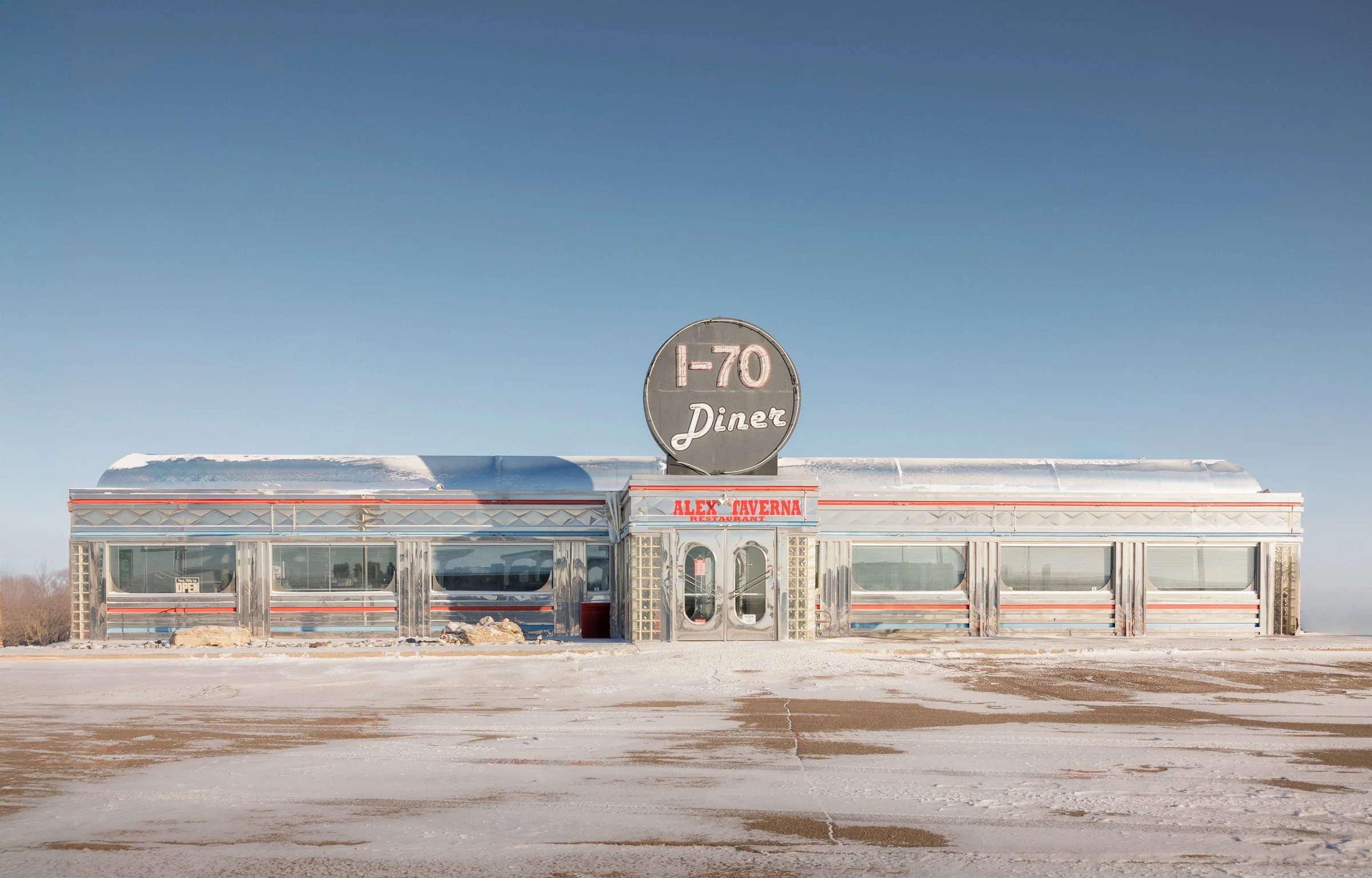
Between the Exits is a study of solitude, memory, and the fading landmarks of the American roadside. Photographed along Interstate 70 during winter, the image centers on an empty diner standing quietly beneath a cold sky, its presence softened by patches of snow and the stillness of the season. Once a place of movement, conversation, and passing travelers, the building now exists in a quieter state—suspended between past and present. Drawing inspiration from the cinematic observations of Wim Wenders and the quiet emotional realism of Edward Hopper, the photograph explores the atmosphere of places that remain long after the crowds have moved on.
The composition balances the diner against the openness of the surrounding landscape, emphasizing both isolation and endurance. Winter light and subdued tones reduce the scene to its essential forms, allowing the structure itself to carry the emotional weight of the image. The nearby interstate remains unseen but implied, a reminder of the movement that once defined the location. Rather than focusing on abandonment alone, the photograph reflects on transition and memory, capturing the lingering presence of a place caught between usefulness and nostalgia.
The result is a photograph that celebrates the quiet poetry of the American road—an image rooted in atmosphere, observation, and the stories that gather around overlooked places.
Design & Styling
An empty diner under a cold winter sky gives Between the Exits a quiet, cinematic loneliness for home offices, dens, restaurants, and any space that loves Americana. Its cool tones suit gray, charcoal, and pale walls.
Curated Pairings
To create a cohesive gallery wall around the American roadside, consider these companion pieces:
For roadside atmosphere: Pair with The Long Way West, extending the themes of travel, distance, and the emotional landscape of the American road.
For quiet observation: Complement this piece with The Bartender's Measure (Color), sharing the same sense of quiet observation, human absence, and cinematic atmosphere.
For the highway at night: Pair with Exit 280, Interstate 64 in St. Louis after dark, another view of a road that carries more than it shows.
Fine Art Presentation
Available as a signed fine art print on ChromaLuxe® Metal (gloss, semi-gloss, or matte), Glossy Anti-Glare Acrylic (TruLife), canvas, wood, and archival paper (framed or unframed). Framed archival paper is the recommended presentation: its matte surface suits the subtle winter tones and the muted, cinematic atmosphere of a snow-patched roadside. ChromaLuxe® Metal is the alternative for crisper architectural detail.
Note: Custom and oversized photographic prints are available. Please contact the studio directly to discuss custom framing, matting, or specialized museum glass options.
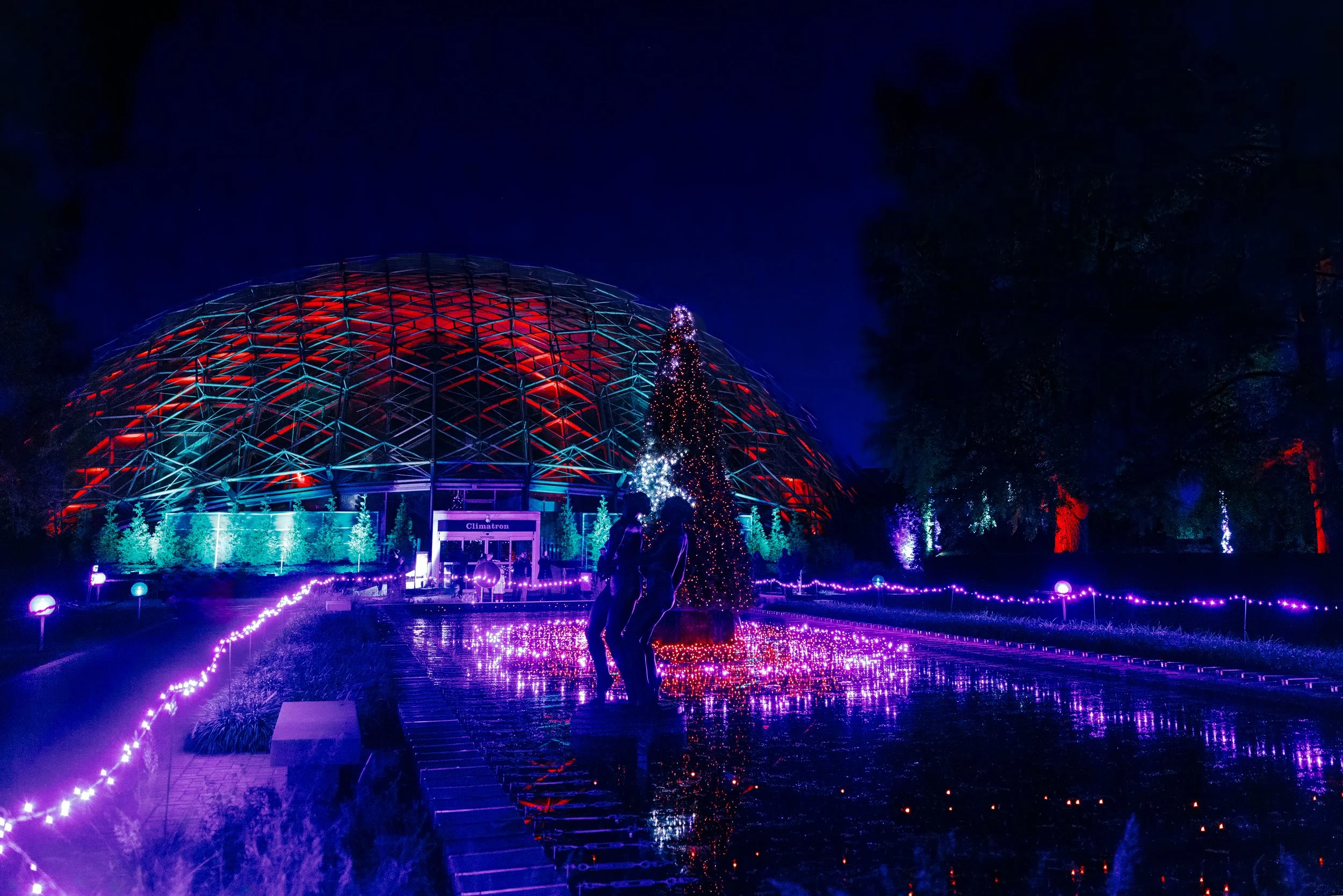
As the Glow Ends is a study of light, atmosphere, and the quiet transformation of architecture after dark. Photographed at the Missouri Botanical Garden in St. Louis, Missouri, the image captures the iconic Climatron illuminated against the night sky as the final traces of daylight disappear. The glowing geodesic structure emerges from the darkness like a lantern within the landscape, revealing a striking balance between technological innovation and natural beauty. Drawing inspiration from the luminous color sensibilities of Ernst Haas and the contemplative urban atmospheres found in the work of Wim Wenders, the photograph explores the emotional character of a place suspended between day and night.
The composition emphasizes the Climatron's distinctive geometric form while allowing light itself to become the primary subject. The illuminated structure stands in contrast to the surrounding darkness, creating a visual tension between transparency and mystery, presence and absence. Familiar during daylight hours, the Climatron takes on an entirely different personality at night, becoming less a botanical conservatory and more a beacon of light within the landscape.
Rather than functioning solely as an architectural study, the photograph reflects on transition—the quiet moment when public spaces become still and architecture begins to reveal a more intimate character. The result is an image that celebrates both the innovative design of the Climatron and the atmospheric beauty of St. Louis after dark.
Design & Styling
The Climatron glowing like a lantern against the night sky makes As the Glow Ends a strong fit for hospitality lobbies, corporate and institutional offices, science and garden organizations, and St. Louis homes. Dark walls make the glow read as light.
Curated Pairings
To create a cohesive gallery wall around St. Louis after dark, consider these companion pieces:
For complementary architectural atmosphere: Pair with Evening at the Pavilion, two iconic St. Louis landmarks transformed by evening light.
For tonal harmony: Complement this piece with Blue Interval, sharing the same fascination with contemporary architecture, reflection, color, and the changing character of light.
For the city after dark: Pair with Crowned in Light, the Gateway Arch and Old Courthouse beneath fireworks, another luminous St. Louis night.
Fine Art Presentation
Available as a signed fine art print on ChromaLuxe® Metal (gloss, semi-gloss, or matte), Glossy Anti-Glare Acrylic (TruLife), canvas, wood, and archival paper (framed or unframed). Acrylic is the recommended presentation: its depth and luminosity suit a glowing geodesic structure emerging from the dark and the last blue of the sky. ChromaLuxe® Metal is the alternative for crisper architectural detail.
Note: Custom and oversized photographic prints are available. Please contact the studio directly to discuss custom framing, matting, or specialized museum glass options.
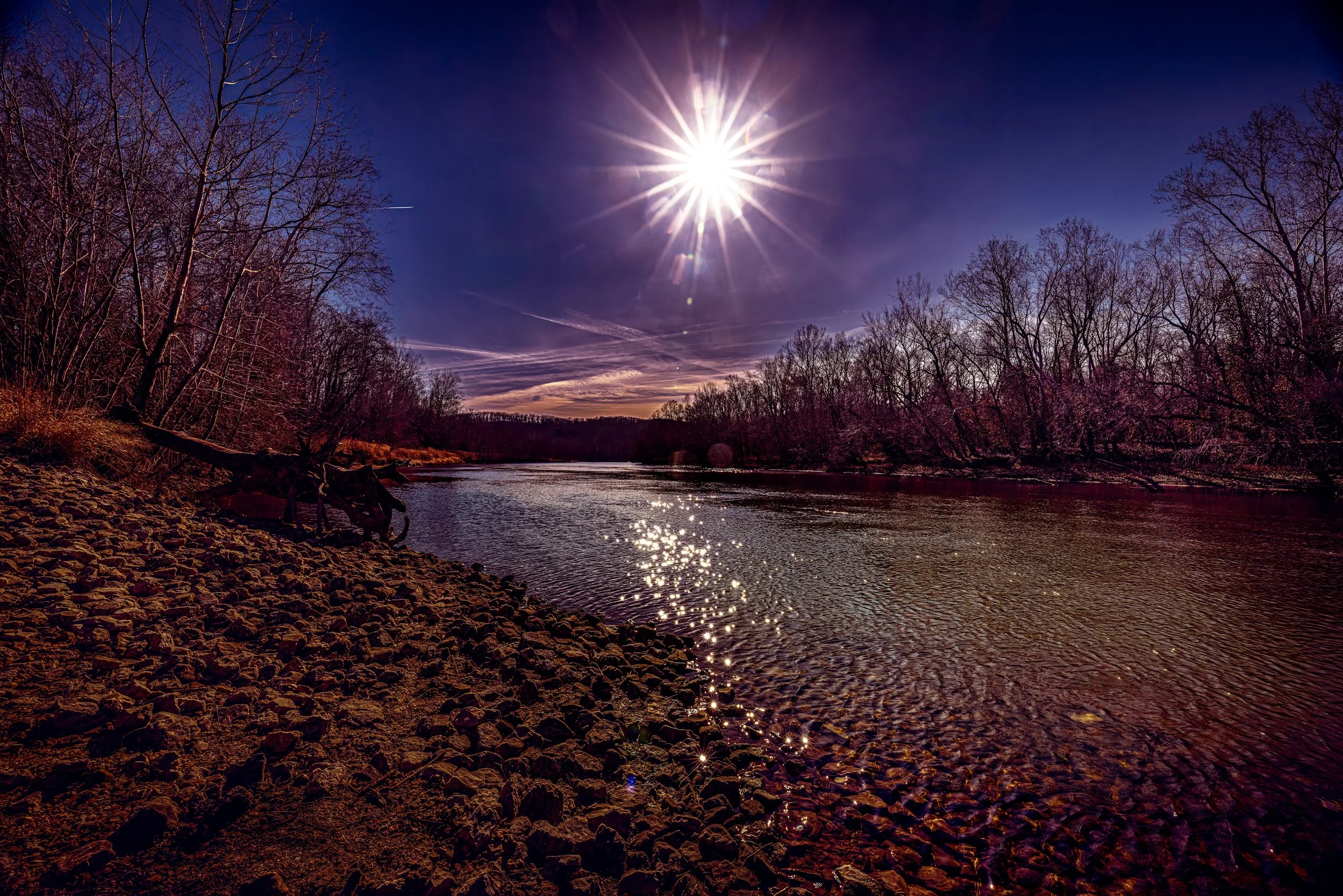
Dawn at the Meramec River is a study of stillness, reflection, and the subtle transition between night and day. Photographed during blue hour along the Meramec River in Missouri, the image captures the landscape in a brief interval when the world is illuminated not by direct sunlight, but by the soft, atmospheric glow that precedes sunrise. Cool tones, gentle reflections, and the quiet presence of the river combine to create a scene that feels suspended between darkness and morning. Drawing inspiration from the contemplative landscapes of Hiroshi Sugimoto and the atmospheric color sensibilities of Ernst Haas, the photograph explores the restorative qualities of light, water, and time.
The composition balances the calm surface of the river against the surrounding landscape, allowing reflections and subtle tonal transitions to become central elements of the image. The absence of dramatic sunlight encourages attention to quieter details—the movement of water, the layering of color, and the sense of anticipation that accompanies the arrival of a new day. Rather than emphasizing spectacle, the photograph embraces restraint, inviting viewers to slow down and experience the landscape as it gradually awakens.
The result is a photograph that celebrates the beauty of ordinary moments and the profound sense of calm that can be found within the natural rhythms of the landscape.
Design & Styling
The cool tones and gentle reflections of Dawn at the Meramec River bring a calm, restful atmosphere to bedrooms, spas, waiting areas, offices, and living rooms, especially for Missouri homes near the water. It suits soft gray, blue, and white palettes.
Curated Pairings
To create a cohesive gallery wall around still water and first light, consider these companion pieces:
For river atmosphere: Pair with Where Winter Waited, extending themes of reflection, stillness, and the restorative qualities of water within the landscape.
For tonal harmony: Complement this piece with Enduring Silence, sharing the same contemplative pacing and emphasis on quiet discovery.
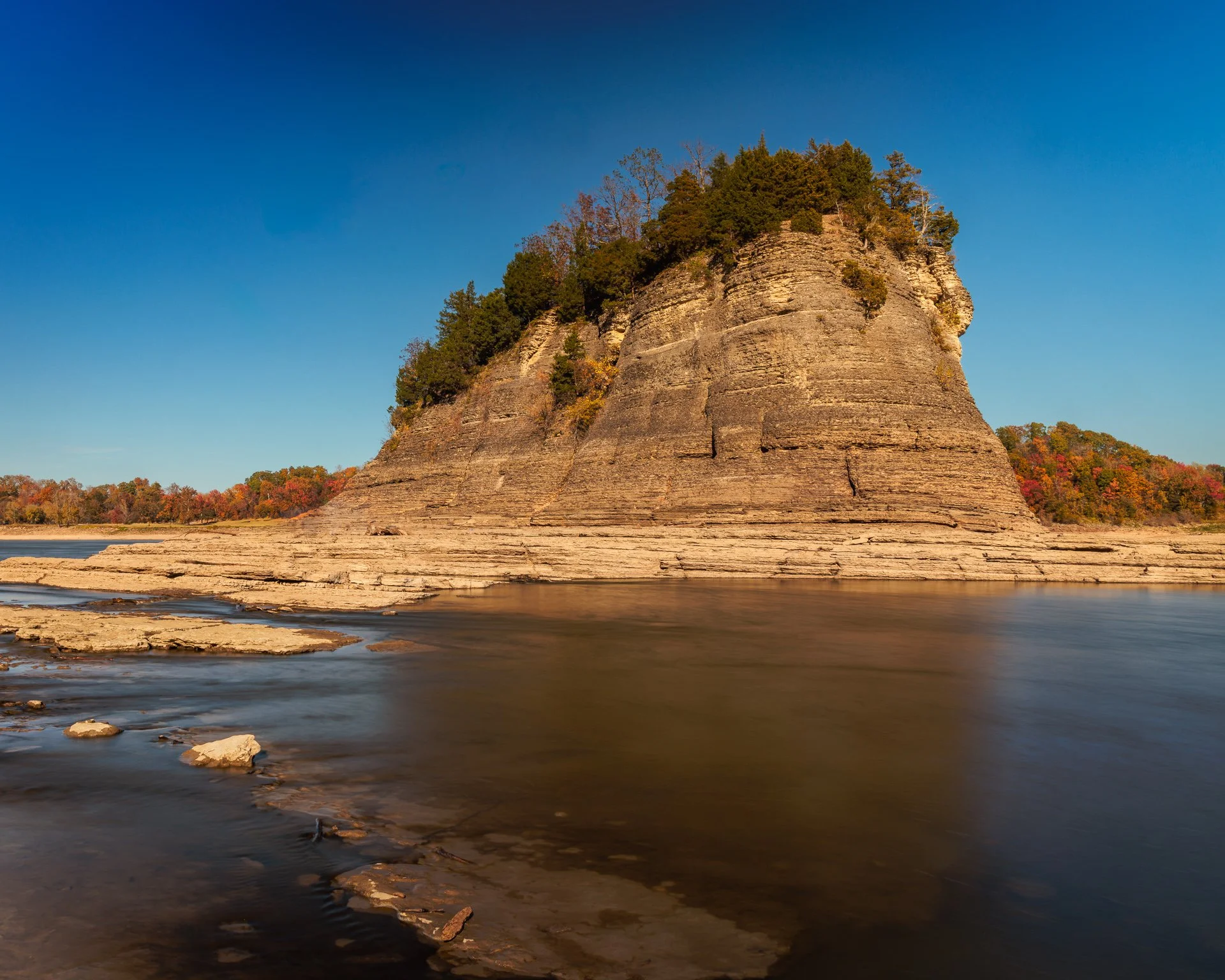
For Missouri waterways: Pair with Held by the River, the Mississippi at Tower Rock, another Missouri river in its own light.
Fine Art Presentation
Available as a signed fine art print on ChromaLuxe® Metal (gloss, semi-gloss, or matte), Glossy Anti-Glare Acrylic (TruLife), canvas, wood, and archival paper (framed or unframed). Acrylic is the recommended presentation: its depth and luminosity suit blue-hour tonal transitions and the reflective detail of still water. Framed archival paper is the alternative for a softer, more restful read.
Note: Custom and oversized photographic prints are available. Please contact the studio directly to discuss custom framing, matting, or specialized museum glass options.
Held by the River is a study of permanence, landscape, and the enduring forces that shape the American heartland. Photographed at Tower Rock along the Mississippi River in Perry County near Wittenberg, Missouri, the image centers on one of the region's most distinctive natural landmarks. Rising from the river that has flowed around it for centuries, Tower Rock stands as a symbol of endurance against the constant movement of water, weather, and time. Drawing inspiration from the formal clarity of Ansel Adams and the contemplative atmosphere found in the work of Hiroshi Sugimoto, the photograph explores the relationship between permanence and change within the natural landscape.
The composition balances the solid mass of the rock against the flowing character of the river, allowing the contrast between movement and stability to become the central theme of the image. Light, reflection, and atmosphere work together to emphasize the rock's commanding presence while revealing the quieter beauty of the surrounding landscape. The river serves as both setting and participant, continuously shaping the environment while the ancient formation remains anchored within it.
Rather than presenting Tower Rock as simply a geological feature, the photograph explores its role as a witness to history—standing through changing seasons, shifting river levels, and generations of travelers who have passed along the Mississippi. The result is an image rooted in place, inviting reflection on resilience, continuity, and the enduring power of the natural world.
Design & Styling
Tower Rock rising from the Mississippi gives Held by the River a grounded sense of permanence for offices, lodges, river homes, civic buildings, and Midwest hospitality spaces. Its muted tones suit natural stone, wood, and neutral walls.
Curated Pairings
To create a cohesive gallery wall around landscape and permanence, consider these companion pieces:
For river atmosphere: Pair with Dawn at the Meramec River, two distinct expressions of Missouri waterways and their relationship to light and landscape.
For contemplative permanence: Complement this piece with Enduring Silence, sharing the same contemplative pacing and sense of permanence.
For a single form that stands alone: Pair with Sentinel of the Plain, a lone butte in black and white, another landmark that outlasts everything around it.
Fine Art Presentation
Available as a signed fine art print on ChromaLuxe® Metal (gloss, semi-gloss, or matte), Glossy Anti-Glare Acrylic (TruLife), canvas, wood, and archival paper (framed or unframed). Framed archival paper is the recommended presentation: its matte surface preserves the atmospheric detail and tonal richness of a river landmark. ChromaLuxe® Metal is the alternative for crisper rock texture.
Note: Custom and oversized photographic prints are available. Please contact the studio directly to discuss custom framing, matting, or specialized museum glass options.
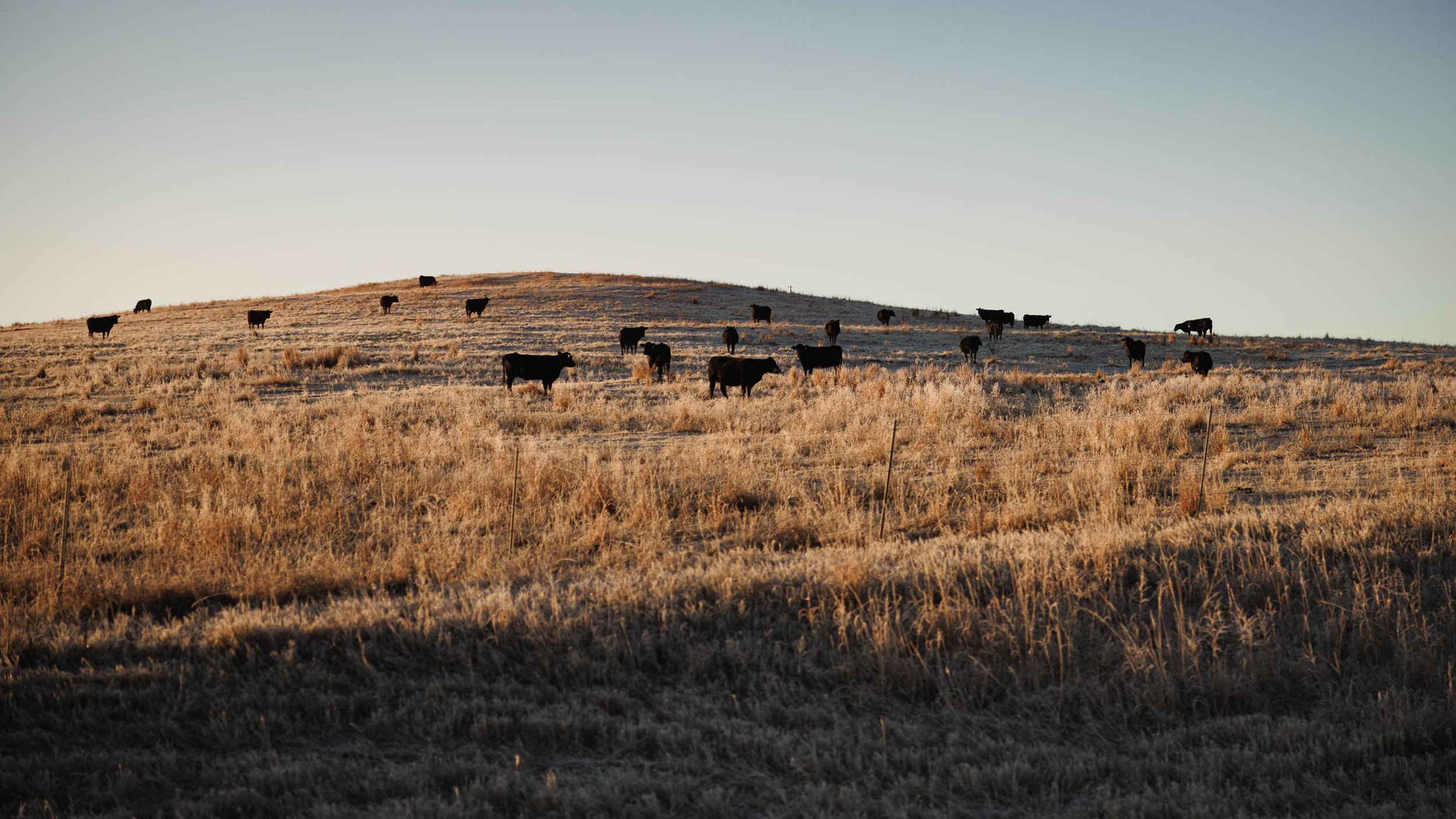
Frostline, Kansas is a winter photograph about the hour when frost still holds the prairie: a herd of black cattle standing along the crest of a hill, the grass beneath them lit to amber, and a pale blue sky above. Made in Kansas in January 2024.
The herd runs along the ridge in small groups, with three larger animals near the center of the frame. The eye settles there first, travels the skyline in both directions, then drops through the golden grass toward the foreground, where a thin wire fence and four slim posts cross the field, easy to miss on a first look. The low light does the rest. It catches the frost on every blade of grass and leaves the cattle as dark, unhurried shapes.
The photograph carries the restraint of Andrew Wyeth's dry-grass hillsides, where a field and a fence line say as much as a figure would. Frost lays a pale silver glaze over the amber, and the cool sky keeps the warm color from tipping into sentiment.
Design & Styling
With its warm amber ground, cool sky and wide 16:9 proportions, Frostline, Kansas suits long walls: over a sofa or fireplace in a ranch or lodge home, along a restaurant banquette, in a boutique hotel lobby, or across the wall of an office or conference room. The amber works with leather, walnut and warm neutrals, and the pale blue sky ties to slate, denim and soft gray textiles. It is a natural fit for Midwest homes and for anyone with ties to the Kansas prairie.
Curated Pairings
For shared subject: Pair with Standing Ground, also cattle on the Kansas prairie, where a single red cow stands out against the black herd, a close look at one animal where this image steps back to the whole ridge.
For shared place: Complement with The Day the Prairie Paused, another Kansas prairie in soft, atmospheric light, where the land is the subject and the eye is given room to rest.
For shared color: Pair with Woven Gold, where grass and gold are pulled into an abstraction by camera movement, the same warm palette as the hillside here, taken from literal to painterly.
For deliberate contrast: Complement with Where Winter Waited, I Fished, a cold white storm with a single red ice-fishing tent, set against this image's warm frost and living herd: two winters, one pale and one golden, each with a small presence in a very large landscape.
Fine Art Presentation
Available as a signed, numbered limited edition print (edition of 15) in ChromaLuxe® Metal, TruLife Acrylic, archival paper, canvas, and wood presentation formats. ChromaLuxe® Metal is the strongest choice: the amber stays saturated, the frost keeps its fine detail, and the silhouetted cattle stay deep black. TruLife Acrylic, in a low-glare finish, suits a lit wall where the glow of the grass is the point. Framed archival paper is the quieter option and keeps the frost texture soft. A matte or semi-gloss finish is recommended on metal so reflections do not interrupt the long horizon.
Note: Custom and oversized photographic prints are available. Please contact the studio directly to discuss custom framing, matting, or specialized museum glass options.
Color & Atmosphere
Color & Atmosphere
Filters
No results found
No results match your search. Try removing a few filters.
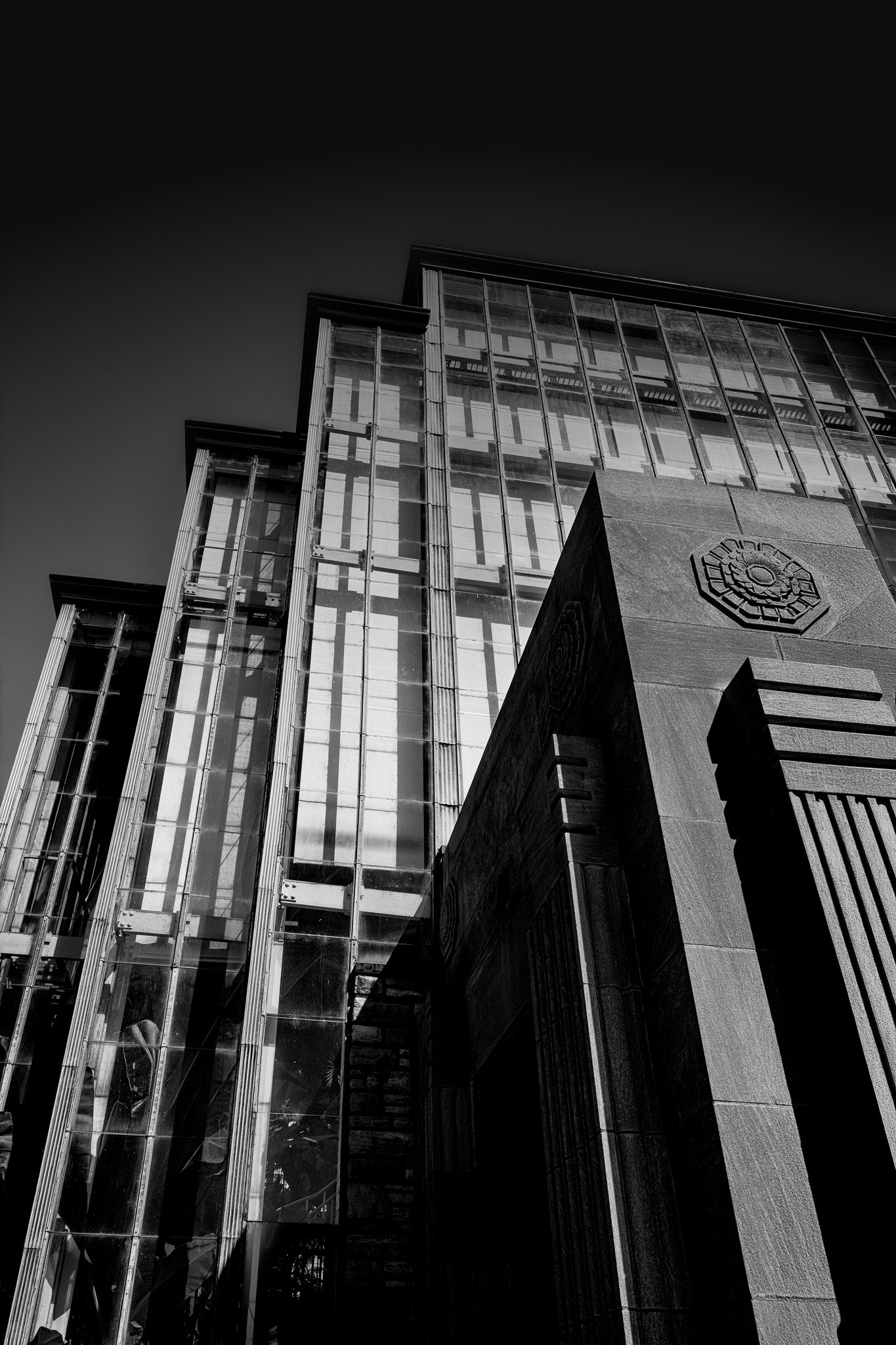
Silver-gray glass and illuminated stone rise against a charcoal sky at the Jewel Box in Forest Park, St. Louis. Seen from below, four stepped rooflines establish an ascending rhythm, while the carved stone entrance gives the foreground weight and texture.
The monochrome photograph brings transparency and solidity into the same frame. Through the glass, repeated structural panels create a layered pattern of light and shadow. Beside them, the entrance’s ornament and projecting stonework become sculptural forms. The upward viewpoint reveals the building through its geometry, making an arrival at a familiar landmark an invitation to look more closely.
Design & Styling
This vertical architectural study suits contemporary living spaces, architectural offices, and hospitality interiors. Its monochrome palette connects naturally with stone, concrete, metal, and neutral furnishings. The stepped silhouette reads across a room, while the glass framework and carved detail reward closer attention.
Curated Pairings
Vertical Interval — An upward architectural view whose repeated structures complement the Jewel Box’s rhythm of ascent.
Within the Nave — A monochrome St. Louis companion, contrasting this sunlit exterior with the quiet scale and shadows of a cathedral interior.
Steel Echoes — Repeating steel circles offer a curved, colorful counterpoint to the Jewel Box’s angular glass and stone.
Fine Art Presentation
Framed archival paper is a strong choice for the photograph’s tonal transitions and stone texture. ChromaLuxe® Metal, available in gloss, semi-gloss, or matte, emphasizes the clean structural lines and contrast. Acrylic offers additional visual depth in the layered glass facade.
Note: Custom and oversized photographic prints are available. Please contact the studio directly to discuss custom framing, matting, or specialized museum glass options.
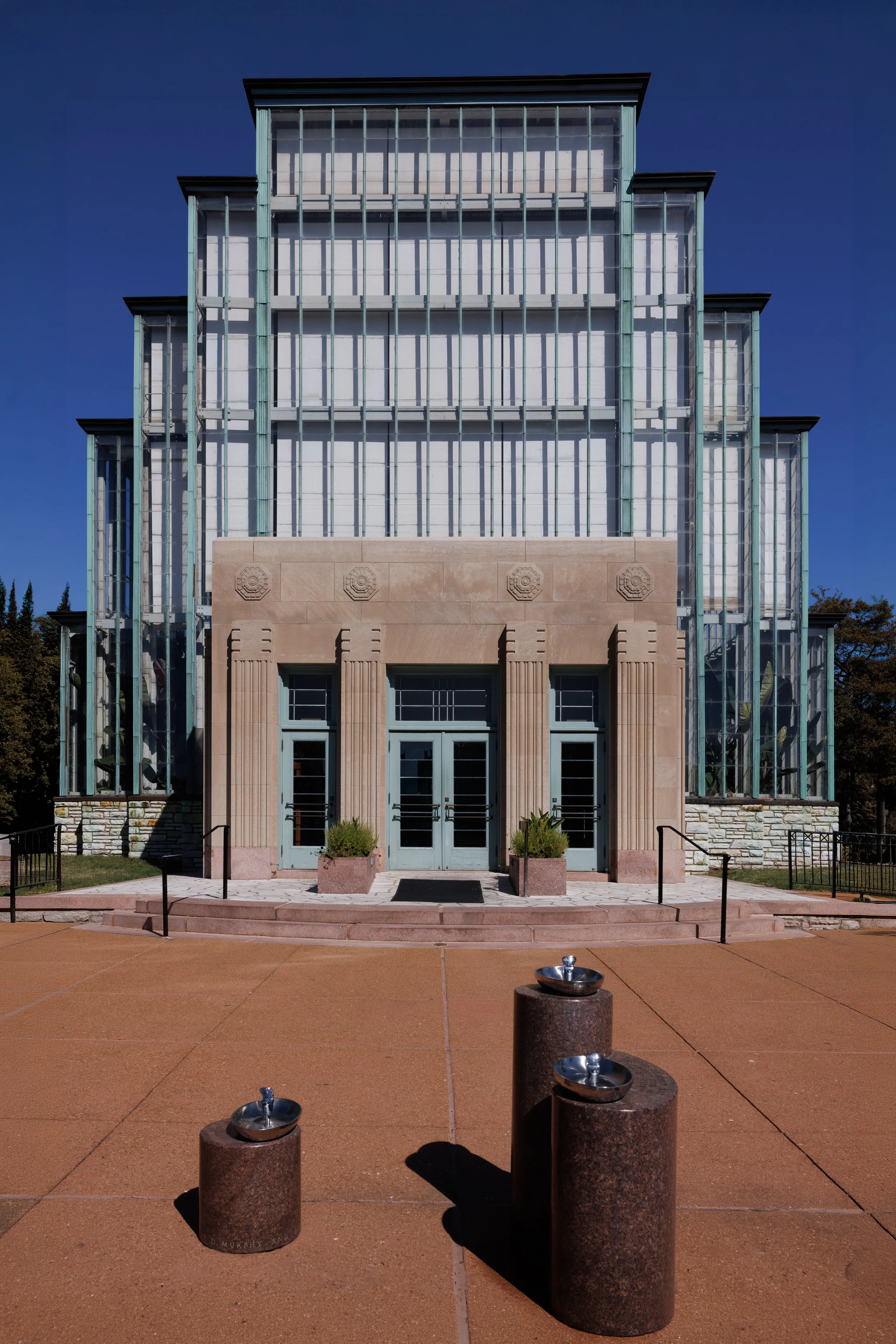
Deep blue sky and terracotta pavement frame the Jewel Box entrance in Forest Park, St. Louis. The stepped glass façade rises above pale stone columns and blue-green doors, while three drinking fountains occupy the foreground. Their polished bowls catch the daylight, introducing rounded forms beneath the building’s repeated vertical lines.
The fountains are part of the portrait. Their different heights establish a smaller rhythm in front of the rising roofline, and their substantial stone bases cast distinct shadows across the pavement. They bring the scale of the photograph back to an everyday encounter: approaching the doors, pausing for water, spending time in the park.
No visitors appear, but the entrance remains a place built for people. Doors, steps, handrails, planters, and fountains describe how the landmark is used as well as how it looks. At the Jewel Box Entrance brings those ordinary details into a formal daylight view of a familiar St. Louis building.
Design & Styling
The vertical composition suits an entryway, an office, or a narrower wall where the building’s upward rhythm can register. Deep blue, blue-green, warm stone, and terracotta connect naturally with wood furniture, cream walls, and restrained earth tones.
The photograph offers a recognizable local subject for St. Louis homes, hospitality spaces, and architecture or design offices. For someone with memories of the Jewel Box, the direct view of its doors and approach provides a personal connection to the place.
Curated Pairings
For another view of the same landmark: Pair with Held in Glass. Its cooler pond reflection complements this close daylight portrait of the entrance and drinking fountains.
For Forest Park architecture: Pair with Evening at the Pavilion. The bandstand’s open curves and evening light contrast with the Jewel Box’s upright glass grid and sunlit stonework.
For glass, geometry, and blue: Complement with Blue Interval. Its reflected clouds and repeated window patterns extend the architectural rhythm into a more abstract view.
For a deliberate architectural comparison: Pair with El Santuario de Chimayó. Both compositions approach a centered entrance through a prominent foreground feature, setting warm building materials against deep blue sky; glass and stone here contrast with the church’s adobe forms.
Fine Art Presentation
Gallery Metal offers a clean presentation for the façade’s fine lines, carved stone, and foreground textures. ChromaLuxe® Metal in gloss, semi-gloss, or matte provides an alternative for emphasizing the blue sky and warm pavement.
Framed archival paper suits a quieter presentation, with a warm white mat and a simple frame that supports the architectural geometry. TruLife Acrylic offers additional visual depth, while canvas gives the fine detail a softer treatment.
The full composition, including all three drinking fountains, is preserved in standard vertical 2:3 proportions.
Note: Custom and oversized photographic prints are available. Please contact the studio directly to discuss custom framing, matting, or specialized museum glass options.
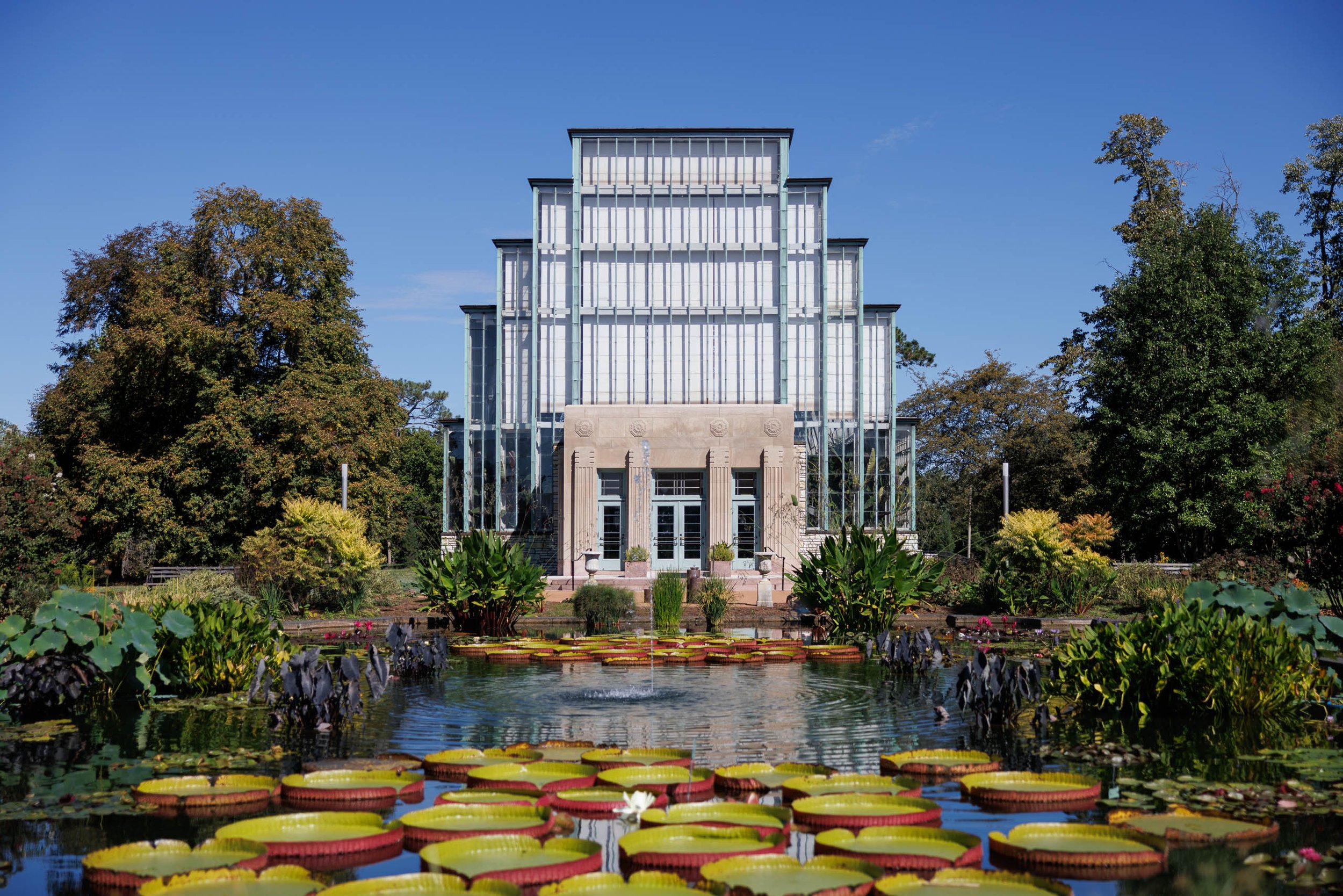
Blue sky and garden green surround the Jewel Box in this daylight photograph from Forest Park in St. Louis. The glass conservatory rises between mature trees, while broad lily pads with deep red rims spread across the foreground pond. A small fountain sends ripples through the reflected façade, connecting the building’s straight lines with the movement of water.
The centered entrance anchors the composition. Repeated glass panels climb toward the stepped roofline, while the planting opens around a clear stretch of water leading toward the doors. Near the viewer, rounded leaves and white water lilies introduce a different rhythm: overlapping, irregular, and close enough to reveal the garden’s changing textures.
The Jewel Box Garden holds the landmark within its surroundings. It offers a daylight view for those who remember the conservatory through garden visits, Forest Park walks, or celebrations connected to this familiar St. Louis place.
Design & Styling
The horizontal composition suits a wall above a sofa, console, or office credenza. Blue, green, pale stone, and burgundy-red accents work comfortably with warm neutrals, natural wood, and interiors that connect architecture with the outdoors.
For St. Louis homes, hospitality spaces, and professional offices, the recognizable building gives the photograph a local connection. The garden and fountain broaden its appeal to viewers drawn to conservatories, water gardens, and botanical subjects.
Curated Pairings
For Forest Park in different light: Pair with Evening at the Pavilion. Both photographs place Forest Park architecture beside water, with the pavilion’s evening glow offering a contrast to this garden’s clear daylight.
For another interpretation of the Jewel Box: Pair with Held in Glass. Its cooler light and emphasis on reflection complement the wider garden setting and red-rimmed lily pads here.
For architectural rhythm: Complement with Blue Interval. Reflected sky and repeated glass lines connect the two photographs, moving from a recognizable garden landmark to a closer architectural abstraction.
Fine Art Presentation
ChromaLuxe® Metal is the recommended presentation for the building’s defined glass lines and the contrasting green and burgundy tones of the lily pads. Gloss, semi-gloss, and matte finishes offer different surface treatments for the intended setting.
TruLife Acrylic is an alternative for emphasizing depth in the water and reflected architecture. Framed archival paper gives the scene a quieter presentation, especially with a warm white mat and a simple wood or dark frame. Canvas softens the fine architectural detail, while wood introduces a warmer surface character.
The complete horizontal composition is preserved in standard 3:2 proportions.
Note: Custom and oversized photographic prints are available. Please contact the studio directly to discuss custom framing, matting, or specialized museum glass options.
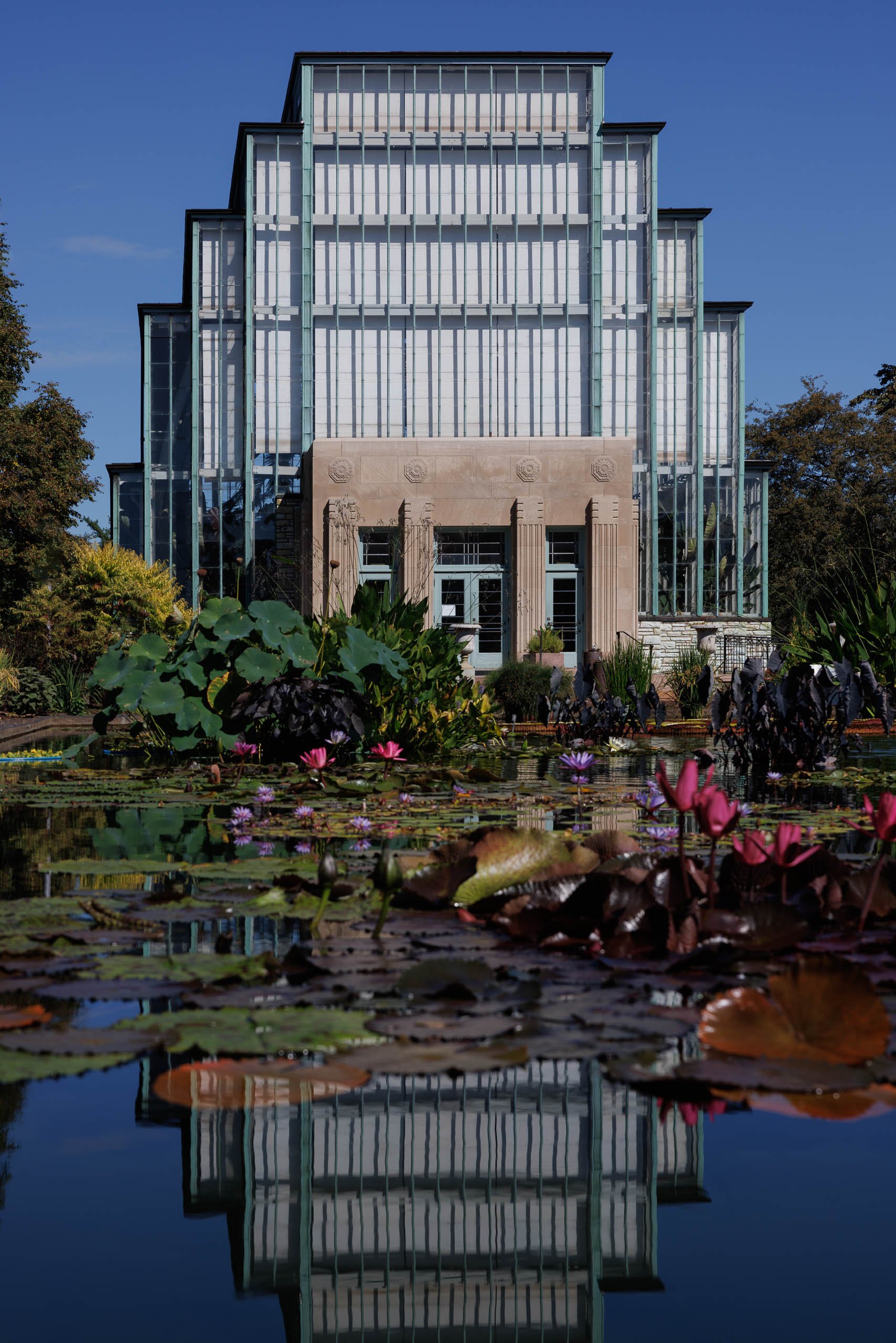
Blue sky and garden green surround the Jewel Box in this daylight photograph from Forest Park in St. Louis. Its stepped glass façade rises above a pond of lily pads and pink blossoms, then appears again in the darker water below. Pale glass, warm stone, and deep foliage give the familiar landmark a distinct presence within its garden.
The building establishes the composition’s order: repeated vertical lines, a centered entrance, and a roofline that climbs toward the middle. Across the pond, broad leaves and scattered flowers interrupt that geometry. The reflection brings the two together, carrying the architecture into the garden without losing its recognizable shape.
For those who know the Jewel Box through visits, celebrations, or everyday walks in Forest Park, this photograph offers a clear daylight view of a place tied to personal memories.
Design & Styling
The vertical composition suits an entryway, a reading corner, or a narrower wall in a professional office. Blue, green, and warm stone tones work naturally with cream walls, wood furniture, and restrained blue accents, while the pink flowers provide a small point of contrasting color.
Jewel Box Reflections also suits St. Louis hospitality spaces and architecture or design offices seeking a recognizable local subject. For someone with a personal connection to the conservatory, it offers a place-specific gift with both architectural detail and garden character.
Curated Pairings
For the same place in different light: Pair with Held in Glass. Its cooler evening interpretation creates a direct comparison with the blue sky, flowers, and defined daylight of Jewel Box Reflections.
For a Forest Park pairing: Pair with Evening at the Pavilion. Two Forest Park structures connect through water reflections, with the pavilion’s evening glow complementing the Jewel Box’s daylight clarity.
For glass and reflected sky: Complement with Blue Interval. Its closer, more abstract treatment of glass architecture echoes the façade’s repeated lines while changing the scale of the view.
Fine Art Presentation
ChromaLuxe® Metal in gloss, semi-gloss, or matte suits the defined architectural lines and blue-green palette. TruLife Acrylic offers an alternative presentation emphasizing the depth of the water and reflection. Framed archival paper provides a quieter treatment, particularly with a warm white mat and a simple frame that echoes the building’s geometry.
Canvas softens the fine architectural detail, while wood introduces a warmer material character. The full vertical composition is maintained in standard 2:3 proportions.
Note: Custom and oversized photographic prints are available. Please contact the studio directly to discuss custom framing, matting, or specialized museum glass options.
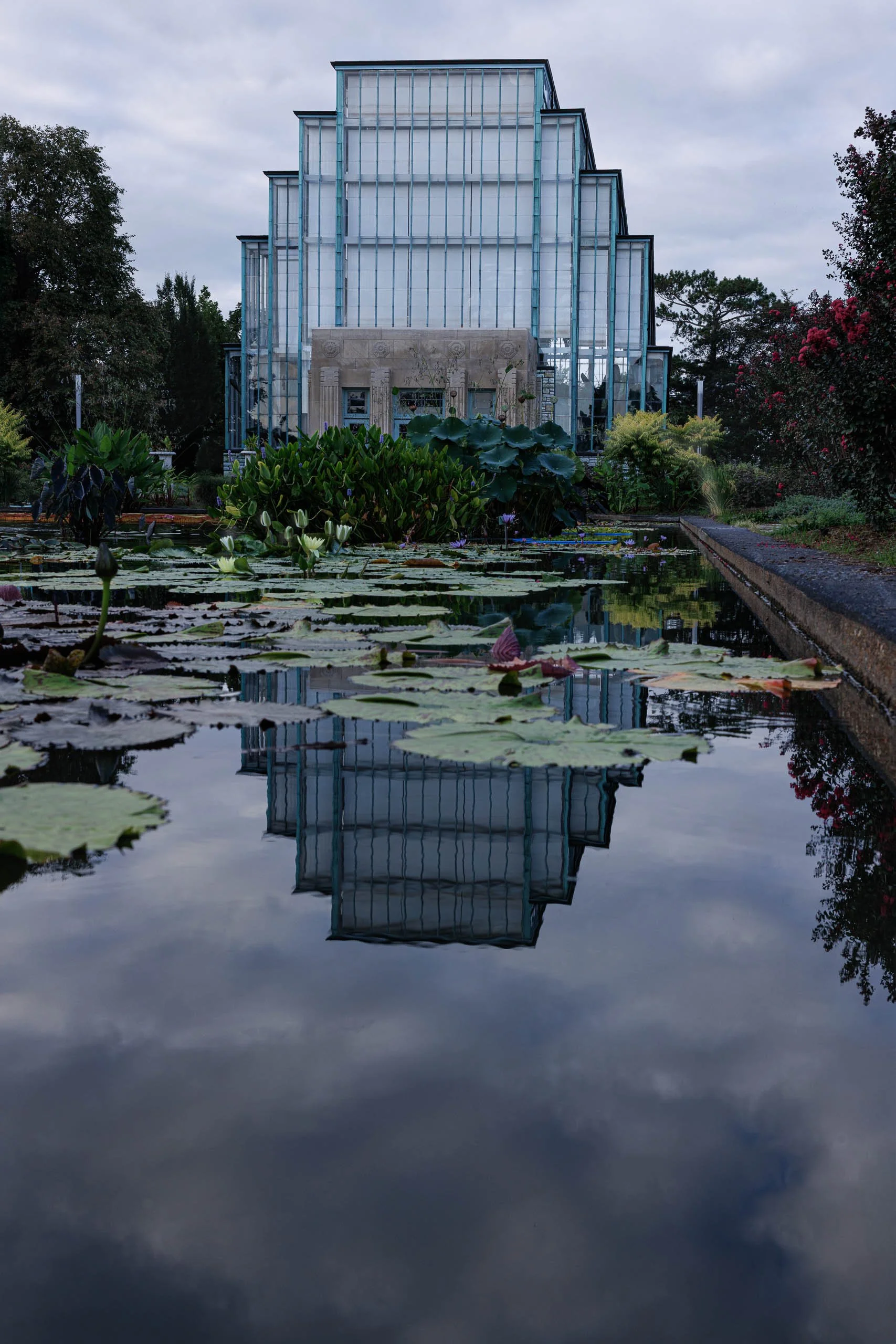
Held in Glass finds the Jewel Box, Forest Park’s, Art Deco glass conservatory, doubled almost perfectly in the still surface of its reflecting pool at blue hour, a dense foreground of lily pads and a single white water lily blossom breaking the symmetry below.
The stepped-pyramid glass structure rises center-frame, its vertical mullions catching the last cool light of dusk, while the pool beneath mirrors the whole building back into the water — look closely and the reflection holds real color, not just silhouette. The overcast sky sits flat and even above, giving the scene a quiet, held-breath calm rather than any drama.
Forest Park’s Jewel Box is one of the most recognizable buildings in St. Louis, and this particular vantage — the reflecting pool, straight on — is close to the view most visitors come away with. What sets this apart is the blue-hour timing and the density of the lily pads pressed right up to the lens, continuing the same interest in still-water doubling found in pieces like The Silent Assembly, here turned toward architecture instead of landscape.
Design & Styling
With its cool, restrained palette and unmistakable architectural subject, Held in Glass suits hospitality lobbies, hotel and resort interiors, architecture and design firm offices, and healthcare or senior-living settings where a calm, non-jarring image is preferred. The Jewel Box is also one of St. Louis's most popular wedding venues, making this a natural anniversary gift or keepsake for couples married there.
Curated Pairings
For shared place: Pair with Evening at the Pavilion, photographed in the same St. Louis park system at a similarly soft evening hour.
For shared formal device: Complement with Blue Interval, which shares the same interest in St. Louis glass architecture rendered in a cool, abstracted register.
For shared formal treatment: Pair with The Silent Assembly, which uses the identical device of a still, mirror-calm water surface doubling the scene above it.
Fine Art Presentation
Available as a signed, numbered limited edition print (edition of 15) in Gallery Metal, ChromaLuxe® Metal, TruLife Acrylic, archival paper, canvas, and wood presentation formats. The glass structure and its water reflection suit TruLife (Low-Glare) Acrylic particularly well, giving both the architecture and the pool real depth and luminosity; ChromaLuxe® Metal is a strong alternate, its cool sheen echoing the blue-hour palette and the building's own glass surfaces.
Note: Custom and oversized photographic prints are available. Please contact the studio directly to discuss custom framing, matting, or specialized museum glass options.
Have Questions?
To accommodate grand residential or corporate spaces, larger scale photographic prints and custom dimensions are available upon request.
For collectors seeking ready-to-hang presentations, we welcome the opportunity to collaborate on custom framing, museum-quality matting, and specialized glass selections tailored to your unique aesthetic.
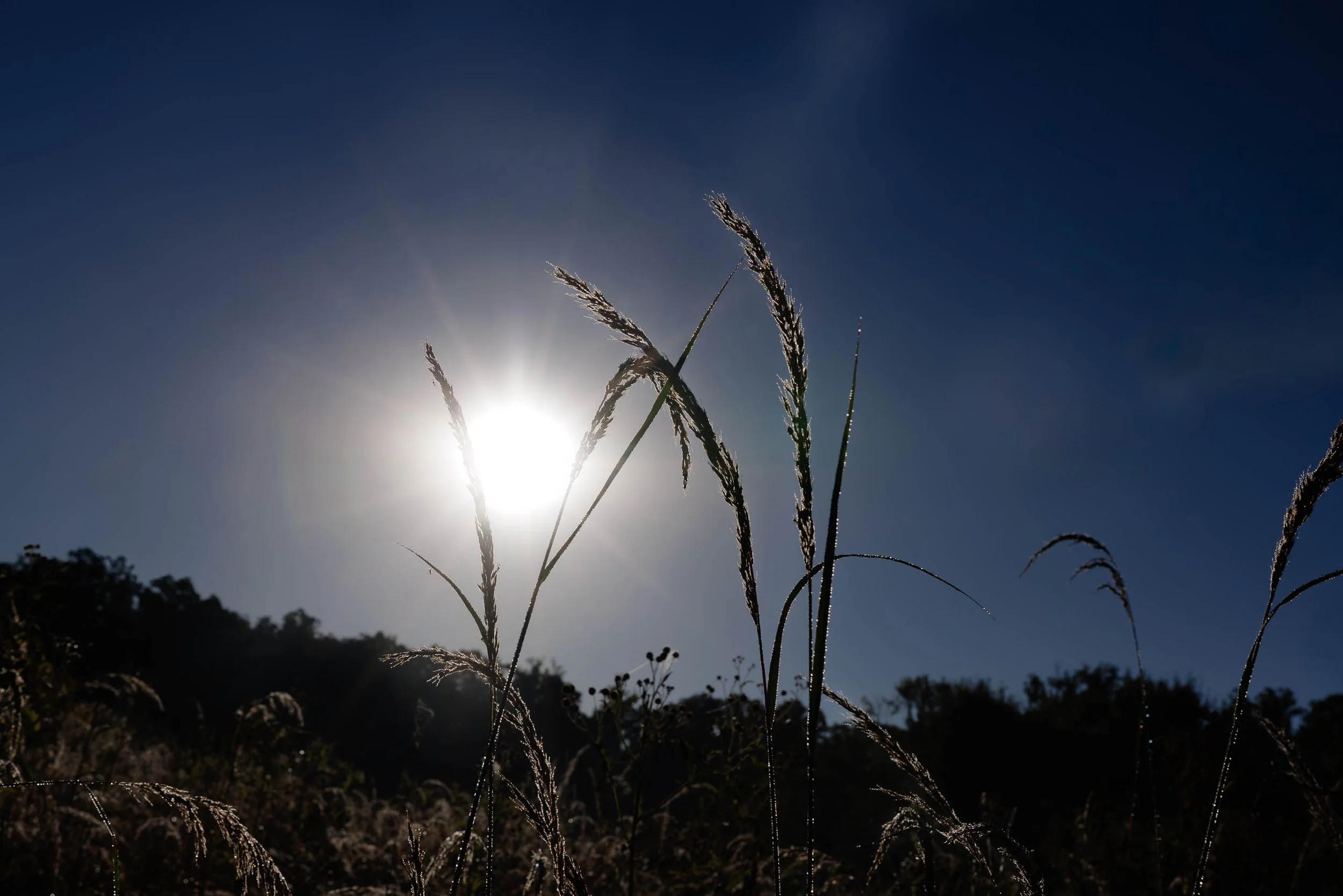
Some mornings the light does its work in a few minutes. What the Dew Kept catches tall meadow grass at Quail Ridge Park in Wentzville, Missouri, every seed head beaded with dew and edged in light, while a low sun opens into a starburst behind them.
One seed head crosses in front of the sun, and the blades below it cross at a diagonal. The eye starts at the sun, follows the diagonal up through the tall heads, and then drops to the dark treeline, where small wildflower heads stand against the sky. The dew shows only where the light catches it, in a fine line of sparkle along each stem.
This is quiet, light-first landscape photography in the lineage of Wynn Bullock and Ernst Haas, attentive to what a few minutes of morning does to an ordinary field.
Design & Styling
The strong silhouettes and deep blue palette suit hospitality lobbies, restaurants and hotel corridors, design-led offices, and modern homes with dark wood, charcoal or warm neutral walls. As a Missouri image, it is a natural keepsake for anyone with ties to St. Louis and St. Charles County.
Curated Pairings
For shared subject and light: Pair with Where Morning Lingers, where dew still clings to grass and leaf in warm morning backlight.
For shared subject, in motion: Pair with Woven Gold, which turns a stand of tall grass into streaks of color through camera movement where this holds every blade still.
For shared formal device: Pair with Meadow Radiance, where direct light opens a bloom into a starburst.
For shared subject at a different scale: Pair with Seeds of the Meadow, a macro study of seed heads that answers this wide view with close detail.
Fine Art Presentation
Available as a signed, numbered limited edition print (edition of 15) in Gallery Metal, ChromaLuxe® Metal, TruLife Acrylic, archival paper, canvas, and wood. ChromaLuxe® Metal is the first recommendation: it keeps the dew sparkle crisp and the starburst clean against the deep blue. TruLife (Low-Glare) Acrylic is a strong alternate that deepens the blacks of the silhouettes. Archival paper, framed, suits a quieter, more traditional presentation.